Teaching Strategies Using IEP Accommodation Frameworks
Distinguishing accommodations from modifications ensures students access grade-level work.

An IEP accommodation lays out how a student gets access to grade-level work. It does not lower the bar. That distinction sounds small on paper, but it separates a legally sound classroom from one that quietly cheats a kid out of the education they are entitled to.
Modifications change the actual content or the standard being measured. Reduced reading level. Pass/no-pass grading. A shorter list of vocabulary words on the same test everyone else takes. Accommodations do something else entirely: they remove a barrier to full participation without touching the target. A student who gets extended time on an essay is still writing to the same rubric as everyone else. A student who dictates an answer instead of writing it by hand is still expected to hit the same content points.
Teachers who blur that line tend to make one of two mistakes. Either they accidentally water down what a student is expected to know, or they skip supports the student is legally owed because it feels like special treatment. Neither is fine. One shortchanges rigor, the other shortchanges access, and both violate the plan on file.
That plan typically places accommodations alongside the section on specially designed instruction and service minutes, the part of the IEP that lists how many hours a week a student gets pulled for reading support or speech therapy. It's easy to skim past. It also governs almost every minute of daily classroom life, which is the opposite of skippable.
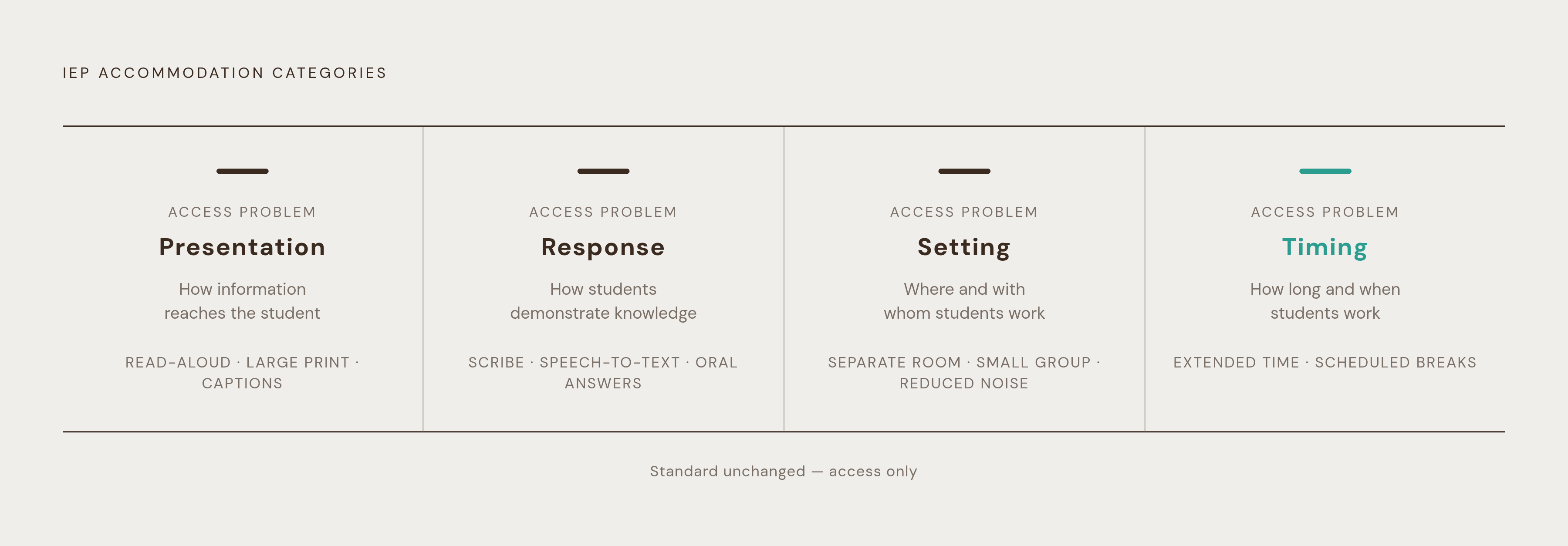
Accommodations sort into four buckets: presentation, response, setting, and timing. Each one solves a different kind of access problem. The rest of this piece walks through what each one actually looks like on a Tuesday afternoon.
Presentation accommodations: changing how information reaches the student
This category covers how content gets delivered, formatted, or displayed. Not what the content is, just how it lands on the student's desk or screen.
Some of the most common versions:
- Directions read aloud while the printed version stays in front of the student
- Text-to-speech tools built into classroom devices
- Worksheets with less packed onto each page (four to six math problems per page instead of twenty crammed into a grid)
- Key words highlighted in written directions or textbook passages
- Visual aids paired with anything explained out loud
- A finished sample shown before students start their own
- Multi-step directions broken into a numbered list instead of one dense paragraph
- Glossaries or reading guides handed out ahead of the assignment
- Audio versions of textbooks, sometimes with the student following along in print
- Materials available in large print, Braille, or digital text
- Discussion questions given out before the reading, not after
The planning implication shapes which supports actually reach the worksheet, more than the list itself does. These supports work best when they're built into the lesson from the start, not bolted on after a kid is already three questions behind and visibly frustrated. A teacher who plans a worksheet with generous spacing for the whole class doesn't have to remember which students need it. It's just how the worksheet is made.
Text-to-speech tools like Dolphin EasyReader show up in accommodation plans and are worth understanding as more than a checkbox. These are add-on tools. Schools have to download the app and carry a paid Education Plan subscription to make it work. Setup requires coordination between staff and administration before a student ever opens the program.
Treating read-aloud as something that only happens during a test is a habit worth breaking. If a student gets directions read aloud on an exam, they should be getting directions read aloud every day in class too. Consistency is the whole point. If a student gets directions read aloud on an exam, they should be getting directions read aloud every day in class too. Consistency is the whole point.
Response accommodations: changing how students demonstrate what they know
This category covers the format a student uses to produce an answer, not the answer itself.
Common examples:
- Speech-to-text tools like Dragon Anywhere, often used by students who benefit from dictation as a response format
The thread running through all of these: the delivery vehicle changes, the thinking required does not. A student dictating a thesis analysis into a recorder is still building an argument, still organizing evidence, still doing the actual intellectual work. The words just get onto the page differently.
This is where teachers need to know, cold, what skill a given assignment is actually measuring. Letting a student use a calculator on a word problem makes sense if the point of the problem is understanding rate and distance. It makes no sense if the assignment exists specifically to check whether the student has memorized multiplication facts. Same tool, two very different calls, depending on the target.
Grading tools built for teachers have started to catch up with this reality. Platforms like CoGrader, which connects with Google Classroom on all plans and with Canvas and Schoology on school or district plans, let teachers apply a single rubric even when responses come in different formats, some typed, some dictated, some turned into a slideshow instead of an essay. CoGrader also supports imported rubrics and AP or IB rubric libraries. Gradescope, used across more than 3,000 institutions, is built around the same problem: keeping grading consistent when the paper in front of the teacher isn't always a paper. These tools don't replace judgment, but they cut down on the risk of a scribed response getting graded more harshly just because it looks different from everyone else's handwriting.
Setting accommodations: structuring the physical and social environment
This category covers where a student works, who they work near, and what the room feels like while they're doing it.
Preferential seating gets more attention than any other setting accommodation, and it's also the most misunderstood. The goal is to remove a specific barrier, not to reward good behavior or punish bad behavior by moving a desk around.
- A student with attention difficulties might need a front-corner desk, away from the door and away from the pencil sharpener, both of which are basically distraction machines
- A student with sensory sensitivities, including many autistic students, might need a quieter corner of the room with less visual and auditory noise
- A student with a vision or hearing barrier might need a clear, unobstructed line to the board, the teacher, and the screen
"Sit them near the teacher" "Sit them near the teacher" is the right call sometimes and completely irrelevant other times, depending on what barrier is actually in play. It's the right call sometimes and completely irrelevant other times, depending on what barrier is actually in play.
Other setting accommodations:
- Testing alone or in a small group instead of a full classroom
- Study carrels, with extras placed around the room so no one student is obviously singled out for using one
- Noise-blocking headsets
- FM systems or sound-field amplification for students with hearing needs
- A workspace kept clear of unrelated clutter
- Quiet maintained during intensive focus periods
- Extra space between desks
- Permission to leave class a few minutes early to skip a crowded, overstimulating hallway
- Flexible furniture: wobble chairs, standing desks
- A distraction-reduced room during formal testing
As more students with disabilities spend the bulk of the school day inside general education classrooms, setting accommodations increasingly have to work inside that room rather than requiring a student to be pulled out. Building a flexible room from day one (varied seating, a quiet corner already in place, clutter already under control) beats retrofitting one after a student starts struggling.
Timing accommodations: managing when and for how long students work
This category covers duration, pacing, breaks, and how a task gets scheduled.
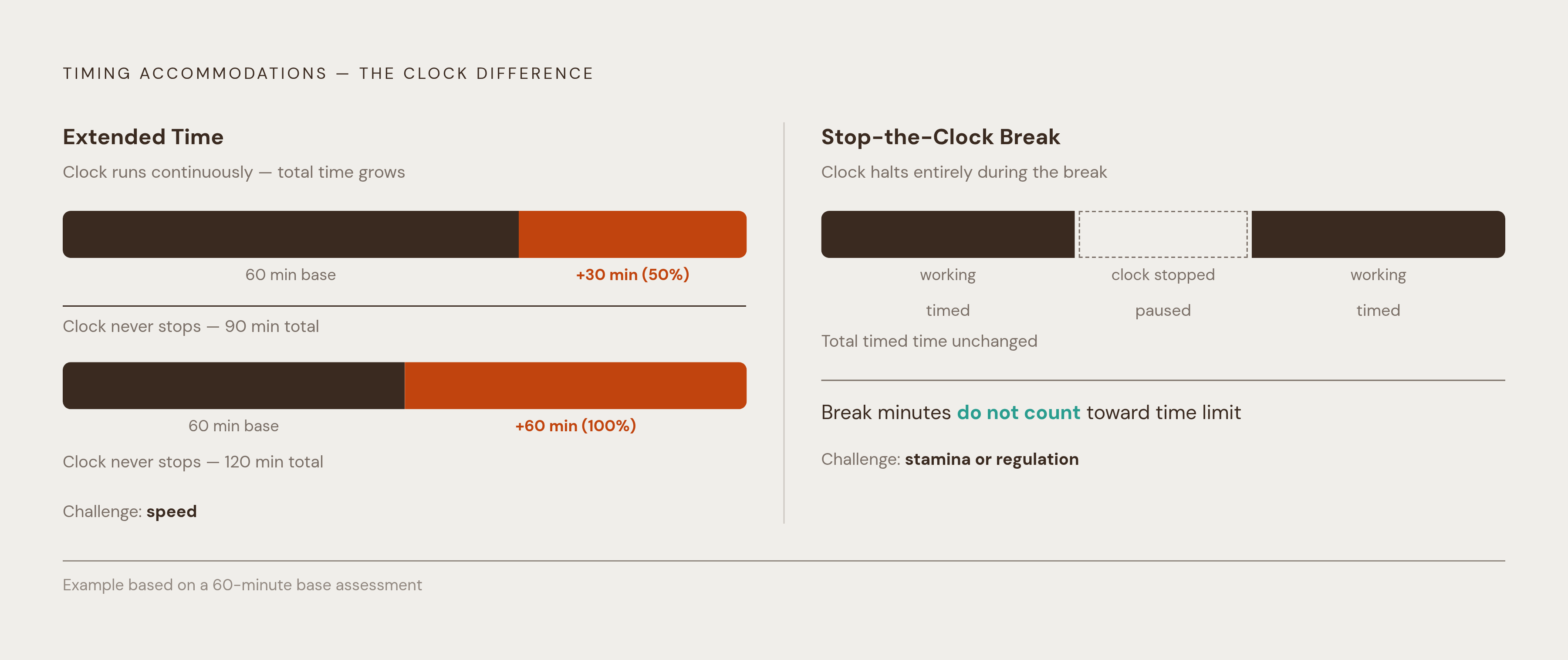
Extended time is the most common version, and it usually shows up in one of two ratios: time-and-a-half (50% more time) or double time (100% more time). Those exact ratios carry over to AP exams and the SAT, which matters for reasons covered in the next section.
Other timing supports:
- Flexible deadlines on multi-day projects
- Splitting one long assessment across two or more sessions instead of one marathon sitting
- Frequent short breaks, sometimes every few minutes for a student with significant attention needs
- A structured movement-break pass, not an ad hoc "raise your hand whenever"
- Test questions ordered easy to hard, so a student can show what they know before fatigue sets in
- Reduced homework volume that still hits the key concepts, rather than assigning fewer easy problems and calling it done
Stop-the-clock breaks deserve their own mention, because they get confused with plain extended time constantly. Extended time gives a student more total minutes. A stop-the-clock break lets a student pause a timed task entirely, without the clock running while they step away. That distinction matters most for students whose challenge isn't speed, it's stamina or regulation. A kid who needs a brief moment to reset after a panic spike doesn't need more time. They need the clock to actually stop.
Track how much of the extended time a student actually uses. If a student with double time consistently finishes in the original window anyway, that's worth a conversation at the next IEP meeting. The accommodation might need recalibrating, either because the s... If a student with double time consistently finishes in the original window anyway, that's worth a conversation at the next IEP meeting. The accommodation might need recalibrating, either because the student's needs shifted or because the original call didn't match reality.
The underlying goal is to measure what a student knows, not how fast they can retrieve it. Timing accommodations make sense when the point of the assessment is content mastery. They stop making sense the moment speed itself is the thing being tested, which is rare but not nonexistent.
How Classroom Accommodations Translate to AP Exams and the SAT
This is where a lot of families get blindsided, so here is the legal setup, stated bluntly.
Inside a public high school, IDEA governs the building. IEP accommodations are not optional there, they're required by law. Standardized testing organizations that run the AP exams and the SAT operate under a completely separate approval process. They have no jurisdiction over what happens in a classroom, and a classroom IEP does not automatically bind them. An accommodation a student has used every day for three years does not walk into an AP exam room with them unless it's been separately approved.
For the 2025 to 2026 cycle, every request, whether it's for an AP exam, the SAT, the PSAT/NMSQT, PSAT 10, or PSAT 8/9, runs through the same online system, called SSD Online. Once a student is approved for one of those exams, they don't have to reapply for another. But changes to a student's needs or documentation may require updated materials to be submitted. For AP exams specifically, all requests and supporting documentation need to be submitted by the school's SSD coordinator through SSD Online by January 16, 2026.
What separates a request that sails through from one that gets stuck usually comes down to two things:
How current the documentation is. Reports need to reflect how the student is functioning now, not three years ago. Documentation that does not reflect a student's current functioning is a common reason requests get flagged or rejected.
How specific the documentation is. A diagnosis alone doesn't cut it. The report has to draw a direct line from that diagnosis to a specific functional problem on a specific kind of exam. A vague label with no functional link attached is the single most common reason a request stalls out. Cognitive and achievement testing data carries more weight than a clinician's general impressions alone when supporting a request. ADHD documentation needs to establish a clear clinical basis for the specific functional limitations being accommodated.
Extended time on these exams mirrors the same ratios used in the classroom, typically 50% or 100% more time. On the digital SAT, extended time gets applied section by section rather than as one lump sum across the whole test.
A few digital-specific details:
- Bluebook, the digital testing platform, has a built-in text-to-speech engine that students can request as a presentation accommodation
- A human reader is a separate, specifically approved accommodation on digital tests. Being approved for text-to-speech doesn't automatically include it
- Starting in fall 2025, screen reader approvals no longer come bundled with extra time automatically
- Schools should check directly with their SSD coordinator about what types of adjustments can be made within the system
The ACT has shifted its own calendar for 2026. Accommodation request deadlines now line up with the regular registration deadline, starting with the June and July 2026 test dates. The Special Testing window, previously two weeks, has been cut down to nine days, including two full weekends, beginning in June 2026.
The practical upshot: start early. For exams early in the school year, starting the request process well in advance gives documentation review enough time to complete. Documentation review alone can eat up several weeks, and a request filed too close to test day risks simply not being processed in time, no matter how solid the paperwork is.
A real case that shows how classroom documentation supports exam approvals
A case from Precision Psychological Assessments makes the documentation requirement concrete.
The student, referred to as Marcus, was a 17-year-old junior with a long-standing ADHD-C diagnosis and an active IEP. His classroom accommodations already included extended time and a distraction-reduced testing room. His assessment profile showed strong verbal reasoning, but working memory and processing speed scores that sat well below that verbal ability. That gap, not the diagnosis by itself, was the functional evidence that mattered. The pattern showed up repeatedly in the classroom: Marcus kept running out of time on multi-section exams even with the school-based accommodations already in place.
For AP exams, his team requested three things: 100% extended time, stop-the-clock breaks every 60 minutes, and a small-group distraction-reduced room. All three were approved.
The reason it worked comes down to what got submitted. It wasn't just a diagnosis on a letterhead. It was a documented IEP history combined with objective neuropsychological testing that drew a straight line between Marcus's cognitive profile and his actual performance on timed work. That's the functional link testing organizations are looking for.
The case illustrates how documented classroom use of an accommodation can directly support the exam approval process, which is exactly the barrier his documentation described.
The lesson for classroom teams isn't complicated. Document how a disability actually shows up in a student's performance on timed, multi-section tasks. That functional detail is what turns a request into an approval.
How Inclusion Trends and Co-Teaching Models Change Accommodation Delivery
Roughly 7.6 million students between ages 3 and 21 receive special education services under IDEA nationwide, according to a special education trends report from New Mexico State University. That's a large enough number that it shapes how entire school systems think about inclusion, not just individual classrooms.
National data shows a clear pattern: more special education students are spending large portions of their school day in general education classrooms alongside their peers. That means accommodations increasingly have to work in real time, folded into grade-level instruction, rather than delivered in a separate room down the hall.
Co-teaching and shared planning models have grown for two practical reasons. They let students get support without being pulled out of core instruction, and they help address a real shortage of special education teachers, with roughly 37,800 special education teaching job openings a year on average, driven largely by retirements and people leaving the field for other careers.
What that shift means day to day:
- General education teachers now carry direct responsibility for accommodations they may never have been formally trained to deliver
- Lessons need to be built with accommodations already baked in, not adjusted after a student starts falling behind
- Special educators are spending more of their time planning alongside general education teachers, coaching them on implementation, and checking that accommodations are actually happening consistently across every classroom a student walks into, not just the ones with a special education teacher physically in the room
That last piece is the quiet shift. The paperwork hasn't changed much. Who's responsible for making it real, every day, in a room built for thirty kids, has changed a lot.