Using AI Data to Inform Differentiated Instruction
A gradebook tells you a student got a passing score. That's like a weather report that just says "bad."
AI diagnostic data tells you something more specific. Which question types trip a student up. Where their response time spikes. Which errors keep coming back. And sometimes whether they're getting the right answer for the wrong reason entirely.
That last one is the sneaky one, and it took me a while to appreciate just how sneaky. A student can guess correctly and still have a foundational misunderstanding baked in. A gradebook won't catch that. Some AI tools are starting to.
Here's what the data actually looks like when you pull it up:
- Per-student error analysis. Not just "wrong," but how they got it wrong. Tends to miscalculate when units change. Consistently misreads conditional logic in reading passages.
- Mastery estimates by skill, updated closer to real time than a unit test ever could be.
- Persistent gap flags. Skills a student has practiced repeatedly but hasn't consolidated. These are different from skills they just haven't seen yet, and that distinction matters more than most dashboards make obvious.
- Structured feedback trails from AI grading. What the student wrote, where the reasoning broke down, what the rubric required.
Passionfruit builds toward this for AP and SAT prep. Their gap tracking distinguishes between a student who got something wrong once and a student who consistently misunderstands the same concept. That's the difference between "they need more reps" and "they need to go back two units." Not the same call.
There's also emerging work on mining student-AI dialogue for knowledge gap signals. The idea is that how a student explains a concept reveals more than any multiple-choice score. Most classroom tools aren't fully there yet, but the direction is clear.
One honest caveat: most AI platforms right now are student-facing first. The teacher-facing data layer is thinner, and the dashboards often weren't built with a teacher's actual workflow in mind. You'll do interpretation legwork regardless of which tool you're using. That's not a disclaimer. That's just Tuesday.
How to Read AI Diagnostic Data to Form Instructional Groups
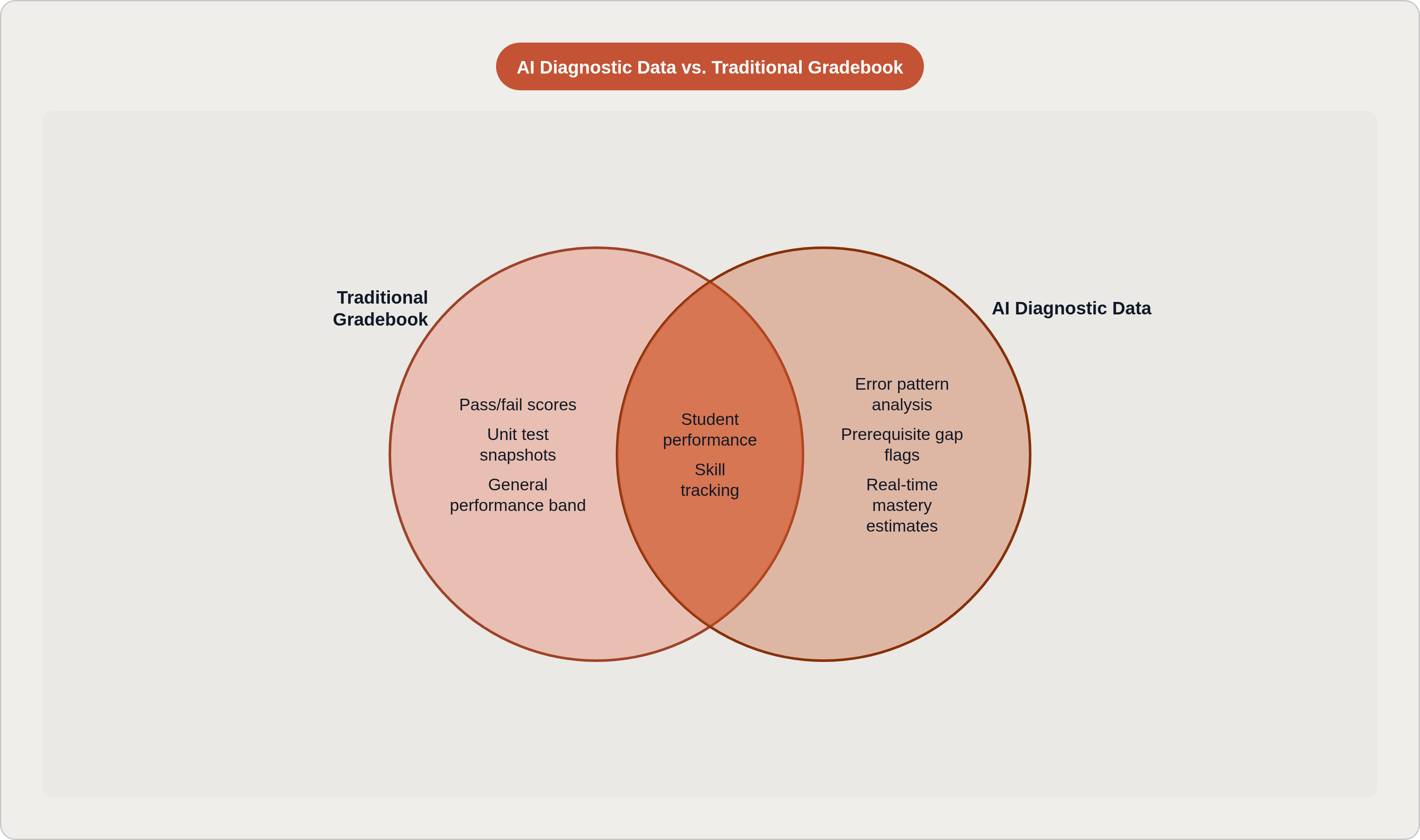
Flexible grouping is the practical heart of differentiation. But grouping by "level" is a blunt instrument. It collapses very different kinds of not-knowing into the same bucket.
Three students all score similarly on an AP History unit test. One is weak on sourcing. One on contextualization. One on synthesis. Same score, completely different instructional needs. Put them in the same intervention group and you've helped nobody.
Or in SAT Math: two students miss the same number of questions, but one struggles with algebraic manipulation while the other keeps setting problems up wrong from the start. Same score band. Totally different gaps. The score is almost beside the point.
So what's the actual shift AI data enables? Grouping by specific gap type rather than general performance band. That sounds simple. It is not how most grouping actually gets done.
A practical weekly process that doesn't require reinventing your planning:
- Pull your AI error-pattern report.
- Sort students by gap cluster, not score rank.
- Identify two or three dominant error patterns across the class.
- Form temporary groups around those patterns. Groups that dissolve and re-form as gaps close.
That last part is the one teachers push back on. It feels logistically messy. But these aren't the reading groups from 2007 that never changed. A student who closes their sourcing gap moves out. Someone who develops a new stumbling block moves in. The whole point is that the grouping responds to evidence.
But where does AI grouping actually have teeth, and where does it fall flat? Research points to a real difference: AI-generated learning pathways appear more effective at closing foundational, lower-order gaps than higher-order ones like synthesis and evaluation. For skill-based deficits, the payoff is clearest. For the more complex thinking AP exams demand, teachers still need to do the harder interpretive work. That's not a knock on the tools. It's just where they currently operate well, and where they don't.
Albuquerque Public Schools has been using Google Gemini to identify and address student learning gaps at the classroom level. This isn't hypothetical. Gap-informed grouping is being tested in real buildings, with real schedules, by teachers who have thirty kids and one prep period.
Adjusting Content and Task Difficulty Based on What the Data Reveals
More practice isn't always the answer. Sometimes it's the exact wrong answer.
If a student is drilling the same problem type that's rooted in a prerequisite gap from two units ago, more volume just means more time reinforcing a misunderstanding. AI data can surface when that's happening. It might flag, for example, that a student's SAT algebra errors are actually rooted in fraction rules rather than equation logic. The fix isn't more algebra. Going back is. That's a different lesson plan entirely.
Concrete adjustments AI data can support:
- Assigning practice sets that isolate the specific skill a student misapplies, rather than re-assigning the whole unit.
- Identifying students who are ready to advance and giving them extension tasks, rather than holding them to whole-class pacing.
- Flagging prerequisite gaps buried further back in the curriculum. The ones that look like a current-unit problem but aren't.
For AP teachers, there's a format dimension worth paying attention to. College Board shifted to digital exams starting May 2025, with 16 subjects fully digital and 12 in hybrid format. Students need practice with format-specific demands: typed FRQs, Bluebook navigation, the rhythm of working on screen. AI data can reveal whether a score drop on digital practice reflects a content gap or a format-adjustment problem. Conflating the two leads to the wrong instructional response at exactly the wrong time.
The Digital SAT adds another layer. Its adaptive two-module structure means Module 2 difficulty is set by how a student performs in Module 1. AI data revealing which question types a student tends to miss early has direct strategic implications. It's not just diagnostic anymore. It's prescriptive for how a student should prioritize prep.
One more: AP English Language's pass rate shifted significantly following College Board's EBSS recalibration. Students need feedback calibrated to current standards. AI grading tools trained on current rubrics handle this in a way a teacher working from memory of a previous scoring guide simply can't keep pace with. That's not a criticism of teachers. That's a recognition of how fast the target moves, because it moves fast.
Using AI Grading to Close the Feedback Loop Quickly Enough to Matter
Here's the practical reality of essay feedback in most classrooms. A student writes a synthesis essay on Friday. It comes back two weeks later with margin notes and a score. By then, they've taken three quizzes, started a new unit, and mentally filed that essay under "ancient history." The window where the feedback could have actually changed something has closed.
AI grading compresses that cycle. Students get rubric-level feedback fast. Teachers get error-pattern data without spending their evenings marking.
But here's what I think gets missed. The feedback does different things for each person sitting in that loop, and mixing those functions up muddies how you use the tool.
For the student: it shows where their argument broke down, what the rubric actually required, and how to revise. Specific, tied to their own work, actionable before the next draft.
For the teacher: it shows which students share the same breakdown point, and whether that pattern is a teaching gap (the class needs re-instruction) or a practice gap (students understand the concept but haven't consolidated it through application). Seeing both in the same data view changes what you do on Monday morning.
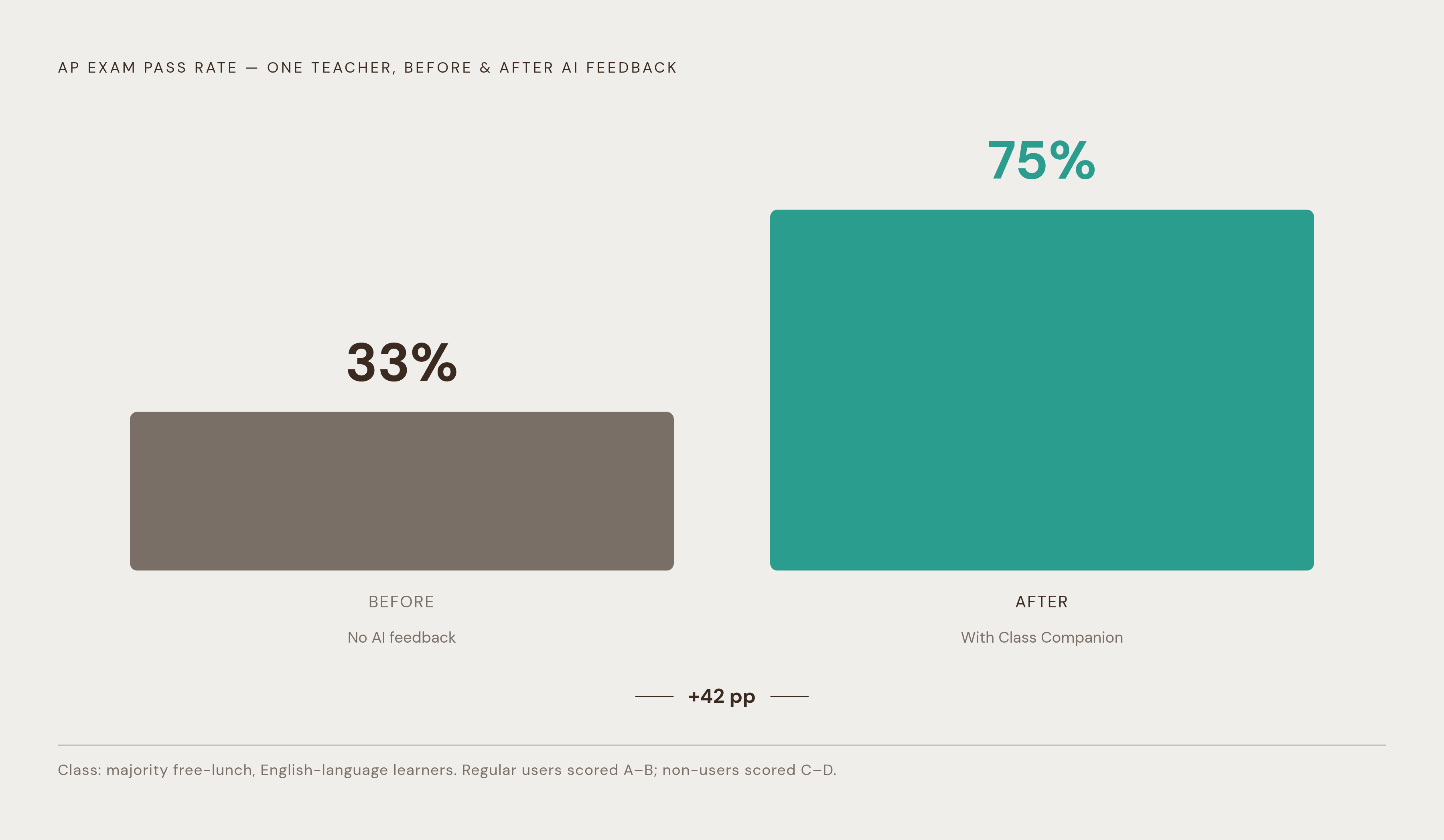
A teacher using Class Companion's essay feedback tool reported that 75% of her students passed the AP exam. Her previous typical pass rate had been around 33%. Students who used the tool regularly scored in the A-B range. Students who didn't scored in the C-D range. Most of her students were on free lunch with English as a second language. That gap points directly at what fast, rubric-tied feedback cycles can do when they're consistently available to kids who haven't historically had access to that kind of support.
Passionfruit operates in this space as well, with AI grading tied to specific reasoning errors rather than just right/wrong verdicts. The structure gives teachers something to act on, not just something to log.
One real limit: AI grading is strongest on structured, rubric-defined tasks. For open-ended creative or highly argumentative work, AI feedback is a useful starting point, not a replacement for teacher review. That line matters.
Where AI-Generated Data Reaches Its Limits in Informing Differentiation
I'll be honest: this is the section I almost got wrong when I first started thinking through how these tools work.
The easy version of this section is "AI is great, but it has limits." Neat, balanced, wrapped up. That framing undersells how genuinely tricky the limits are in practice, because they're not always obvious until you've already made a wrong call.
AI performance data is largely blind to what's actually driving a student's error pattern when the cause isn't cognitive. A student with ADHD or reading difficulties may produce error clusters that look exactly like a content gap. The root is something AI can't detect. Acting on the data without that context can point a teacher in exactly the wrong direction, with confidence. That's a specific kind of wrong that's easy to miss, and harder to undo.
The higher-order gap problem is real too, and it's not a footnote for AP teachers. The same research that found AI-driven pathways effective for foundational gaps also found they're significantly less effective for synthesis and evaluation-level thinking. AI can help close the foundational floor. Raising the ceiling is still a different job.
There's also a difference between a snapshot and a trend line that most dashboards don't make easy to see. A student whose error rate is high but declining needs different intervention than a student whose rate is stable and high. Teachers still need to read the trajectory, not just the current number.
And then there's equity. Access to these tools is uneven. Schools without stable device infrastructure or strong platforms generate worse data, or no data at all. In those environments, AI-informed differentiation can actually widen gaps. Some students benefit from the feedback loop. Others don't have access to it. That asymmetry is a real risk, and it gets glossed over in most conversations about scaling these tools, which makes me suspicious of anyone selling a tidy story about AI closing achievement gaps at scale.
So what does AI data actually do well? Detection and volume. It spots patterns across thirty students faster than any teacher can. What it can't do is tell you why the pattern is there, or whether the instructional response it implies is the right one for that particular kid. That part doesn't get automated. It gets informed.
Practical Steps for Building an AI-Informed Differentiation Workflow
The goal isn't to adopt every AI tool available. Pick one or two reliable data streams and build a consistent routine around them. Small and repeatable beats comprehensive and unsustainable every time, and I say that as someone who has watched more than a few "comprehensive" rollouts quietly collapse by November.
A structure that doesn't require overhauling your planning:
Weekly:
- Pull AI error-pattern reports.
- Identify two or three class-wide gap clusters.
- Adjust next week's small-group focus accordingly.
Per assignment:
- Use AI grading data to flag students whose breakdown points differ from the class norm. Those are the students who need a different approach, not more of the same thing.
Monthly:
- Track which gaps have closed and which persist across multiple practice cycles.
- Persistent gaps usually signal a need for a different instructional strategy, not just more practice volume. More of the same thing that isn't working is still just more of the same thing.
For AP teachers: align your AI gap data to the skills College Board rubrics actually assess. Use AI-graded FRQ feedback to distinguish whether a student is missing content knowledge or argument structure. Conflating them wastes the student's prep time at exactly the wrong moment in the year.
For SAT prep: identify whether a score gap is concentrated in a specific skill cluster (evidence-based reasoning, data interpretation, problem setup) and prioritize accordingly. Given the Digital SAT's adaptive structure, early performance matters more than it used to. That's a real strategic variable now.
Tools worth knowing:
- Passionfruit: AI grading and persistent gap tracking for AP and SAT prep, with data structured for teacher use rather than just student interaction.
- Class Companion: AP essay feedback with fast turnaround and rubric-level detail.
- SchoolAI and Google Gemini: broader differentiation support at the classroom and district level.
On the policy side: College Board's AI use policies vary by AP course. Before assigning any AI tool for practice or feedback, verify it's permitted for your specific exam. The April 2025 White House Executive Order signals growing institutional support for intentional, policy-guided AI use in K-12. The framework is still evolving, and staying current on it is part of the job now.
None of this replaces what you already know about your students. AI data gives that knowledge something concrete to work with. The tool surfaces the pattern. You decide what it means.