AI Feedback Quality and Student Learning Outcomes
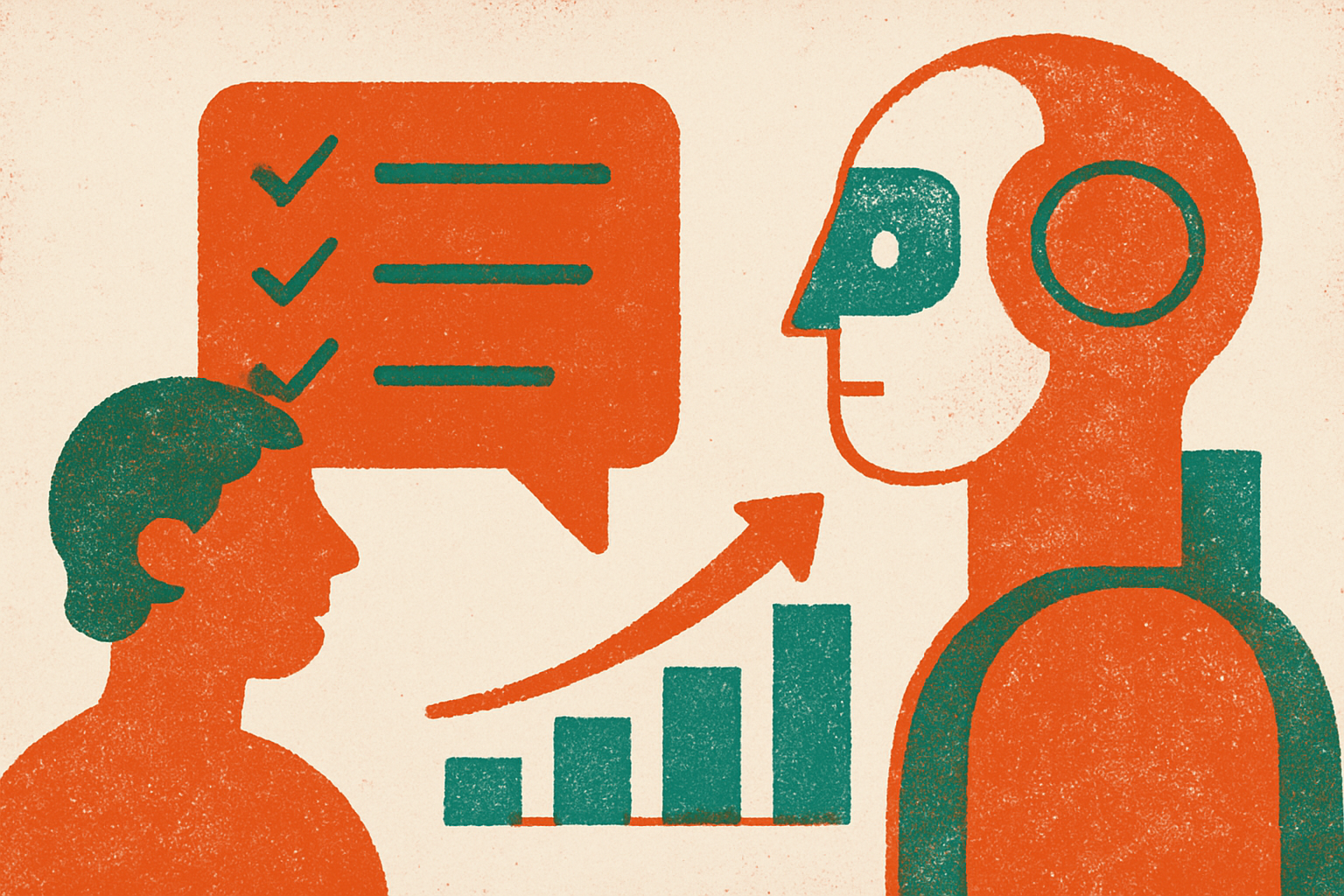
Most AI feedback tools do one thing: they tell you if you got the answer right or wrong. And somehow, we've built an entire edtech industry on the assumption that this is enough.
The truth is, it isn't enough.
The gap between "you got this wrong" and "here's where your thinking broke down" is exactly where learning either happens or doesn't. If AI feedback is going to actually move the needle for students (especially in high-stakes prep like AP and SAT) it has to explain reasoning. Most tools don't.
So what does the research actually say? The answer is messier than either the skeptics or the boosters want to admit.
A 2025 meta-analysis across 41 studies involving 4,813 students found no statistically significant difference in learning outcomes between AI-generated and human feedback. Sounds like a wash, right? But averages bury everything. Aggregate across a hundred mediocre tools and a handful of exceptional ones, and the good ones disappear into the noise.
Meanwhile, a 2025 randomized controlled trial published in Scientific Reports found that AI tutoring outperformed in-class active learning by an effect size between 0.73 and 1.3 standard deviations. In educational research, that's not noise — that's a real signal.
What explains the gap between those two data points? The meta-analysis averages across every flavor of AI feedback imaginable. The RCT tested one specific, well-designed tutoring system. Design is doing most of the work here.
The countervailing evidence is real and shouldn't be hand-waved away. Some AI systems hallucinate. Some reveal the answer instead of supporting reasoning. Some produce feedback students can't act on. A 2026 review in Tandfonline found that poorly calibrated feedback (feedback that feels arbitrary or harsh) can actually undermine student engagement regardless of whether it's technically accurate.
So the question isn't "does AI feedback work?" It's which design choices make it work. And which ones quietly guarantee it won't.
The Specific Qualities That Separate Feedback That Teaches From Feedback That Just Corrects
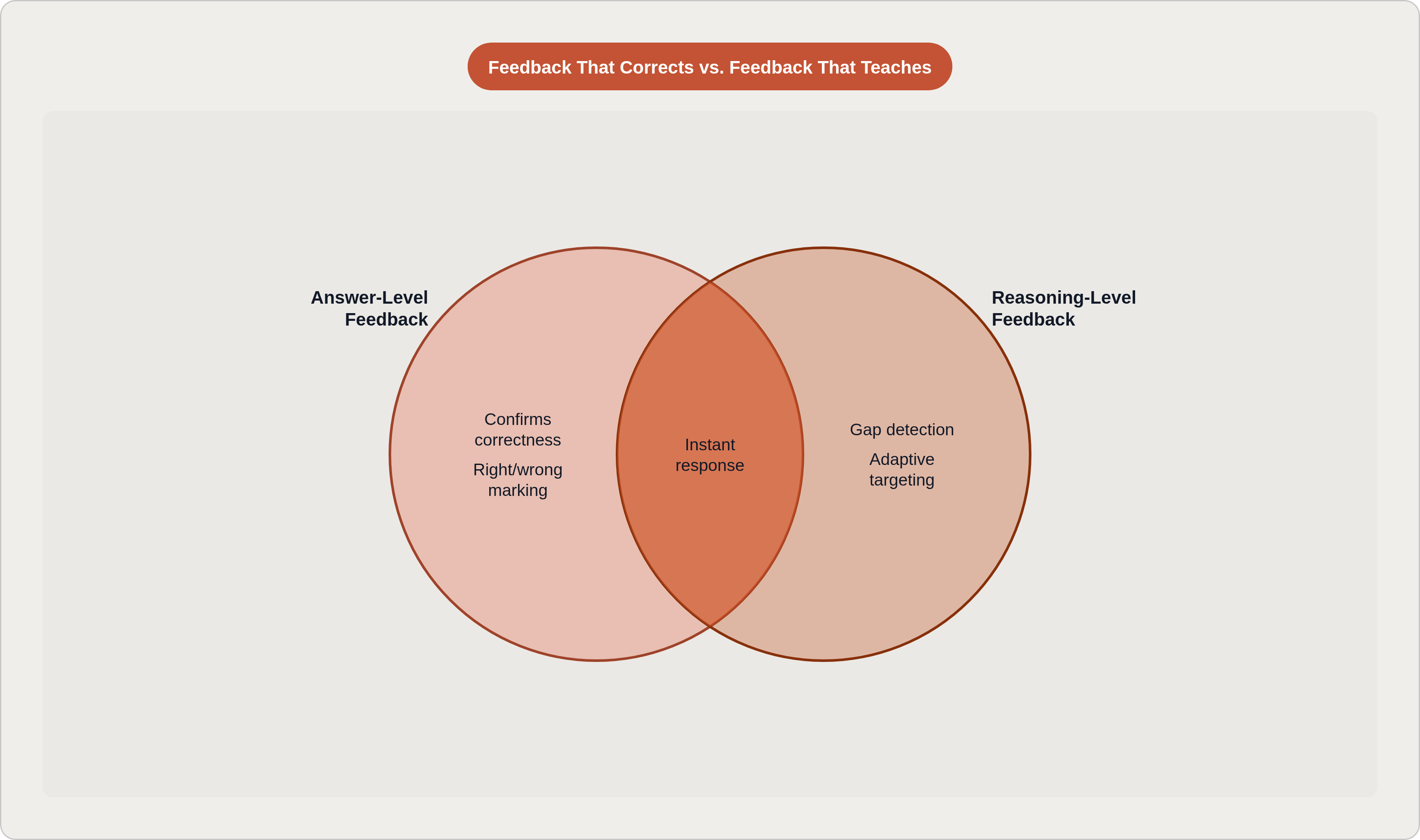
Here's a distinction that matters more than it might seem at first: answer-level feedback versus reasoning-level feedback.
Answer-level feedback confirms or denies correctness. "Incorrect. The answer is C." The student knows they got it wrong but not why.
Reasoning-level feedback identifies where in the student's thinking the error actually entered. Was it the wrong concept applied entirely? The right concept applied incorrectly? The right process, with a careless execution error at the end? These are three completely different problems requiring three completely different fixes. Feedback that doesn't make this distinction isn't really telling you anything useful.
The research literature calls this "elaborative feedback," and it consistently outperforms simple right/wrong marking. Not because it feels nicer. Because it gives students something to work with.
Specificity matters more than it sounds. "Needs more analysis" leaves a student guessing at what you mean. "You identified the theme but didn't connect it to textual evidence" gives them a task. In practice, that's the difference between a student who improves and one who keeps practicing the same mistake on a loop, getting more confident in doing it wrong.
Then there's actionability. High-quality feedback closes the loop. It doesn't just explain the gap, it points somewhere: re-examine this concept, try a related problem, revisit this section of your response. Generic feedback leaves that loop wide open. Most students don't know how to close it themselves, and expecting them to is asking a lot of someone who doesn't yet understand the concept well enough to have gotten it right in the first place.
Effective AI feedback is specific about where reasoning broke down, explains the gap in plain terms, and points toward a next step. If it only does one or two of those things, it's correcting rather than teaching.
How Rubric-Based Feedback Changes the Picture for AP Free-Response Questions
Over 1.3 million students from the Class of 2025 took more than 4.8 million AP Exams in U.S. public high schools. Seventy-three percent scored a 3 or higher — the highest pass rate since the pandemic. But that also means more than one in four students didn't earn qualifying credit, and that's a lot of people.
Here's the thing: a large share of free-response points aren't lost because students don't know the content. They're lost because of structural errors. A missing thesis element. Insufficient evidence commentary. Failing to address the specific prompt. That's a rubric problem, not a knowledge problem. And those are two very different things to fix.
What rubric-level AI feedback does differently is score a student response against the actual scoring criteria. It shows which points were earned, which were missed, and what a full-credit response would require. That's a fundamentally different signal than "good effort, needs more development."
The College Board's 2025 EBSS recalibration makes this concrete. AP Physics 1 moved from a 47.3% to 67.3% pass rate. AP English Language jumped from 54.6% to 74.3%. These weren't easier exams. The scoring standards were recalibrated using data from hundreds of college professors. 773 professors at 524 colleges evaluated AP English Language responses and found that only 11% of AP students would earn a college A (even as colleges award 37% of their own students an A).
Students who don't understand what the updated rubric actually rewards will repeat the same structural errors regardless of how much they practice. Generic AI feedback cannot close this gap. It doesn't know what the College Board is looking for. Rubric-anchored feedback does. That's not a small distinction.
Why Gap Detection Has to Come Before Feedback to Matter
Picture a student who drills a hundred practice problems. Gets some right, some wrong. Reviews the errors. Feels productive. But what if they're systematically missing the same concept every time without realizing it's the same mistake? What if they're quietly avoiding the thing they most need to fix?
Volume of practice doesn't solve this. It can actually entrench it. What do you call a student who practices the wrong concept a thousand times? Someone who ends up confidently wrong — and harder to correct than before they started.
What adaptive systems do is use performance data across multiple problems to distinguish a consistent knowledge gap from a one-off error. A 2024 study using adaptive learning tools across 300 students and 50 educators found post-assessment scores rose from 68.4 to 82.7. The gain was attributed specifically to adaptive targeting of weak areas. Not more practice, but smarter practice.
The chain that actually produces learning looks like this:
- Diagnose the gap
- Surface it to the student clearly
- Deliver feedback that explains the specific breakdown at that gap
- Assign targeted follow-up at that gap
What breaks the chain? AI that tracks wrong answers but doesn't model why the student got them wrong. A list of incorrect responses tells you something went wrong, but it doesn't tell you what or why. A system that can't make that distinction leaves the hardest interpretive work to the student — which is a lot to ask of someone who doesn't yet understand the concept well enough to have gotten it right.
Gap detection isn't a nice feature. It's the prerequisite for feedback to matter at all.
What Teachers Can Actually Do With AI Feedback Data That Students Can't Do Alone
In a class of 30, tracking each student's reasoning errors across dozens of assignments is practically impossible. Not because teachers aren't skilled. Because there aren't enough hours in a day.
Think about the difference between a gradebook and a gap map. A gradebook tells you what scores look like. A gap map tells you where thinking is breaking down and for whom. Those are not the same instrument, and they don't support the same decisions.
Aggregate gap data (specifically, which concepts a class is systematically misunderstanding) lets a teacher redirect instruction before a test rather than after. That's the difference between catching a problem while there's still time to fix it and doing a post-mortem on something that already happened.
By 2026, over 60% of educators are expected to adopt AI for grading and assessments. But the value isn't just time saved on marking. The real value is the diagnostic signal the feedback generates, if the system is designed to surface it usefully. Raw score exports don't do this. A teacher needs to see student reasoning patterns in readable form, not just a spreadsheet of percentages.
This is where Passionfruit is designed to serve both sides of the classroom. The AI grading isn't built around marking answers. It's built around understanding what students actually know, and making that gap data usable at the class level, not just the individual level. Whether that holds up in practice is a fair question to bring to any tool.
What Students Should Look For When Evaluating Whether an AI Feedback Tool Will Actually Help Them Learn
Start with one question: does this tool explain why an answer was wrong, or just confirm that it was?
If the answer is "just confirms it," you know what you're dealing with — a more sophisticated answer key, not a teaching tool.
Before committing to any tool, check these things:
- Does feedback reference the specific reasoning step or concept where the error occurred?
- Does it align to actual scoring criteria for high-stakes exams (AP rubrics, SAT scoring logic) rather than generic correctness?
- Does it tell you what to do next, not just what you missed?
- Does the system track patterns over time to surface recurring gaps, or treat each problem in isolation?
And some things that should give you pause:
- Tools that reveal the correct answer immediately without explanation
- Tools that give the same feedback regardless of how you went wrong
- Tools that don't adapt based on what you've already practiced
Private AP and SAT tutoring costs anywhere from the mid-double-digits to several hundred dollars per hour, with premium test prep packages running into the thousands. For students without access to a tutor, AI tools that deliver real diagnostic feedback aren't just a cheaper option. They may be the only realistic one.
A student spends weeks grinding practice tests. Low 3s on AP History free-response, stuck in a loop. Essays are detailed, even passionate. But points keep disappearing on the same structural element — document sourcing — and nobody has named that pattern because nobody has been tracking it across their work. When they finally get feedback that names the gap specifically and shows what sourcing commentary looks like on a full-credit response, the score jumps fast. The content knowledge was there the whole time. The diagnostic signal wasn't. That's not a knowledge problem. That's a feedback problem.
Passionfruit is built specifically for this gap: unlimited practice problems, AI grading designed to identify where thinking breaks down rather than just which answers were wrong, anchored to AP and SAT rubrics. That's a design claim worth pressure-testing.
Whatever tool you choose, the logic holds the same way. Practice builds skill only when the feedback makes the gap visible. Without that, you're just putting in reps.