Risks of Low-Quality AI Tools in Education
Confident AI can teach students wrong answers they won't question or catch.
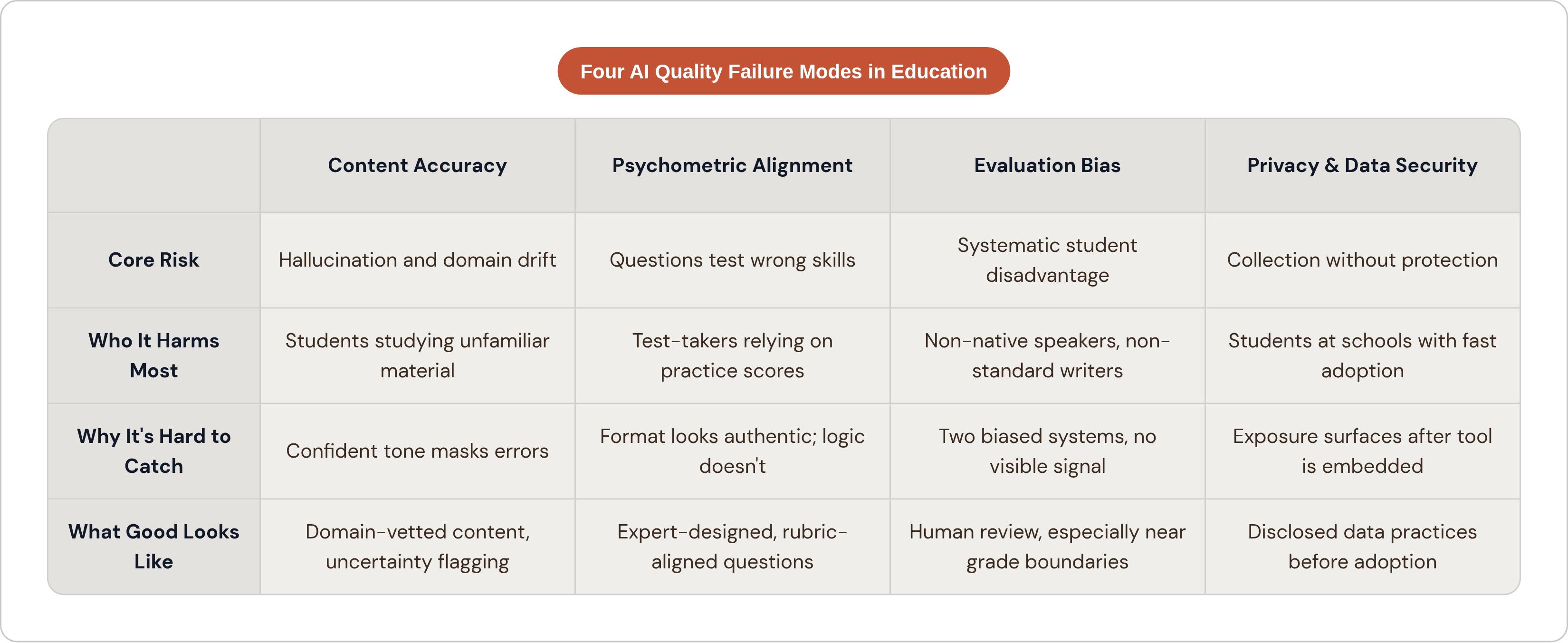
Low quality isn't just about getting facts wrong. It's at least four separate failure modes, and the frustrating part is that they stack on each other.
- Content and feedback accuracy. Hallucination, domain drift, explanations that sound right but aren't.
- Psychometric and pedagogical misalignment. The tool looks like learning. It doesn't produce it.
- Bias in evaluation. Certain students are systematically disadvantaged by how the tool assesses them.
- Privacy and data security failures. Collection without protection, disclosure without transparency.
Here's the thing that trips people up: a tool can be polished, well-designed, and aggressively marketed while failing on all four. Surface quality hides structural weakness. That's the trap — like a bridge that gleams with fresh paint while the steel underneath is quietly rusting through.
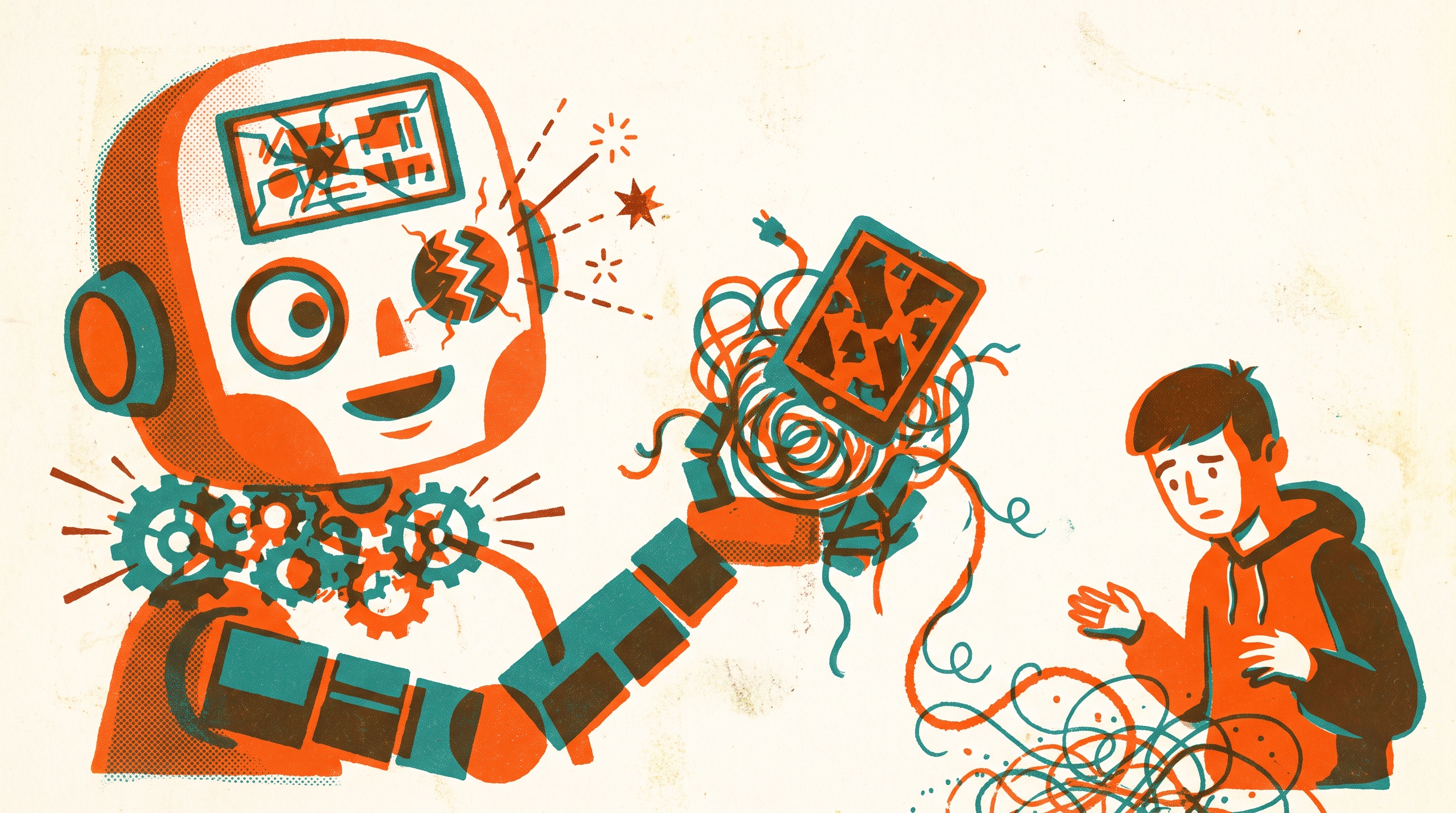
What makes it harder to catch? AI outputs are confident. They don't hedge. They rarely say "I'm not sure about this." They deliver information in the same authoritative tone whether they're right or completely off base. Students and teachers are measurably less likely to push back on a fluent, confident response. In high-stakes contexts, that misplaced trust leaves a mark.
There's also a meaningful difference between tools built on rigorous, domain-specific design and general-purpose AI that gets repurposed for education without subject-matter expertise or psychometric review. That distinction sounds dry and technical. But it determines whether a student actually learns anything.
How Hallucination and Content Drift Undermine AI Tools Used for Subject-Area Study
Let's be clear about what hallucination actually means in practice. It's not a rare glitch. It's a documented, widespread pattern where AI generates content that is fluent, organized, and completely wrong. Analysis of AI-generated content found hallucination rates roughly doubled year over year between 2024 and 2025. That's not a niche problem in an otherwise clean system. That's the system behaving as designed, just not in the way anyone advertised.
Domain-specific accuracy is especially uneven. Math and health science have shown notably unreliable results from widely-used models. Model performance can also degrade as the underlying model updates. A tool that was acceptably accurate one semester may be unreliable the next, and there's usually no announcement when that happens.
For students doing subject-area study, this creates a specific trap worth thinking through. They can't always identify what's wrong because they're using the tool precisely because they don't yet know the material. That's the whole point of studying. But if the tool is feeding them confident misinformation, they're not just missing information. They're actively building wrong mental models of the subject.
So what happens when a student can't verify what they're learning? They don't. They absorb it. The confident delivery of AI reinforces the misconception instead of correcting it. There's no uncertainty marker, no "you might want to double-check this," no built-in prompt to question the source. It's like getting directions from someone who's been to the destination but speaks with the calm authority of a seasoned local — you don't realize you're lost until you're already there.
And there's a second problem underneath that one. Students who rely heavily on AI-generated explanations may fail to develop the self-monitoring skills they need to detect when they don't understand something. The habit of asking "wait, do I actually get this?" can quietly atrophy when a tool consistently makes it feel like you do. That's a slow, invisible kind of harm.
Trustworthy tools invest in domain-specific content vetting and flag uncertainty rather than smooth over it. That's not a complicated standard. It's just one most tools don't meet.
Why AP Exam Prep Built on Generic AI Creates Specific, Compounding Risks for Students
AP participation has grown substantially. Millions of students now take multiple exams. And recent scoring changes mean students need rubric-level understanding, not just familiarity with the content. Several AP courses saw significant pass-rate shifts under new scoring standards. What counted as adequate preparation a few years ago may actively mislead a student today.
The College Board has said directly that AI-generated content can contain errors, inefficiencies, and biases, particularly in code, and that these errors may not be obvious to students using AI to study. That's not a third-party critique. That's the organization running the exams telling students to be careful about the tools they're using to prepare for those exams.
Generic AI tools built before or without accounting for those scoring shifts can mislead students about their readiness. False confidence is the central risk. A student who receives consistently positive AI feedback on incorrect work enters the exam with an inaccurate picture of what they actually know. They've practiced. They feel prepared. They're not. You could call it studying hard to fail efficiently.
Then there's the academic integrity layer, which makes things worse in a different direction. The College Board investigates submissions showing signs of inappropriate AI use. Violations can result in a zero on a component, exam cancellation, or bans from future exams. But AI detection tools have documented false positive rates, especially for non-native English speakers. So a student who hasn't misused AI can still be flagged, investigated, and penalized. The tool creates the risk even for students who followed every rule.
Cost pressure is part of the story too. Premium tutoring is expensive. Students reach for cheaper or free tools that lack the subject-matter expertise needed. That's understandable. It's also where the most damage tends to happen.
What effective AP prep AI actually requires: rubric-aligned feedback, subject-specific question design, and real awareness of current scoring standards. Not generic question generation from a repurposed general model. Tools like Passionfruit are built around exactly this gap, with AI grading calibrated to actual AP rubrics rather than generic feedback that sounds authoritative but misses what the graders are actually looking for.
How Psychometric Misalignment in SAT Prep Tools Produces False Progress
Standardized tests are psychometrically engineered. Every question follows precise skill targets, difficulty progressions, and reasoning structures developed over years of research. That engineering is invisible to most students. But it's the whole architecture of the test.
AI-generated SAT-style questions often look authentic. They don't reproduce the underlying logic. They can test incidental knowledge or surface familiarity instead of the skills the SAT actually measures.
Here's a concrete example worth sitting with. Imagine an AI-generated Words in Context question that mimics the format of an official SAT item. Same structure, same length, same phrasing style. But instead of testing whether a student can infer meaning from context, it tests knowledge of an obscure phrase most students wouldn't have encountered. The format is right. The skill being tested is wrong. A student who misses that question learns nothing useful about what they need to work on. And a student who gets it right learns the wrong lesson about what the test rewards.
Experts reviewing AI-generated practice tests have found multiple questions misaligned with official College Board skill targets. This isn't one bad question here and there. It's a structural pattern.
The harm accumulates quietly. Students build inaccurate mental models of what the test is measuring. They develop wrong habits. They misread their diagnostic scores. They do all of this while believing they're preparing effectively. A senior executive at a major test prep firm noted directly that AI-only prep lacking psychometric review does not reliably deliver positive outcomes, and that students routinely mistake activity for real progress.
There's also a systemic dimension. If a whole cohort of students is over-preparing on misaligned material and seeing inflated practice scores, the gap between practice performance and test-day reality widens across the board. It's not one student being misled. It's a class of students walking into exam day more confident than they should be.
Tools built specifically for the SAT, including Passionfruit, invest in question design that reflects the actual reasoning the test rewards. That's not a feature. It's an engineering decision that either gets made or doesn't.
Where AI Grading Bias Falls Hardest, and Why It Matters for Equity
AI grading performs reasonably well on structured, lower-order tasks. Short answers, multiple choice, fill-in-the-blank. The reliability scores look impressive on paper. But when the task becomes holistic writing or complex open-ended response, meaningful accuracy gaps show up.
There's a documented pattern called central tendency bias. AI grading systems pull scores toward the middle. They underscore strong work. They overscore weak work. The students whose grades matter most at grade boundaries are evaluated least accurately. Think about that for a second. The students right at the line between pass and fail, between a B and an A, are exactly the ones the system handles worst.
UK research using hundreds of authentic undergraduate essays confirmed this. High-performing essays were systematically underscored. Low-performing essays overscored. Across every AI system tested.
Linguistic and cultural bias compounds the accuracy problem in ways that land unevenly.
- AI grading systems trained predominantly on Western academic writing penalize structurally valid arguments that follow different rhetorical traditions.
- Non-native English speakers are assessed less accurately as a baseline.
- Students using non-standard English varieties face double exposure: biased grading and biased AI detection.
That last point is worth pausing on. The same students who get flagged at higher rates by AI detection systems are also graded less accurately by AI grading systems. Two separate mechanisms, both disadvantaging the same students, often without anyone in the room noticing.
Model drift adds a consistency problem over time. A grading system that was reasonably accurate when adopted may grade differently after an update. The same quality of work, assessed differently, with no explanation given to the student or the teacher.
Transparency matters here in a basic way. Students have a legitimate interest in knowing whether and how AI is involved in evaluating their work. Institutions that deploy AI grading without disclosure deny students the ability to contest decisions or understand their results. That's an accountability failure, and it's a choice someone made.
The practical implication: AI grading is most defensible as a supplement with human review, rather than as a standalone judgment. Tools that present AI grading as conclusive without flagging its known limitations are misrepresenting what they offer.
How Personalized Learning AI Can Widen Knowledge Gaps Instead of Closing Them
Personalized learning is the most ambitious promise AI makes in education. It's also the most unevenly delivered.
Research shows AI-generated personalized learning pathways can reduce lower-order skill gaps. The problem is that AP exams and the SAT are designed to assess higher-order thinking. That's exactly where AI personalization tends to struggle.
The evidence base is also thinner than the marketing suggests. A large share of studies validating AI personalization rely on predicted or simulated outcomes rather than longitudinal evidence of real learning improvement. Reported accuracy rates in vendor studies are often produced using validation methods that inflate performance. Very few studies address production-level requirements including privacy and scalability. Worth knowing before a school district makes a multiyear procurement decision.
Two behavioral risks emerge when personalization is shallow.
Cognitive offloading. When AI does the thinking for you, you gradually stop doing the thinking. Quietly. Independent problem-solving weakens. Memory retention drops. The tool is doing the cognitive work the student needs to be doing themselves.
Metacognitive drift. When AI facilitates too smoothly, students miss the productive difficulty that triggers self-monitoring and deeper understanding. Struggle isn't a bug in learning. It's a feature. Remove it and you remove the mechanism that builds genuine mastery.
But what if, in trying to close gaps, these tools are actually widening them? Students who most need to develop independent mastery are often the most drawn to tools that make learning feel effortless. That's not a character flaw. That's a rational response to a tool that rewards ease. But it means low-quality personalization tools can disproportionately harm the students they claim to serve most.
Substantive personalization requires more than adaptive content delivery. It requires accurate diagnosis of where a student's thinking actually breaks down, rather than just tracking right and wrong answers. There's a real difference between knowing a student missed a question and understanding why their reasoning failed.
Passionfruit's design targets this specifically. Rather than tracking performance at the surface, it works to understand where a student's reasoning breaks down and builds practice toward filling those gaps.
Privacy and Data Risks That Students and Schools Often Don't See Until It's Too Late
The Center for Democracy and Technology's 2025 report is direct: increased AI use in schools is associated with increased rates of data breaches, ransomware attacks, and tech-enabled harassment. Not speculation. Documented trends.
Many AI education tools collect extensive student data. Behavioral patterns. Performance history. Interaction logs. Often without clear disclosure of how that data is stored, shared, or sold. Schools adopting tools quickly, under budget pressure or administrative urgency, frequently skip the procurement review that would surface these practices. By the time the exposure surfaces, the tool is already embedded in the curriculum.
AI-enabled harassment is an underappreciated risk category. Tools that generate or manipulate content can be misused by students against other students. Schools that deploy these tools without safeguards bear some responsibility for what happens next. That's uncomfortable but it's accurate.
Regulatory complexity adds another layer. FERPA, COPPA, and emerging state-level student privacy laws create compliance obligations that vary by jurisdiction. Low-quality tools built without legal review can expose schools to liability they didn't anticipate and didn't budget for.
The practical consequence for school administrators: choosing an AI tool is now partly a risk management decision, not just a pedagogical one. Vendor accountability for data practices matters as much as feature sets. Maybe more.
What Students, Teachers, and Schools Can Actually Do to Evaluate AI Tools Before Adopting Them
There are specific questions worth asking before any tool gets adopted. The goal isn't to avoid AI. It's to adopt it with open eyes.
For Students Choosing Study Tools
- Ask whether questions are designed by subject-matter experts or generated by a general model. Surface similarity to real test questions is not the same as alignment with what the test actually measures.
- Treat AI feedback as a starting point for self-examination, rather than a verdict. The goal is understanding why an answer is wrong, not just knowing that it is.
- Prefer tools that surface where your reasoning breaks down over tools that only track right and wrong answers.
For Teachers Evaluating Classroom AI
- Look for transparency about how grading works and where it falls short. A vendor that can't describe its accuracy limitations is a vendor to avoid.
- Treat AI grading as a supplement requiring human review, especially for non-native English speakers, students with non-standard writing styles, and anyone performing near a grade boundary.
- Consider what happens to your own professional judgment if you stop reading student work through your own lens. The deskilling risk is real. It accumulates slowly enough that you might not notice it until it matters.
For Schools and Districts Making Procurement Decisions
- Require vendors to disclose data practices, storage, and sharing policies before adoption. Not after.
- Ask for evidence of real-world accuracy, rather than predicted accuracy from vendor-run studies.
- Ensure teacher training accompanies tool deployment. Adoption without guidance is exactly how the safeguard gap opens.
- Prioritize tools built for education specifically, with domain expertise embedded, over general AI platforms repositioned as education tools.
It is also worth considering that most of the harm described here isn't the result of bad actors. It's the result of well-intentioned adoption moving faster than scrutiny. The tools that cause the most damage aren't built to deceive. They're built without enough care, deployed without enough oversight, and trusted without enough skepticism.
The question isn't whether AI belongs in education. It clearly does. The question is whether the specific tool in front of you was built by people who understood the domain, respected what's at stake, and actually designed with the student's learning in mind.
That question is answerable. It just requires asking it.