How AI Detects Student Knowledge Gaps
AI tracks hesitation, error patterns, and reasoning—not just right or wrong answers.
There's a version of test prep almost every student has done. You take a practice test, get your score, go back through the questions you missed, read the explanations, and move on. Feels productive. Feels systematic. And it barely works.
Not because the student isn't trying. Because the whole model rests on a flawed assumption: wrong answer means gap, right answer means mastery, more practice closes the distance. That's not how understanding actually breaks down.
A student can guess correctly and have no idea why. They can apply a memorized procedure, get the right answer, and be operating on entirely wrong reasoning. They can miss a question because they misread it, or slipped on arithmetic, or because of a conceptual misunderstanding that will keep derailing them on every similar problem going forward. A score treats all of those identically. It can't tell the difference.
So score tracking captures which items were answered incorrectly. That's it. It misses where thinking broke down. It can't tell you whether an error is a fluke or a fixture. And that distinction is the thing that actually matters. Students who review wrong answers without understanding why they went wrong tend to make the same errors again. More practice doesn't close the gap. It rehearses it.
So what do intelligent tutoring systems actually do about this?
The core move is less glamorous than it sounds. Instead of logging right or wrong, the system maintains a probability estimate for each skill. How likely is it that this student actually understands this concept? Every response updates that estimate. Not just whether you got it right, but how long it took, what you tried first, whether your errors are consistent or scattered.
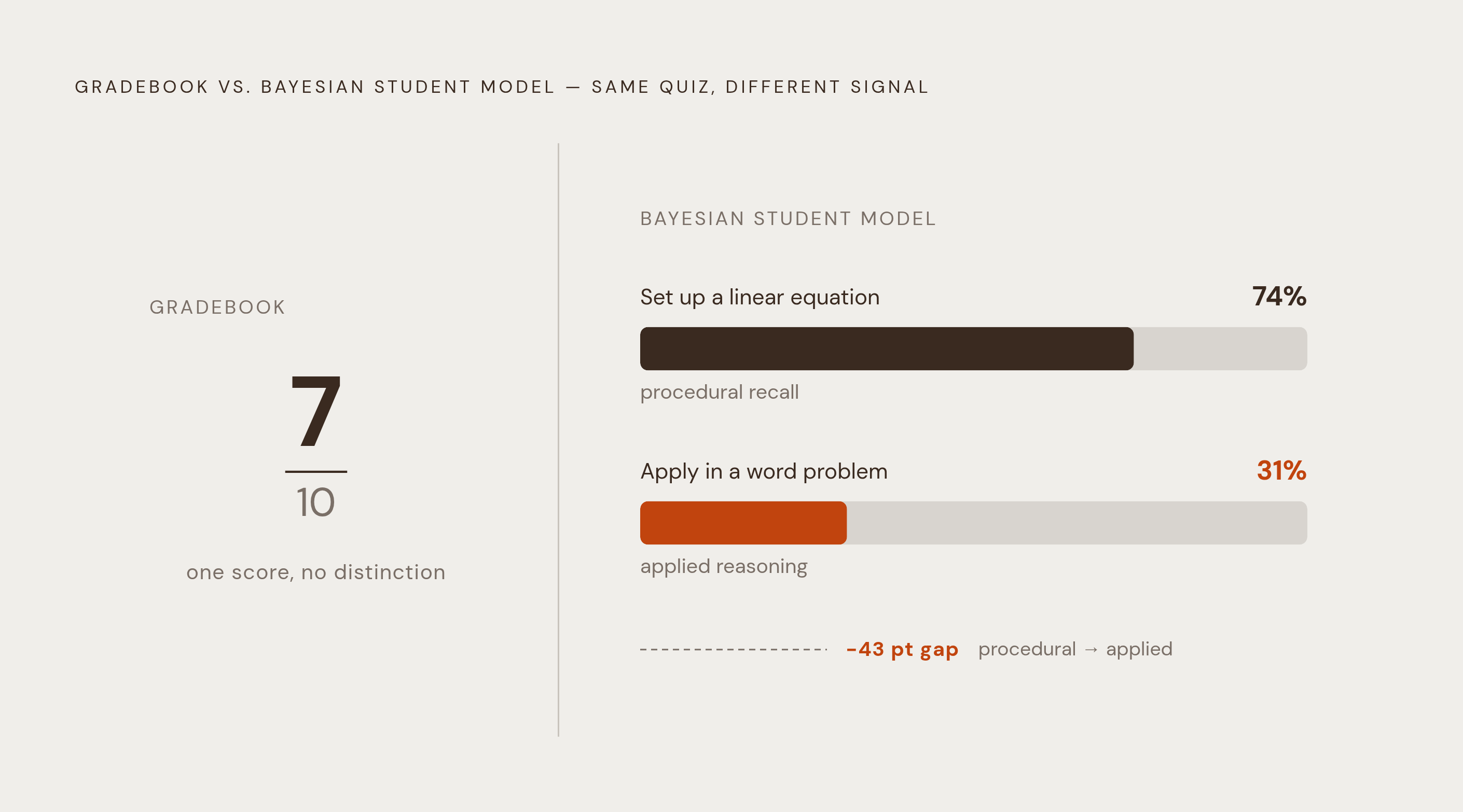
This is called Bayesian student modeling. A gradebook says you got seven out of ten on linear equations. A Bayesian model says there's roughly a 74% probability you understand how to set up a linear equation, but maybe a 31% probability you can apply that skill when the equation is embedded in a word problem. Same quiz. Completely different picture.
What is the system tracking underneath each answer?
- Response latency. Hesitation on an "easy" question can signal shallow understanding even when answered correctly. You got it right, but it took you forty seconds. That's a flag.
- Error type. A systematic wrong answer points to a misconception. A scattered wrong answer points to carelessness. These require different interventions, and a gradebook cannot tell them apart.
- Sequence patterns. Getting concept A right but concept B wrong repeatedly suggests a broken dependency in your understanding. Not a gap in a topic. A gap in the connection between two ideas.
Effect sizes between 0.40 and 0.80 have shown up in peer-reviewed research on these systems. The better implementations land somewhere in the range of one-on-one human tutoring. The mechanism works not because AI grades faster, but because it's tracking something a gradebook was never designed to track.
Your Explanation Reveals More Than Your Answer Does
Multiple-choice responses reveal patterns. Free-response questions reveal reasoning. And reasoning is where conceptual gaps actually live.
Natural language processing lets AI evaluate written answers for things a rubric score can't capture. Whether a student is using vocabulary correctly or just mimicking the right-sounding words. Whether an explanation reflects causal understanding or just correct label association. Whether the specific language a student uses matches known misconception patterns.
That last one tends to get overlooked. Certain wrong explanations show up again and again across thousands of students who share the same conceptual blind spot. NLP can recognize those patterns and flag a student whose phrasing matches a known misconception template, even if their final answer happened to be correct.
This kind of language-based gap detection has become more viable as NLP accuracy in these systems improved substantially over the past decade. What it enables is worth pausing on: flagging a student who writes a technically correct answer using reasoning that will fail on the next, harder problem. Or distinguishing between two students who scored identically on an essay but for entirely different reasons. Same number, different gaps, different paths forward.
But here's where I want to slow down. NLP is pattern matching at its core. It finds language that resembles known misconceptions. What it can't always determine is why a student chose that language. Sometimes a student writes something that looks like a misconception but is actually imprecise phrasing for a correct idea. A skilled teacher catches that in thirty seconds. An NLP model might flag it as a gap. The output is a strong first filter. Not a final verdict.
Bloom's Taxonomy Isn't Just for Lesson Planning. It's a Diagnostic Map.
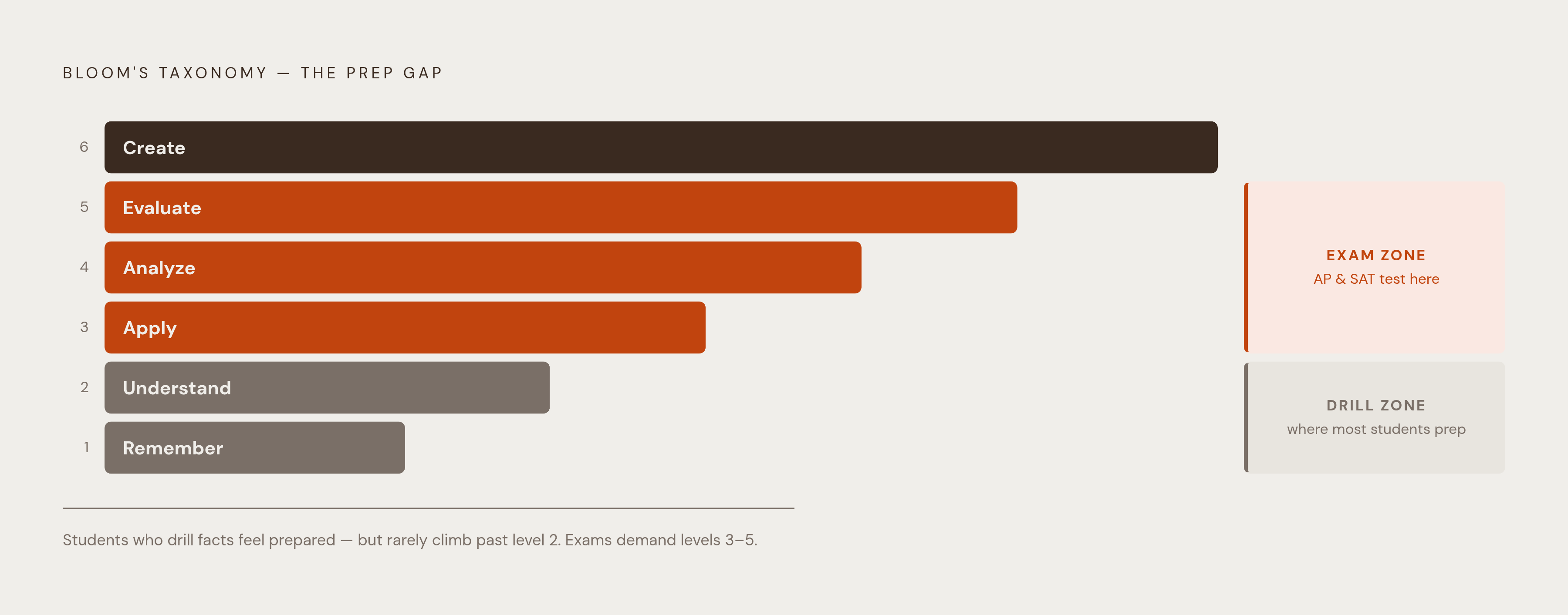
Most people treat Bloom's Taxonomy as a curriculum planning tool. Something teachers use to make sure they're covering different levels of thinking. But it's also a gap detection framework, and that use case is underappreciated.
The six levels: remember, understand, apply, analyze, evaluate, create. A student can recall a definition and completely fail to apply the concept in a novel context. Those are different gaps. A score that says "a passing score on photosynthesis" cannot tell you which one you have, and they require entirely different remediation.
AI systems address this by generating and evaluating questions mapped to all six levels in real time, then classifying where a student's understanding is actually operating. If a student consistently succeeds at recall-level questions but breaks down at analysis-level questions on the same topic, the gap isn't "I don't know this material." It's "I can recognize this concept but I can't reason with it yet."
That distinction matters enormously for test prep because AP exams and the SAT do not primarily test recall. They test application, reasoning, and analysis. A student who has drilled facts but never been pushed past the lower levels of Bloom's will feel prepared and still underperform. I've watched this happen with students who had genuinely strong content knowledge and still struggled on exam day because they'd never been asked to do anything with that knowledge except repeat it. It's a particular kind of frustrating to diagnose in hindsight.
Research supports this pretty clearly. Students who used AI as a constructive tool, engaging at the application and integration level rather than just extracting answers, were the ones who reached deeper learning. The taxonomy actually predicts this. If you're using AI to get answers, you're staying at the remember level. If you're using it to interrogate your own thinking, you're climbing. Which raises an uncomfortable question: how many students are actually doing the latter?
On the SAT, an Undetected Gap Can Cascade
The Digital SAT is adaptive. The second module's difficulty is set entirely by how you perform in the first. That structural fact changes the stakes of gap detection significantly, and most students I've talked to haven't fully absorbed what it means.
A recurring blind spot, if undetected, doesn't just cost you a few questions. It can push you into an easier second module and cap your score ceiling before you've even reached the harder material. Static prep books cannot simulate or diagnose this dynamic. They treat every question as independent.
AI-based SAT prep works differently at the detection level. Diagnostic tools using Computer Adaptive Testing logic can estimate ability levels quickly and identify gaps without requiring a full-length test. More importantly, what they're detecting isn't just wrong topics. It's the specific type of error a student makes repeatedly.
"You got linear equations wrong" is a topic flag. "You consistently misread the scope of the question before setting up the equation" is a cognitive flag. One tells you what to study. The other tells you what to change about how you think. That is a qualitatively different thing, and the gap between those two types of feedback is roughly the gap between prep that moves the needle and prep that doesn't.
Students completing the recommended AI practice plan on Khan Academy have averaged meaningfully higher scores than those using traditional static practice books, according to a joint College Board/Khan Academy study. That gap reflects more than extra practice hours. It reflects the difference between practicing with and without gap-targeted feedback. Though I'd be skeptical of anyone who claims those studies fully isolate the detection mechanism from the motivation effect of having a structured plan. The gain is real. The cause is probably several things working together.
AP Prep Is a Different Problem. The Gaps Run Deeper.
AP exams test sustained conceptual understanding across a full course's worth of content. The gap detection problem is structurally different from the SAT, and conflating the two is a mistake I've seen students make repeatedly.
Consider AP Statistics. A student might not just be missing practice. They may have a fundamental misunderstanding of statistical inference that makes an entire question type systematically wrong, every time, in the same direction. In 2025, only 60.3% of AP Statistics students scored a 3 or higher. A large share of those test-takers arrived with undetected gaps in core reasoning frameworks, not just insufficient practice volume. More drilling on the same misunderstanding isn't a solution. It's more practice being wrong.
Adaptive AP platforms address this by building study plans organized around the intersection of topic weight on the exam and the size of the student's gap on that topic. A small gap on a heavily weighted unit gets prioritized over a large gap on a rarely tested concept. The system doesn't just tell you what you missed. It tells you where to spend the next hour.
Some platforms also shift between modes based on what kind of gap the system detects. Socratic mode, where the platform asks the student to reason through a concept rather than just providing the answer. Drill mode for procedural fluency. Strategic mode for exam-day timing decisions. Which mode gets selected is itself a diagnostic judgment. Conceptual confusion gets Socratic questioning. Procedural shakiness gets repetition. Those are different treatments for different diagnoses.
Whether the platform is actually correct about which diagnosis applies is worth asking separately. The classification is only as good as the signal feeding it, and that signal is still imperfect.
AP participation grew 7% from 2024 to 2025, increasing across 36 of 40 AP courses. More students in harder courses means gap detection tools aren't serving a niche edge case anymore. They're serving a large population under real academic pressure, and the tools are being used at scale before we fully understand their limitations.
AI Grading Is a Gap Detection Tool First, Time-Saver Second
When AI grades a written response, it produces a structured signal about where a student's reasoning diverged from correct understanding. That signal, aggregated across many responses, builds a more detailed picture of a student's conceptual state than any single score can. The time-saving angle gets most of the headlines. The diagnostic output is the more consequential thing.
AI grading systems are trained on large datasets of human-graded examples. They learn to associate specific response features with specific quality levels. Not just correctness, but depth of reasoning, use of evidence, and logical coherence. Estimates suggest these systems save teachers a meaningful number of hours per week in 2025. That matters. But what it matters for is freeing teacher attention for the interpretive work AI can't yet do reliably.
Because it can't fully do it yet. Research published in 2025 found human-provided feedback to be more accurate than AI-generated feedback. A separate 2025 study examining AI grading of university exams against human teachers found meaningful inconsistencies, particularly around longer answers and edge-case reasoning. AI grading is most reliable for structured, well-scoped responses. It struggles most where nuanced judgment about the quality of an argument is required. Anyone who's watched an AI confidently assign full marks to a student who arrived at the right answer through circular reasoning knows exactly what that looks like.
What this means for gap detection: AI grading is a powerful first filter. It surfaces likely gaps quickly and at scale. But its diagnostic output is most useful when a teacher or student interrogates it rather than accepts it wholesale. The signal is strong. It still needs a human in the loop to interpret it correctly.
The Detection Is Only Worth Something If You Actually Engage With It
Here's the part that gets glossed over in conversations about AI-powered prep tools. The detection is the beginning of the work, not the end of it.
Being told "your gap is in applying conditional probability reasoning" is not the same as drilling more probability questions. It changes which problems to do next, and it changes how to approach them. Students who receive a diagnostic output and respond by doing more of the same kind of practice are not closing the gap. They are, in a very literal sense, practicing the gap.
For students evaluating an AI prep tool, a few questions worth actually asking:
- Does it distinguish between error types, or just flag wrong topics?
- Does it adapt what comes next based on how you answered, not just whether you were right or wrong?
- Does it give feedback that names a reasoning error, or does it just confirm the correct answer?
For teachers, the shift is real. When AI is handling the detection, the teacher's role moves from gap-finder to gap-responder. Research suggests that teacher interventions using real-time intelligent tutoring dashboards are substantially more effective than delayed feedback. The diagnostic output is only actionable if teachers have time and context to interpret it, which is the argument for AI handling surface-level grading in the first place. The tools work best when the roles are clearly divided, not when one is expected to replace the other.
There's also a genuine cognitive risk here. Research found that frequent generative AI use negatively correlated with critical thinking when it enabled what researchers call cognitive offloading. Students using AI to get answers rather than to interrogate their own reasoning can rehearse the gap rather than close it. That's not an argument against the tools. It's an argument about the direction of use, and it's one that gets undersold when platforms market themselves primarily around efficiency and score gains.
A 2025 meta-analysis found generative AI effective for both lower- and higher-order skills when deployed as a constructive tool. The outcome depends substantially on whether the student is using the AI to think harder or to avoid thinking altogether. That framing is simple. Living it out, actually sitting with a wrong answer and trying to understand the reasoning failure rather than just moving to the next problem, is harder than it sounds. The AI can detect the gap. Closing it is still on you.