SAT Target Score Setting by College and Major
Your intended major determines which SAT section score matters most to admissions officers.

Most students pick their SAT target the way they pick a gym goal. They round up from where they are, copy what a friend is doing, or just pick a number that sounds impressive. Then they prep toward that number without asking the obvious question: impressive to whom, exactly?
A 1400 is a reach score at one school and a liability at another. The score itself means nothing without a specific institution attached to it. Students treat the SAT like it exists in a vacuum. It doesn't.
So let's fix that.
The majority of four-year colleges in the U.S. are test-optional or test-blind right now. That sounds like the SAT is quietly on its way out. But that majority hides something important at the top of the market.
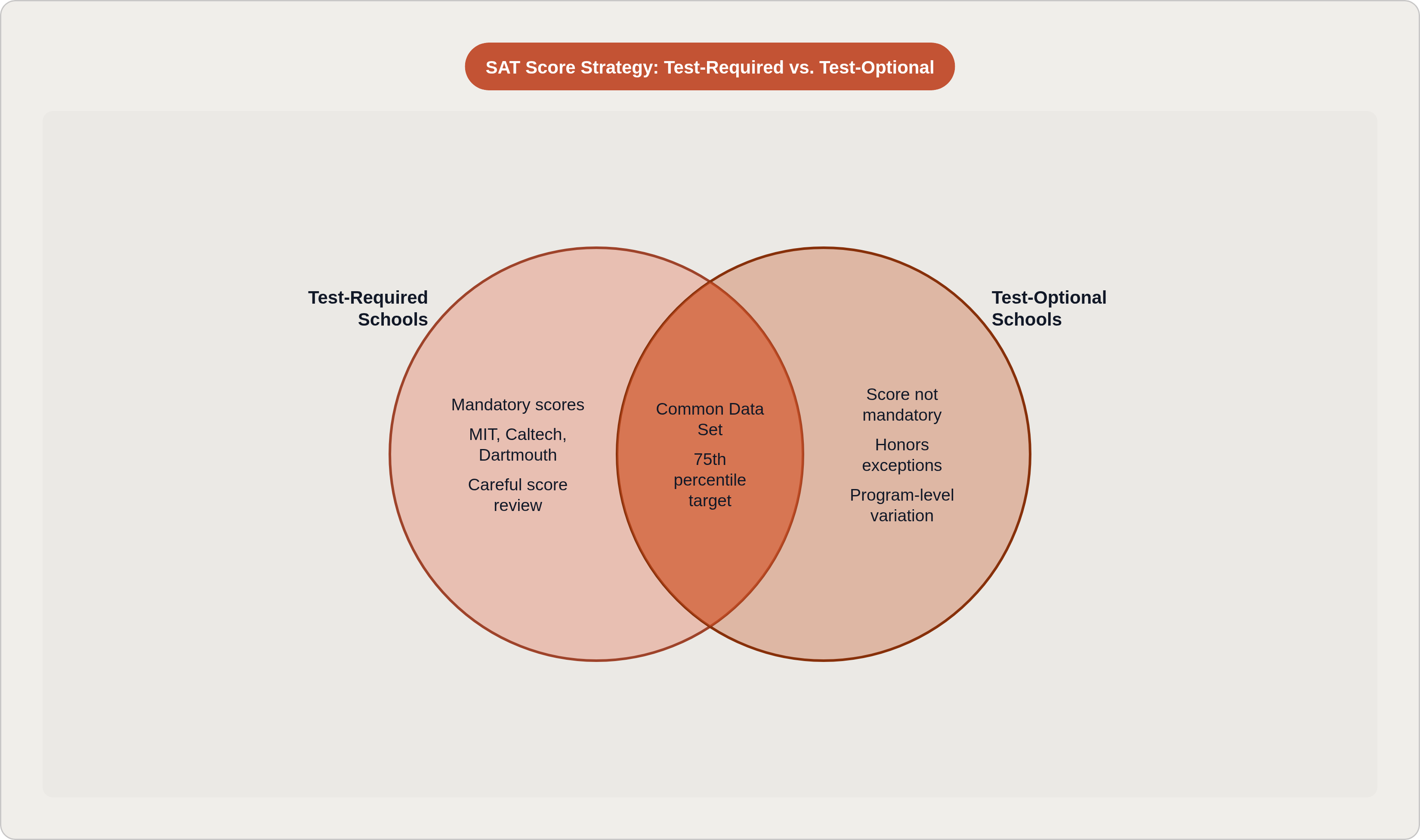
Several highly selective schools, including MIT, Caltech, and Dartmouth, have returned to requiring scores. If your list includes any of those institutions, the SAT is not optional. It's mandatory. And your score will be read carefully. The trend at the most selective schools is moving back toward test-required, not away from it.
The University of California system sits at the other extreme. It's test-blind. A score submitted to a UC campus plays no role in your admission. For admission purposes, that score is invisible.
But here's where students get tripped up. Test-optional doesn't mean what most people think it means. Some schools that waive score requirements for general admission still require them for honors programs, competitive internal majors, or merit scholarships. A school's headline policy and the policy for your specific program can be two entirely different things.
Do you actually know the testing policy for each school on your list at the program level, not just the institutional level?
If not, that's where you start. Setting a score target before you know whether that score even counts for your specific application is backwards.
Reading the Common Data Set to Find the Number That Actually Matters for Your List
Once you know which schools on your list are test-required or test-optional, you need one specific document: the Common Data Set.
Most colleges publish it voluntarily. It usually lives in the Institutional Research or Admissions section of the school's website. Search "[College Name] Common Data Set [year]" and it'll come up. Go to Section C. That's where the test score data lives.
You're looking for two numbers: the 25th percentile and 75th percentile SAT scores for the most recently admitted class. Not the average. Not the minimum. The middle 50% range.
Here's how to actually read those numbers:
- The 75th percentile is your working target. At or above this score, the SAT essentially stops working against you. It's no longer a question mark in your file.
- The 25th percentile is your floor. Fall meaningfully below this number and the SAT starts doing damage. It becomes a liability, not a neutral factor.
Do this for every test-required and test-optional school on your list. Find the highest 75th percentile across all of them. That number becomes your SAT target. It's the one score that covers the full list.
One more thing: use the most recent year's CDS. Score ranges shift. A school that showed a 1400 at the 75th percentile two years ago might be sitting at 1450 now, and that gap matters when you're building a prep plan around a specific number.
Score Ranges Vary Wildly by Institution Type. That Matters for How You Build Your List.
Before you pull individual Common Data Sets, it helps to have a rough sense of what tier each school occupies. Not to chase a ranking. Just so you don't calibrate your target to the wrong benchmark.
A rough map:
- Most selective universities (top ten nationally) enroll students with scores in the high 1400s to low 1500s at the 25th percentile. Their 75th percentiles sit at or near the ceiling of the scale. A score that would be outstanding almost anywhere else can sit near the bottom of their enrolled class.
- Competitive state flagships and strong regional universities show middle 50% ranges in the mid-1100s to mid-1300s. More spread, and section balance matters differently here.
- Broader-access four-year colleges cluster closer to the national average, with real variation across schools and programs.
Stanford's published middle 50% is a useful illustration of how little room there is at the most selective end. Even a genuinely impressive score can sit near the floor of their admitted class. That's not discouraging. It's just the math. Know which tier you're calibrating to before you pick a number.
Military academies are worth mentioning as an outlier. They require scores, and their competitive ranges look similar to selective state universities. But the entire application runs through a different lens. Scores are one signal among several that carry unusual weight there, and the process is just different enough that it's worth researching separately if any academies are on your list.
The point isn't to sort schools into rankings. It's to make sure your target reflects the actual pool you're competing in.
Your Intended Major Should Change Which Section Score You Prioritize
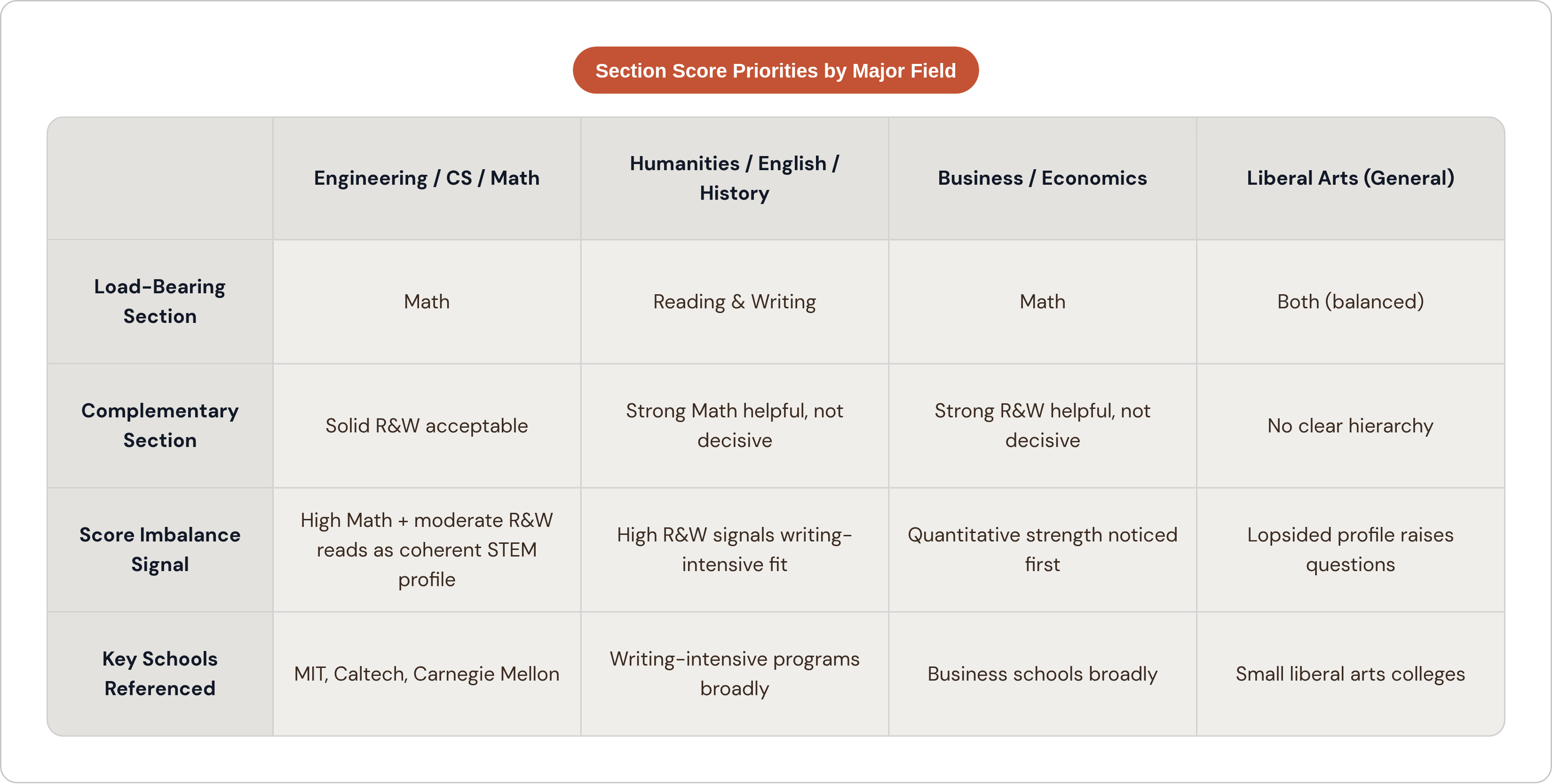
Colleges report total SAT scores. But admissions officers in program-specific or departmentally organized schools often look at section scores first. Before the total. The section score tells them something the composite obscures.
Think about what that means in practice.
Engineering, computer science, physics, math. The Math score carries disproportionate weight. At schools like MIT, Caltech, and Carnegie Mellon, admitted engineering students cluster at the very top of the Math scale. A strong Reading & Writing score does very little to compensate for a weak Math score in these programs. Interestingly, a high Math score paired with a merely solid Reading & Writing score is actually a coherent, defensible profile for a STEM applicant. The imbalance signals something real about what you're built for.
Humanities, English, history, social sciences. The Reading & Writing score carries more interpretive weight. A strong R&W score, somewhere around 700 or above, is a meaningful signal for writing-intensive programs. A strong Math score doesn't hurt, but an admissions officer reading an English applicant's file will weight R&W more heavily. The reverse imbalance also tells a story.
Business and economics. Treat these more like STEM. Quantitative strength matters. A strong Math score is the section admissions officers notice first.
Liberal arts colleges. These evaluate the total more holistically. Balance reads as intellectual breadth. Scores within a reasonable range of each other across sections make a different kind of case than a lopsided profile, even a high one.
The practical rule: identify which section maps to your major's core skill. Set that section's target first. Then figure out what the complementary section needs to be to hit your total-score goal. The total score is the sum. The section that matters most for your field is the load-bearing part of that sum.
When a School Publishes Section-Level Data and How to Use It
Some universities break out admissions data by school or college within the university. The College of Engineering may publish its own middle 50% ranges, separate from Arts and Sciences. When that data exists, use it. The institutional aggregate can obscure a significantly higher Math floor in engineering or a meaningfully higher R&W floor in a journalism program.
Where to look: the admissions page for the specific school or program, departmental FAQs, and any CDS supplement the university publishes by division.
When program-level data isn't available separately (and often it isn't), apply the section-score logic from the previous section rather than assuming the overall institutional range applies uniformly to every program. It probably doesn't.
One more thing worth flagging. If you're undecided, or if you're applying to one school's engineering program and another school's liberal arts college, you need separate section-score priorities for each application. The single highest 75th percentile still governs your total score goal. But which section matters most differs by application, and your prep should reflect that.
Building the Actual Target: A Working Method from College List to Score Goal
Pull out your college list and work through this in order.
Audit the testing policy for every school. Test-required, test-optional, or test-blind. Note any program-level exceptions for your intended major, honors programs, or merit scholarships. Nothing downstream of this step is reliable until you've done it.
Pull the most recent Common Data Set for each test-required or test-optional school. Record the 25th and 75th percentile total SAT scores.
Set your score target as the highest 75th percentile on your list. That's the number you prepare toward.
Identify your floor. The 25th percentile of your most reach-level school is the zone where the SAT starts doing damage rather than good. Know where it is.
Assign section priorities based on your intended major. Decide which section is load-bearing for your field and set a section sub-target accordingly.
Calculate your current gap. The distance between your most recent practice or official score and your target. That gap is your syllabus.
A target score is only useful if it connects to a preparation plan. The number without the gap analysis is just arithmetic.
Closing the Gap Between Your Current Score and Your Target Through Deliberate, Structured Practice
The gap between a current score and a target is rarely uniform. Students don't lose points evenly across the test. They lose them in specific question types, specific content areas, specific timing patterns. The problem is usually concentrated somewhere. You just have to find where.
Generic drilling, meaning more practice tests without diagnosing why you're missing questions, tends to reinforce what you already know rather than surface what's actually holding your score down. More reps of the same thing is not the same as better preparation. I've watched students take six practice tests in a row and improve by exactly zero points because they kept practicing their strengths.
Effective gap-closing starts with identifying where the score is actually leaking:
- Section-specific work when one section is significantly below target.
- Content-area drilling when a specific domain like algebra, data analysis, or evidence-based reading is dragging down an otherwise solid section score.
- Strategy and pacing work when errors cluster at the end of a module. That pattern usually means time management is the issue, not content knowledge.
One structural thing worth knowing about the Digital SAT: it's adaptive. Performing well on the first module unlocks a harder second module, and scoring well on that harder second module is what pushes scores into the upper ranges. Consistent accuracy early matters more than it did on the paper test. The two modules are genuinely different animals, and your prep should treat them that way.
Tools like Khan Academy's SAT prep and other structured platforms can help surface patterns across your practice items that are easy to miss when you're reviewing your own work. A student looking at their own results sees individual wrong answers. A structured review sees trends across hundreds of them. Those are different things.
Finally, revisit your target if your list changes. Adding a more selective school raises the bar. Removing one may mean your current trajectory is already sufficient. The target isn't fixed. It's downstream of your list, and as the list evolves, so should the number you're chasing.