SAT Reading and Writing Section Mastery Techniques
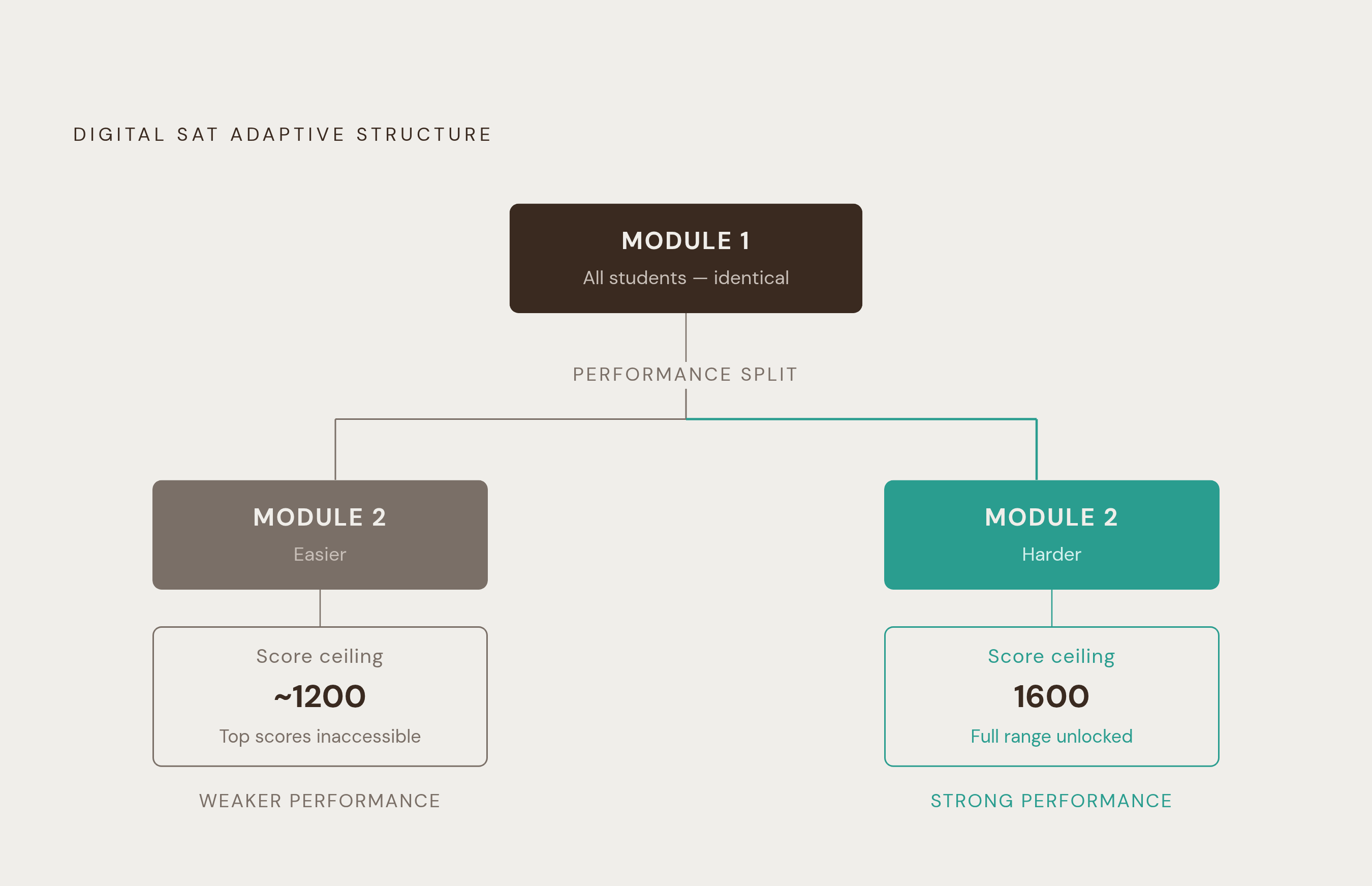
Adaptive routing means acing Module 1 determines your score ceiling.

Here's something most students don't figure out until they're sitting in the test room: the two people next to you are probably not taking the same test you are.
The digital SAT runs on a multistage adaptive design. Module 1 is identical for everyone. How you perform there determines which version of Module 2 lands in front of you. Do well, and the test routes you toward a harder second module. Struggle, and it sends you to an easier one. The catch is simple and a little brutal: the harder Module 2 is the only path to a higher score ceiling.
That changes everything about how you should think about Module 1. It isn't a warm-up. It's a routing decision. Every question quietly determines which scoring band is even available to you in the second half. And here's the part that trips people up: you won't feel the decision being made. You'll just be answering questions.
What that means practically:
- Prioritize accuracy over speed in Module 1. It is not a throwaway round.
- Don't adjust your strategy in Module 2 based on how hard the questions feel. Your gut read on difficulty is unreliable. Run the same game plan regardless.
- Stop trying to figure out which module version you got. It's a distraction, and knowing changes nothing.
One more number worth chewing on: the average SAT Reading and Writing score in 2025 was 521, down from 531 in 2019. That gap exists largely because students are running old strategies on a fundamentally different test. The format isn't what's breaking people. The mismatch is.
Reading the question before the passage — and why the short format makes this essential
On the old SAT, passages ran hundreds of words. Skimming was a real strategy. You could build context, find your footing, then hunt for the answer.
That's gone now.
Passages on the digital SAT cap out around 150 words. Sometimes they're a few sentences. Every sentence is doing work. There's no padding, no redundancy, nothing you can safely skim past. Read passively and you'll miss the exact thing the question is testing.
So read the question first. Every time. Without exception.
Because the question tells you what kind of reading to do before you've touched a single word of the passage. A vocabulary question says: figure out how this word functions in context, not what it means in the abstract. A claim-support question says: find the one sentence that directly backs this specific claim. A transition question says: track the logical relationship between the ideas on either side of the blank.
Without that signal, you're reading for everything. At 71 seconds per question, reading for everything is a losing bet.
There's also a cognitive cost that doesn't get talked about enough. Every passage drops you into a completely different subject. Marine biology. 19th-century economic policy. A student's argument about renewable energy. That constant topic-switching is disorienting, and it accumulates across a full section in ways that are hard to notice until you're already tired and halfway through Module 2. Reading the question first means you arrive at each new passage already oriented, with a specific job to do — like walking into a room knowing exactly what you're looking for, rather than just looking around.
This applies across all four content domains, but it pays off most on Information and Ideas questions. Those passages are loaded with details that sound plausible but fail to actually answer what was asked.
How question order inside the section creates a navigation opportunity
Most students move through the section in a straight line. Question 1, question 2, question 3. They hit something hard, burn two minutes on it, feel behind, and rush everything that follows.
There's a better way.
Within most content domains, questions tend to cluster by skill and run easier to harder within each cluster. Standard English Conventions is a partial exception. But for Information and Ideas, the hardest question types pile up together. And they are time-consuming in a way grammar questions usually aren't.
The heaviest ones:
- "Logically complete the text" questions, where you're reasoning toward a conclusion the passage implies but doesn't quite state.
- Data interpretation questions, where you're working through an embedded graph or table alongside the passage text.
These eat time. They are not where you want to spend your first and sharpest cognitive energy.
A smarter first pass: knock out grammar questions and clear vocabulary questions first. Reliable points, lower time cost. Flag the complex Information and Ideas questions and come back after you've banked those easier ones. And leave nothing blank. There's no guessing penalty on the digital SAT. An educated guess beats an empty box every time.
Pacing by question type — allocating 71 seconds where it produces the most return
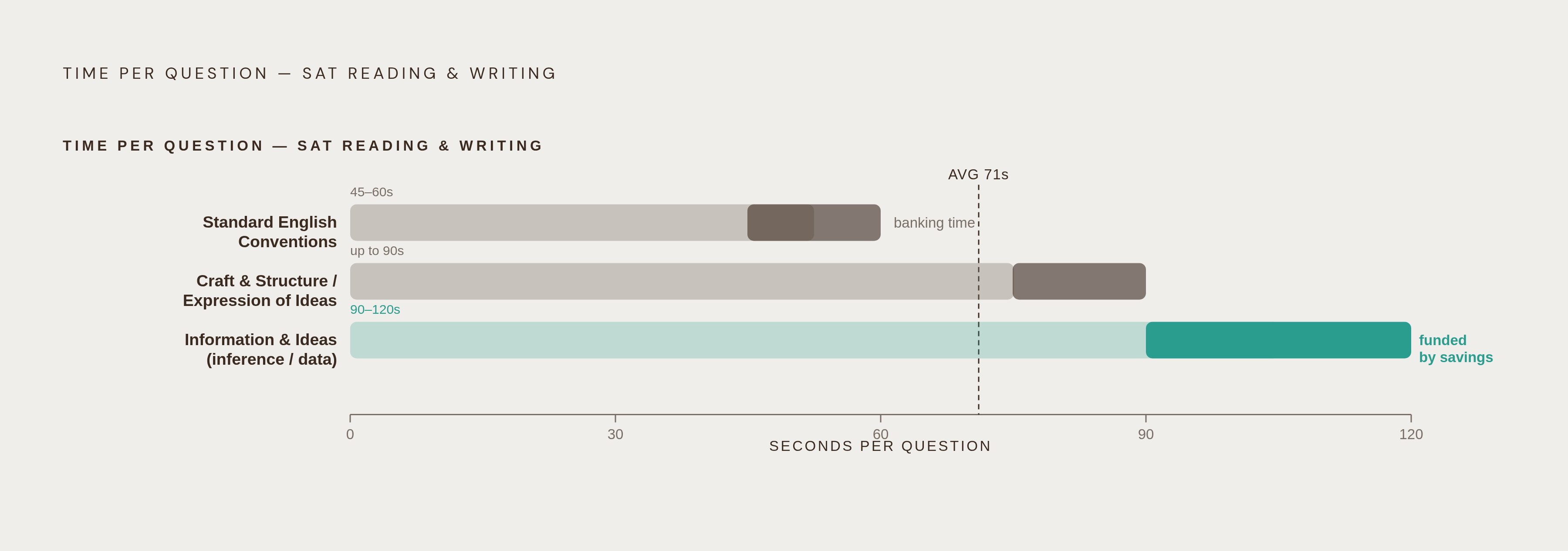
Seventy-one seconds is the average time per question across the full section. It is not a per-question budget. The whole point of pacing strategy is deliberate unevenness: spend less time where less is needed and bank those seconds for where they actually matter.
By domain, here's roughly how that plays out. Standard English Conventions: aim for 45 to 60 seconds. These are rule-recognition questions. If you know the rule, you're done quickly. If you don't, sitting there longer won't conjure the answer. Craft and Structure and Expression of Ideas: up to 90 seconds on harder items, but only after you've built a cushion elsewhere. Information and Ideas involving complex inference or data interpretation: these can justify 90 to 120 seconds, provided that time was earned on easier questions first.
One rule overrides the others. If a question hasn't moved in roughly 40 to 50 seconds, flag it and keep going. Students pour two minutes into a single question because they've already invested time in it. That's sunk-cost thinking, and it compounds across the section fast.
The target is two minutes of buffer at the end of each module for flagged items. That buffer has to be built question by question. It cannot be wished into existence at the end.
Grammar and conventions mastery as a consistency lever, not a point ceiling
Grammar questions are the most controllable points on the section. Every other domain requires some degree of interpretation. Grammar doesn't. The answer is either correct against the rule or it isn't. That's what makes conventions the one area where consistent, near-perfect performance is achievable through drilling alone.
But why do so many students still drop points there? Usually because they're still reasoning through the rules in real time instead of recognizing them on sight. That distinction matters more than it sounds.
The highest-frequency conventions on the digital SAT: sentence boundaries (run-ons, comma splices, fragments), subject-verb agreement and tense consistency, pronoun clarity and agreement, punctuation around dependent clauses and before lists or explanations, modifier placement, and parallel structure.
The goal is automaticity. Not "I can work through this comma rule if I think carefully enough." The goal is that your brain flags the error category before you've consciously deliberated over the options. Students who are still actively reasoning through comma placement under time pressure have yet to get there. That just means the drilling hasn't finished its job.
At higher scoring ranges, score differences come down to precision and consistency. Conventions is the domain where precision is most reliably within reach. It's not the ceiling you're aiming for. It's the floor you build everything else on top of.
Handling Expression of Ideas questions — logic, not just grammar
This is where students who are strong on grammar sometimes bleed unexpected points.
Expression of Ideas questions are not grammar questions. The test isn't asking whether the sentence is grammatically correct. It's asking whether the sentence or paragraph works logically and clearly. A grammatically perfect answer can be the wrong answer. That surprises people the first time it costs them points.
Three sub-skills this domain actually tests. Transitions: does the connecting word accurately reflect the relationship between the ideas? Contrast? Continuation? Cause and effect? A word like "however" in a sentence that's continuing an idea, not contrasting one, is wrong even if the grammar is spotless. Concision: is this the most economical version that still preserves full meaning? When two answers are both grammatically acceptable, the shorter one is usually right, as long as it doesn't quietly cut something meaningful. Logical sequencing: does the sentence belong where it is, or would moving it somewhere else make the passage actually flow better?
The trap is a grammatically clean answer that creates a logical mismatch. Students reading purely for grammar errors walk right into it.
Read the full relevant sentence or the full relevant paragraph before choosing. The surrounding context tells you whether a change improves the text or quietly breaks it.
Transitions are worth drilling specifically, and the check is simple: read the two ideas on either side of the transition word and ask yourself whether the relationship is contrast, continuation, or cause. If the word doesn't match the relationship, it's out.
Working Information and Ideas questions — predicting before looking at answer choices
Wrong answers on Information and Ideas questions are built to feel right. They use vocabulary from the passage. They reference ideas that appear in the passage. They sound authoritative. The College Board's distractor engineering here isn't subtle. It's the whole game.
Evaluating answer choices one by one, in isolation, is exactly what the test wants you to do. Because when you evaluate in isolation, you're vulnerable to whichever answer sounds most confident. And some of those wrong answers sound very confident.
Predicting before you look breaks that pattern. Read the question, read the passage, then cover the answer choices and sketch out in your own rough words what the correct answer needs to say. Then look at the choices and match against your prediction. Your prediction is anchored in the text. You're deciding which answer matches what you already know the passage supports, rather than which answer sounds best. That's a fundamentally different cognitive task, and it short-circuits a lot of distractor traps.
A few elimination signals worth knowing: absolute language like "always," "never," or "completely" in a context where the passage makes no such claim. An idea absent from the passage entirely — if you can't point to the sentence that supports it, it's out. And the most dangerous category: an answer that's technically passage-supported but doesn't answer the specific question asked. The information is real. It just doesn't answer what was asked.
For data interpretation questions with an embedded graph or table: read the axis labels first, then re-read the specific claim in the passage. The question is asking what the data shows in relation to that claim. Students who go straight to the answer choices without establishing that connection are guessing, even when it doesn't feel that way.
Building an error log that identifies pattern, not just missed questions
Reviewing wrong answers without categorizing them is one of the least efficient things you can do in test prep. You finish a practice set, look at what you got wrong, feel a vague sense of frustration, and move on. Nothing changes. The same errors show up next time.
An error log that actually does something captures four things for every missed question. Which content domain the question belonged to. The specific error type — grammar rule gap, misread evidence, wrong transition logic, ran out of time and guessed. Why the answer you chose was wrong, in your own words, not "it sounded off" but a real explanation. And why the correct answer is right, traced back to a specific sentence in the passage or a specific rule.
That last one is where most students stop short. If you can't explain why the correct answer is correct, the gap will repeat itself.
The payoff shows up over multiple sessions. Patterns surface. Maybe it's transition questions. Maybe it's possessive apostrophes. Maybe it's claim-support inference. Once you can name the specific sub-skill that keeps costing you points, you can target it directly instead of running through full-length sections and hoping improvement shows up on its own. Volume without diagnosis produces diminishing returns. The log is what converts one into the other.
Why the students below benchmark need different support than students near the top
According to the College Board, only 39% of the more than 2 million class of 2025 SAT takers met or exceeded college readiness benchmarks in both Reading and Writing and Math. The average RW score of 521, down from 531 in 2019, suggests that participation growth and benchmark attainment aren't moving in the same direction.
But that aggregate number hides something important. Students below benchmark are typically failing on specific sub-skills, not across all four domains equally. General test prep treats everyone as having the same problem. It gives everyone more practice of the same kind, which helps some students and misses many others entirely.
Students near the top have a different problem. At the 760-plus range, they typically understand the material. Their losses come from precision failures — inconsistent decision-making under time pressure. A transition question answered correctly nine times and blown on the tenth because they were rushing. More content review doesn't touch that.
So what follows from this? A student who keeps missing Information and Ideas inference questions needs targeted inference practice, not more grammar drills. A student whose score swings because of pacing needs pacing-specific practice sets, not content review. A student strong on conventions but weak on Expression of Ideas needs time on logical sequencing and transition logic, not another round of comma rules.
Generic prep is inefficient for both groups. And notice the irony: the adaptive design of the test itself is built on exactly this logic. The test adjusts to the individual student. Preparation probably should too.
How a structured study timeline maps to the digital SAT's specific demands
Most students need two to three months of consistent practice to see meaningful score improvement. Students starting from a lower baseline, or targeting a large point gain, need a longer runway — three to six months. The skills this test rewards, especially pacing automaticity and domain-specific pattern recognition, take repetition over time. You cannot cram them in a week — like trying to learn to ride a bike by reading the manual the night before a race, you might feel ready right up until the moment the road proves otherwise.
Three phases map best to how this test is actually built.
Early weeks: format familiarization. Complete official College Board digital practice tests in Bluebook. Not PDF printouts. Not third-party simulations. The actual interface, with actual adaptive module behavior, actual passage lengths, and the actual question style. The goal is to stop being surprised by the format so you can start focusing on the content.
Mid-phase: domain-targeted work. This is where the error log pays off. By now you've identified the one or two content domains producing most of your losses. Drill those sub-skills in isolation, rule by rule, question type by question type, before returning to full timed sections. Most students skip this phase entirely. That's where the most durable improvement tends to happen, so skipping it is a significant miscalculation.
Late phase: timed, full-section practice under real test conditions. By this point, the techniques should be internalized. The purpose here is to make the strategies you've already learned automatic under the pressure of 71 seconds per question, rather than to learn new strategies. There's a meaningful difference between knowing how to do something and doing it without thinking about whether you're doing it. That gap is what this phase closes.
The College Board offers free practice materials through Bluebook and Khan Academy. They're the highest-fidelity option available because the question style, passage length, and domain distribution actually match the test. Use them.
The late-phase target isn't "I know how to do this." It's: the decision is already made before you've finished reading the question.