SAT Punctuation Rules That Affect Score
Master five punctuation rules to gain a high-leverage edge on standardized tests.
SAT punctuation questions don't ask whether a sentence sounds right. They ask whether a student can classify what sits on each side of a comma, semicolon, colon, or dash, and apply a fixed rule to that classification. That's a different skill than the one most students bring to the test, and the gap between the two is where points get lost. The Digital SAT's Standard English Conventions section tests 15 specific grammar rules, and punctuation (commas, semicolons, colons, dashes) is the most frequently tested sub-category within that group. Most students were taught commas through "pause" logic: read the sentence out loud, and if it feels like it needs a breath, drop one in. The Digital SAT doesn't grade breathing. It grades structure, and that mismatch explains why strong writers with good instincts still miss these questions at a surprising rate. The SAT calls these "Boundaries" questions, and they make up a substantial share of the English module. Because the test applies the same small set of logical rules to every form it prints, the time spent learning those rules pays off consistently, test date after test date. Punctuation on this test is a closed system with learnable rules, not a matter of taste.
How the Digital SAT embeds punctuation into every test form
Punctuation isn't a side quest tucked into one part of the test. The Reading and Writing section runs as two 32-minute modules, each packed with several dozen questions, and Standard English Conventions questions, including the punctuation ones, are spread across both rather than clustered in one place, because the Digital SAT integrates grammar and comprehension rather than separating them, making punctuation a live scoring variable on every form. That spread matters: there's no single section to "get through" and move on from. Punctuation is live on every page. And within the Conventions domain, punctuation rules account for over a quarter of all grammar items, making them the single largest sub-category a student will face. Scaled out across a full test, punctuation stops looking like a minor technical skill and becomes one of the highest-leverage things a student can actually study for, because the rules don't change shape from form to form.
The five rule clusters that account for most punctuation questions
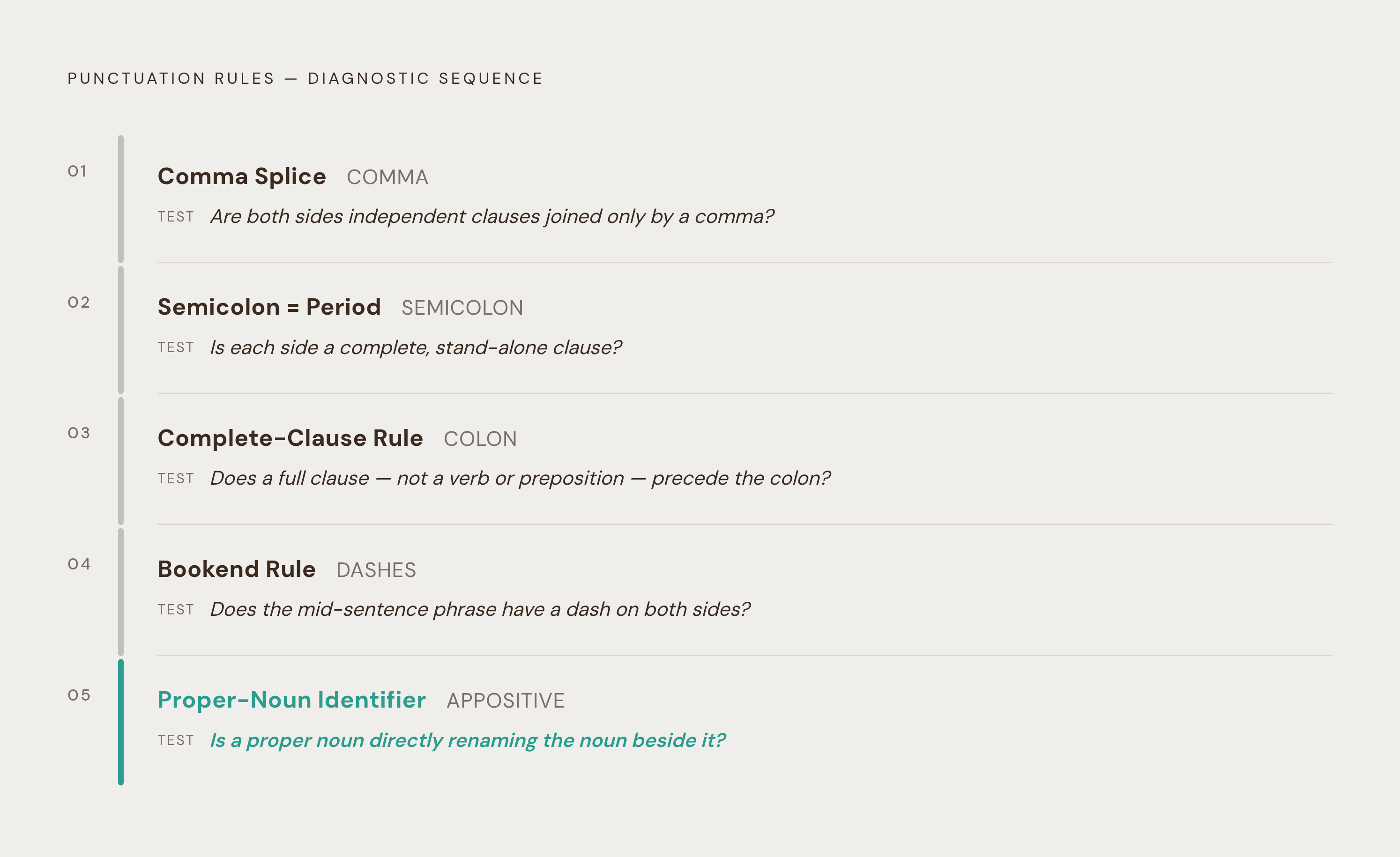
A small number of rule clusters cover the large majority of punctuation questions on this test, and the first is the comma splice. A comma by itself can never join two independent clauses, full stop, and a sentence like "The experiment failed, the team tried again" needs a period, a semicolon, or a comma plus a coordinating conjunction such as "so" to be correct. The second cluster treats the semicolon as functionally equivalent to a period, connecting two independent clauses without a conjunction, where both sides must be able to stand alone as complete sentences. The third cluster governs colons: a colon introduces a list, an explanation, or an example, but only after a complete, independent clause, so a colon can never follow directly after a verb or a preposition. The fourth cluster is what's worth calling the Bookend Rule for dashes. A single dash can introduce an explanation on its own, but when a pair of dashes sets off a non-essential phrase in the middle of a sentence, both dashes have to appear, and swapping a comma in for one side of the pair breaks the rule. The fifth cluster covers proper-noun identifiers: when a proper noun directly renames or identifies the thing right before it, as in "fellow OECD member Chile" or "the novelist Zadie Smith," no punctuation goes between them at all, not a comma, not a colon, not a dash.
The conjunctive adverb trap that mid-to-high scorers keep hitting
Knowing the five clusters above doesn't fully protect a student, because the test is good at disguising which rule actually applies to a given sentence, and the clearest version of that disguise involves conjunctive adverbs. Words like however, therefore, nevertheless, and moreover aren't coordinating conjunctions, even though they often sit in a sentence doing work that looks similar. When one of these words connects two complete sentences, the rule requires a semicolon or period before it and a comma after it. The SAT's own rule table states this directly: conjunctive adverbs need a semicolon or period before them when they're joining clauses, and a comma sitting in that spot instead creates a comma splice. This trips up mid-to-high scorers specifically, because "however" sounds like it's doing the job of "but," and a student relying on ear rather than structure will reach for a comma because the contrast feels conversational. The contrast is a meaning signal, not a structural one, and the test is testing structure. A related trap works the same way with subject-verb separation. An interrupting phrase dropped between a subject and its verb can make a comma feel natural, even though the grammar doesn't allow one there, so "The reason for the delay, was unclear" reads as smoother than it actually is, when the correct version drops the comma entirely: "The reason for the delay was unclear." Both traps work the same way: they take a real rule and hide it behind a sentence that sounds fine out loud.
Reading clause structure rather than sentence surface as the more reliable solving method
The fix is to read for clause structure instead of sentence surface. The more durable method is to look only at what falls on each side of the punctuation mark in question, classify each side as a complete sentence or an incomplete phrase, and apply whichever rule matches that combination. Call it the 5-second solve: check what comes before the mark, check what comes after it, classify the relationship, apply the rule, done, without needing to absorb the full meaning of the sentence first. When a question's answer choices cycle through different punctuation marks, a colon in one option, no punctuation in another, a comma in a third, a dash in a fourth, that pattern is the test's way of flagging a Boundaries question outright. At that point, the content of the sentence barely matters. The structure on either side of the mark decides the correct answer regardless of the topic being discussed. This reframes what a checklist is good for. A checklist applied to the surface of a sentence breaks down the moment an interrupter sits between the subject and the verb, because the interrupting phrase can be mentally deleted, and a student who doesn't delete it first will misjudge whether the subject is singular or plural. The skill is training the eye to isolate clause boundaries before applying any rule at all, a skill that compounds and rewards precision over volume. After practicing a substantial set of punctuation questions using this method, students recognize the four core patterns by their shape, often before they've even finished reading the sentence.
The "Unknown Unknowns" Problem in Punctuation Errors
A student can practice punctuation for weeks and still lose points to the same rule, because the errors involved are frequently invisible to the person making them. A student who misapplies the colon rule usually doesn't know that's what's happening. The question felt fine, the answer felt right, and the miss gets filed away as bad luck rather than a specific, repeatable gap. This is a documented pattern in how people learn in general: learners tend to overestimate how well they understand material, and they struggle to name the exact prerequisite skill they're missing. That's the textbook "unknown unknowns" problem, and it describes precisely the condition under which punctuation errors survive round after round of practice. They don't have the outside view needed to separate "I understand commas" from "I understand four of the five comma rules and consistently miss the fifth." At higher score ranges this becomes the whole story. A student scoring well overall may have a firm grasp of nearly everything on the Conventions list, while still bleeding points to one specific, repeated punctuation pattern, and the fix isn't more review of grammar broadly. The fix is finding that one gap and closing it.
Locating the specific rule that is still breaking down with AI-assisted practice tools
Closing a gap a student can't see requires feedback that goes deeper than a score. The most useful AI-assisted prep tools move past topic-level feedback ("you missed a punctuation question") toward rule-level feedback that names which specific clause-logic rule failed and why. That distinction, adaptive gap detection versus a generic missed-question tally, is what separates a genuinely useful AI tool from a question bank that just hands back a percentage at the end. A tool that only reports a score leaves the diagnosis work to the student, which is the same unsolved problem from the section above. A tool built around AI weakness feedback, by contrast, aims to surface the mistake pattern itself rather than stopping at the answer key, which is the stated approach behind platforms such as The Test Advantage. A student who learns, specifically, that they're misapplying the semicolon rule in conjunctive-adverb sentences can often fix that in a single focused session once the gap is named. A student who doesn't get that information can drill hundreds of practice questions and never close it, because the practice keeps reinforcing the same blind spot instead of correcting it.
Prioritizing which rules to close first based on frequency and fixability
Not every punctuation rule is worth the same amount of study time, so the smartest approach is to sequence by how often a rule shows up and how fast it can be fixed, weighted against how unfamiliar or intimidating it feels. Sentence boundaries and basic comma rules are the fastest win available: Boundaries questions make up roughly 20 percent of the SAT English module, the rules behind them are highly mechanical, and the structural-recognition approach of classifying each side of the mark can be put into practice after a single focused session. From there, conjunctive adverbs and the semicolon-period equivalence deserve the next slot, since they're the specific pattern that trips up mid-to-high scorers, and fixing them is less about learning new logic than about recognizing one repeated surface form once it's been pointed out. Colon and dash rules come next on the list. They show up slightly less often, but each one reduces to a single yes-or-no test, asking whether the left side of a colon is a complete sentence, or whether a dash has its matching bookend, which makes them fast to confirm once a student knows to check. Subject-verb agreement and parallel structure sit after punctuation for most students, since they appear often and reward the same pattern-recognition habit, but they demand spotting a structural disguise (an interrupting phrase, a buried subject) rather than applying one clean punctuation rule. The sequencing principle is simple: find the rule bleeding the most points, isolate it, drill it under timed conditions until it holds, confirm it's actually fixed with real question stems, then move to the next gap. Rotating evenly through every rule without ever confirming a fix is how students end up "reviewing" punctuation for months while their score stays flat.