How to Choose SAT Math Practice Questions That Actually Fix Gaps
Diagnose why you missed each question before choosing what to practice next.

The score plateau that many students hit in SAT Math prep usually gets blamed on not having done enough problems yet, but the real problem is the absence of a diagnostic lens before selecting what to practice. But the shortage isn't material. There's no shortage of SAT Math questions anywhere. The actual gap is a missing diagnostic step before any of that material gets picked up. A wrong answer can come from three completely different places, and each one needs a different fix. Treating them as the same problem spends the finite hours left before test day on the wrong repairs. It's a sequencing problem: diagnosis has to come before question selection, not after. The Digital SAT makes the cost of skipping that step higher than it used to be, because the test itself is adaptive: Module 1 performance decides how hard Module 2 gets. A student grinding through a random question bank is practicing for a difficulty level the actual test may never show them. That adaptive wrinkle matters enough to come back to later. For now, the point is simpler: before picking which questions to practice, figure out why the last batch went wrong.
The three error types that account for every missed SAT Math question
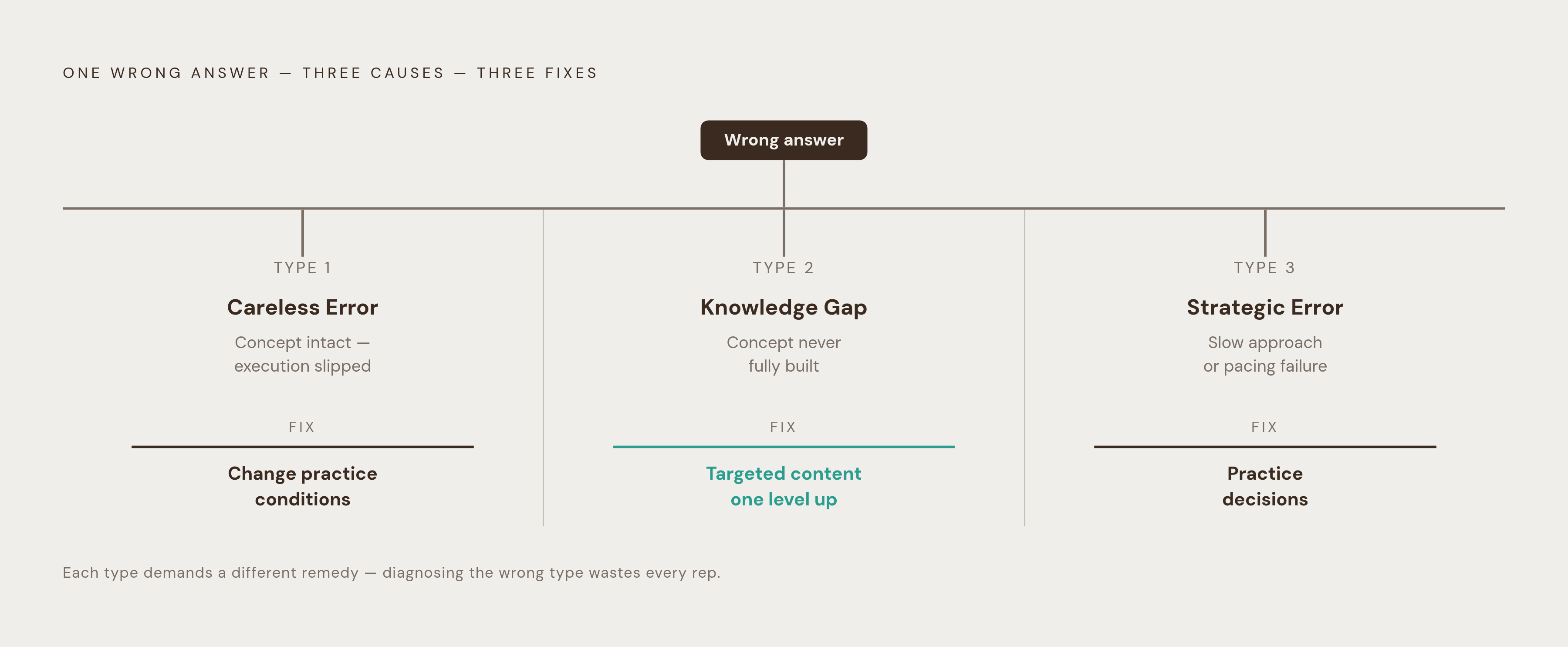
Every missed SAT Math question sorts into one of three categories, and getting the label right is what makes the fix work. The first is a careless error: the student knew the concept, knew the approach, and still landed on the wrong number because of a sign flip, a misread line, or a rushed step. The knowledge is intact. The execution broke down somewhere in the middle of it. The second is a knowledge gap: the concept itself was never fully built, so no amount of careful execution would have reached the right answer. The third is a strategic error: the student picked a slow or clunky approach, mismanaged time, or got the right answer but burned a resource (usually time) that this test doesn't give back.
The real problem: a wrong answer can have three completely different causes, and the fix for each is different; treating all wrong answers as interchangeable wastes the finite hours available before test day. "Oh, I knew that" is a very convincing illusion after the fact. Self-diagnosis done casually, in the student's head, right after checking an answer key, tends to produce the wrong label and therefore the wrong fix. Getting the classification right takes a deliberate review step, which is the subject of the next section.
Running a triage review after a practice session
The review has to happen once the practice session is done, and it has to go deeper than checking which answers matched the key. An error log is the simplest way to do this: question type, the reasoning used to answer it, and the error type, logged side by side right after a practice set. Maintaining that log and reviewing it with real attention is one of the more consistent recommendations behind the 150-point-plus jumps some students manage, and the reason it works is that it forces the classification step instead of letting it get skipped. Could the correct approach be explained right now, without looking at the solution? A no points to a knowledge gap. Was the approach correct but the execution off, so the same method tried again would land somewhere different? A yes there points to a careless error, so it helps to trace the work step by step to find where it broke. Did the right answer get reached, but only after a long detour, or did the clock run out on that question type? That's a strategic error, even though the box got checked correctly.
One signal gets missed constantly: a question answered correctly but slowly still belongs in the strategic bucket. It didn't cost a point, but it cost time, and on a test with 44 Math questions split across two timed modules, time lost on one question raises the odds of a rushed, careless mistake two questions later. Before any of this triage can happen, there needs to be something to triage, so a full-length Digital SAT practice test is the right starting point, used specifically to see which of the four math domains is pulling the score down the most. That gives the error log its first real batch of data before any targeted practice begins. The review itself should take about as long as the practice session did. The learning happens in that slower second pass.
Choosing questions to fix careless errors: what practice looks like at the execution level
Careless errors don't get fixed by doing more of the same type of question. They get fixed by changing the conditions under which the questions get solved. The content stays in the domain where the errors are showing up, but the practice method changes: timed single questions instead of untimed sets, a re-solve under a strict step-check protocol, or writing out every step before touching a calculator. The goal is exposure to the habit that keeps breaking, not more exposure to the concept.
The patterns repeat by domain, which makes them easier to target. In Algebra, the common slips are sign errors across multi-step equations, forgetting to distribute a negative, or solving for x when the question actually asked for some other expression built from x. In Advanced Math, it's expanding quadratics incorrectly, mixing up roots with factors, or misreading a vertex form equation. For a student whose error log shows a pattern of misreading the question itself rather than miscalculating, the fix is a re-read protocol: questions built around two-step scenarios, paired with a forced annotation (writing out, in plain words, what the question is actually asking before solving). That one habit does more for misread-driven errors than another batch of content drill ever will.
At the higher score bands, careless errors stop being a minor nuisance and become the main thing standing between a student and a near-perfect score, quietly costing 30 to 50 points a sitting even when the content knowledge is fully there. The Desmos graphing calculator, built into the testing platform for the entire Math section, is one of the simplest tools against this: using it to verify an answer catches an arithmetic slip without costing meaningful time, for students who've practiced knowing when it's worth pulling up.
Choosing questions to fix knowledge gaps: matching the question to the missing concept, not the missing domain
Knowledge gaps are the most common reason for missed questions below the 700 band, and also the most commonly misdiagnosed, because the natural instinct is to describe the gap at the domain level. "Weak in Advanced Math" sounds like a diagnosis, but it isn't one. "Cannot factor a trinomial with a leading coefficient greater than 1" is a diagnosis, and it's the level of specificity question selection actually needs to work. Algebra and Advanced Math together make up most of the Math section, so a gap in either one drags the score down more than a gap in a smaller domain would, and the test's overall ceiling is set by how solid that core understanding is through Algebra 2 content, something no amount of adaptive routing can substitute for.
Domain names are a starting address. Algebra covers linear equations in one and two variables, systems, inequalities, and interpreting linear functions, and a student can be excellent at systems while consistently missing inequality questions. A domain-level diagnosis ("good at Algebra") would hide that completely. Advanced Math covers equivalent expressions, nonlinear equations including quadratic, exponential, polynomial, rational, and radical forms, plus nonlinear functions, and it carries heavy weight in the harder version of Module 2. Anyone aiming for 700 or above in Math needs real fluency here, which raises the stakes on getting the concept-level diagnosis right rather than settling for the domain-level one.
One of the more counterintuitive findings in gap diagnosis is that the gap isn't always where it looks like it is. A student who fails a quadratic question might be missing something other than the quadratic formula. The real hole might be a factoring prerequisite several steps back. This is the logic behind adaptive systems that track more than right-and-wrong, following where a student pauses, which mistakes keep coming back, and which earlier skill might be the one actually holding everything up. A surface-level review of wrong answers misses that kind of pattern entirely. Research frameworks built around this idea, such as the ALIGNAgent model, formalize the process into integrated knowledge estimation, skill-gap identification, and targeted resource recommendation in a single adaptive cycle, the key insight being that disconnected tools (a quiz here, a video there) tend to fail because nothing links the diagnosis to the next concrete step.
Skill decay deserves more attention than it usually gets. A concept that looked solid two weeks ago can have quietly eroded, especially if it was only ever practiced on its own instead of mixed in with related skills. Spacing out review across related concepts, rather than drilling one topic in isolation and moving on, is the direct answer to that kind of decay. Since nearly every SAT Math question is wrapped inside a word problem, a student can look like they have a math gap when the real barrier is reading the problem itself. Research presented at EDM 2025 found that emerging readers showed meaningfully different mastery outcomes on BKT-based adaptive math platforms compared to stronger readers, pointing to a fairness issue in how those models estimate mastery. Reading fluency, in other words, can quietly shape what looks like a math score, and most diagnostic tools never account for it. Once the gap is pinned to a specific concept rather than a general domain, the actual question selection follows a simple rule: pick problems one difficulty step above where the student currently sits on that exact concept, not on the domain as a whole.
Choosing questions to fix strategic errors: when the problem is timing and approach, not content
Strategic errors are the easiest category to miss, because nothing about them looks like a content failure. Fixing this means practicing decisions, not content, so question selection has to create moments where a choice of approach actually matters instead of handing over a problem with one obvious method.
The clearest example of a strategic error, and the most expensive one, is Module 1 pacing. A student who rushes through Module 1 to bank time for later, then misses several questions to careless arithmetic along the way, gets routed into an easier Module 2, where the score ceiling sits well below what that student is actually capable of, no matter how clean the performance is in that easier module. The fix for this is a simulated, timed run of Module 1 with accuracy set as the explicit goal, tracking which questions ran past two minutes and what approach was used on each one, then reviewing the approach chosen rather than just the final answer.
Some SAT Math questions can be solved more than one way: straight algebra, back-solving from the answer choices, plugging in numbers, or graphing it out in Desmos. Practicing with these multi-method questions, and deliberately pausing to pick the fastest route before solving, builds exactly the kind of decision-making that pacing depends on. And the strategic category includes questions that were answered correctly, since a right answer reached too slowly still eats time that adds pressure on the questions that follow. A student who spends three minutes on a medium Algebra question and then rushes two Advanced Math questions afterward made a strategic error on that first question, a perfect answer notwithstanding. Collecting the easy points early and eliminating clearly wrong choices fast are concrete, practicable skills, and like the other two error types, they only improve with practice aimed directly at the habit that needs fixing.
Sources
- 25 of the Hardest SAT Math Problems in 2026-2027 - PrepMaven
- Free SAT Math Practice Test 2026 | Digital SAT Prep
- Free SAT Practice Test 2026 | Digital SAT Prep
- SAT Question Bank — Practice Questions 2026 | MyCollegeBook
- How to Prep for SAT Math and Hit Your Target Score (2026 Game Plan)
- SAT Question Bank: 196 New Math Questions (August 2026), All Solved
- SAT Prep 2026 | Smartschool - App Store - Apple
- 2026 August SAT Breakdown: Key Trends, Hard Module Shifts, and Desmos Strategies for Fall | AlphaTest Blog