How to Build an AP Bio Study Plan Around Your Actual Gaps
Targeted prep on weak spots beats broad review for reaching a top score.

This article is about building an AP Biology study plan around a student's actual gaps, not around the full syllabus, because the 2026 scoring data shows that broad coverage no longer gets a student to the top of the scale. The overall pass rate held roughly steady, but the share of students earning a 5 dropped back to 15% in 2026, breaking a climb that had run from 2023 through 2025. Roughly two-thirds of test-takers pass the exam, yet only a little over half of those passers land a 4 or 5. Passing and excelling are two different goals that call for two different plans. Reaching a 5 takes strength in both the multiple-choice and free-response sections at once, so a student cannot cover for a weak FRQ performance with strong MCQ scores or the other way around. For students aiming at the 2027 exam, the lesson from 2026 is that the top band does not get easier to reach just because more time passes. Three years of rising 5-rates reversed in a single cycle, and that reversal is the clearest recent evidence that sustaining a 5 is genuinely hard, not a matter of luck or an easy year. The reason so many students stall out below that level traces back to how they spend their study time in the months before May.
Why Broad Coverage Produces a 3
A student who treats AP Biology as eight units to be covered equally is set up to land on a 3. The course spans eight units and a heavy load of terminology that has to be applied to experimental situations the student has never seen before, not just recalled on command, and a plan that spreads attention evenly across all of it ends up shortchanging the areas that actually decide the score. The free-response section makes this worse, because it tests skills that content review by itself does not build: answering the exact task verb a question asks for, choosing precise vocabulary, and showing the steps on a quantitative problem. One writes "describe" when the prompt says "justify," names a process loosely instead of pinning down the exact molecular term, and skips the math setup on a Hardy-Weinberg question because the final number eluded them. The other does all three of those things correctly. The content knowledge might be identical, but the score will not be: a 4 and a 5 usually diverge on FRQ execution rather than on what the student actually knows.
A skeptical student might argue that the answer is still more content review, more flashcards, more rereading of the textbook, but most students who land a 4 already know the material, and their gap sits in how they deploy that knowledge under timed conditions and against a rubric that rewards specific moves. That reframes the whole planning problem. If the gap is not "what do I know" but "where exactly do I lose points," then the next question is where those losses concentrate across the course.
Where the Highest-Weight Units Are
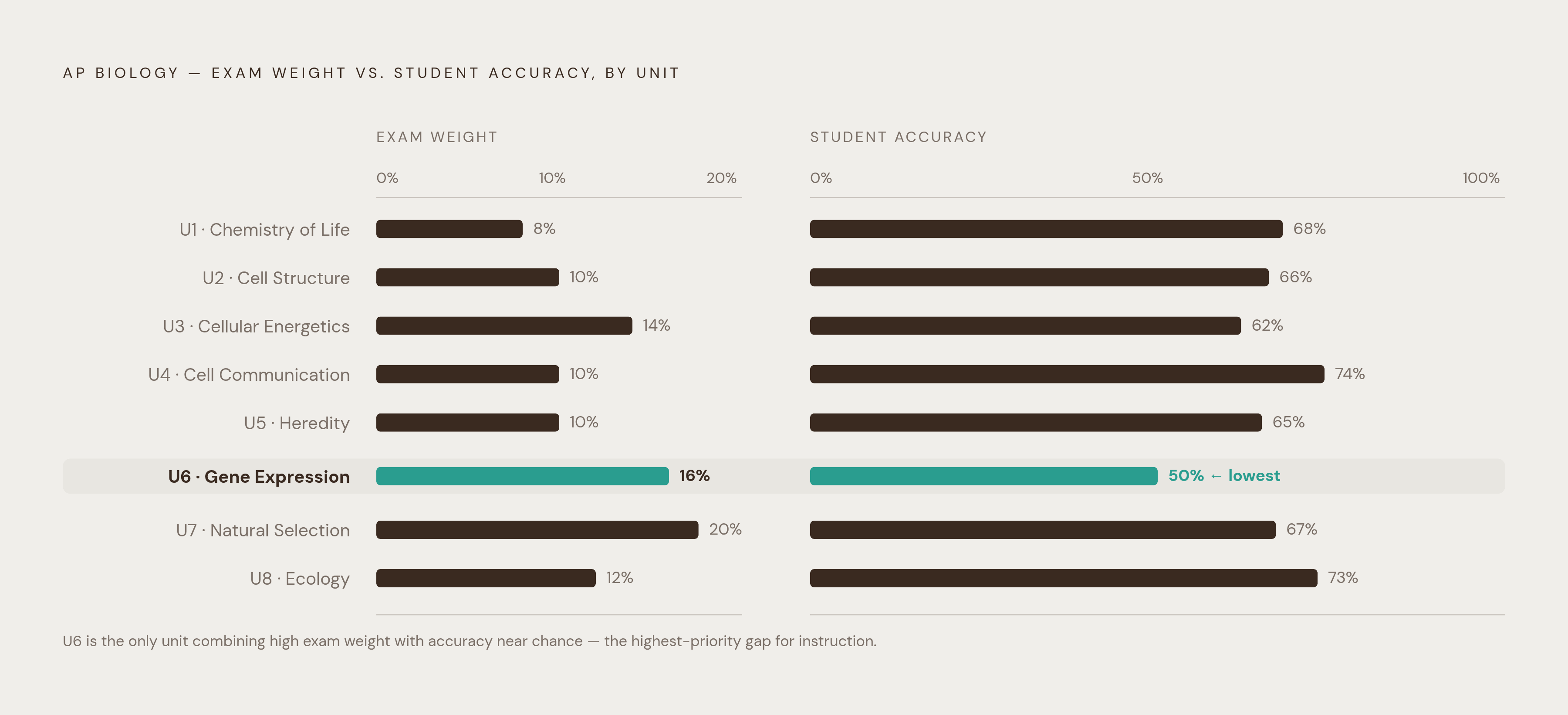
AP Biology's eight units do not carry equal weight on exam day, and the units that give students the most trouble are not always the ones that feel hardest going in. Unit 7, Natural Selection and Evolution, carries more weight than any other unit, potentially making up close to a fifth of the multiple-choice score, and students are most likely to underinvest in it because the broad idea of natural selection already feels familiar from years of general science classes. Familiarity is deceptive here. The exam does not just ask whether a student understands evolution conceptually. It asks students to run Hardy-Weinberg equilibrium calculations with precision and to read cladograms analytically, both of which demand a different kind of reasoning than simply knowing that organisms adapt over time.
Units 3 (Cellular Energetics) and 6 (Gene Expression and Regulation) are the next highest-weighted units, each accounting for a significant share of the MCQ. Unit 6 stands out for a second reason: it is the unit where students have performed worst on multiple choice, answering only about half those questions correctly on average, the weakest showing of any unit on the exam. That weak performance lines up with how much the unit demands. Unit 6 packs in DNA replication, transcription, translation, the lac and trp operons, epigenetics, mutations, and lab techniques like gel electrophoresis and PCR, and the exam expects students to apply all of it rather than simply name it. By contrast, Unit 8 (Ecology) and Unit 4 (Cell Communication) were the strongest performers, with a large share of students answering most or all questions correctly, which makes those units relatively lower priority for a gap-targeted plan. Unit 5 (Heredity) hides a trap of its own: students generally handle basic Punnett squares fine but lose points on incomplete dominance, codominance, epistasis, and polygenic inheritance, precisely because the exam leans on those harder, non-Mendelian cases rather than the basics. And on the free-response side, the numbers are weaker across the board. Short-answer FRQs (Questions 3–6) had mean scores between 1.70 and 2.00 on the 2025 exam, and most students are not earning full credit even on these shorter, more structured questions, where rubric precision is most achievable. Knowing where the weight sits and where scores break down is only half the picture, though. Finding out which of these gaps actually belong to a given student is just as important.
Running a Real Diagnostic Before Building a Study Timeline
Most of what passes for a diagnostic only measures content recall, and that leaves out a piece of the exam that counts for a lot. Argumentation alone makes up 20 to 26% of exam weight under the AP Biology science practice breakdown, and no topic-recall quiz or progress-check score can tell a student whether that skill is solid. A diagnostic that only checks whether a student remembers facts is going to miss the kind of gap that actually separates a 4 from a 5.
A diagnostic worth building a plan around works on two layers. The first layer is content: a full-length or section-based practice exam, taken under real timed conditions and scored unit by unit, to show which content areas fall short of where the student needs to be. The second layer is skill: at least two FRQs, graded against the actual AP rubric, to reveal whether the problem is content knowledge, task-verb execution, vocabulary precision, or quantitative reasoning, since each of those calls for a different kind of practice afterward. Running both layers before opening a review book keeps the plan targeted on real gaps; a plan built before diagnosis tends to default back to broad, even coverage, and the chance to target the real gaps is gone before studying even starts. The diagnostic has to come first, as the thing that actually decides what the plan looks like.
How to sequence study sessions once the diagnostic reveals where the gaps are
Once a student has a ranked list of weak spots from the diagnostic, the sequencing logic is straightforward: tackle the units with the highest exam weight and the lowest current performance first, but check for prerequisite gaps before jumping straight into them. A plan that charges at the weakest late-course units without checking what they depend on can end up making things worse instead of better. Gene Expression and Regulation (Unit 6), for example, depends on Cell Structure (Unit 1) and Cellular Energetics (Unit 3) being solid, so a student who treats Unit 6 as the priority purely because it scored lowest may be chasing the wrong fix, when the real problem traces back to one of those earlier units. The better move is to check Unit 3 first, since Units 3 and 6 are both high-weight units where a gap in one can mask or compound difficulty in the other.
Spaced retrieval is what turns an identified gap into something the student actually remembers on exam day, and it only works with real scheduling rather than casual rereading. Coming back to a weak unit after three or four days, long enough that the student has to pull the information from memory instead of just recognizing it on the page, builds real retention; reviewing the same material again the same day mostly just feels like progress without producing it. A 2025 peer-reviewed study in Frontiers in Medicine, led by Tembhurne and Vagha at Jawaharlal Nehru Medical College, found that more than 90% of students using spaced intervals reported better retention, engagement, and confidence, suggesting the mechanism holds up well beyond any one subject.
A weekly structure that applies that spacing logic might run like this: spend the first day attacking the target unit's highest-weight topics actively, through practice problems rather than rereading, then going back over what went wrong. The next two days shift to a secondary unit or to science-practice skills like data analysis and argumentation. The fourth day returns to the target unit's weak spots, but through recall rather than rereading. The fifth day closes with FRQ practice on that same unit, scored against the rubric. Every student's gap profile looks different, so the unit in the "target" slot should move as the diagnostic results change. As a unit stabilizes, it shifts into a maintenance rotation rather than disappearing from the schedule entirely, since the exam tests connections across units and not units in isolation.
FRQ Practice as the Highest-Leverage Activity in the Gap-Closing Phase
Of everything a student can do in the weeks before May, FRQ practice does the most for the time it costs, because a single FRQ response tests content knowledge, task-verb execution, vocabulary precision, and quantitative reasoning all at once, in the same rubric-scored format the real exam uses. Three specific execution errors tend to separate a 4 from a 5, and FRQ practice is where all three appear. The first is a task-verb mismatch: writing an explanation when the prompt asks the student to "justify," or describing something when the prompt asks the student to "identify," a habit that a simple fix like underlining the task verb before writing can catch. The second is vocabulary imprecision: a 5-level answer names the exact structure or process, something like "the phospholipid bilayer becomes more fluid," while a 4-level answer settles for a paraphrase like "the membrane changes". The third is skipping the quantitative work: on a Hardy-Weinberg or chi-square problem, showing the setup and substitution earns partial credit even with a wrong final answer, while skipping that work earns nothing at all on a question the student partially understood.
Attempting an FRQ and then checking the response against the official rubric, point by point, is the only way to diagnose these errors. That is exactly where most students get stuck. Grading a written FRQ against a rubric with any precision takes real time, and that time cost is a big part of why students end up doing far more multiple-choice practice than FRQ practice in their prep, even though FRQ performance is the most reliable thing separating a 3 from a 4 or 5. A student can write a strong-looking paragraph and still have no idea whether it would earn full credit, partial credit, or nothing, because the feedback that would answer that question usually is not available fast enough to make rewriting and retrying practical.
How AI-Graded FRQ Feedback Closes the Feedback Loop
That lag in getting feedback is the real bottleneck, and it is one a diagnostic, a spaced schedule, and a well-sequenced plan cannot solve on their own. Rubric-based AI feedback changes the math here. Tools now available in 2026 can score a student's FRQ response against the official AP rubric criteria and report back exactly which points were earned and which were missed, cutting the wait from days down to seconds and making it realistic for a student to run through FRQs at high volume instead of rationing them. That speed is what makes the Day 5 FRQ session in the weekly structure above actually work as intended: a student writes the response, gets rubric-level feedback almost immediately, and can see precisely which of the three execution errors (task-verb mismatch, vocabulary imprecision, or skipped quantitative work) cost them points, rather than guessing.
Magna Education has built its AP Biology platform directly around this idea. Students write a real FRQ, get rubric-aligned feedback back within seconds, and then drill the specific topics they missed using a bank of more than 1,800 questions covering every topic in the course. The gap-first plan outlined here only works if a student can find out, quickly and specifically, whether a given FRQ response actually earned the points it was supposed to. Fast, rubric-accurate feedback is what makes that possible at the volume gap-closing requires.