AP Biology Practice Problems and Concept Mastery
Well-prepared students need to diagnose specific reasoning gaps, not just drill more content.

Most students preparing for AP Biology are still studying for an exam that no longer exists in quite the same form.
Start with the basic shape. The exam splits into two sections worth 50% each. Section I is 60 multiple-choice questions in 90 minutes, answered digitally. Section II is 6 free-response questions in 90 minutes, written by hand. Those 6 FRQs break into two long questions, each asking for data analysis, experimental design, and a written explanation of the biology behind it, plus four shorter questions that each test one specific concept. Digital fluency and handwritten FRQ speed don't train each other. They need separate practice.
The content itself moved around too. Unit 1 now presents macromolecules in a more logical sequence than it used to, and photosynthesis and cellular respiration got reorganized across Units 2 and 3. That sounds small, but it means an older prep book, one built on the previous unit order, will walk a student through material in the wrong sequence, which creates confusion that has nothing to do with the biology itself.
None of this is good or bad on its own. It's just the terrain. But that terrain comes with weight attached, and some units count for a lot more than others when the scores get tallied up.
Where the exam gives and costs points, unit weights and FRQ scoring patterns
Not every unit carries the same weight, and the heaviest-weighted material tends to be exactly the kind that punishes memorization and rewards understanding of mechanism. Unit 7, Natural Selection, carries the largest published range for its share of multiple-choice points, which makes it a high-variance unit: strong prep there can swing a score meaningfully, and weak prep does the same in reverse.
The free-response questions from 2026 show how specific the exam has gotten. One question centered on dinucleoside polyphosphates and how they signal stomatal closure in plants. Another asked students to work through siRNA, AGO2 genotypes, and graph mRNA data. A third built an entire question around cyanide poisoning, cytochrome c oxidase, and cellular respiration. The 2026 FRQs illustrate the specificity the exam now demands:
Where did students lose points in 2026? The pattern is consistent across the released scoring data. Students misidentified variables, gave weak explanations for why a control group mattered, and wrote unsupported conclusions on Q5, the question asking them to analyze a model of natural selection using anole toe pads. On Q6, which asked students to analyze data about raptor population decline in protected versus unprotected areas, the recurring problem was weak data interpretation.
Length didn't help. A tight, precisely worded two-sentence answer scored higher than a paragraph full of vague biology terms, because the rubrics now spell out specific elements graders look for. Padding an answer with biology vocabulary that doesn't directly answer the question gets penalized rather than rewarded. That single fact says a lot about what the exam is actually testing: not whether a student knows a lot of words, but whether they can say the right, specific thing.
Why the 5-Rate Fell in 2026 as the Overall Pass Rate Held Steady
The 2026 results make the case concrete.
The 5-rate had climbed for several years running, but in 2026 it dropped back from 18.9% to roughly the mid-teens. At the same time, the overall pass rate held steady.
The students who felt this hardest were the ones sitting just below the 5 cutoff, students who knew the material cold but had never practiced the specific reasoning steps an FRQ response needs, and lost the points there instead. A strong composite score is still the typical bar for a 5, and the multiple-choice section still supplies a large share of that composite. But FRQ execution stopped being optional for anyone aiming at the top of the scale. Meanwhile, the number of students taking AP Biology keeps growing, so more students are chasing a score band the exam is simultaneously making harder to reach.
The scoring shift matters less as a statistic and more as proof of a mismatch: a lot of well-prepared students are studying the wrong thing for the exam they're actually sitting down to take.
Three distinct failure modes that keep prepared students out of the 5 band
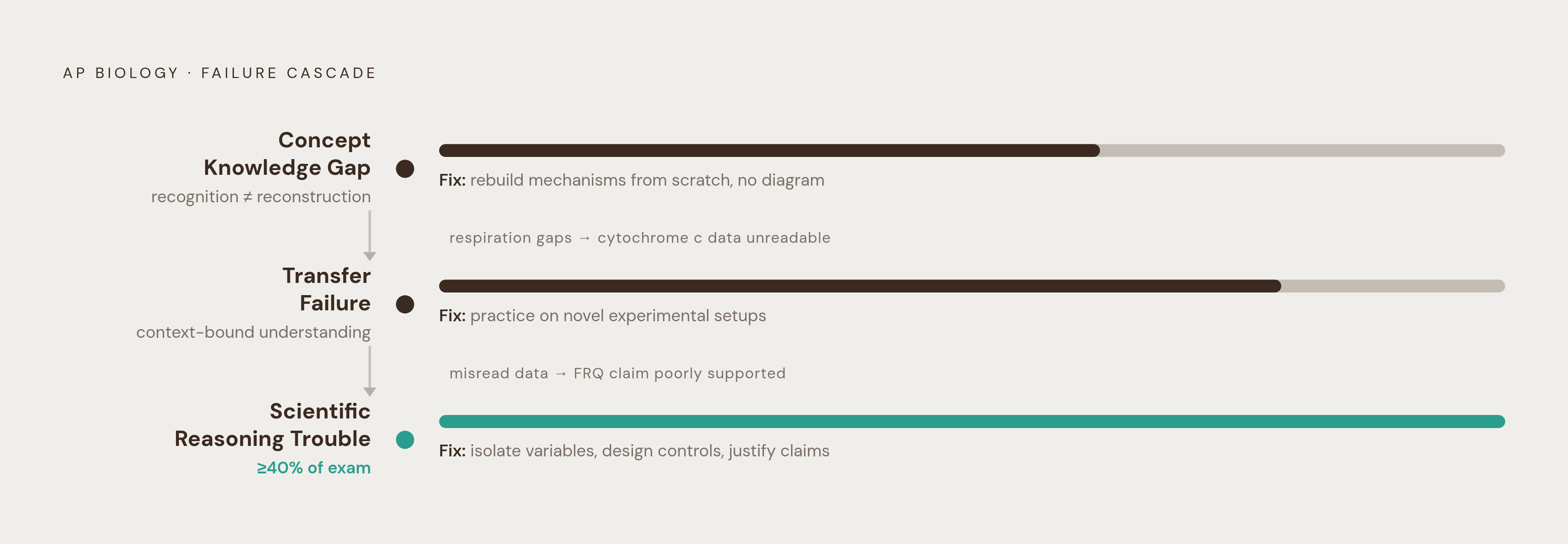
If the scores show a ceiling, the next question is what, specifically, is stopping individual students from getting through it. Students who cover all the content and still land below a 5 tend to fail in one of three distinct ways, and each one needs a different fix.
The first is a straightforward concept knowledge gap: an incomplete or shaky grip on cellular respiration, gene regulation, signal transduction, or natural selection. A student with this gap can often recognize a diagram if it looks the way it looked in class, but can't rebuild the mechanism from scratch when the diagram looks even slightly different. The second is transfer failure: the student understands a process fine in the context they learned it in, but can't make the connection when the same mechanism appears in an unfamiliar experimental setup. Given that the 2026 FRQs are built almost entirely around unfamiliar experiments layered onto familiar biology, this failure mode alone explains a lot of lost points. The third is trouble with scientific reasoning itself: not being able to pick out the independent and dependent variables, not knowing what a reasonable control looks like, not being able to read a trend in data or judge whether the data actually backs up a claim. Since at least 40% of the exam now involves some form of data analysis, this failure mode touches a huge share of the test.
These failure modes compound: a gap in cellular respiration mechanics makes it impossible to interpret a cytochrome c oxidase experiment correctly, which then produces a poorly justified FRQ response. One weakness drags the other two down with it.
The cascading doesn't stop there either. Biology builds on itself across the whole course, so a small, early misunderstanding, something as narrow as confusing how alleles work or how transcription happens, can quietly grow into a much bigger problem once later units depend on getting that first idea right. A student who never clears up the small thing in Unit 2 may not notice the cost until Unit 7, when the bill comes due all at once.
Volume isn't the fix. Identifying the specific gap is step one, and it has to happen before more practice does any good.
Why unit-by-unit drilling misses what the exam is testing
The default way most students study AP Biology is to work through one unit at a time, finish it, and move to the next. That approach is the one least equipped to handle an exam built to reward connecting ideas across units.
Consider what a single FRQ can actually demand: cellular energetics from Unit 3, gene regulation reasoning from Unit 6, and a prediction about evolutionary consequences from Unit 7, all inside one question. A student who studied each of those units in isolation has never once practiced putting them together, because nothing in a unit-by-unit study plan asks them to.
Unit-by-unit drilling is good at building recognition, the ability to answer a question correctly once you already know which unit it's testing. The exam doesn't hand students that hint. It strips the unit label off entirely and presents a scenario the student has to figure out on their own, deciding which biological principle actually applies before they can even start answering.
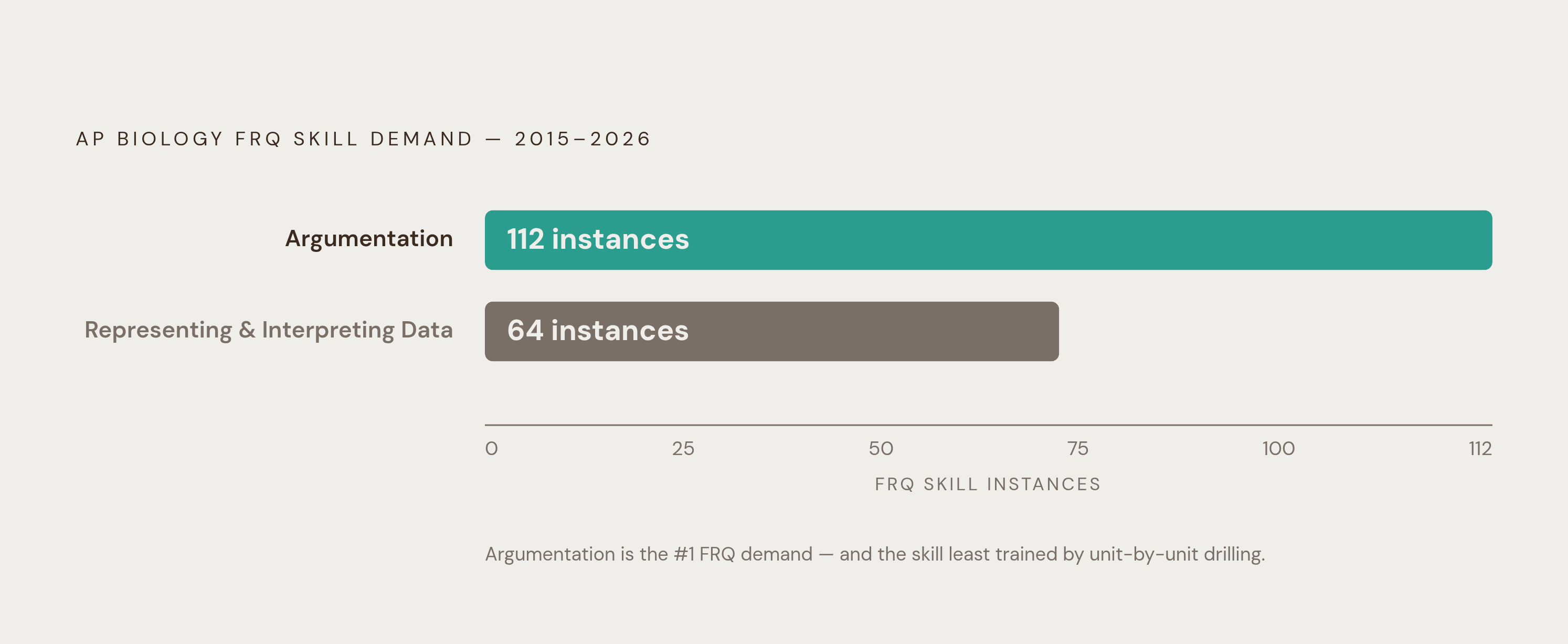
The FRQ record backs this up directly. Argumentation, making a claim, backing it with evidence, reasoning from biological theory, and predicting what happens when a system gets disrupted, is the single most common skill category tested across the FRQ archive, with 112 recorded instances, well ahead of every other category. Representing and interpreting data comes in second. Based on the 2026 exam description, data analysis makes up 16 to 28% of the entire multiple-choice section, split roughly evenly between reading and describing data and running statistical tests on it. Reviewing content unit by unit does nothing to build that skill, because the skill lies in handling information you haven't seen laid out in a tidy, labeled way, not in the content itself.
That's why so many students finish a full round of unit review feeling genuinely confident, then sit down for a full-length practice test and struggle anyway. They've built recognition, not reasoning, and the exam tests reasoning. What they need instead is practice that forces unit connections, written justification on every single FRQ attempt, and real exposure to data scenarios they haven't seen before, not another pass through material they already recognize.
Structure of Effective AP Biology Practice: FRQ Writing, Data Work, and Gap-Targeted Review
Good preparation goes straight at the three failure modes described earlier. It builds the habit of connecting ideas across units, it trains written justification as its own skill, and it leans on data-heavy practice to build scientific reasoning. On FRQ writing:
Every answer should come with a 2 to 3 sentence written justification, because the rubric rewards concise and targeted biological reasoning over volume. Practice material should come from the 2024 and 2025 released FRQs specifically. Use only 2024 and 2025 released FRQ materials for practice, which have different rubric expectations and will train the right scoring instincts. After writing any response, the next step matters as much as the writing itself: check it against the actual published scoring guidelines and find exactly which rubric points got missed, rather than just marking the answer right or wrong. It also helps to get comfortable with the differences between task verbs like describe, explain, predict, and justify, since each one calls for a different kind of answer, and FRQ resources organized by question type make that distinction easier to practice directly.
On data interpretation, the habits are just as specific. The first move on any data question should be picking out the independent and dependent variables immediately, since that's the first point available on experimental design questions and also the one most often missed. Reading error bars and judging statistical significance has to happen before drawing any conclusion from a graph. Overlapping error bars mean the data doesn't support a strong claim, a check plenty of students skip. On graphing questions specifically, the 2026 record shows that labeled axes, correct units, and error bars (when standard error of the mean is given) are required elements. Those are mechanical points, lost for reasons that have nothing to do with understanding the biology, which makes them some of the easiest points to recover with practice.
Cross-unit integration needs direct practice too, not something that happens by accident. Once individual units are covered, the next step is working through problems that explicitly force two or three units together: a signal transduction question that also asks for an evolutionary prediction, or a cellular respiration question that connects to gene regulation under low-oxygen conditions. The FRQ archive covering 2015 through 2026, organized by question type rather than by year, gives the most realistic version of this kind of practice, since working through it by type exposes the patterns the exam keeps repeating.
Finding the gaps in the first place is what makes the rest of this work. A full-length diagnostic practice test, with errors logged by unit and by failure mode (not just marked right or wrong, but tagged as a knowledge gap, a transfer failure, or a reasoning error) gives a student an actual map of where the problems are. Review time should then follow both the weight of the unit and the type of failure found there, since a transfer failure in Unit 3 needs a different fix than a knowledge gap in Unit 5. Going back over problems already gotten wrong, with that diagnosis in hand, closes more gaps than grinding through a pile of brand-new questions ever will.
What Automated Tools Can and Cannot Do for AP Biology Gap Detection
AI tools have become a real piece of how students prepare for AP Biology, but what they reliably deliver is narrower than the marketing around them suggests. Knowing exactly where that boundary sits is what makes them worth using at all. What AI grading does well:
Where these tools do well is grading structured responses against a rubric, fast. CoGrader, for instance, explicitly handles science claim-evidence-reasoning responses and has had its scoring checked against AP and IB exam scorers for accuracy. A systematic review from January 2026 found that ensemble AI marking methods, systems that combine multiple models rather than relying on one, report accuracy between 87% and 98%. That range covers exactly the kind of FRQ response AP Biology relies on most. The practical upside is speed: a tool that grades a structured FRQ response in seconds instead of days lets a student write, get feedback, fix the specific rubric point they missed, and write another response in the same study session, rather than waiting for a single round of feedback a week later.
What these tools don't replace is the diagnostic work described earlier, deciding whether a missed point traces back to a knowledge gap, a transfer failure, or a reasoning weakness, and then deciding how to spend the next hour of study time based on that answer. Grading tells a student which rubric point they missed. It doesn't tell them why, in the deeper sense of which of the three failure modes is actually driving the mistake, and it doesn't build the cross-unit connections or the diagnostic test results needed to plan the following week of review. The fast, specific feedback these tools offer is genuinely useful. Identifying which failure mode keeps recurring in a student's own answers, and pairing that read with the speed these tools offer, is still work the student has to do.
Sources
- legacyonlineschool.com
- calculateconfidence.com
- 2025-2026 Exam Review - AP Biology Penguins
- AP Biology 2026 Changes: Updated Exam Format, New Emphasis Areas & What to Expect
- How to Study for AP Biology and Score a 5: Your 2026 Game Plan
- Every AP Biology FRQ Sorted by Topic • Nerd Notes
- Bridging the Implementation Gap in AI-Powered Personalized Education: A Systematic Review of Learning Style Prediction and Recommendation Systems