AP US History Free Response Question Preparation
Essays win or lose on what students actually know about how to argue with evidence.
The free response section carries 60% of the composite score, so the essays, not the multiple choice, decide whether a student passes. All three formats, SAQ, DBQ, and LEQ, test the same six historical thinking skills: sourcing and situation, contextualization, and argumentation among them. That single fact should change how a student studies. The section is built to check how someone thinks through evidence, not whether they memorized the right dates.
The DBQ carries more points than any other single question on the exam, so a student who walks in with facts but no rubric instincts is leaving the biggest scoring opportunity on the table. Add in that the exam now runs entirely in Bluebook, with multiple choice and free response both completed on screen, and a gap opens up between how a lot of students still practice (handwriting essays on paper, timing themselves loosely) and what exam day actually asks them to do. Content knowledge still matters. But it's the floor, not the ceiling. The rest of this piece walks through what each format demands and how to build the specific skills the rubric rewards.
What the three FRQ formats ask students to do
Treating the SAQ, DBQ, and LEQ as the same task with different word counts is a mistake. Each one has its own format, time limit, source requirement, and point structure, and each demands a different approach.
Start with the Short Answer Questions, Section I Part B. Three questions, each split into three labeled parts, a, b, and c, worth 3 points each for 9 points total. Questions 1 and 2 are required and come with a stimulus: Question 1 hands students a secondary source, meaning a historian's argument, and Question 2 a primary source, both pulled from 1754 to 1980. Then students pick between Question 3, no stimulus, covering 1491 to 1877, or Question 4, no stimulus, covering 1865 to 2001. Each part asks for a description, explanation, or evaluation of a historical development backed by specific evidence, and each part is scored independently with no partial credit inside it.
The Document Based Question, Section II Part A, consists of one question based on seven primary and secondary source documents, scored on a 7-point rubric, with 60 minutes total including a built-in 15-minute reading and planning period. The topic runs from 1754 to 1980. Points break down as Thesis or Claim worth 1, Contextualization worth 1, Evidence from documents plus outside knowledge worth 3, and Analysis covering sourcing and complexity worth 2. Starting in 2026-27, the DBQ widens its chronological range, letting students pull evidence from across the whole course instead of a narrow slice of it, which raises how complex the evidence demands get.
The Long Essay Question, Section II Part B, drops the documents altogether. Students choose one of three prompts, scored on a 6-point rubric, with time periods split into 1491 to 1800, 1800 to 1898, or 1890 to 2001. It follows the same thesis-driven structure as the DBQ, but every bit of evidence has to come from what the student already knows.
The SAQ rewards fast, precise recall. The DBQ rewards document analysis layered on top of outside knowledge. The LEQ rewards a student's ability to build and sustain an argument with nothing to lean on but their own preparation. Each one needs its own practice habit, and the next several sections build those one at a time.
Building a defensible thesis for any APUSH FRQ
The thesis point appears on both the DBQ and the LEQ, and it unlocks almost everything else in the response. Get it wrong and the rest of the essay has nowhere to stand.
The rubric only awards that 1 thesis point when the response makes a claim that goes beyond restating the prompt and actually sets up an argument. According to the APUSH Score Calculator's 2025 scoring data, 79% of students earned this point on the DBQ. That leaves roughly one in five students who missed the most basic scoring criterion on the exam, regardless of how much history they actually knew. A strong thesis for the DBQ or LEQ names the specific factor or factors the essay plans to argue, and it signals what kind of evidence is coming, whether that's cause, effect, or continuity and change. A thesis that just restates the time period or names an event without taking a position does not meet that bar.
The SAQ works differently, and this trips students up constantly. There is no thesis point on the SAQ rubric at all. The task there is to answer each part with specific evidence, so any time spent building a formal thesis for an SAQ response is time taken away from the only thing that actually earns points.
Chief Reader Reports document a specific, recurring failure: students write a solid thesis in the introduction, then drift away from it in the body paragraphs. They keep the thesis point but lose evidence and analysis points because the essay never follows through on what it promised. The fix is mechanical: write the thesis first, then go back and check it against the prompt. Does it take an actual position? Does it predict the shape of the argument that follows? Revise it before writing a single body paragraph, because a thesis built after the fact rarely matches the essay it's supposed to be steering.
What contextualization requires
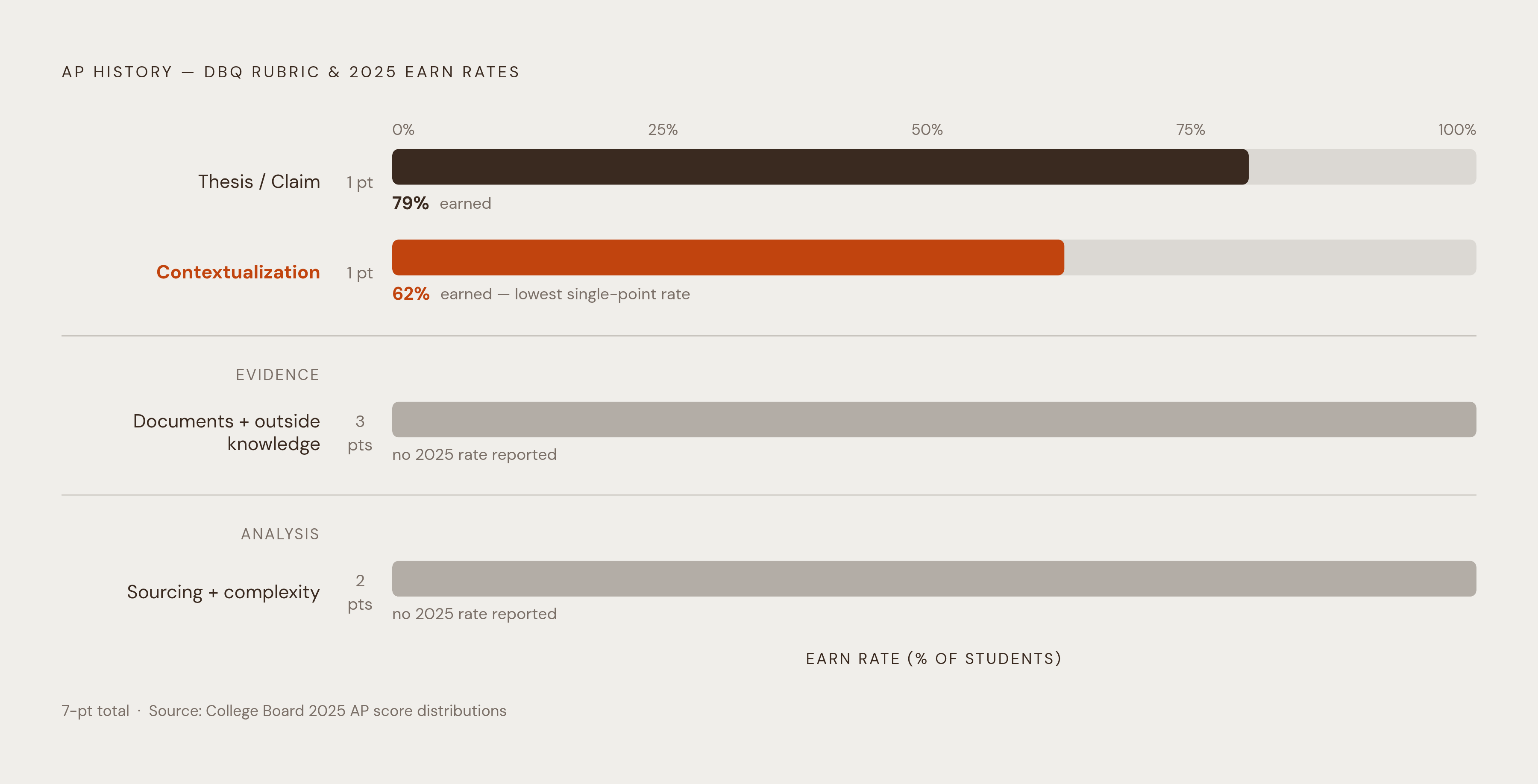
Contextualization gets treated like a warm-up paragraph by a lot of students, and that's exactly the problem. The rubric requires something more specific: accurately describing a broader historical context and explaining how that context connects to the argument. The APUSH Score Calculator's 2025 data found only 62% of students earned the DBQ Contextualization point, confirming how often it gets missed when it's treated as throat-clearing instead of analysis.
The actual requirement is to describe a historical development or process that sits outside the prompt's immediate subject, then explain how it relates to the argument. Mentioning it in passing doesn't satisfy that. A response has to connect it.
A predictable error occurs when a response opens with a sweeping statement about "throughout American history," or lists events strung together with no link back to the thesis. Neither one meets the criterion, no matter how accurate the facts in it are. A typical student error is opening with a general statement about "throughout American history" or listing events without connecting them to the thesis, which does not meet the criterion.
The 2026-27 DBQ scope change makes this skill more important, not less. With a wider chronological range in play, students need to draw connections across a larger span of the course rather than relying on a narrow window they've rehearsed. One practice habit works well here: after drafting a contextualization paragraph, ask directly whether it explains why the events in the prompt happened, or whether it only describes what came before them. If it only describes, it needs a "because" connection added before it counts.
How the DBQ's sourcing point works
Sourcing is the most technically demanding point on the DBQ, and it's also the one students drop most often without realizing it. The rubric wants an explanation of how a document's point of view, purpose, historical situation, or audience connects to the argument. Summarizing the document or quoting from it doesn't do that job.
Earning full sourcing credit requires this kind of explanation for at least two documents. A response can cite all seven documents, quote from every one of them, and still earn zero sourcing points if it never explains why the source of any single one matters.
Four lenses do this work, known by the shorthand HAPP: Historical situation, Audience, Purpose, Point of view. Each one opens a different line of reasoning about why a document says what it says, and students need practice with all four rather than defaulting to the same lens every time.
The 15-minute reading period that opens the DBQ isn't downtime before the real task starts: it is the task, and reading time should be used to annotate documents for sourcing opportunities, not just to absorb content.
The common failure here is subtle: a student notes the author's name or the document's date, treats that as sourcing, and moves on. Noting who wrote something and when is description. Explaining how that author's position or that historical moment shapes what the document argues is sourcing. One way to build the habit is to fill in a sentence frame for every document in a practice DBQ: "Because [author/purpose/audience/historical situation], this document claims X rather than Y, which supports or complicates the thesis by showing Z." Released DBQs give the clearest picture of what this looks like across different prompts and periods, and practicing with them beats reconstructing examples from memory.
Starting in 2026-27, documents may come from a wider range of periods, so students need to be ready to situate sources from eras they haven't reviewed as recently as the core DBQ period.
What the LEQ demands without documents
The LEQ strips away the one thing the DBQ gives students to lean on: documents. That makes it the format most likely to expose a gap in content knowledge that never would have surfaced on a document-supported question. Consistent, deliberate review of outside knowledge is the preparation here.
The LEQ rubric rewards thesis worth 1 point, contextualization worth 1, evidence (specific examples that support the argument) worth 2, and analysis and reasoning, the use of a historical thinking skill like causation, comparison, or continuity and change, worth 2, for 6 points total. Students pick one of three prompts, spanning 1491-1800, 1800-1898, or 1890-2001, and choosing based on which period they know best, rather than which prompt sounds most interesting, is a legitimate strategy worth taking seriously.
A lot of LEQ underperformance traces back to how study time gets allocated rather than how much of it there is. Units 3 through 8 carry the bulk of the exam, and each one carries a different weight. Students who spend most of their prep time on colonial history and run out of runway before reaching the modern era are the most common casualties of weak LEQ scores. The fix is to plan study time around unit exam weight instead of the order units appear in the syllabus.
The complexity point, worth 1 point on the LEQ, is the hardest of the four to earn consistently, and it deserves to be treated as its own skill rather than a sentence tacked onto the conclusion. It asks for a sophisticated understanding of the topic: explaining both similarity and difference, both continuity and change, multiple causes, or acknowledging the limits of the argument itself. None of that comes from writing more. It comes from building the habit of complicating an argument on purpose.
One practice routine builds all of this at once: write a timed, 40-minute LEQ from memory at least once per unit, then compare the evidence used against that unit's content outline to spot specific gaps.
How SAQ preparation differs from essay preparation
SAQ prep gets conflated with essay prep constantly, and it shouldn't be. The SAQ is testing content knowledge and the ability to pull specific evidence quickly across three independent parts, and students who write mini-essays for each part are spending effort on a form the rubric doesn't reward.
Each part earns 1 point for a correct, specific answer, with no partial credit inside a part. A wrong answer on part (a) has no effect on how parts (b) or (c) get scored. That independence changes the stakes of a single mistake. Missing one part doesn't sink the question.
Question 1 always pairs with a secondary source, a historian's argument, and Question 2 always pairs with a primary source, both drawn from 1754 to 1980. Practicing with released stimuli from that window builds real familiarity with how those sources tend to read and what kinds of questions get built around them.
The most common error is length. A multi-paragraph answer for a single SAQ part doesn't earn more credit than a tight one. A focused two-to-four sentence response naming a specific piece of evidence earns the point, and padding it further adds nothing.
For students choosing between Question 3, covering 1491 to 1877, and Question 4, covering 1865 to 2001, the decision should come down to which period they can back up with more specific factual evidence, not which one feels more familiar in a general sense. That choice is itself a piece of exam strategy, not just a formality before writing starts.
At bottom, SAQ prep is content review with a precision requirement layered on top. Knowing that an event happened isn't enough. A student needs to be able to name the specific development, cause, or effect the question is asking about. Released SAQs give a sense of how specific "specific" actually means. The 2025 SAQ, for example, covered early United States politics, Cold War origins, colonial American politics, and African American women's activism, which gives a workable picture of just how targeted these prompts get.
Why timed, rubric-scored practice closes skill gaps
Everything in the sections above describes a rubric criterion. None of it helps unless a student can tell, after writing a practice response, exactly which criteria they hit and which they missed.
The APUSH rubric is discrete and criterion-based. Every question comes with a scoring guideline that spells out exactly what a response needs to do to earn each point, and a response either meets that criterion or it doesn't. There's no holistic impression being formed, no partial credit for a well-written paragraph that doesn't actually hit the sourcing or complexity requirement. That rigidity is actually good news for preparation, because it makes the rubric unusually learnable. Feedback that says "your response described the document's content but didn't explain how the author's purpose shapes the argument" tells a student precisely what to fix. A single number out of 7 or out of 6 tells them nothing of the kind.
That's the real argument for timed, rubric-scored practice over untimed, unscored writing. Writing an essay at a relaxed pace, with no clock and no criterion-level feedback, builds comfort with the subject matter but does nothing to train the specific moves the rubric is checking for. Those are trainable skills. But they only get trained when practice mirrors the actual conditions of the exam: a clock running and a rubric checking the output line by line, not just a grade at the end.