AI Grading vs Human Grading in Student Assessment
AI excels at consistency but struggles with creative work; humans catch nuance but introduce bias.
Speed is the obvious one. AI can process thousands of responses in the time a human grades dozens. But speed alone isn't the interesting part.
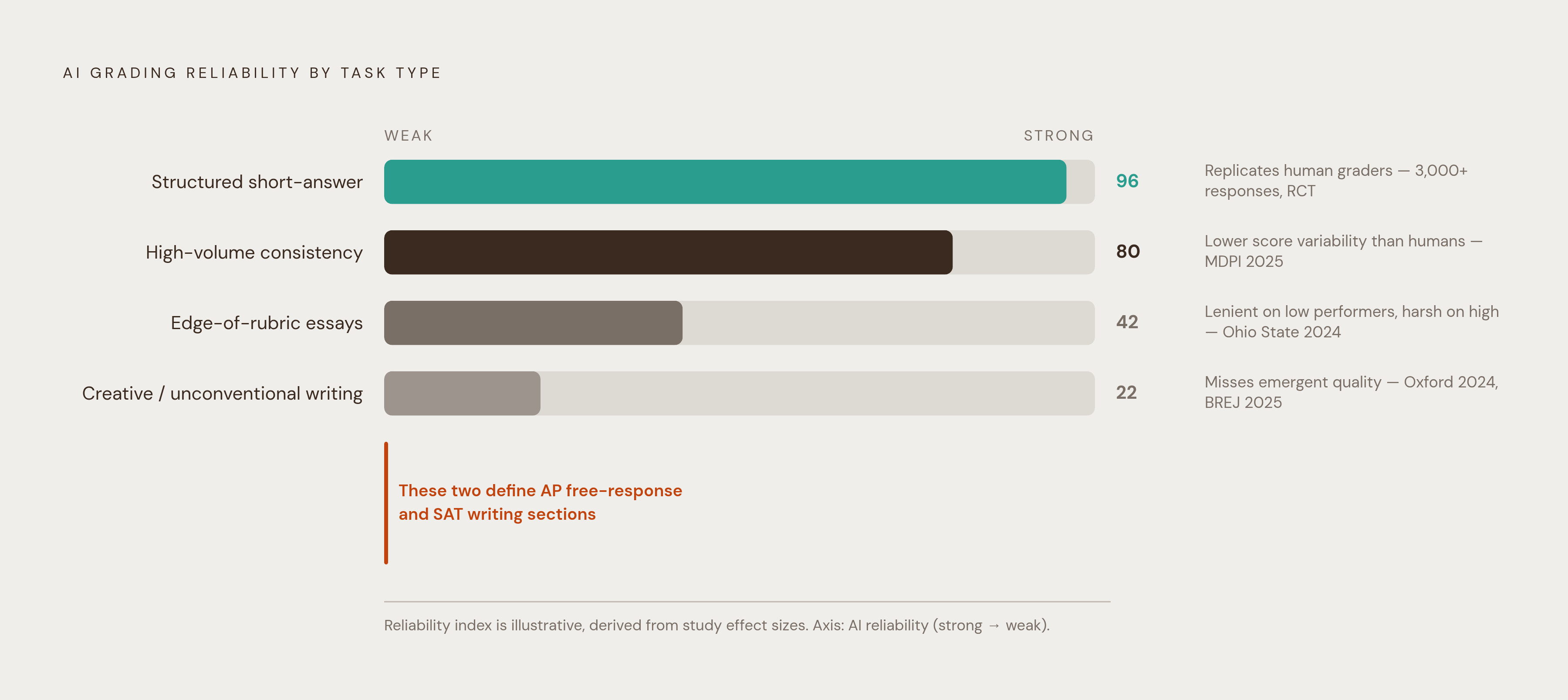
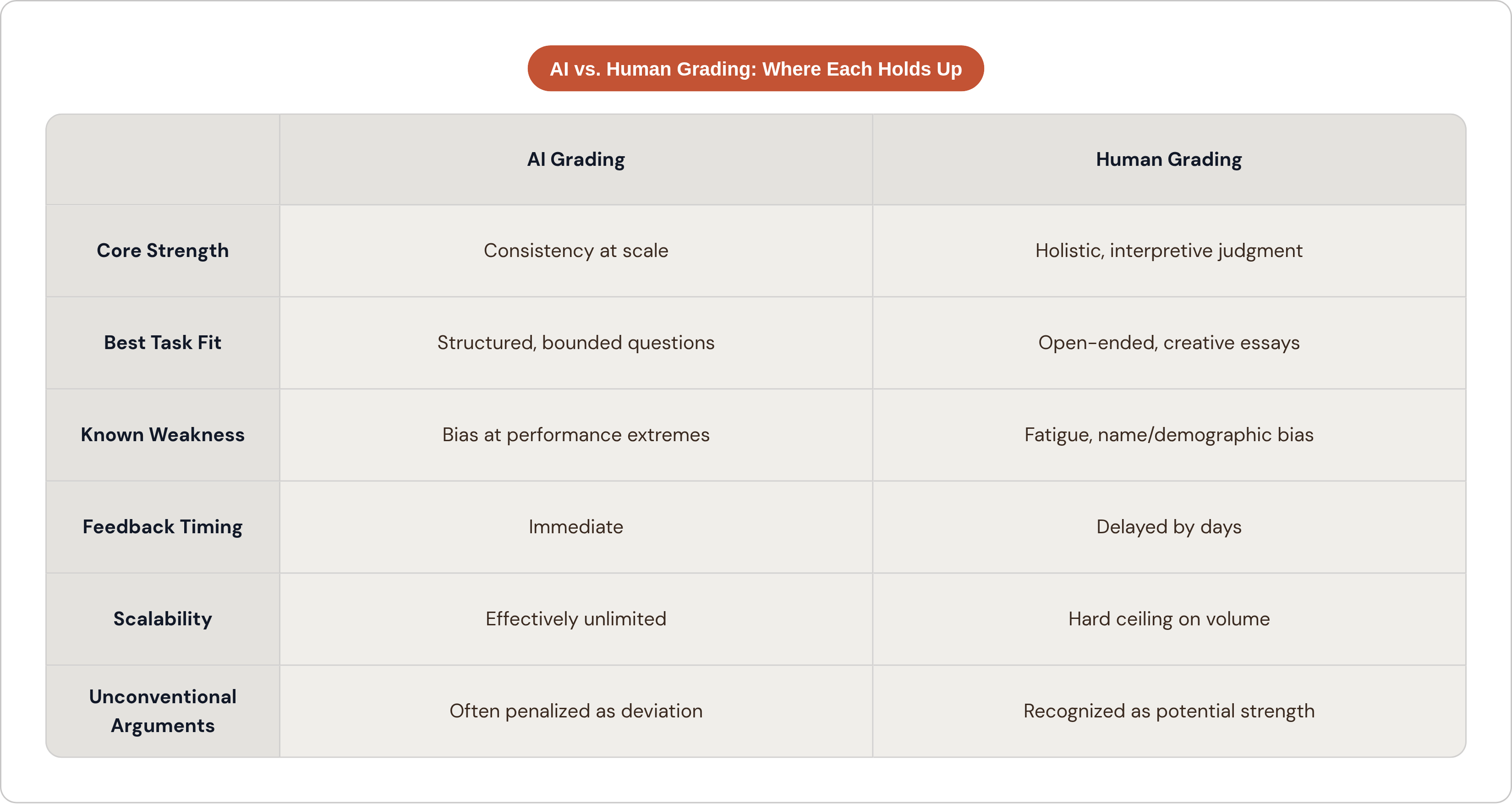
The more structurally important advantage is consistency. AI applies the same rubric criteria on the ten-thousandth response it grades as it does on the first. It doesn't get tired. It doesn't grade the last paper in a stack differently than the first one. Research published in 2025 in MDPI's Education Sciences confirmed that AI systems show lower score variability than human evaluators. The authors were careful to note something worth keeping in mind: consistency is not the same as accuracy.
There's also an equity angle that doesn't get enough attention. AI doesn't register a student's name, their handwriting, or demographic signals that research has repeatedly shown can unconsciously influence human graders. That's a real bias being removed from the equation.
For short-answer tasks specifically, the accuracy numbers are encouraging. A randomized controlled trial across 26 tests and over 3,000 short-answer responses found that AI-assisted grading could replicate what a human instructor would do in a small-class setting. For structured, bounded questions with clear right-and-wrong zones, AI performs well.
Timing matters too. AI can return comments immediately, while a student is still in the headspace of the problem they just worked on. Feedback that arrives three days later, after the student has moved on to the next unit, is less useful. That's just how learning works.
Where AI grading breaks down
This is the part students and teachers actually need to sit with.
Research out of Ohio State University (2024) found that AI tends to grade more leniently on low-performing essays and more harshly on high-performing ones. The students who are either struggling the most or excelling the most are exactly the ones AI gets wrong most systematically. That's not random error. It's a patterned bias at the tails of performance distributions, and it matters enormously when scores near rubric thresholds carry real consequences.
The holistic judgment gap is a separate problem. A 2024 Oxford study found that human graders consistently outperformed AI at recognizing what researchers called "emergent quality," meaning the signal of real intellectual risk-taking that doesn't fit neatly into rubric categories. A 2025 British Educational Research Journal study found AI specifically struggled with creative writing and unconventional arguments. Those unconventional moves are often exactly what separates a good essay from a great one.
It's also worth being clear about something the phrase "AI grading" tends to obscure: there is no single AI grader. A 2025 MDPI Education Sciences study found that Gemini produced scores statistically indistinguishable from human evaluators, while GPT and DeepSeek showed significant differences. "AI grading is consistent" is only true within a given model, and even then, the tool you pick affects results in ways most users don't think about.
What about agreement with human graders? A 2024 study in Medical Education found that ChatGPT agreed with a single human grader roughly two-thirds to four-fifths of the time. That's comparable to the agreement rate between two human graders, which sounds reassuring until you ask the follow-up question. When AI and human grades diverge significantly, one of them is wrong. On a high-stakes assessment, being wrong in the wrong direction carries asymmetric costs for the student.
Human grading's real strengths — and its own consistent weaknesses
A skilled human grader brings something no rubric captures cleanly. They read for intellectual risk-taking. They notice when a student is reaching beyond what the assignment explicitly demands. They write a comment that speaks to where this particular student is in their development, not just whether the answer hit the right categories.
That's mentorship, and it's valuable. The problem is that human grading comes with a consistent set of weaknesses that are just as well-documented as AI's.
The bias research is not subtle. Grades vary based on student names, handwriting quality, perceived gender, even the order in which papers are reviewed. Cognitive fatigue is real. Consistency degrades across a long grading session in ways teachers themselves often don't notice. And there is a hard scalability ceiling. One teacher can only grade so many papers, so fast, so carefully. Past a certain volume, quality suffers.
Two trained, experienced human graders scoring the same essay don't always agree. That's not a knock on human intelligence. It's the reality of evaluating complex, open-ended work. When you're dealing with millions of exams, that inconsistency problem compounds fast. Neither side of this debate gets to claim a clean win.
Why AP and SAT assessment put these differences under a microscope
Consider the scale. In the Class of 2025 alone, over 4.8 million AP Exams were taken by more than 1.3 million students, according to the College Board. Human-only grading at that volume was never a realistic option.
But here's the tension worth sitting with. The task types that define AP free-response and SAT writing sections, including argumentative essays, document-based questions, and extended analysis prompts, are precisely the task types where AI's documented weaknesses cluster most. Holistic judgment. Recognition of unconventional arguments. Calibrating an original thesis. These are not fill-in-the-blank problems.
Pass rates across AP subjects vary widely, which means large numbers of students sit right at the scoring margins where grading precision matters most. The difference between a 3 and a 4 is the difference between college credit and no credit. Getting it wrong at the edge of a rubric band isn't a minor rounding error.
For students using AI tools to prepare, the picture is actually more encouraging. Students who used AI-adaptive SAT prep tools in 2025 scored an average of 90 points higher than those using traditional static practice books, per a College Board Digital SAT Impact Report from January 2026. Students using AI study tools also scored meaningfully higher on AP exams than peers using traditional methods alone, per the EdTech Research Consortium in 2025.
The College Board draws its own careful line: AI is permitted as a study supplement in some AP courses, but the College Board actively investigates submissions where generative AI appears to have produced the work itself. Using AI to practice is one thing. Submitting AI-generated work as your own is a different matter entirely.
The hybrid model research actually supports
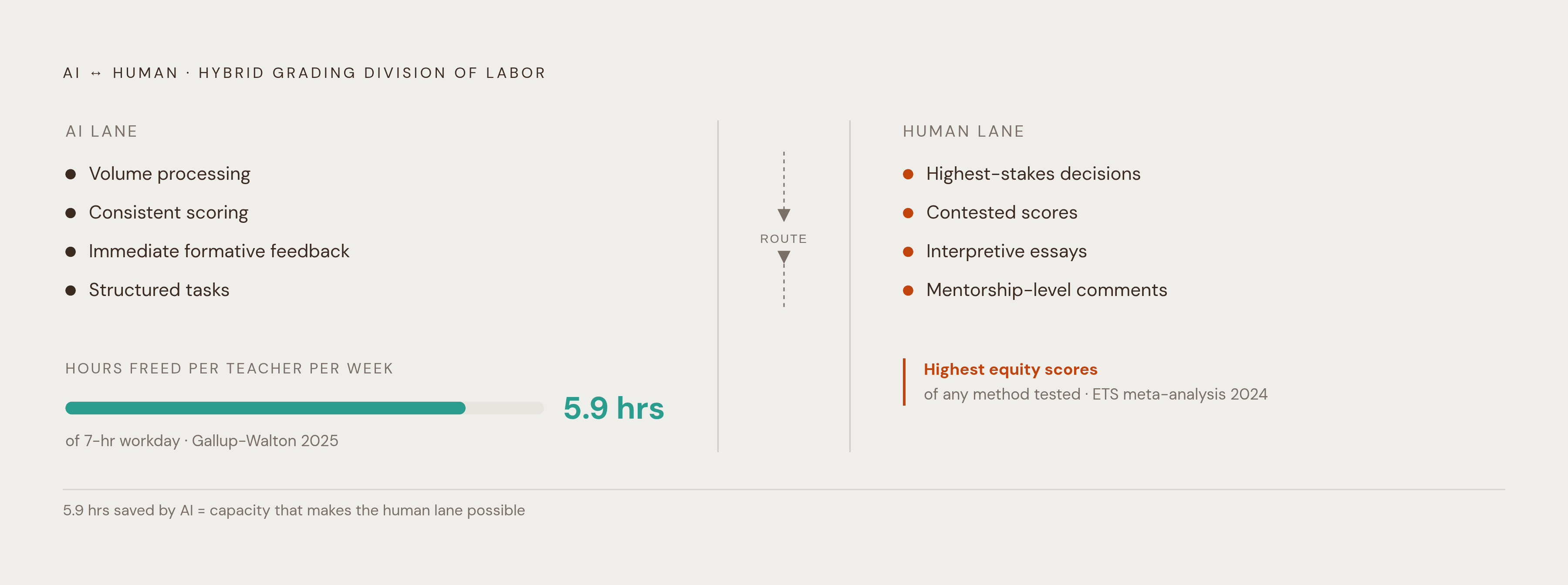
What does the evidence actually point toward? Not a winner, but a division of labor.
Ohio State's framing was direct: generative AI is currently unsuitable as the sole grading tool for nuanced writing tasks. It works best where its output supplements human judgment rather than replaces it. A 2024 Educational Testing Service meta-analysis found that hybrid models, meaning AI pre-screening combined with human oversight, produced the highest equity scores of any approach tested, with perceived fairness ratings well above pure AI systems.
Student trust matters here too. Research published in 2025 found that transparency about how grading works is the main driver of perceived fairness, and perceived fairness drives satisfaction and trust. Students want to learn from their grades. A consistent score without a useful explanation doesn't accomplish that.
Older and higher-performing students expressed particular skepticism about AI-only grading in the British Educational Research Journal study. The students most sophisticated about their own thinking are also the most likely to notice when feedback misses what they were actually trying to do.
So what does hybrid look like in practice?
- AI handles volume, consistency, and immediate formative feedback on structured tasks
- Human review focuses on the edges: highest-stakes decisions, contested scores, and the essays that require real interpretive judgment
Both tools doing what they're built for. Not a compromise so much as an honest accounting of where each one holds up.
What teachers actually gain when AI handles the first pass
A Gallup-Walton Family Foundation poll from June 2025 found that teachers who use AI tools at least weekly save an average of 5.9 hours per week. Across a school year, that's roughly six weeks of working time returned.
The real question is what that time buys. If it flows back into administrative churn, the gain is minimal. But if it redirects toward the interpretive, mentorship-heavy feedback that AI can't provide, that's a meaningful upgrade to what students receive. A teacher's scarce attention gets concentrated on exactly the moments where human judgment is irreplaceable.
One underrated benefit: AI grading at scale generates pattern data across an entire class. Which concepts get consistently misunderstood. Which question types produce the most partial-credit responses. Surfaced to a teacher, that data enables targeted re-teaching instead of broad review. A teacher grading 30 papers by hand can't easily see those patterns.
The adoption gap is worth naming though. Only about a third of teachers report using AI tools at least weekly. The gap between what's technically available and what's happening in classrooms remains wide, and closing it is a different problem than building the tools in the first place.
How students should think about AI feedback when preparing for high-stakes exams
For practice, AI feedback is hard to beat on volume and speed. Generating and grading dozens of free-response attempts in a single study session is something no human tutor can replicate at that scale or cost. Private AP and SAT tutoring runs from around $25 to well over $100 per hour. AI tools extend personalized, rubric-anchored practice to students who can't access that. That's a real access equalizer.
But there are specific situations where AI feedback shouldn't be your only input.
On essays where creative argument or unconventional thinking is the actual point, AI may penalize the exact moves that earn top scores from human graders. If your argument is original, a rubric-matching system might flag it as a deviation rather than a strength. When your scores cluster near the edge of a rubric band, the Ohio State bias finding becomes directly relevant. AI gets those edge cases wrong more often than it gets the middle right.
Platforms like Passionfruit are built around this logic. Unlimited AI-graded practice with feedback calibrated specifically to AP and SAT formats, designed not just to flag wrong answers but to identify the conceptual gap underneath them. The goal is pattern recognition at scale. Where does a student's understanding consistently break down? Which argument structures fall apart under pressure?
The practical approach for a student in the middle of AP or SAT prep:
- Use AI feedback heavily for volume and pattern recognition during practice
- Seek human feedback at key checkpoints, especially on full-length essays, to get the holistic read that resembles what actual exam graders are doing
- Pay attention to where AI and human feedback diverge. That gap is information. It often points to exactly the kind of unconventional move that human graders reward and AI systems miss
The goal isn't picking a side. It's understanding what each tool is actually measuring, and using that knowledge to get better feedback, not just more of it.