Personalized Learning Platforms Compared
Most platforms confuse content routing with actual gap diagnosis.

Over 6 million AP Exams were taken in May 2025. More than 3.2 million students across nearly 24,000 secondary schools sat for them. About 37% of U.S. public high school graduates took at least one AP Exam that year.
Only 24.8% of those graduates scored a 3 or higher on at least one.
More than a third of all public high school graduates showed up. Less than a quarter cleared the bar. A prep platform is supposed to close that gap. Most don't. That's not a cynical take. It's just what the numbers say.
2025 also changed the terrain in concrete ways. Most AP exams moved to Bluebook digital format. Student satisfaction rose in 29 of 40 subjects after the switch. AP Physics 1 pass rates jumped from 47% to 66% in a single year. Some of that was the format change itself. Which means how an exam is delivered directly shapes how students perform, and a platform still serving practice in the old format is already behind before a student answers question one — like a coach drilling a swimmer for a race that switched from freestyle to butterfly while they weren't looking.
The Digital SAT compounds this. It's adaptive by design, adjusting difficulty in real time based on how a student responds. A platform serving static question sets in a fixed order isn't just suboptimal. It's training students for a test that no longer exists.
So before personalization, before gap analysis, before any of the features platforms love to lead with: does the platform match the actual current format of the exam? That's the floor. Everything else is built on top of it, or it isn't built at all.
The difference between adaptive content delivery and actual knowledge gap diagnosis
"Personalized learning" has become one of those phrases that means everything and therefore means nothing. Every platform uses it. Every sales page leads with it. And almost no one explains what they actually mean by it.
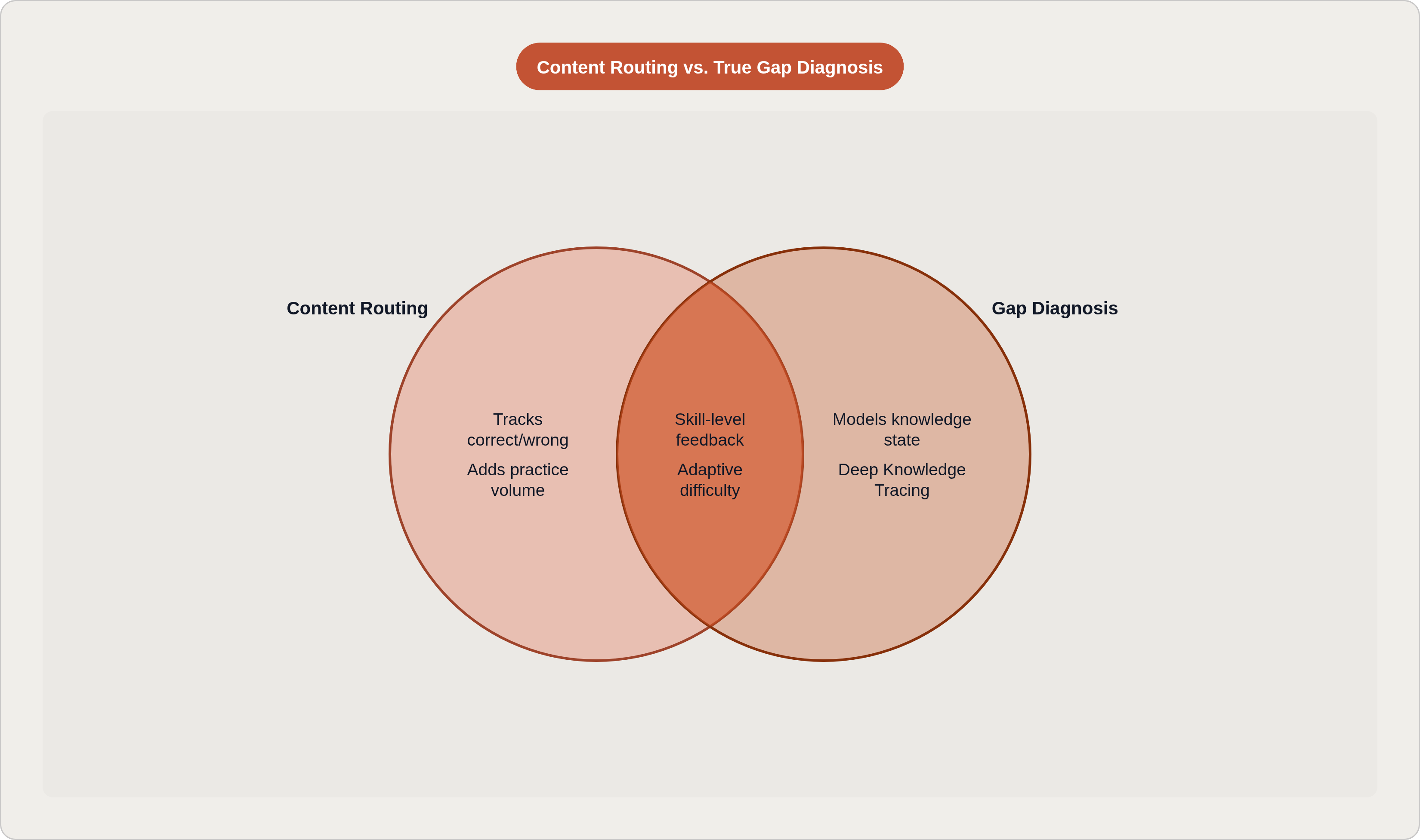
Push a platform on that question, and the honest answer is usually some version of: we give you harder questions when you do well and easier ones when you don't. That's content routing. It's not diagnosis. And the difference matters more than most people realize.
Real gap diagnosis tries to model what a student actually understands, not just which question types produce wrong answers. Some platforms use Deep Knowledge Tracing, which uses recurrent neural networks to represent a student's knowledge state across specific skills based on their sequence of responses over time. Others use probabilistic models that infer readiness for new topics by looking at patterns across related skills. What these approaches share is that they build a picture of a learner from interactions over time, not from a single session.
Here's a concrete way to see the difference. A routing system notices a student is missing algebra questions and sends more algebra questions. A diagnostic system notices the algebra errors trace to a specific misconception about negative exponents and addresses that root cause. One adds practice volume. The other changes what the student believes. Content routing is like handing someone an umbrella every time it rains, while diagnosis is fixing the roof.
For AP and SAT prep, that distinction is actually the whole thing. College Board questions are deliberately designed to surface underlying misconceptions. They're not just checking whether you've seen the material. They're checking whether you understand it well enough to use it somewhere new. Getting students ready for that requires knowing what they actually believe, not just what they mark wrong.
So the one question worth putting to any platform: does it track what went wrong conceptually, or just whether the answer was correct?
How leading platforms handle (or don't handle) gap detection in practice
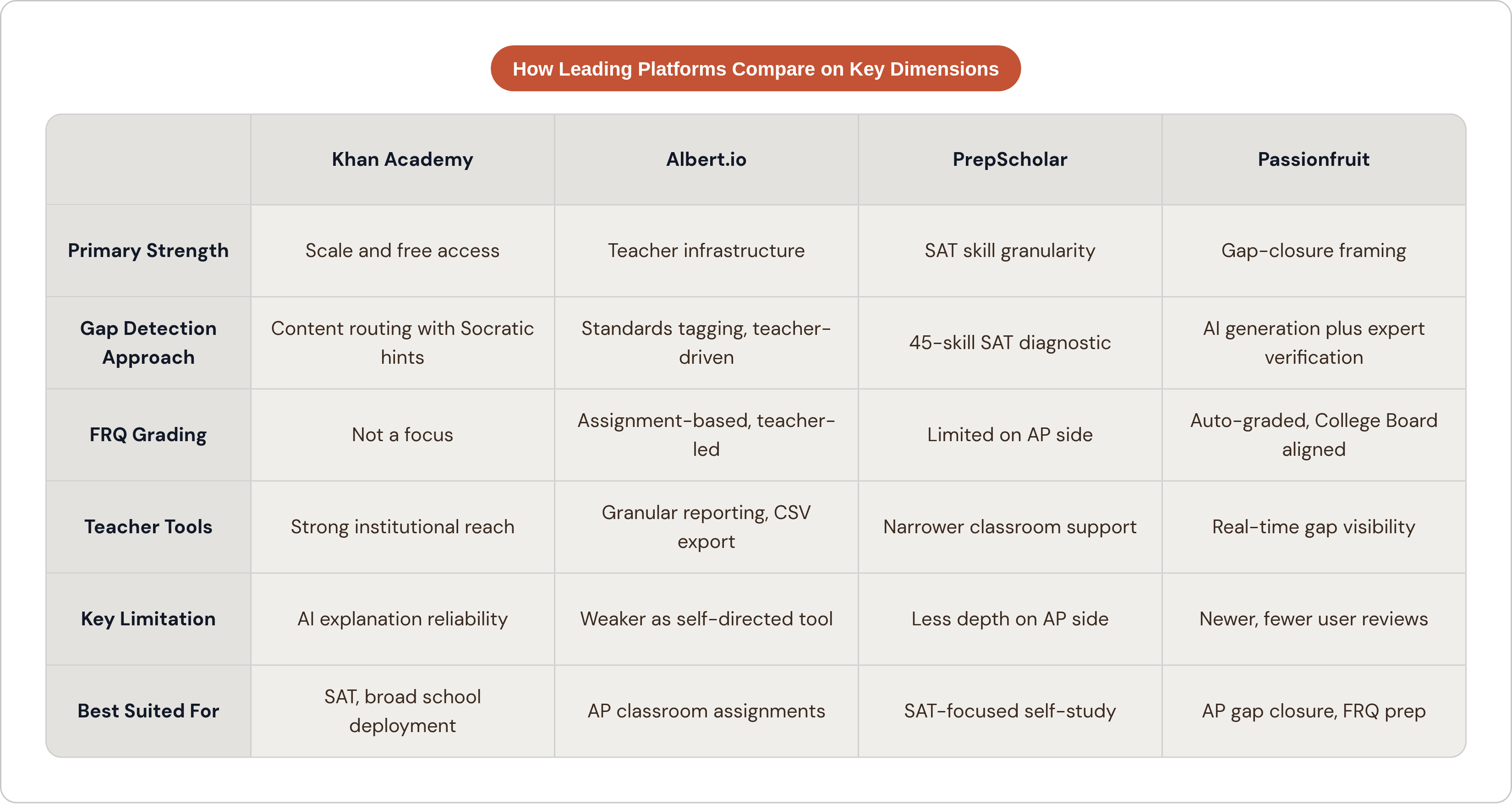
No platform does everything well. Knowing where each one actually delivers versus where it papers over the gaps with good marketing is more useful than any ranked list.
Khan Academy's SAT prep has reached 25 million students. Users average a 115-point score improvement. That's real scale and a real result. Khanmigo, its AI layer, uses Socratic questioning rather than direct answer-giving, which is genuinely solid pedagogy. It nudges students toward reasoning instead of just handing them solutions.
But user reviews are split on reliability. There are documented cases of incorrect AI explanations, and in high-stakes prep, a wrong explanation isn't just annoying. It can quietly entrench a misconception that resurfaces on exam day. The gap modeling also leans toward content-routing with guided hints. Helpful, but not the same as deep conceptual diagnosis.
Albert.io has a large question bank aligned to every unit in the AP course frameworks. Its tagging system lets teachers analyze student performance by standard across six different report types. For teachers assigning and tracking practice, it's a strong tool. The limitation is that it functions better as a teacher-assignment platform than as a self-directed diagnostic engine for a student working alone. Users on Reddit also report variable question quality across subjects, so check reviews for the specific AP you're targeting before you pay.
PrepScholar's diagnostic maps proficiency across 45 distinct SAT skills. That's one of the more granular skill breakdowns available for SAT prep specifically. A 2024 Niche.com survey found students using PrepScholar's programs were notably more likely to report satisfaction than peers using generic resources. That said, satisfaction and score gains aren't the same metric. And PrepScholar's diagnostic depth is narrower on the AP side than on the SAT side.
Passionfruit positions itself around a specific premise: helping students and teachers identify and close knowledge gaps rather than simply adding practice volume. AI-generated questions are reviewed and verified by curriculum experts, with explicit alignment to 2025 College Board standards. It offers unlimited multiple-choice questions, auto-graded free-response questions, and full-length practice exams. The teacher tools are built around gap closure at the classroom level, not just score reporting after the fact.
What free-response grading reveals about a platform's diagnostic capability
Multiple-choice results tell you what a student got wrong. Free-response grading can tell you how their thinking went wrong. Those are genuinely different things, and one of them is much harder to fake.
Most AP exams include free-response questions requiring constructed answers, document analysis, or multi-step reasoning. This is where nuanced misconceptions actually surface. And most platforms either skip FRQ scoring entirely or offer rubric-based checklists without interpretive feedback. A checklist tells a student they lost two points. It doesn't tell them why their argument collapsed in paragraph three.
Meaningful AI FRQ grading does a few specific things. It identifies the reasoning step where the student's logic broke down, not just which rubric point they missed. It connects that error back to the underlying concept, so review is targeted rather than a vague "go back over Unit 4." And it applies College Board rubric criteria consistently, not approximately. That last one sounds minor. It isn't. College Board rubrics are specific. Approximations train students for a slightly different test than the one they'll actually take.
Albert.io provides assignment-based FRQ feedback, but it's primarily teacher-driven. Passionfruit offers auto-graded FRQs with College Board alignment and frames FRQ feedback as a gap-detection tool rather than just a scoring mechanism.
When you're evaluating any platform on this dimension, ask three questions. Does the feedback explain why points were lost, or just how many? Does it connect the error to a specific skill or concept? Can it generate a follow-up practice item targeting that same gap? If the answer to any of those is no, the FRQ grading is cosmetic. It looks like feedback. It doesn't function like feedback.
Teacher and classroom tools as a meaningful evaluation dimension
A tool that works well for a motivated student working alone may be completely unusable for a teacher tracking 30 students' gaps at once. These are different problems. Not every platform is designed to solve both, and the ones that claim to often mean something much narrower by "teacher tools" than teachers expect.
What those tools should actually provide isn't complicated. Class-level reporting that shows which concepts are weakest across the group, not just individual scores sorted by grade. Assignment tools that let teachers target specific units or skills instead of pushing out a generic practice set. Progress tracking that updates as students work, not only after a graded assessment.
Albert.io has strong teacher infrastructure. Granular standards tagging, multiple report types, CSV export for external analysis. It's widely adopted in classrooms for good reason, and the structural investment in teacher workflows shows.
Khan Academy is deployed in more than 15,000 U.S. school districts. Teacher access to Khanmigo is free in supported countries. The institutional reach is largely unmatched. Diagnostic depth at the classroom level varies by subject, but the deployment feasibility at scale is something most platforms simply can't match.
Passionfruit's teacher tools are built around the same gap-closure premise as its student-facing features, giving teachers visibility into where specific students are struggling and the ability to act on that data in real time.
But what does "act on it" actually mean? It means a teacher can look at Thursday's data and change what they do on Friday. Not schedule a review session for next week. Not flag it for a parent email. Change the lesson, that day. That's the real test for any school or teacher evaluating a platform: does it let you act on gap data as it emerges, or does it only report once the window to adjust has already closed?
Content quality and question accuracy as non-negotiable baseline criteria
Before personalization. Before adaptive algorithms. Before any of the sophisticated features matter at all. The questions have to be accurate.
This sounds obvious. It is somehow not universal.
AI-generated content creates a quality control problem that didn't exist with human-authored question banks. Errors can be plausible-sounding and hard to catch. A student working independently has no way of knowing when an explanation is wrong. And given that AP exams moved to new digital formats in 2025, a platform not actively maintaining alignment to current College Board frameworks is giving students practice for an exam that has already changed.
A few signals of genuine content quality are worth looking for:
- Expert review of AI-generated content, not just AI generation alone
- Explicit alignment to current College Board course and exam descriptions, updated after curriculum changes
- Transparency about the question authorship and review process, not just a general claim of accuracy
Albert.io's authoring team continuously adapts to College Board curricular changes, though user-reported quality varies by subject. Passionfruit combines AI generation with expert verification and explicit 2025 College Board alignment.
The practical check is simple. Look for platforms that disclose how they verify and update questions. "Our questions are accurate" is marketing copy. "Here's our review process and how we handle curriculum updates" is a quality control system. One of those you can actually evaluate before you hand a student a practice set.
Pricing structures and what they imply about access and depth
The range for SAT prep runs from free to over $2,000. That spread is wide enough that price alone tells you almost nothing about quality. You have to look at what's actually gated.
The structural differences in how platforms charge matter more than the number itself. Per-subject pricing, like Albert.io's roughly $79 per subject, suits students with a clear target exam. For multi-subject AP students, it compounds fast. Flat monthly fees favor students who want broad access over a concentrated prep window. One-time course access works for students who want a defined, finite program. Free tiers are genuine entry points, but they often gate the actual diagnostic features behind a paywall, which is worth checking before you build a study routine around a platform and then hit the wall.
There's also an access problem here that doesn't get talked about enough. In 2025, 27% of AP exam takers were low-income students. College Board has invested nearly $210 million in fee reductions over five years to make the exams themselves more accessible. But if the prep tools that actually work are priced out of reach for the students who most need them, fee reductions solve half the problem and quietly leave the other half in place.
The real question for any pricing tier: does it gate the diagnostic features, or are gap detection and personalized feedback available at the level most students actually use? If the free tier is flashcards and the gap analysis lives behind a paywall, the platform's most meaningful capability has an access barrier worth naming directly.
A practical framework for choosing the right platform given your specific situation
No ranked list here. The right platform depends on who's using it and what they actually need. So here's a way to think through it instead.
For a self-directed student preparing for one or two AP exams, prioritize FRQ grading quality, subject-specific depth, and whether the gap feedback is actually actionable or just a score attached to a rubric. Passionfruit is worth evaluating given its gap-closure framing, expert-verified content, and FRQ auto-grading. Albert.io is worth considering if teacher-style structure and a large question bank match how you study. Either way, check subject-specific user reviews before committing. Quality varies.
For a student preparing for the Digital SAT, format accuracy is the baseline and it matters more than most students think. The exam is adaptive, so prep should be too. PrepScholar's 45-skill diagnostic is one of the more granular maps available for SAT-specific gap analysis. Khan Academy's free access and 115-point average improvement make it a compelling starting point, and Khanmigo is a useful supplement for students who want more Socratic scaffolding than a static practice set provides.
For a teacher or school evaluating platforms at the classroom level, the question is whether the platform gives you visibility you can act on, not just data you can look at. Albert.io's reporting infrastructure is strong. Passionfruit's teacher tools are built around gap closure at the class level. Khan Academy's institutional breadth makes deployment feasible at scale in a way most platforms genuinely can't match.
One question cuts across all of these situations. Whatever platform you're evaluating, ask it this: when a student gets something wrong, what does the platform do next?
A platform that gives the student more practice on that topic is a routing tool. A platform that identifies the specific concept behind the error and targets that directly is a diagnostic tool. The market is full of the first kind, and they're not useless. But they're not solving the hard problem either. The harder problem is figuring out why a student is stuck, not just that they are, and the exams students are sitting for in 2025 are specifically designed to expose that difference.