Identifying Your SAT Knowledge Gaps Before Test Day
Learn to diagnose what's actually causing your SAT mistakes, not just score numbers.

Somewhere around test prep season every year, I watch students make the same move. They take a practice test, get their score back, look at it for about thirty seconds, and say something like: "Okay, I'm at a 580 in Math. I should study more math."
That's not a diagnosis. That's just reading a number.
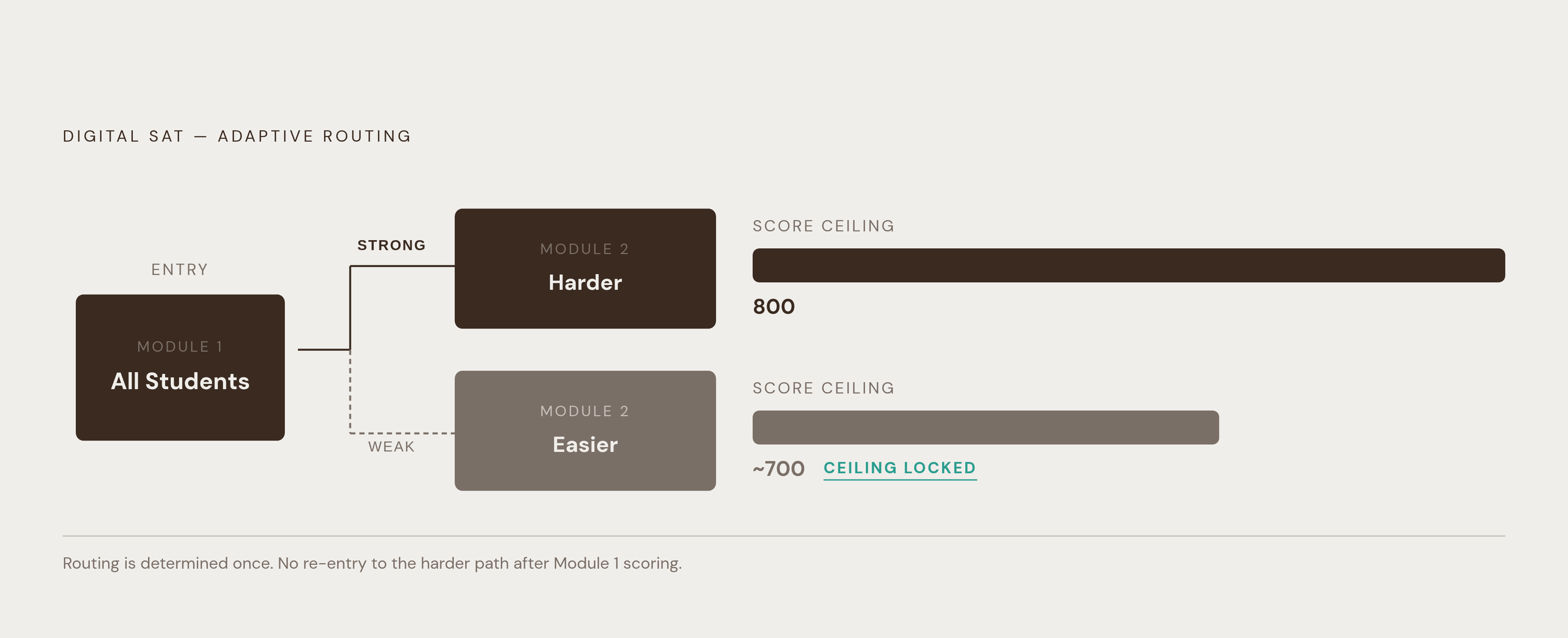
And here's the thing about the digital SAT specifically. It is not a linear test. It is an adaptive test. How you perform in the first module determines which second module you see. A stronger first-module performance routes you to the harder module, which is also the higher-scoring module, a design sometimes called multistage adaptive testing. A weaker performance routes you to the easier one, and once you're there, the ceiling on your section score is set. Not negotiated. Set.
That structure changes everything about what "knowing your gaps" actually needs to mean.
A Practice Test Score Tells You That You Have a Problem. It Doesn't Tell You What the Problem Is.
Most students treat a score as the end of a diagnostic. It's actually just the beginning.
Think about what a score actually shows you. It shows you that you lost points somewhere. It doesn't show you why. Did you get a question wrong because you've never learned the underlying concept? Because you learned it wrong and have been applying a broken version of it ever since? Because you ran out of time? Because you second-guessed a correct instinct?
Those are four different problems. They require four different fixes. Treating them all as "I need to study more" is like a doctor looking at a patient's blood pressure and saying "something is off." Sure. But what, exactly?
Effective gap detection, which practitioners call error analysis, looks at patterns. Which wrong answer choices do you keep picking? There's a big difference between consistently choosing "too specific" distractors in Reading and Writing versus misreading what a question is actually asking. One points to inference habits. The other points to question-reading habits. Both show up as wrong answers. Neither shows up in a score.
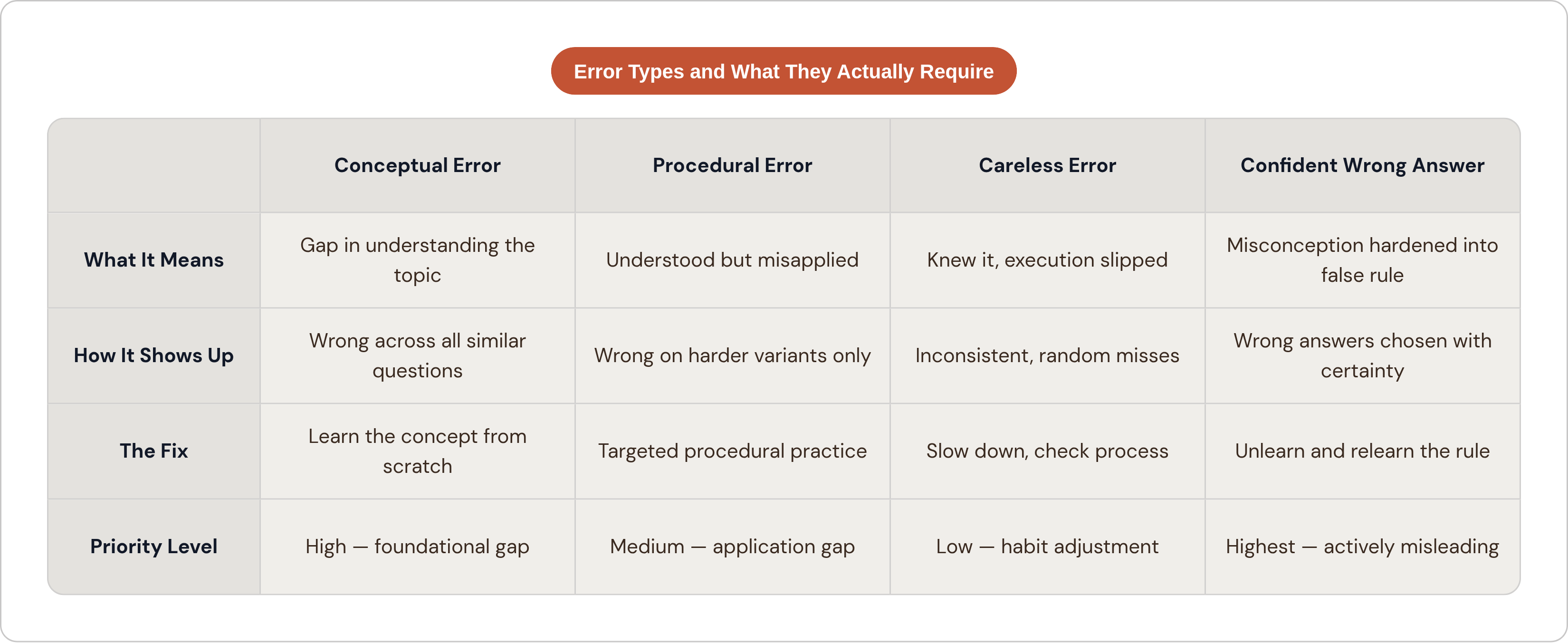
Confident wrong answers are especially worth flagging. When a student misses a question and says "I was sure about that one," that is the signal. Not a stumble. A misconception. Something got learned incorrectly at some point, hardened into a rule, and is now being applied with full confidence in the wrong direction. That's a deeper fix than just reviewing a topic.
One more level of specificity matters here. A gap description that says "weak in data analysis" is nearly useless for building a study plan. A gap description that says "confuses correlation with causation when interpreting graphs" is actionable. The first tells you a category. The second tells you what to actually fix.
The Two Sections, and Where the Sneaky Gaps Live
The digital SAT runs 2 hours and 14 minutes. Reading and Writing covers 54 questions. Math covers 44.
That's the easy part. Here's where it gets interesting.
Reading and Writing
The RW section covers four broad areas: information and ideas, craft and structure, expression of ideas, and standard English conventions. Most students feel like they understand what those mean. Many of them are wrong.
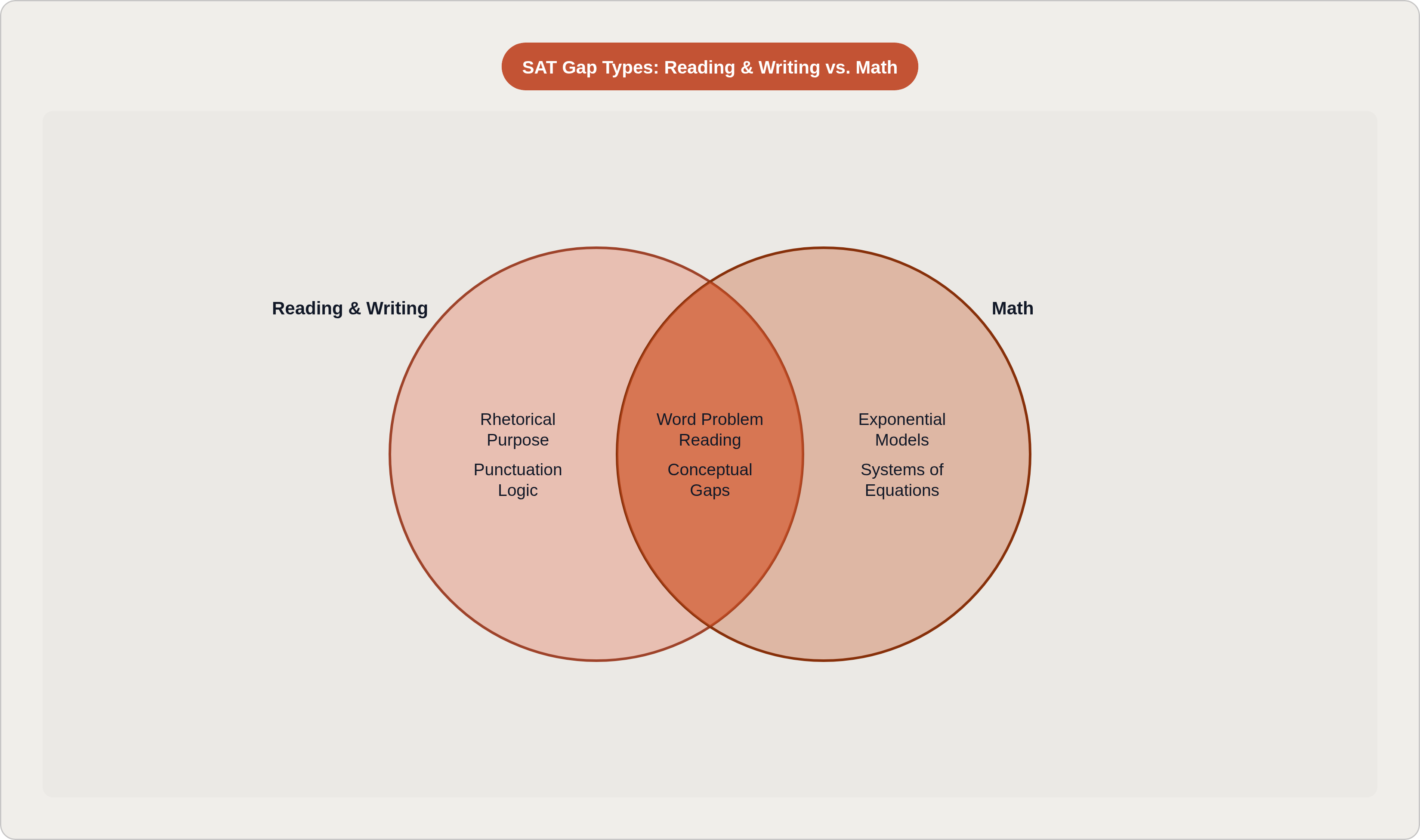
Here's a gap that goes undetected constantly: confusing a text's purpose with its main idea. These feel like the same question. They aren't. Main idea is about content. Purpose is about intent. Why did the author write this? What are they trying to do to the reader? That distinction is at the heart of rhetorical purpose questions. Students who conflate the two miss rhetoric and purpose questions at a surprisingly consistent rate, often without realizing it's the same mistake repeating.
Punctuation is another one. Students learn the surface rule: comma here, semicolon there. But the deeper logic, about independent clauses and how different punctuation marks create different relationships between ideas, often doesn't stick. They get the easy versions right and the harder ones wrong, and because the easy ones worked, they never go back and find the gap.
And then there's processing speed. Passage length on the digital SAT has increased. If a student is routinely finishing late, a reading fluency gap can disguise itself as a content gap. The questions they're missing in the final minutes might be questions they would have gotten right with more time. That's a different study target than a student who finishes comfortably but chooses wrong answers confidently.
Math
The Math section has a quirk worth knowing. The calculator-permitted module allows Desmos, the graphing calculator, which is embedded directly in the Bluebook testing platform. This shifts which gaps matter most. Computational errors hurt less when you can graph or check arithmetic with a tool. Conceptual gaps hurt more, because no calculator tells you which equation to set up or what a question is actually asking.
The most common Math gaps I see: misapplying linear versus exponential models (they look similar on a word problem until they don't), misreading word problems rather than failing the underlying math, and shaky fluency with systems of equations, particularly when they're presented in non-standard forms.
That middle one is worth pausing on. A student who struggles with word problem comprehension isn't struggling with Math. They're struggling with a reading and interpretation skill that lives inside a Math question. The fix isn't more algebra practice. The fix is slowing down the problem setup, sometimes called the representation phase, before any computation starts.
Run the Diagnostic Before You Build Any Plan
Here's the sequence that actually works.
Take a full-length official practice test. Not a topic quiz. Not a shortened version. The College Board offers free official digital practice tests through Bluebook, and those are the only tools that authentically replicate the adaptive module routing. Everything else is an approximation.
After the test, resist the urge to just count wrong answers. Instead, sort every missed question across three dimensions:
- Content domain. Which topic or skill does this question belong to?
- Question type. Was this a main idea question? A rhetoric question? A linear equation? A geometry problem?
- Error type. Was this conceptual (you didn't understand it), procedural (you understood it but applied it wrong), or careless (you knew it, just slipped)?
Then look at the distractor patterns. The wrong answers you chose are more informative than the right answers you got. If you're consistently choosing the same type of wrong answer across multiple questions in a section, that's a pattern. Patterns are addressable.
Finally, note your confidence level on every missed question. Sort them into "I guessed" and "I was sure." The confident wrong answers are the ones to prioritize.
The goal of the whole diagnostic is a short list. Three to five sub-skills, ranked by how often they appear and how much they affect Module 1 performance specifically.
The Tools That Speed This Up
Khan Academy's Official SAT Practice connects directly to College Board score data. If you've taken the PSAT or the SAT, those results populate a personalized skill queue automatically. You're not starting from scratch.
According to College Board research, 20 hours of study on Khan Academy's Official SAT Practice is associated with an average 115-point gain, nearly double the gain of students who forgo it. And those gains held across income, race, and GPA groups. That last part matters.
But here's the part worth interrogating. Why 115 points? Is it just because students practiced more? No. The gain comes from targeting. Students work on their specific flagged skills, not a generic curriculum. Volume of practice isn't the variable. Alignment between what you study and where your gaps actually live is the variable.
AI-powered platforms have added another layer. The better ones can deliver feedback on a question in seconds, which compresses the feedback loop meaningfully. When you get a wrong answer, the fastest path to improvement is immediate, specific feedback. Not a review session three days later.
That said, one limitation is worth naming. AI-generated practice questions sometimes mimic the style of the SAT without testing the reasoning the College Board actually measures. Reviewers have found misaligned questions in at least one major AI tool's practice set. So the right question to ask of any adaptive platform is this: does it distinguish between something I haven't studied and something I've studied but misunderstand? Those are different problems. They need different solutions. Many tools are simply not built to tell them apart.
From Gap List to Schedule
Once you have your gap list, the schedule follows a specific logic. It doesn't split time evenly across all topics. It weights by two factors: how often a gap appears in your error log, and whether it lives in Module 1 content.
That second factor is the one most students miss. A gap in a high-frequency Module 1 skill gets addressed first, even if a different gap feels more uncomfortable to study. The reason is the routing logic. Weak Module 1 performance doesn't just cost points on those questions. It costs you access to the harder module, which is where the higher scores live. A gap that might cost a handful of points on a traditional linear test can cost far more on the adaptive format because it changes which module you see.
Serious prep for the digital SAT generally requires somewhere between 8 and 20 weeks of structured work. The diagnostic determines how that time is distributed, not a predetermined schedule.
Study sessions should be organized around sub-skills, not sections. "Linear equation word problems" is a study session. "Math Tuesday" is not.
After working on a targeted gap, retest on official questions in that specific sub-skill before moving on, which is the core logic behind spaced practice. Not a full practice test. Just that skill. You want to confirm the gap actually closed before you move forward and assume it did.
And re-run the full diagnostic every 3 to 4 weeks. New gaps surface as foundational ones close. Your list should evolve.
The Stakes Are Higher Now Than They Were a Few Years Ago
This part is worth saying plainly.
For the 2026 to 2027 admissions cycle, Harvard, Yale, Dartmouth, Brown, Cornell, MIT, Caltech, Stanford, and Penn all require SAT or ACT scores. Columbia announced a return to testing requirements beginning 2027 to 2028. The test-optional window is closing.
And the score bar has moved. The mid-50% SAT ranges at most Ivy League schools have climbed roughly 50 points at the 25th percentile since the 2018 to 2019 cycle. That shift is largely the result of self-selection during the test-optional years. High scorers kept submitting. The reported ranges reflect that. The benchmark students are now working toward is objectively higher than it was when many of their older siblings or cousins went through this process.
A score of 1200 puts a student around the 75th percentile nationally. That's useful context for understanding where someone stands relative to selective admissions ranges.
For students from less-resourced high schools, this has an added dimension. Research has found that SAT scores can surface achievement and potential that GPA alone doesn't always reflect, particularly when course rigor varies across schools. Strong SAT performance can be a signal that travels further than a transcript's context allows. That makes thorough, targeted preparation a matter of access, not just ambition.
Which is exactly why starting early matters more now than it did before. The student who begins gap identification in the fall has time to close foundational gaps before the adaptive format makes those gaps permanent during the test. The student who starts two weeks out doesn't.
The goal was never to take more practice tests. It was to understand, with real specificity, what is standing between you and the score you're working toward, and then address exactly that, nothing less and nothing extra.