SAT Math Concepts Students Most Often Miss
Algebra weakness ripples across the entire test, especially in quadratics and functions.
How the Digital SAT Math Section Is Actually Structured
Two 35-minute modules. Forty-four questions. Thirty-three multiple choice, eleven student-produced responses where you write in your own answer from scratch, no options in sight.
That last part trips people up more than you'd expect.
The test is also adaptive, which sounds more exotic than it is. Your Module 1 performance determines whether you get an easier or harder Module 2. Scoring into the harder module is the only way to reach a top score. A rough Module 1 caps you, full stop.
A calculator is allowed on every question, and there's a built-in Desmos graphing calculator provided. Real gift. But it shifts the burden in a way students don't always account for. Computation isn't the hard part anymore. Knowing what to compute is.
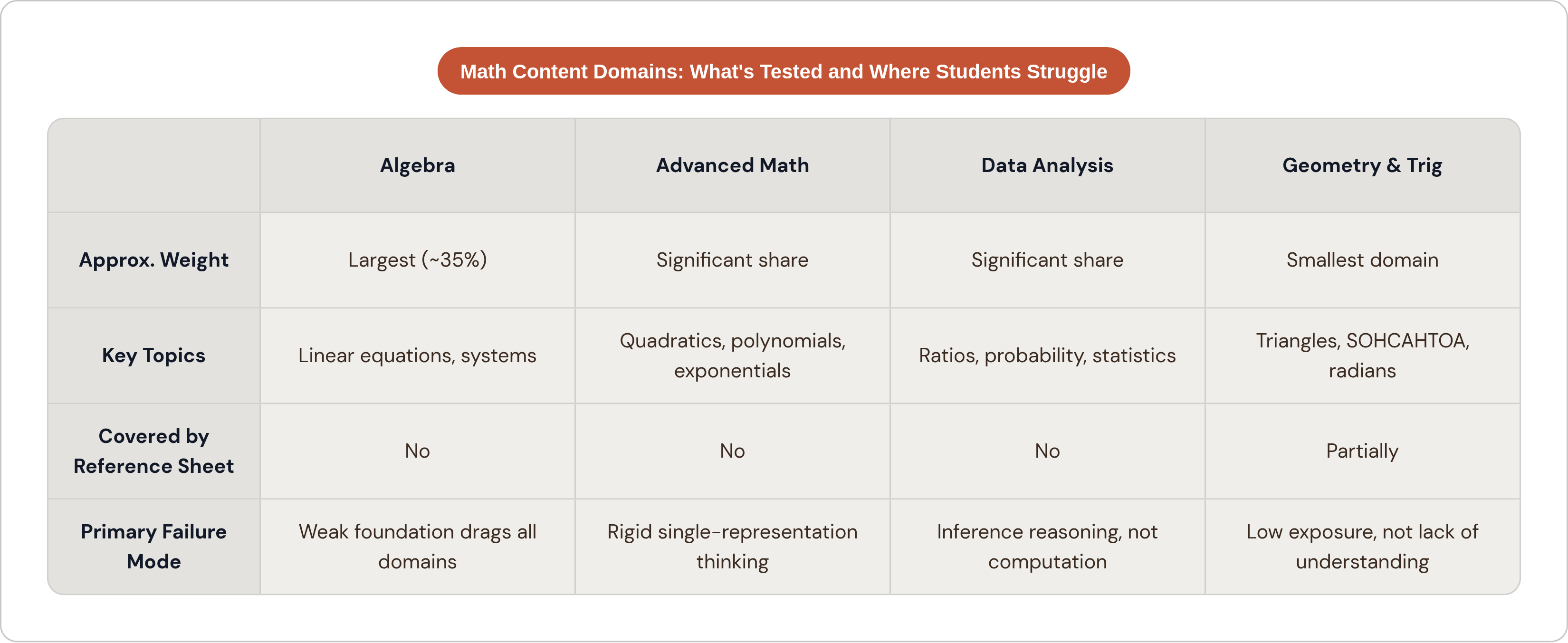
The four content domains aren't weighted equally. Algebra is roughly 35% of the test. Advanced Math, Problem Solving and Data Analysis, and Geometry fill in the rest. A weak algebra foundation doesn't just hurt your algebra score — it creates drag across the whole section.
One thing worth flagging: the reference sheet covers some geometry formulas. It does not cover algebra, quadratics, or statistics formulas. Some students discover this mid-test. That is, to put it mildly, a bad time to find out.
Where Quadratics and Nonlinear Functions Break Down for Most Students
Quadratics can account for five to seven questions per test. High-impact topic. And consistently, across students I've worked with at every level, this is where the most ground gets lost.
The frustrating part is that it's rarely because students haven't seen quadratics. The issue is flexibility.
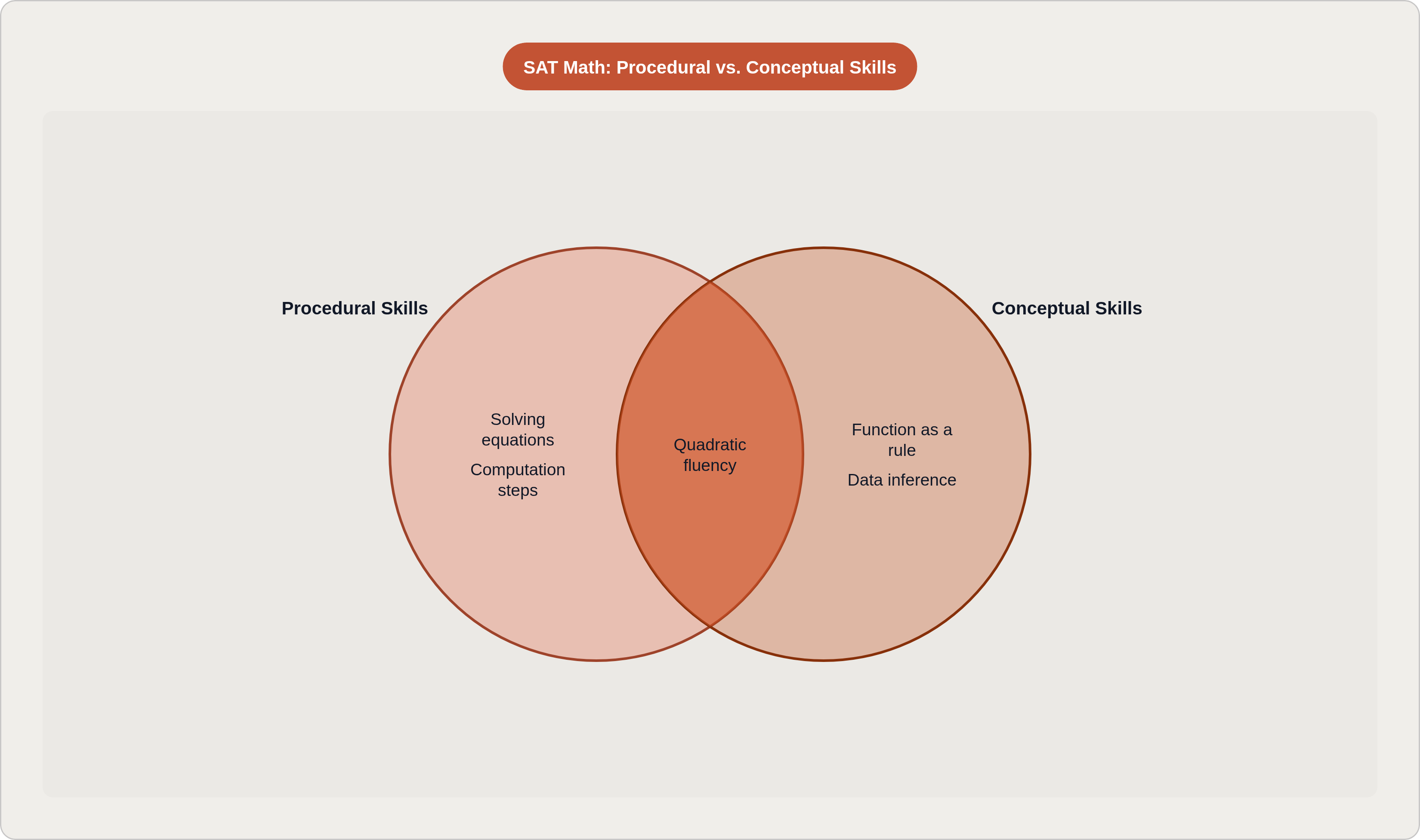
The digital SAT doesn't ask you to solve a quadratic in a vacuum. It asks you to recognize one in a graph, match it to a table, work backward from its roots, or figure out what something like (u minus t) equals when only that combined form is defined. That last one is worth pausing on. The instinct is to solve for u and t separately. But the question only gives you enough to find the difference. The move is recognizing a difference of squares and using it directly, without ever isolating either variable.
That is a meaningfully different skill than solving. It requires reading what the problem is actually telling you rather than pattern-matching to a procedure you've run a hundred times.
Exponential growth and decay have also been appearing more in the harder module. Polynomial manipulation too. What's consistent across all of it: students who've drilled one representation of a nonlinear function run into trouble when the test shows them another. The math hasn't changed. The angle has.
Why Functions Trip Up Students Who Are Otherwise Solid at Algebra
Here's something I find particularly interesting, and a little maddening. Functions aren't computationally harder than other algebra topics. But they catch confident students at a surprisingly high rate.
Most students, somewhere underneath their work, treat f(x) like a variable. Something to solve for. But a function is a rule. A process. When you see f(x+2), you're not plugging in a new value. You're applying the entire function to x+2 as the input. That shift seems minor when you write it out like this. In practice, it generates systematic errors across a whole category of questions.
I had a student once — sharp kid, great instincts — who kept getting function composition questions wrong and couldn't figure out why. We sat down and traced through one together. She wasn't misreading the algebra. She was treating the function like a variable every single time, automatically, without realizing it. Once she saw it, she couldn't unsee it. That one session was worth more than the previous month of drilling.
Graph interpretation makes it worse. Students misread slope. They lose track of what each axis represents when the problem roots the graph in a real-world context, distance and time, cost and quantity. These aren't careless mistakes exactly. They're what happens when someone can execute a procedure without fully working out what a function represents.
A student can solve quadratic equations correctly time after time and still miss every function composition or transformation question on the test. Those two skills look like neighbors. They aren't. A practice test won't reliably show you which one is broken unless you're specifically looking for it.
The Data Interpretation and Statistics Questions That Look Easier Than They Are
These have a reputation for being the approachable section. The math usually isn't complicated. No elaborate formulas, no multi-step algebra chains. Students relax into them. That's often exactly when the points walk out the door.
The content is broad. Ratios, rates, proportions, percentages, probability, mean, median, mode, range, standard deviation. That breadth alone creates exposure. A student who is solid on percentages but shaky on probability has quietly surrendered several questions before realizing it.
The harder questions push further. They ask you to evaluate what a data set actually allows you to conclude, and what it doesn't. A scatterplot question might ask whether a particular interpretation is supported, overstated, or completely unsupported by the data. Students who haven't practiced that specific reasoning move will answer the question they expected to see instead of the one in front of them. That's not a reading problem. It's a reasoning habit, and training it is a different exercise than drilling calculations.
Probability adds another layer. Conditional probability, independence, combinations, permutations. These require holding more than one idea in tension at once. Students who rarely encounter these in class are especially exposed, and the questions have a way of not announcing themselves as hard until you're already halfway down the wrong path.
Geometry and Trigonometry: Smallest Domain, Occasionally the Cruelest Questions
Geometry and Trigonometry is the smallest domain by question count. It also tends to produce the hardest individual questions on the test. For prepared students, that's a quiet opportunity. For everyone else, it's a place where points disappear without much warning.
Multi-step geometry problems are a real documented stumbling block. Equilateral triangles inscribed in circles, for example, require pulling together multiple geometric relationships in sequence. One wrong assumption early and the whole thing falls apart in a way that's hard to trace.
Trig on the SAT is limited in scope, which is good news. Right triangles only. SOHCAHTOA, complementary angle relationships, radians, special angle values. No unit circle, no trig identities beyond the Pythagorean. That's a manageable body of material. The problem isn't the content. It's the exposure gap. Students see trig far less than they see algebra, so even a concept they understand well can go blank under time pressure if they've only encountered it twice in the past year.
Familiarity and understanding aren't the same thing. Worth repeating that to yourself before you decide you've "covered" trig.
The Behavioral Errors That Turn Understanding Gaps Into Score Gaps
Knowing the content is necessary. It is not sufficient. Some of the most reliable point-losers on the Math section have nothing to do with whether a student actually understands the concept in question.
The single most common error I see: solving for the wrong variable. Not because the student can't solve. Because they didn't read the full question before starting. They solved for x. The question asked for 2x plus 3. Technically correct work, completely wrong answer.
Unit conversion is another one. Students know percentages become decimals and degrees can become radians. They skip the translation under time pressure. The concept is there. The execution breaks.
SPRs make all of this harder to catch. Without answer choices, there's no quiet self-check when you finish. Multiple choice gives you that: if your answer isn't among the options, something went wrong and you have a chance to find it. SPRs don't offer that safety net. A sign error or misread exponent just... goes in as your answer.
Pacing matters more than most students think it does. College Board's own data shows that students who leave five or more questions blank score an average of 60 points lower than peers with similar accuracy who attempt every question. A wrong answer costs you nothing on the digital SAT. A blank costs you a point. That gap isn't about knowledge. It's about strategy, and it's correctable.
Finally, calculator overuse. Desmos is powerful. It's also slow if you reach for it reflexively. A ratio problem that logic or estimation resolves in ten seconds can eat thirty if you're busy entering expressions. The calculator is a resource, not a first response.
Why Identifying the Specific Gap Matters More Than Logging More Practice Hours
Two students can miss the exact same question for completely different reasons. Walk away with the same wrong answer. Have entirely different things broken underneath it.
I've watched this happen enough times that it stopped surprising me. What still surprises me is how rarely students or their tutors slow down to ask which breakdown actually occurred.
Drilling 50 more quadratic equations won't help a student who's confusing difference of squares with the quadratic formula. It also won't help a student who can solve the equation fine but can't read it off a graph. More practice aimed at the wrong thing is just more practice aimed at the wrong thing.
The adaptive structure makes this especially consequential. A rough Module 1 caps the score regardless of what happens in Module 2. Early gaps compound — they don't just cost you points in the moment, they change the difficulty ceiling of everything that follows.
Is the quadratic gap about algebra manipulation, or about moving between representations? Is the data gap about computation, or inference? Is the function gap conceptual, or is it a notation issue that quietly went uncorrected two years ago?
Those are different problems. They need different fixes. And figuring out which one you actually have is more valuable than another hundred problems logged against the wrong diagnosis.