Best SAT Prep Apps for Self-Study Students
Adaptive testing routes your score ceiling on Module 1, so targeted practice beats volume.
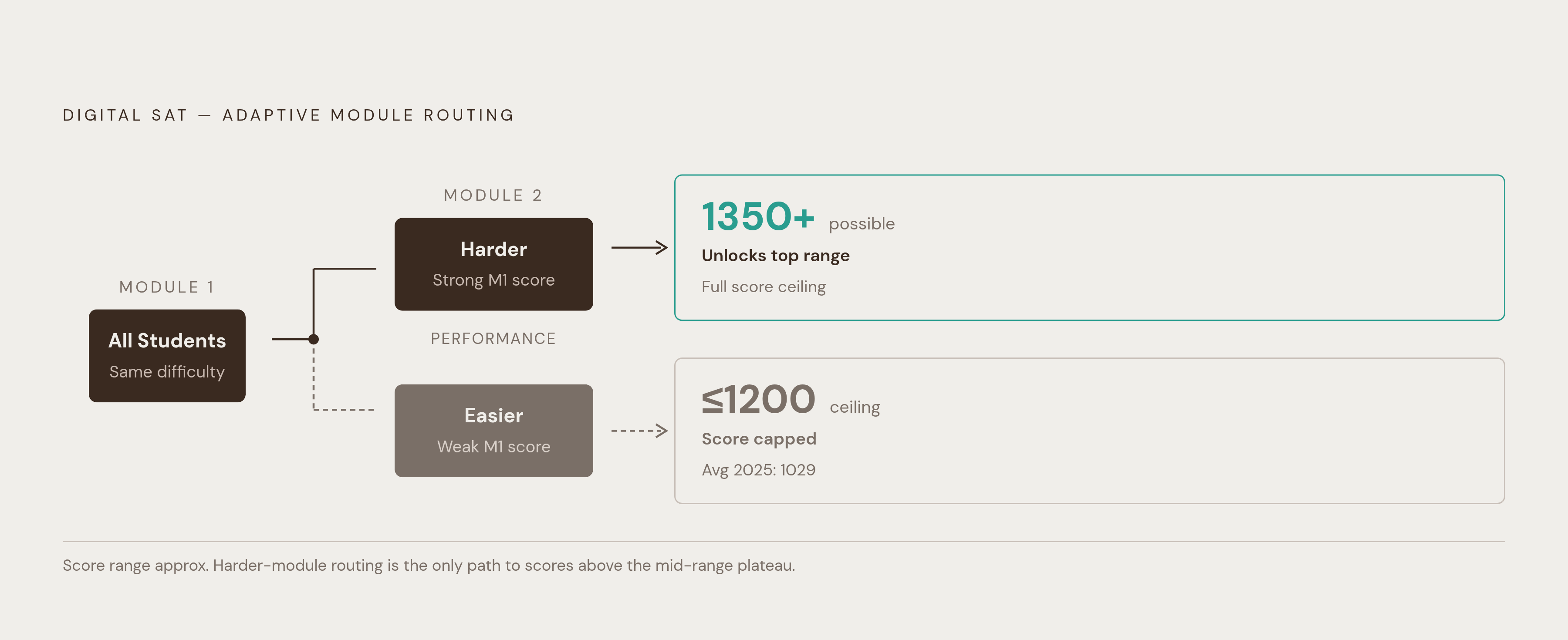
The Digital SAT has two sections: Reading and Writing, and Math. Each splits into two modules. Your performance on Module 1 determines the difficulty of Module 2.
Do well on Module 1, and you get routed to harder questions. Those harder questions are the only path to top-range scores. Do poorly, and Module 2 gets easier. That caps your ceiling no matter how well you perform afterward.
So what does that actually mean for how you practice?
It means studying broadly but shallowly gets you stuck. A student can log dozens of hours and still plateau at mid-range difficulty if they fail to close the specific gaps Module 1 is testing. The average 2025 score was 1029. Breaking 1350 puts you in the top 10%. That gap doesn't close by doing more questions. It closes by working on the right ones.
Think of it like trying to fill a leaky bucket — pouring in more water doesn't help if you haven't found the hole.
Start with the College Board's free Bluebook app. It's the official test environment: full-length adaptive practice tests, a built-in graphing calculator, flagging tools, a countdown timer. It replicates test-day conditions as closely as anything can. But here's what it won't do: tell you why you missed what you missed, or what to fix next. That's the hole every prep app is racing to fill, with very different results.
The feature that separates useful apps from busywork generators
Most apps advertise the same things. Big question banks, video lessons, full-length mock tests, score tracking. Those features matter. They're also the floor, not the ceiling.
An app can flag a wrong answer. Easy. What's hard is distinguishing between a careless arithmetic slip and a real conceptual gap in how linear equations work. Those two errors look identical on a score report. They require completely different responses.
What does actually useful feedback look like?
- Granularity at the skill level. Not just "Math," but the specific problem type: systems of equations, ratios, inference questions in Reading.
- Explanations that walk through reasoning. Not just the right answer, but why the wrong answer felt tempting.
- A system that adjusts what you see next based on what you've actually demonstrated, not just what you've clicked through.
Pacing is underrated here. Untimed practice builds false confidence. If you're consistently getting questions right but taking twice as long as you should, the real test will expose that fast. A useful app trains toward paced performance, not just accuracy.
Content volume is not the metric. Diagnostic depth is.
Khan Academy: the free official option and what it actually delivers
Khan Academy is the only platform besides Bluebook itself with exclusive access to official SAT practice materials. It's the College Board's official prep partner. And it's completely free.
That last part matters more than people give it credit for. A Florida district with 73,000 students, 25% of whom were English language learners, used Khan Academy's SAT tools and saw improved scores and higher graduation rates. The equity argument for this platform is documented and real.
There's also a widely cited finding that students who spent 20 hours on the platform gained an average of 115 points. Some gained more than 200. That data predates the Digital SAT, so treat it as a rough signal, not a promise.
Here's where it gets complicated, though.
- Answer explanations show you the correct method. They rarely diagnose why you chose differently.
- Most exercises are untimed, which works against pacing practice.
- The platform doesn't integrate with Bluebook. Two separate environments, no crossover.
- It's entirely self-guided. If you don't already know your weak areas, nothing here surfaces them.
Khan Academy hands you the tools and leaves the strategy entirely up to you. That works if you already know how to direct yourself. If you don't, you can spend weeks feeling productive and barely move your score. It's a bit like being handed a map with no starting point — useful only once you know where you are.
Magoosh: affordable self-paced prep with a score guarantee
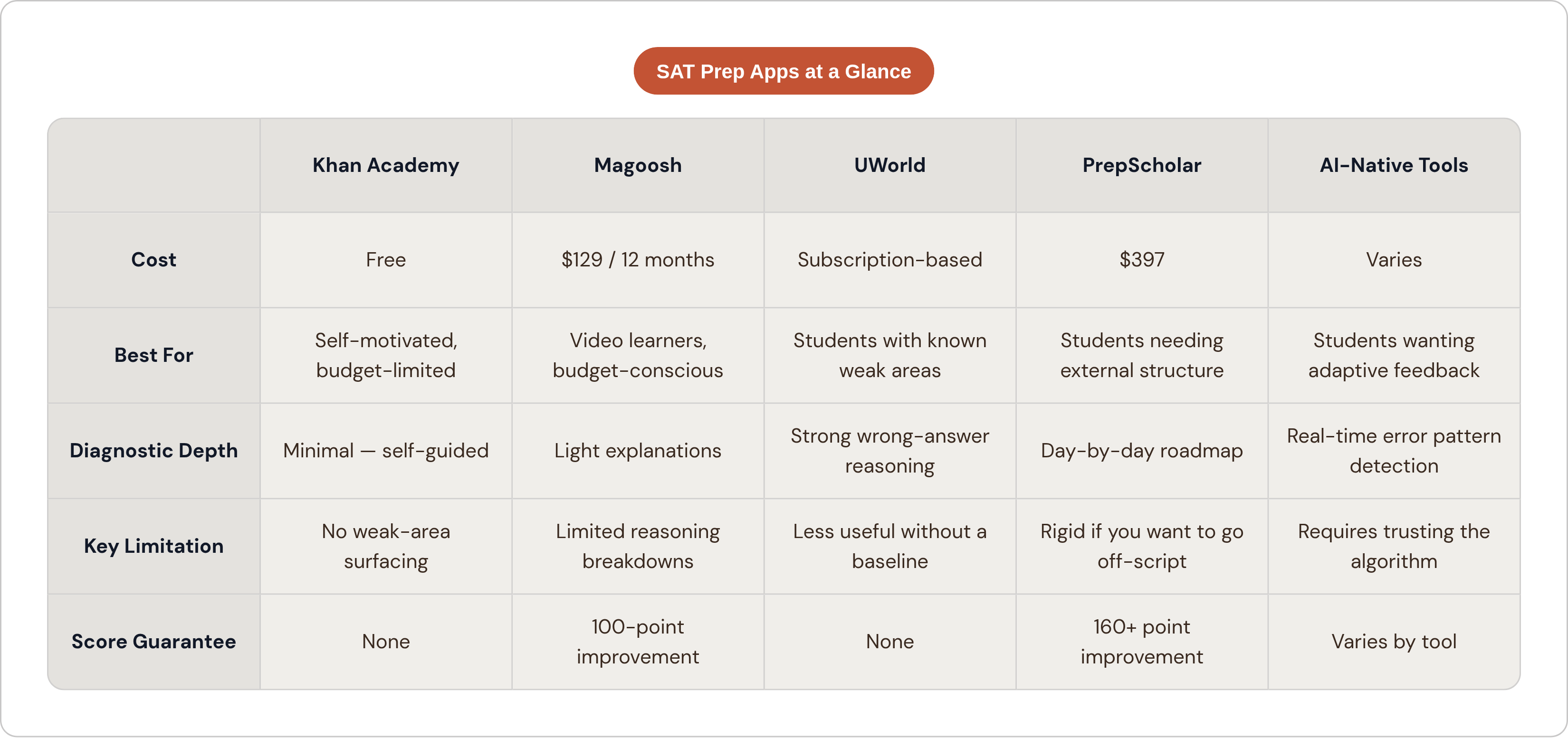
Magoosh offers 12 months of access for $129, well below most paid options.
You get over 200 video lessons, sessions designed to run as short as 20 minutes, and a 100-point score improvement guarantee. The flashcard system removes terms you've already mastered from rotation, so you're not grinding vocabulary you already own. That's a small design decision that signals someone thought about the difference between looking busy and actually improving.
It fits students who need more structure than Khan Academy provides but can't justify a higher price point, and who absorb information well through video.
One thing to sit with: a score guarantee is a marketing commitment. It reflects confidence in the product, not a replacement for feedback on why your answers are wrong. The explanatory depth here is lighter than what you'd get from tools built specifically around diagnosis and reasoning breakdowns. You'll know you got something wrong. You may not fully understand why your thinking went there in the first place.
If budget is the primary constraint and video instruction clicks for you, Magoosh is a legitimate choice. Just go in knowing what it is.
The value of deep answer explanations, and when they help most
There's a real difference between an app that tells you the right answer and one that shows you where your reasoning went sideways. Some tools sit firmly in the second camp, offering long-form explanations that walk through the logic of wrong answer choices and help you understand why a trap was tempting. That's often more useful than knowing what the correct answer was.
That kind of depth is most valuable once you already know which areas need work. If you're still mapping your weak spots, deep answer explanations are somewhat wasted on you. You're not ready for them yet.
A few questions worth asking before committing to any explanation-heavy platform:
- Does the explanation address the reasoning process, or just the answer?
- Does it explain why wrong answers are wrong, not just why the right answer is right?
- Does it help you categorize the type of error you made?
If the answer to all three is yes, you're looking at a useful tool. If it's just walking you through a worked solution, you're still doing most of the diagnostic work yourself.
The practical implication for any explanation-heavy platform: get a diagnostic baseline first. Knowing which skill areas need attention before you go deep makes those detailed explanations land. Without that, you're reading thorough explanations for the wrong problems.
PrepScholar: structured diagnostic plans for students who need a roadmap
PrepScholar's value is structure. Take a diagnostic test, get a day-by-day study schedule, and the platform tells you what to work on, in what order, and when.
For a self-study student without a tutor, that matters more than it sounds. The hardest part of self-directed prep isn't access to content. It's knowing what to do with your time and having something external hold you to the plan you've already committed to.
The content library is substantial: over 7,100 practice questions, hundreds of strategy videos, multiple full official SAT exams, and a 160-plus-point score improvement guarantee. The core program runs $397.
But here's a question worth sitting with. What happens when the structure stops fitting?
Students who are past the diagnostic phase and want to drill deep into a specific skill area may find PrepScholar's structured plan more rigid than useful. The system works best when you trust it and follow it. If you're the type to go off-script because something finally clicked and you want to chase it for a week, the platform's architecture might frustrate you more than it helps.
Best match: students who know they need external direction, aren't sure what to study, and want a system that makes those decisions for them.
AI-native apps pushing toward real-time gap detection
This is where the category is heading.
A newer wave of tools is trying to close the gap between "you got this wrong" and "here is the specific pattern in your errors, and here is what to do about it." That's a harder problem than building a question bank. It's also the right problem to be solving, and the early attempts are interesting enough to pay attention to.
SAT Prep 2026 by Smartschool includes an AI tutor called Yoko, more than 5,000 questions aligned to Bluebook format, and real-time diagnostic quizzes covering all 42 math question types and all 28 reading and writing question types. It's attempting to close gaps in real time, not just report on them afterward.
AlphaTest AI generates a readiness map from a short diagnostic. Its "Weakness Conqueror" feature auto-detects error patterns and serves targeted drills. The concept is sound: stop making students decide what to work on, and let the pattern data decide for them.
Passionfruit Learning, an AI-powered SAT and AP exam-prep platform, works from the same premise but goes a step further. Its AI tutoring and analytics track not just right and wrong answers but where a student's thinking breaks down, distinguishing a conceptual gap from a careless error. It's also built to work for individual students and for teachers managing gaps across a whole classroom.
The common thread: these tools are most useful when a student is willing to trust the diagnostic and follow where it leads. If you keep drilling what you're already good at because it feels productive, no algorithm can fix that. You have to actually let the data lead.
How to match the right app to how you actually study
The question isn't which app has the most features. It's which one closes the gap between "I practiced" and "I improved."
A few matches by situation:
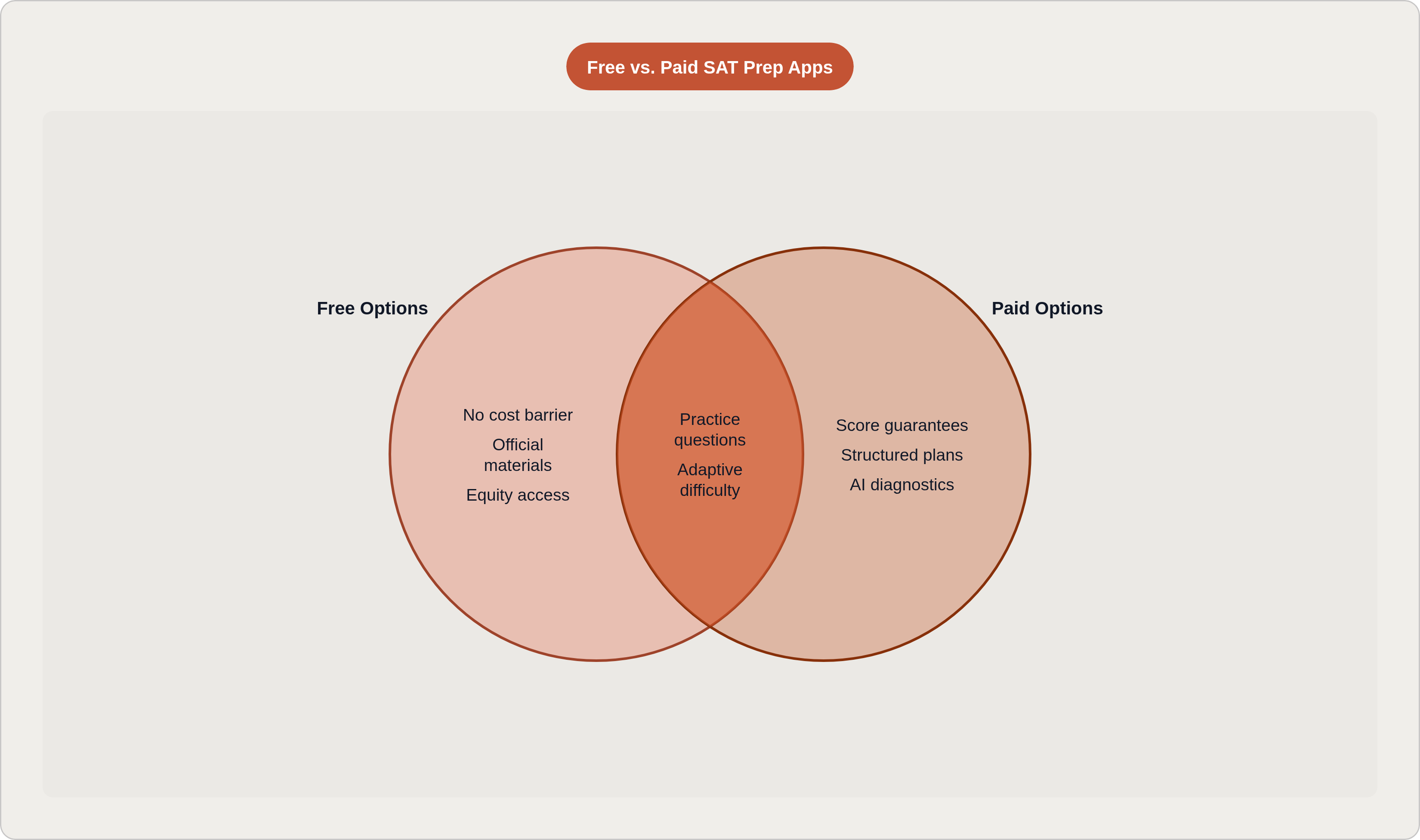
- Budget is the primary constraint, and you're self-motivated. Khan Academy as a free foundation, supplemented by Bluebook full-length tests. Official materials, zero cost.
- You need structure and a clear daily plan without paying for a tutor. PrepScholar's diagnostic roadmap at $397 takes the burden of deciding what to study next off your plate.
- You want deep explanations and already know roughly where you struggle. Look for a platform built around long-form, reasoning-focused answer explanations. Go in after you've identified your weak areas, not before.
- Budget-conscious but want paid structure and a guarantee. Magoosh at $129 offers video instruction and a score commitment at a price that doesn't sting.
- You want feedback that adapts as your understanding develops. AlphaTest AI, SAT Prep 2026 by Smartschool, and similar AI-native tools are built for this.
One thing applies across all of them: take a full-length Bluebook practice test before you choose a study tool. Knowing your baseline score by section makes every subsequent decision more useful. You'll know which area to prioritize, whether you're a Khan Academy candidate or a PrepScholar candidate. You stop guessing and start working.
After that, the students who improve most tend to be the ones who actually look at their wrong answers instead of clicking past them. That's less inspirational advice and more just pattern recognition from watching a lot of people study. The score is in the review, not the reps.