Best AP Exam Prep Apps Compared
Practice on Bluebook before test day, or risk learning the hard way on exam day.

Most AP exams now use the College Board's Bluebook platform for multiple-choice sections. Some are fully digital, and others are hybrid. A large majority of students in post-exam surveys said Bluebook was easy to use, which sounds reassuring until you ask the obvious follow-up: easy compared to what? If your only practice was on printed PDFs, you have no real basis for comparison until you're already sitting in the exam room. It's like training for a swim meet by reading about water.
Comfort with an interface comes from using it, not from assuming it'll feel intuitive.
The question layout looks different on screen. Pacing shifts. Even small things, like flagging a question to return to, work differently in Bluebook than on paper. A student who has drilled exclusively on printouts is practicing the right content in the wrong environment. That's a preparation gap that has nothing to do with subject knowledge.
So digital readiness is now a real, separate criterion alongside question quality and explanation quality. A tool that delivers excellent content without putting you anywhere near a Bluebook-style experience is leaving a whole layer of preparation on the table. Worth keeping that in mind as you evaluate your options.
AP Classroom: the official platform most students underuse
AP Classroom is built by the College Board, and that one fact gives it an advantage no third-party tool can replicate: the question bank is drawn from actual past AP exams. You're practicing on the real thing.
The feature set is strong:
- AP Daily Videos tied to specific units and skill types
- Progress Checks mapped to the exact framework the College Board uses to write the test
- A searchable question bank indexed by content area and skill
- FRQ scoring with official College Board rubrics, directly inside the platform
- Printable assessments, which matters where digital access is uneven
So why does this end up as the most underused tool in AP prep? Because it requires a teacher's join code, and with no code, there's no access. Students who are self-studying are completely locked out. That is a strange design choice for the most authoritative AP prep resource in existence, and the students who most need independent access are the ones who pay for it.
For teachers reading this: the platform has improved. FRQ scoring with official rubrics inside the tool is a real upgrade. If your students have access, there's more here than most teachers are currently using.
Khan Academy: the strongest free option, with real limits on AP depth
Khan Academy is an official College Board partner. For most major AP subjects, including Biology, Chemistry, Physics, Calculus AB/BC, Statistics, US History, World History, Government, and English, the content is aligned to College Board standards. Its most credible proof point is SAT prep: documented score gains, consistent across income levels and GPA, at real scale.
Khanmigo, Khan Academy's AI tutor, asks guiding questions rather than handing you answers, which is the right instinct — building reasoning, not answer recognition.
But the AP coverage has limits worth knowing about. Video instruction leans heavily toward math. Reading and writing subjects get noticeably thinner treatment. And there's no live help when you're stuck at 11pm on something that makes no sense and your exam is in three days.
Here's the more specific problem. Khan Academy can tell you whether you got a problem right, but it's not really designed to tell you why you got it wrong. For students who already have strong study instincts and a clear sense of their own gaps, that's workable. For students who are still learning what they don't know, the platform doesn't do much to surface it. And that second group is most students.
Albert.io: deep question banks and strong teacher controls, at a price
Albert.io claims the largest library of standards-aligned AP questions among third-party platforms. More than 40,000 practice questions across subjects, full-length exams, FRQ prompts with sample responses, and explanations that walk through the reasoning rather than just restating the answer.
The teacher-facing tools are where it actually separates itself. Teachers can hide full-length exams until they're ready to assign them, which preserves fresh tests that haven't been previewed. Custom assignments can be tailored per student based on performance data. FRQ practice includes sample responses with AP-style rubrics, which gets closer to real scoring than most competitors manage.
The content team also updates materials when the College Board changes a course framework. That sounds minor, but it isn't. Outdated practice material can quietly mislead a student who has no way of knowing it's stale.
Full access starts at $79 per AP subject. Passionfruit Learning, an AI-powered AP and SAT prep platform, takes a different pricing approach by offering unlimited AI-generated practice questions under one plan. A student taking three exams is doing real math on that. The free tier exists but covers a limited slice. For one high-stakes subject where you need exhaustive practice, the cost can make sense. Spread across several subjects, it adds up fast.
Knowt and community-first tools that trade depth for accessibility
Knowt's core mechanic is simple and useful. Upload your notes, a PDF, a slide deck, and the AI generates flashcard sets and practice quizzes from that material. For students who are already doing the reading but haven't been turning it into active recall, that's real friction reduction. Instant grading with feedback is included, even for FRQ-style responses. The free tier is more robust than most competitors.
Some tools lean into community. Study streams, peer collaboration, live review sessions. These create accountability that solo tools can't replicate, and for some students that social layer is the actual difference between showing up to study and not.
But here's where both platforms hit the same ceiling. They're built for memorization and surface-level recall. Neither is designed to diagnose why your thinking broke down on a question, or whether the same conceptual gap is going to surface differently on a different question type next week. They can tell you that you missed something, but what the miss actually means is left for the student to figure out on their own.
The Princeton Review and Study.com: full-service options for students who want more hand-holding
Study.com covers more than 25 AP subjects with video-based courses, practice questions, and full-length practice tests. For students who absorb material better through explanation than through reading alone, the video-forward approach helps. The personalized study schedule tool is underrated, especially for students who struggle with pacing themselves across a long prep timeline. There's also 24/7 access to expert tutors, which is useful at 11pm the week before an exam.
The Princeton Review brings structured curriculum, a strong brand, and multiple format options including self-paced online courses and live instruction. The trade-off is cost. Full-service options are priced for families who have already decided they're spending real money.
Both platforms depend on a human tutor recognizing where you're stuck. That's meaningful feedback, but it's also dependent on the student being able to articulate what's confusing them, which is harder than it sounds when the confusion itself is the actual problem.
What most of these tools have in common, and why it's a problem
Strip away the branding and most AP prep tools run on the same model. Deliver content. Generate questions. Show a score. Maybe explain the correct answer.
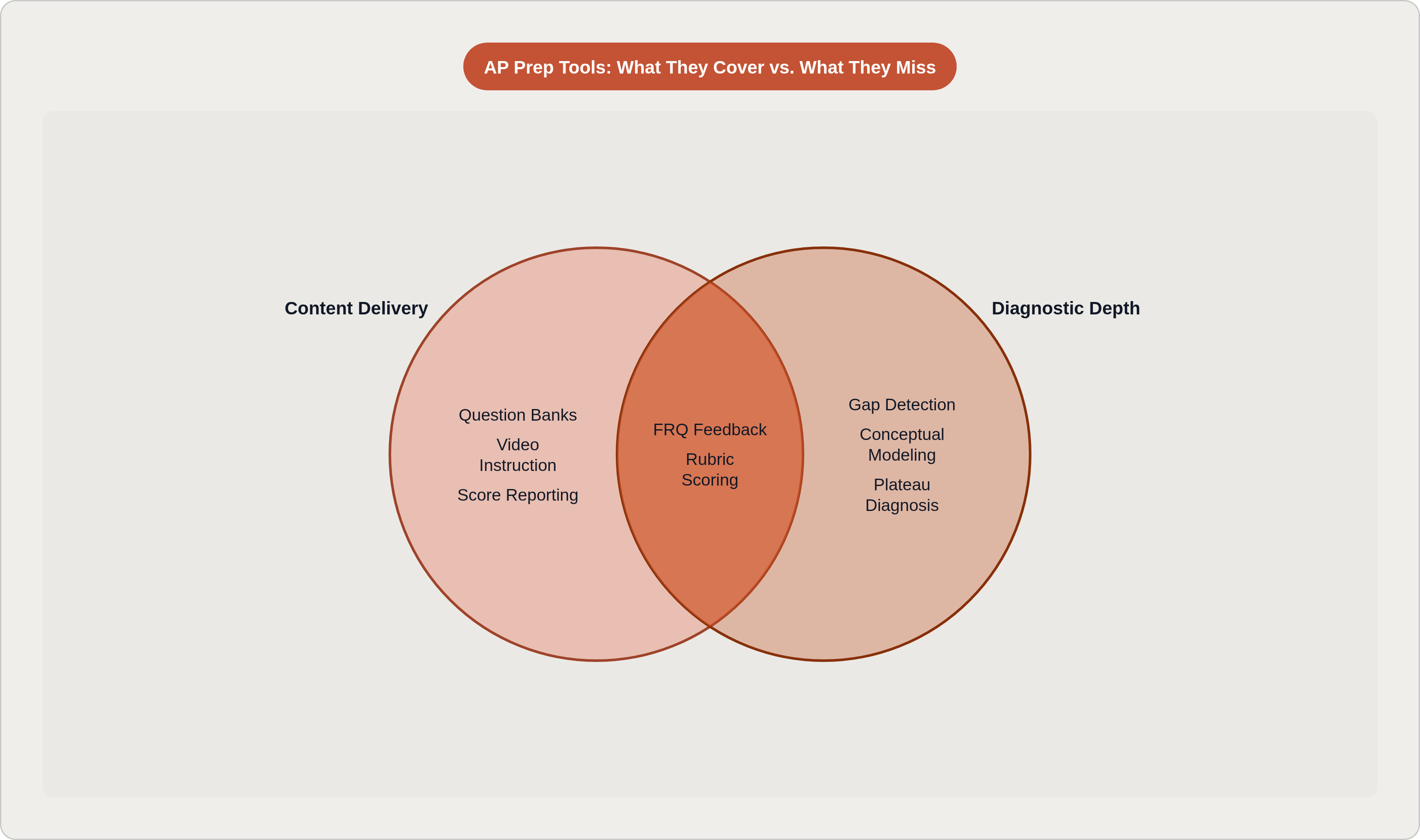
A score tells you how you performed. It doesn't tell you why you got something wrong. It doesn't surface the conceptual misunderstanding sitting underneath that error. It doesn't flag whether the same gap will show up again on a different question type next week. Those are three different things, and almost nothing in this space addresses all three.
FRQ feedback is where this breaks down most visibly. Most tools offer sample responses and rubrics, then hand the gap analysis back to the student, who is often the least equipped person in the room to do it. You don't know what you don't know — and that's not a knock on students, that's just how knowledge gaps work. The person with the gap rarely knows its shape. Asking a student to diagnose their own blind spot is like asking someone to see the back of their own head without a mirror.
Even tools with AI features are mostly designed to help students practice more, not to model what a student actually understands versus what they're pattern-matching through or outright guessing.
So a student can complete hundreds of practice questions, score somewhere around average, and walk into exam day carrying a structural gap they've been unable to name. No part of their prep was built to find it. Drilling produces familiarity with questions, but mastery requires understanding the subject underneath the questions. The difference tends to show up in the score.
Where Passionfruit fits, and what AI-powered gap detection actually looks like in practice
This is the part where I'm supposed to say something like "look, I know how this reads," but that framing is its own kind of deflection, so let's just get into it.
The gap described in the previous section is real. It shows up consistently across the platforms above, not as a flaw in any one product but as a structural limitation of how most prep tools are built. Passionfruit is designed specifically for AP subjects and the SAT, not as a general study tool that got retrofitted for exam prep. The foundation is unlimited practice problems with AI-powered grading, which directly addresses the FRQ feedback problem that most established platforms still handle poorly.
The more interesting layer is what happens after grading. The system models where a student's thinking actually breaks down — not just "you missed this question," but here is the conceptual gap that explains the miss, and here is what that same gap looks like when it surfaces in a different format. That's a categorically different signal than a score.
That distinction matters most for students who have been practicing steadily but can't get their scores to move. There's often something structural underneath a plateau that practice volume alone won't fix. Finding it requires something in the prep stack that's built to look for it, not just to deliver more content.
Passionfruit works for individual students targeting a specific score and for teachers trying to close gaps across a full classroom. The value is diagnostic depth and feedback quality, not raw question volume.
How to choose the right combination of tools given your situation
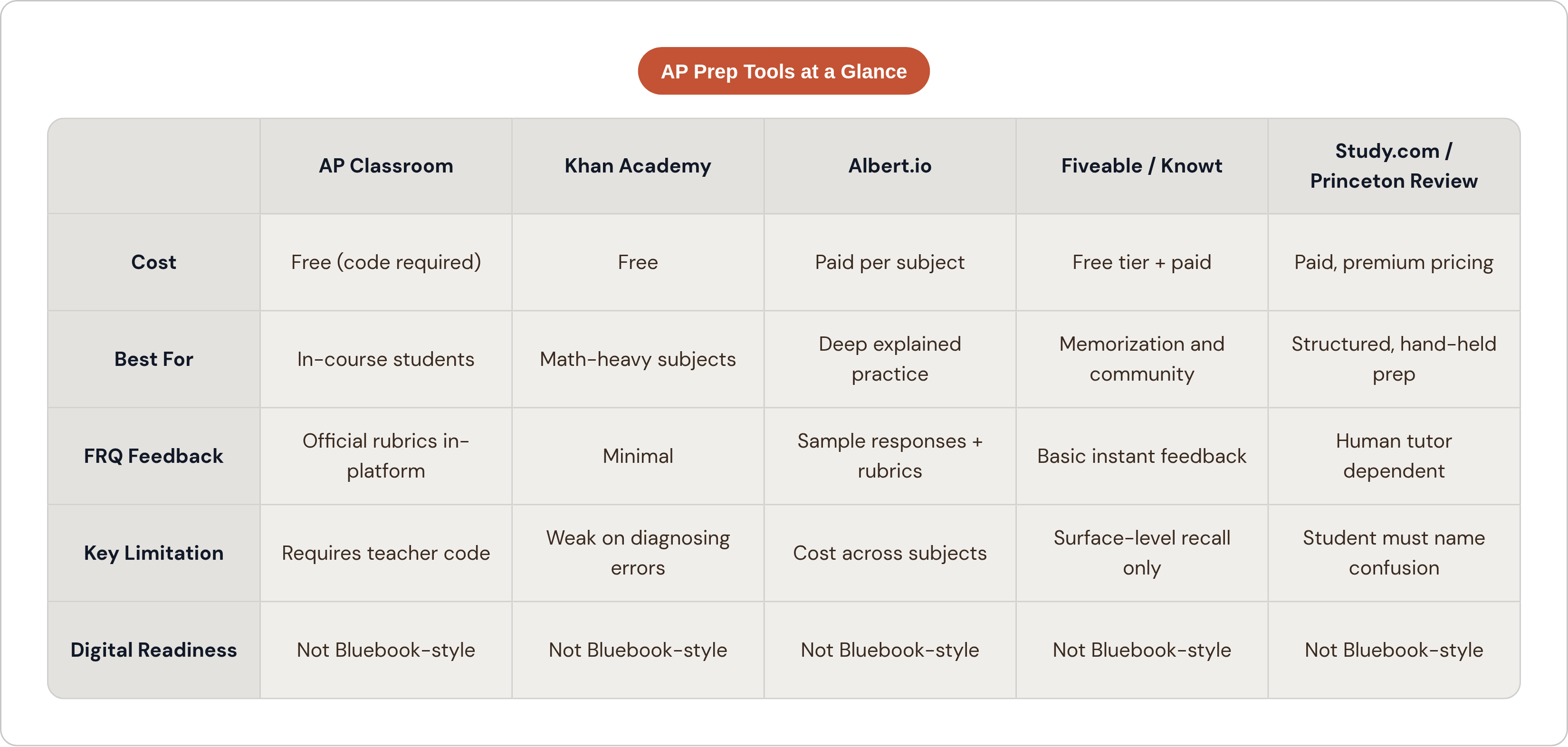
No single tool covers every need. That's not a failing of any individual platform — it's just the shape of this space. Students who do well tend to combine a content resource with a diagnostic one. Here's how to think through it based on your actual situation.
In an active AP course: Start with AP Classroom. It's free, it's official, and it's built around the same framework your exam uses. Get your baseline there before adding anything else.
Self-studying and need free content coverage: Khan Academy is the strongest no-cost option, especially in math-heavy subjects. Expect thinner coverage on FRQs and reading-heavy subjects, and plan to fill those gaps elsewhere.
Need deep, explained practice in one or two specific subjects: Albert.io's question depth is hard to match among third-party tools. The per-subject cost is real. For a high-stakes exam where you need exhaustive explained practice, it can be worth it.
Budget is a real constraint: Layer the free tools (AP Classroom plus Khan Academy) and add one paid tool targeted at your weakest subject. Pay for depth where you actually need it, not for broad access you won't use.
Prepping for a harder exam (AP Physics 1, AP Statistics, AP Latin, AP Music Theory all carry lower pass rates) or you've been practicing steadily and still can't figure out why your score won't move: that's the specific situation where a diagnostic tool like Passionfruit fills the gap that content platforms leave open.
The real question isn't which app has the most questions. It's which combination will surface the specific gaps standing between you and the score you're targeting. Those gaps are often invisible until something in your prep is built to find them.