AP English Language and Composition Exam Difficulty and Workload
Hundreds of thousands take it, but most still score below passing.

Before getting into what makes it hard, it helps to look at who is actually taking it. In 2025, 617,689 students sat for the exam, making it the single most-taken AP course in the country. That is not a niche elective. That is a huge, varied slice of the entire junior class nationwide.
Part of the reason so many students end up in this class is the credit. It's the credit. AP Lang satisfies a core composition requirement at most colleges, no matter what a student plans to major in, so guidance counselors point students toward it almost by default. That has a real effect on how to read any pass rate or difficulty claim about this exam. That breadth of enrollment is the first thing that makes any difficulty statistic for AP Lang tricky to read at face value. A pass rate is only meaningful once you know who's in the room.
What the score data shows, and what it obscures
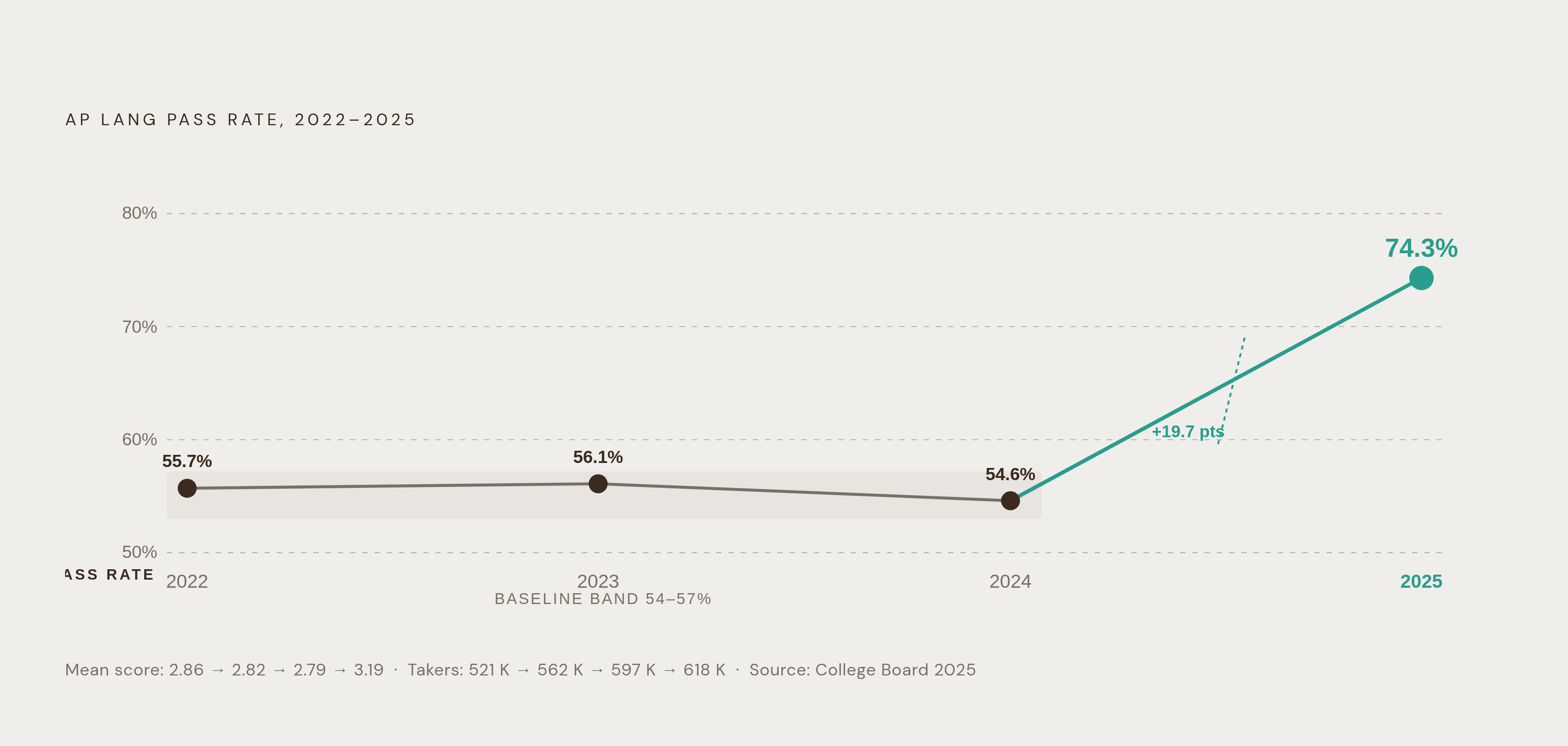
Start with the headline number, because it's a genuinely strange one. That's a sharp jump from 2024, when only 54.6% passed and the mean sat at 2.79, out of 597,097 students. A near-20-point swing in pass rate, in a single year, on an exam taken by hundreds of thousands of students? That should make anyone pause before assuming 2025 tells the whole story.
Look at the run-up to it. In 2022, 55.7% passed with a mean of 2.86 across 520,771 test takers. In 2023, 56.1% passed with a mean of 2.82 across 562,328 test takers. In 2024, 54.6% passed with a mean of 2.79 across 597,097 test takers. Then 2025 jumps to 74.3% and a mean of 3.19 across 617,689 test takers. The 2022–2024 baseline is the more instructive signal for a student planning preparation, reflecting three consecutive years where the average student scored below a 3.
What does that actually mean for a student building a study plan? It means the "average" outcome on this exam, historically, has been a middling score, not a comfortable pass. And the top tier stays narrow even in a strong year: 13.4% of students earned a 5 in 2025, and across 2022 to 2024 that figure sat between 9.8% and 10.4%. So even when overall passing gets easier, a 5 remains a genuinely selective outcome. One might argue this is actually good news for a prepared student. If roughly half the room is scoring below passing in a typical year, a student who shows up with consistent practice isn't competing against the median test-taker. They're separating from a large, underprepared cohort just by doing the reps everyone else skips. The year-by-year picture shows the 2025 result is an outlier relative to the 2022–2024 trend.
How the exam is structured and why that structure creates pressure
The exam runs 3 hours and 15 minutes total. Section I is 45 multiple-choice questions in 1 hour, worth 45% of the score.
The multiple-choice section isn't just "read a passage, answer some questions about what it said." Questions are organized across five passage sets, and some of them ask students to revise and edit the stimulus text as if they were the writer, not just interpret it as a reader. That's a different skill than comprehension. It's closer to editing.
Then comes the essay gauntlet. Three distinct essay types, each demanding something different. The Rhetorical Analysis essay asks students to explain how a writer's specific choices, diction, syntax, structure, actually serve their purpose.
Notice what's not on that list: length. The rubric rewards explanation and complexity, not word count. That's not a lot of runway for someone who drafts slowly or freezes trying to figure out a structure on the spot.
Two structural changes apply to anyone taking the exam going forward. Starting in 2026, the multiple-choice section drops from five answer choices to four, part of the broader shift to a digital exam. And the exam is now fully digital: students read, answer multiple choice, and type all three essays inside the Bluebook app, with responses auto-submitting the second time runs out. That last detail changes the physical task facing a student who has only ever handwritten timed essays on exam day. A student who has only ever handwritten timed essays is walking into a different physical task on exam day. Pacing math works out to roughly 40 minutes per essay after the reading period (a real constraint that punishes students who draft slowly or freeze on structure).
Where the difficulty lives (skill-based, not content-based)
AP Lang looks easy on paper, which trips people up. There are no dates to memorize, no formulas, no required reading list, no lab procedures. That absence of fixed content is exactly what makes the class feel approachable when students first walk in.
But absence of content doesn't mean absence of difficulty. It just relocates it. Reading dense nonfiction fast enough to get through 45 multiple-choice questions in 60 minutes is a real skill, and it's one most students haven't built by junior year. Synthesizing six sources into an essay without letting those sources hijack the argument is another. So is generating specific, well-chosen evidence for the Argument essay from memory, on the spot, under a countdown clock.
The most common failure mode is summarizing instead of analyzing, describing what a passage is about instead of explaining what the writer is doing and why it works on the reader. Rhetorical Analysis raises this problem most severely. Plenty of students can spot parallelism, anaphora, or juxtaposition and name it correctly. Naming the device isn't the point, though. The score comes from explaining what that specific choice does to this specific audience in this specific text. Skipping that step means the device-spotting earns almost nothing.
Dropping in a broad example without explaining exactly why it proves the claim leaves points on the table. Of the eight skill categories tested, Claims and Evidence, Reading and Reasoning, and Organization and Reading carry slightly more weight than the rest, which makes them the highest-leverage areas for a student deciding where to spend limited study time.
Compare that to something like AP US History or AP Biology, where difficulty often comes down to how much content a student has crammed into memory. AP Lang flips that. There's less to memorize and more precision required in applying skills that only get sharp through repetition. It's also, in a strange way, a fairer test. It rewards a whole year of habit rather than a caffeinated weekend of flashcards.
What the course demands week to week
Course providers put the typical AP Lang workload at 10 or more hours per week. That number surprises some students, since there's no textbook to memorize and no problem sets in the traditional sense. Instead, the hours go into a steady diet of short writing assignments, paragraph rewrites, timed essays, essay analysis, and discussion work.
Writing stamina is easy to underestimate. Plenty of students write well when they have time, quiet, and no clock running. Under exam conditions, three essays inside 120 minutes of writing time, performance drops. That's not a knowledge gap.
AP English Language is in the middle of the AP difficulty spectrum, but its challenge is distinctive (not content memorization, but the timed synthesis of analytical reading and three-essay writing under pressure). A course like AP Chemistry front-loads a mountain of content that a student has to absorb early and then apply. AP Lang doesn't work that way. The pressure in this class is flat, spread evenly across every single week of the year. There's no unit test to cram for and then forget.
Difficulty here also isn't a fixed quantity. It scales with what a student walks in with. A student who already reads and writes comfortably may find the course manageable, even light. A student starting from a weaker reading and writing base can find the exact same class overwhelming, even though nothing about the curriculum changed. Same course, wildly different experience, depending entirely on where a student's skills sit on day one.
How to prepare strategically given where the difficulty is
Since the exam tests skill and not memorized content, the right prep model looks less like flashcards and more like practice-and-feedback, over and over, on the same handful of moves.
Start with a nonfiction reading habit. Speeches, editorials, memoir, journalism, historical documents, anything with a real argument and a real audience. The goal is to read actively for the rhetorical situation. It's to read actively for the rhetorical situation: what is this writer trying to do, to whom, and what specific choices are they making to get there?
On the multiple-choice section, there's no penalty for guessing, so every single question should get an answer, even a blind one on a question that's eating too much time. Scanning the questions before diving into a passage helps too, since it flags whether a set is testing rhetorical situation, reasoning, evidence, or revision, which changes how a student should read the passage in the first place. Before locking in an answer, it helps to find the exact line or phrase in the passage that justifies it, rather than going with a gut feeling.
Each essay type calls for its own approach. On Rhetorical Analysis, every device named needs a partner: the specific effect that device has on this audience, for this purpose, in this text. On Argument, the strongest move is building a small bank of flexible evidence before exam day, examples from history, science, current events, or personal experience that can stretch across different prompts, and then practicing the explanation of why each piece actually proves the claim.
Timed practice isn't optional here, it's the whole game. That means practicing by typing essays under conditions that mimic the Bluebook app, not handwriting practice essays and assuming the skills transfer one to one.
A reasonable timeline: begin a focused review at least 6 to 8 weeks out from the exam, starting broad, then narrowing to whatever skill area the exam approaches reveals as weakest. That narrowing only works, though, if the feedback is specific. Knowing an essay scored a 4 out of 6 doesn't tell a student much. Knowing the point was lost specifically on evidence and commentary, and not on thesis or sophistication, is what actually changes how the next essay gets written. AI-assisted grading tools built around the exam's own rubric criteria can help here, flagging exactly which row a student keeps losing points on so practice time goes toward the actual gap instead of repeating a skill that's already solid.
Memorizing the answer to a specific practice question does nothing for the next question that tests the same skill on a different passage. The whole point of practice is recognizing the underlying skill and reapplying it cold, on material never seen before. That's true for AP Lang. It's also true, as it turns out, for the SAT.
The college credit payoff and the connection to SAT reading and writing skills
The payoff for doing all this work is concrete. A score of 3, 4, or 5 earns college credit at hundreds of schools, though some selective institutions set the bar at a 4 or 5. The exact value varies by school: Duke requires a 4 or 5 for one course's worth of credit, Carnegie Mellon requires a 5 for 9 credits, and Texas A&M awards 3 credits for a plain passing score of 3. Given that in 2025 13.4% earned a 5, and in the 2022–2024 band the figure hovered between 9.8% and 10.4%, earning a 5 is genuinely selective.
Credit is only part of the return, though. The actual skills built in this course, constructing an argument, weighing evidence, revising prose under pressure, appear in every research paper and essay exam a student will face in college, regardless of major. That's a strange kind of return on investment: a high school class that pays dividends in courses that haven't even been chosen yet.
AP Lang and SAT Reading and Writing prep aren't separate tracks, they're the same muscle group. The SAT's Reading and Writing section measures four domains: understanding information and ideas, craft and structure, improving expression of ideas, and applying standard English conventions. Every one of those domains gets developed by AP Lang's core work, close reading, rhetorical analysis, revision. The SAT no longer includes an essay for most students, so its highest-leverage prep leans toward grammar, sentence structure, concision, and transitions inside a timed module, which is a narrower task than AP Lang's essays but draws on the same underlying reading skill.
Treating AP Lang prep and SAT prep as two separate projects means competing for the same limited hours. Students who treat AP Lang and SAT prep as parallel skill-building, rather than separate content silos, get compounding returns on the same hours of reading and analysis practice. SOURCE PAGES (what the pages behind the outline's links say).