AP English Language Argument Essay Mastery
Master the rubric's three layers to raise your AP Lang argument score.

This piece covers the AP Lang argument essay rubric, and the claim driving it is simple: the score is decided by how well a student writes to the rubric's three layers, not by talent, vocabulary, or hours logged.
Why the argument essay determines your AP Lang score
The multiple-choice section feels like the main event because it comes first and it's gradable with a bubble sheet. It isn't the main event. The exam is split into two unevenly weighted halves: multiple-choice questions make up less than half the score, and the three free-response essays make up 55 percent. That alone should change how a student spends prep time.
Running the arithmetic sharpens the stakes: a student who crushes the multiple-choice section but writes thin, unfocused essays can still land below a 3. A student who's middling on multiple-choice but writes essays that actually hit the rubric can reach a 4. The 2026 AP Lang score calculator breakdown lays this math out directly, and it's not subtle once you see it.
The argument essay carries extra weight inside that already-heavy essay block. Synthesis, rhetorical analysis, and argument each count equally toward the free-response score. That means one weak argument essay doesn't just cost points in isolation. It drags the whole composite down, because there's no fourth essay to average it out. The essay section is where a score is made or broken. Everything in this piece follows from that fact.
The 2026 Digital Exam and the Argument Essay
The 2026 shift to a digital exam changed a lot about how the test feels to sit through, but it left the argument essay's actual structure and scoring untouched.
On the multiple-choice side, the digital test now opens with reading questions rather than easing in with sentence-revision tasks, and roughly half of Section I consists of draft-based "writer's choice" revision items that simply didn't exist in the paper era. Reading sets come first, writing and revision sets follow. If someone studied from an old paper exam and expected the test to start with grammar-style editing questions, that assumption no longer holds.
None of that touches the argument essay. The prompt format is locked in place: a single quotable claim from a public figure, and the task is always to evaluate the extent to which that claim holds up. The 2026 U.S. paper uses the exact same template as the 2024 and 2025 exams. Delivery changed, students now work through the Bluebook app, choose from four answer options instead of five, and get Highlight and Notes tools built into the interface, but the 0-6 scoring rubric and the three-criteria structure behind it carried over without modification.
That's good news for anyone prepping right now. The rubric knowledge in the rest of this piece isn't at risk of going stale before exam day. The scoring logic examined here is the current logic.
How the Rubric's Three Layers Divide the 6 Points
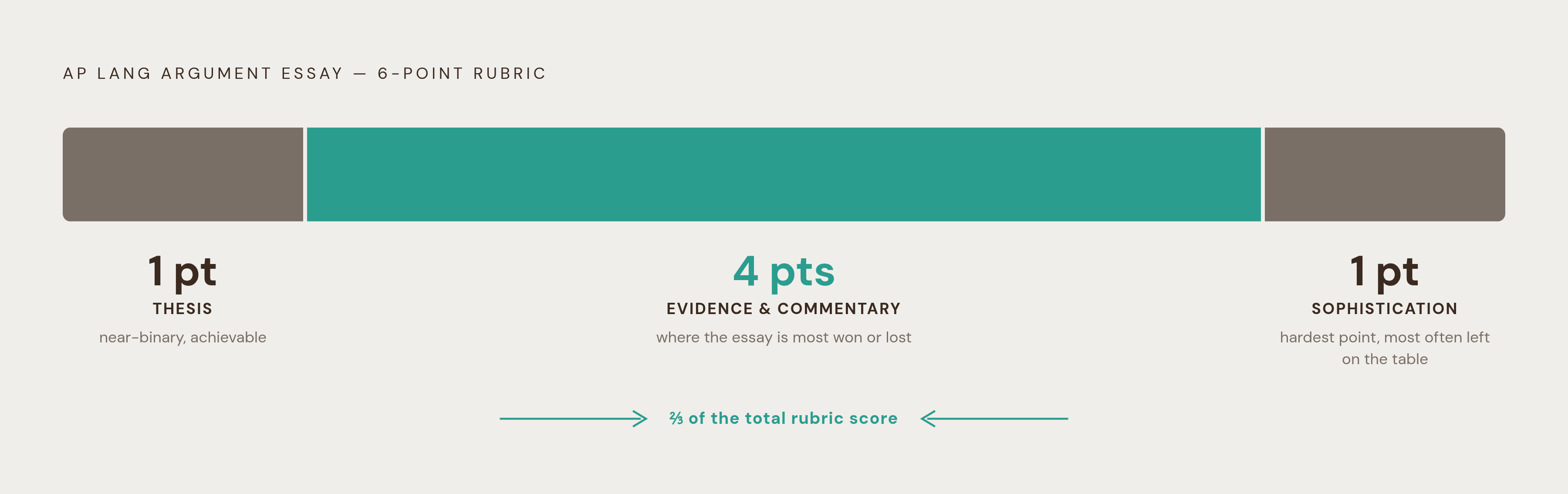
Before getting into how to earn points, it helps to see the whole map at once. The rubric allocates points unevenly across its three criteria, and understanding that distribution is the first strategic decision a writer must make. Understanding that imbalance is the first real strategic decision any student makes when planning how to spend their 40 minutes.
Thesis is worth 1 point, evidence and commentary is worth 4 points, and sophistication is worth 1 point. That adds up to the full 6. Notice where the weight sits. Evidence and commentary holds 4 of the 6 available points, making it the category where the essay is most won or lost.
Thesis and sophistication both carry just 1 point each, but they behave nothing alike. The thesis point is close to binary, a student either states a defensible claim or doesn't, and it's achievable through disciplined writing rather than inspiration. Sophistication sits at the opposite end: it is the hardest point on the whole rubric to earn, and the one most students leave on the table without realizing it.
That imbalance has a direct, almost counterintuitive consequence. A student with an elegant, carefully worded thesis and thin, underdeveloped body paragraphs will score lower than a student with a plain, functional thesis and fully developed commentary. The point distribution rewards depth in the middle of the essay far more than polish at the start. Keep that order in mind: thesis, then evidence and commentary, then sophistication, because the sections ahead walk through each layer in exactly that sequence.
What Earns the Thesis Point
Start with the easiest point on the rubric, and also the one most casually given away. To earn the thesis point, a response needs to relate to the prompt, make an actual claim rather than summarize it, and be identifiable as present somewhere in the essay. If a response skips any one of those, the score on this row is zero.
The failure mode here is hedging. A student who lays out "both sides" of the issue without ever committing to a position doesn't earn the thesis point, no matter how fluent or well-organized the prose is around it. The rubric is checking for a claim that takes a stand on this row.
The exam splits into two weighted sections: multiple-choice questions worth less than half and three free-response essays worth 55%, a structural fact that means essay performance outweighs MCQ performance. One is restating the public figure's quotation in slightly different words and calling it a position. The other is writing some version of "there are many perspectives on this issue" and leaving it there. Both read to a trained scorer as no thesis at all, regardless of how much the surrounding paragraph says.
The thesis doesn't have to open the essay. It needs to show up somewhere as a clear, defensible claim that the rest of the essay can actually argue for, and because the thesis is only worth 1 point, students should spend minimal time on it but make it count, one or two sentences, a real position, nothing fancier required. That's where the easy point ends and the hard work starts, because the next 4 points don't come nearly as cheap.
What earns points at the evidence and commentary layer
This is where most of the essay's score actually lives, and where most students quietly lose it. The rubric is checking two separate things at once: whether the evidence chosen is relevant and specific, and whether the student explains how and why that evidence actually supports the thesis. Most students do the first and skip the second.
The row is graded on a scale, and moving up that scale requires more than swapping in better examples. Higher scores demand evidence that's specific rather than vague, paired with explanation that makes the logical link between evidence and claim explicit rather than implied. A fact sitting next to a thesis isn't the same as a fact connected to it.
Picture two versions of the same body paragraph. This shows that peaceful resistance can be powerful." That's evidence dropped in place, followed by a restatement rather than an argument. The second version tells the reader what the example proves and why it matters to the specific claim on the table. That's the entire difference between partial credit and full credit on this row.
The habit that costs students the most points here is quote-dumping: citing a fact, a historical event, a line from a book, and moving straight to the next point without a sentence that explains what it proves. The rubric's own language requires commentary to make clear connections between evidence and thesis, and that word "connections" is doing real work. The evidence has to point back to the claim.
A practical habit fixes most of this. After writing any piece of evidence, stop and ask directly: what does this prove? Write the answer as its own full sentence before moving forward. That single habit converts a listed example into an argued point.
Depth consistently beats breadth on this row. Two or three examples developed with real reasoning outscore five examples that each get a sentence and nothing more. A student planning an argument essay is better off choosing fewer pieces of evidence and spending the saved time explaining them.
What the sophistication point requires
Sophistication gets described in vague, almost mystical terms, "show deep thinking," "write with nuance," phrases that tell a student nothing about what to actually do differently. The rubric is more concrete than that reputation suggests, and the point separates a 4-scoring essay from a 5-scoring essay.
The rubric rewards a short list of specific moves. One is complicating the argument, openly acknowledging what the claim can't explain or where it breaks down. Another is engaging substantively with a counterargument, not mentioning it in passing but actually working through it. A third is drawing a connection that reveals a broader implication or tension the prompt leaves unstated.
None of that has anything to do with vocabulary. A flowing introduction doesn't earn it. A strong-sounding conclusion doesn't earn it. These are style choices, and the rubric's sophistication row isn't scoring style.
The reason most students miss this point comes down to a specific, repeatable habit: acknowledging the other side in a single sentence, something like "some might argue the opposite, but that view ignores the bigger picture," and then moving on without actually engaging it. Sophistication requires sitting with the counterargument long enough to show why it's incomplete. The paragraph's structure carries the weight, not the sentence's sound.
Why writing toward the rubric requires criterion-specific feedback
Knowing what the rubric wants and actually hitting it are two different skills, and the gap between them closes through a specific kind of feedback, not through writing more essays in a vacuum. A student who writes five timed argument essays without ever comparing them against the rubric criterion by criterion is practicing the same habits, good and bad, five times over.
The real obstacle is that most students never find out what a scorer is actually looking for at each row. Writing without any rubric-aligned feedback produces far less improvement than writing and then checking that work specifically against thesis, evidence and commentary, and sophistication.
The comments students typically get fall short of that standard. "Needs more evidence" or "be more specific" are both generic enough to apply to almost any essay about almost anything. Compare that to a comment like "your commentary doesn't connect the evidence back to your thesis claim," which points to the exact row on the exact rubric and tells the student what to fix next time.
Teachers know why the generic version wins out more often than it should. Giving criterion-specific written feedback on a full set of timed argument essays, one at a time, for an entire AP class, takes real time. Under that kind of load, feedback either slows down to a crawl or collapses into something generic that doesn't point at a specific rubric row. That's the actual bottleneck standing between a student who understands the rubric in theory and a student who can hit it under timed conditions.
AI Grading Tools and Their Limits
The bottleneck described above, fast, specific, rubric-aligned feedback at scale, is exactly the problem AI grading tools are built to solve. The value proposition is straightforward: a student gets feedback tied to thesis, evidence and commentary, and sophistication within seconds, instead of waiting days for a teacher to work through a stack of essays. That feedback is pinned to rubric criteria rather than floating as a general comment on writing quality.
A few tools built for this purpose work in different ways. FRQuick is a free, student-facing grader covering AP Lang, AP Lit, AP US History, AP European History, and AP World History essays. In a June 2026 benchmark against human-graded AP essays, its scores landed within one point of a trained reader most of the time, with an average quadratic weighted kappa of 0.88 and a mean absolute error of 0.50 points. Its revise-and-regrade loop lets a student fix a weak paragraph and immediately see whether the fix actually moved the score.
GraideMind takes a different angle, built for teachers running timed essay conditions in class. Students write under real time pressure, teachers get evaluations back immediately, and students see the same kind of evaluation an AP grader would apply, which lets them adjust their approach before the next practice round.
GradeWithAI is built specifically around AP course structures. Label an assignment by course and it automatically pulls the matching rubric, covering AP Lang, AP Lit, APUSH, AP World, AP Euro, and AP Seminar. It runs on FERPA-aligned workflows and doesn't use student data to train its underlying models.
Passionfruit provides unlimited, high-quality practice with AI-powered grading built around exactly the kind of criterion-specific feedback the AP Lang argument rubric requires, its model of learning what a student actually understands, not just what they got wrong, maps directly onto identifying whether the gap is at the thesis, commentary, or sophistication layer.
None of this comes with a guarantee, and the research on AI grading accuracy makes that clear. Studies show AI grading reaching 85 to 92 percent agreement with human graders on rubric-based essay assessment, a range comparable to how often two trained human graders agree with each other. But that agreement isn't uniform across every kind of writing. AI tools struggle specifically with sophisticated rhetorical strategies and nuance, the exact territory the sophistication row is built to reward. A 2025 study in an introductory psychology course found no agreement at all between instructors and an AI grader, with the AI consistently grading more leniently.
Fairness is still an open question rather than a settled one. A 2026 paper in Assessing Writing examined accuracy and fairness in generative AI essay scoring, and a NAACL paper titled "LLMs Are Biased Teachers" found that AI graders behaved differently across different student subgroups. Anyone leaning on these tools for exam prep should treat them as a fast way to check rubric alignment on the thesis and commentary rows and as one input toward judging whether a counterargument was handled with real sophistication.