AP World History Units, Themes, and Exam Weight Breakdown
Focus your study time on the four high-weight units that dominate the exam.

Units 3, 4, 5, and 6 carry almost half the multiple-choice section between them, and treating all nine units as equally worth studying is the single biggest planning mistake students make with this exam. AP World History: Modern covers roughly 800 years, from around 1200 CE to the present, packed into nine units and six recurring themes. If time is limited (and for most students, it is), the unit weighting should decide where that time goes. Not chronology. Not personal interest. The weighting.
The exam runs 3 hours and 15 minutes, fully digital through the Bluebook app, split into four parts: 55 multiple-choice questions (40% of the score, 55 minutes), 3 short-answer questions (20%, 40 minutes), one document-based question (25%, 60 minutes including a 15-minute reading period), and one long essay (15%, 40 minutes). In 2025, 411,547 students sat for it. The pass rate landed at 64%, with a mean score of 3.16. That's a large, competitive pool, and it means the format itself demands serious preparation. It's the baseline everything else gets built on.
Starting with the 2027 exam, the format changes: all three short-answer questions become required instead of choosing one from a set, and the long essay drops to a single required prompt instead of a choice of three. Anyone using older prep material should check it reflects the format running through May 2026, not the version coming after.
The official weight distribution across the nine units
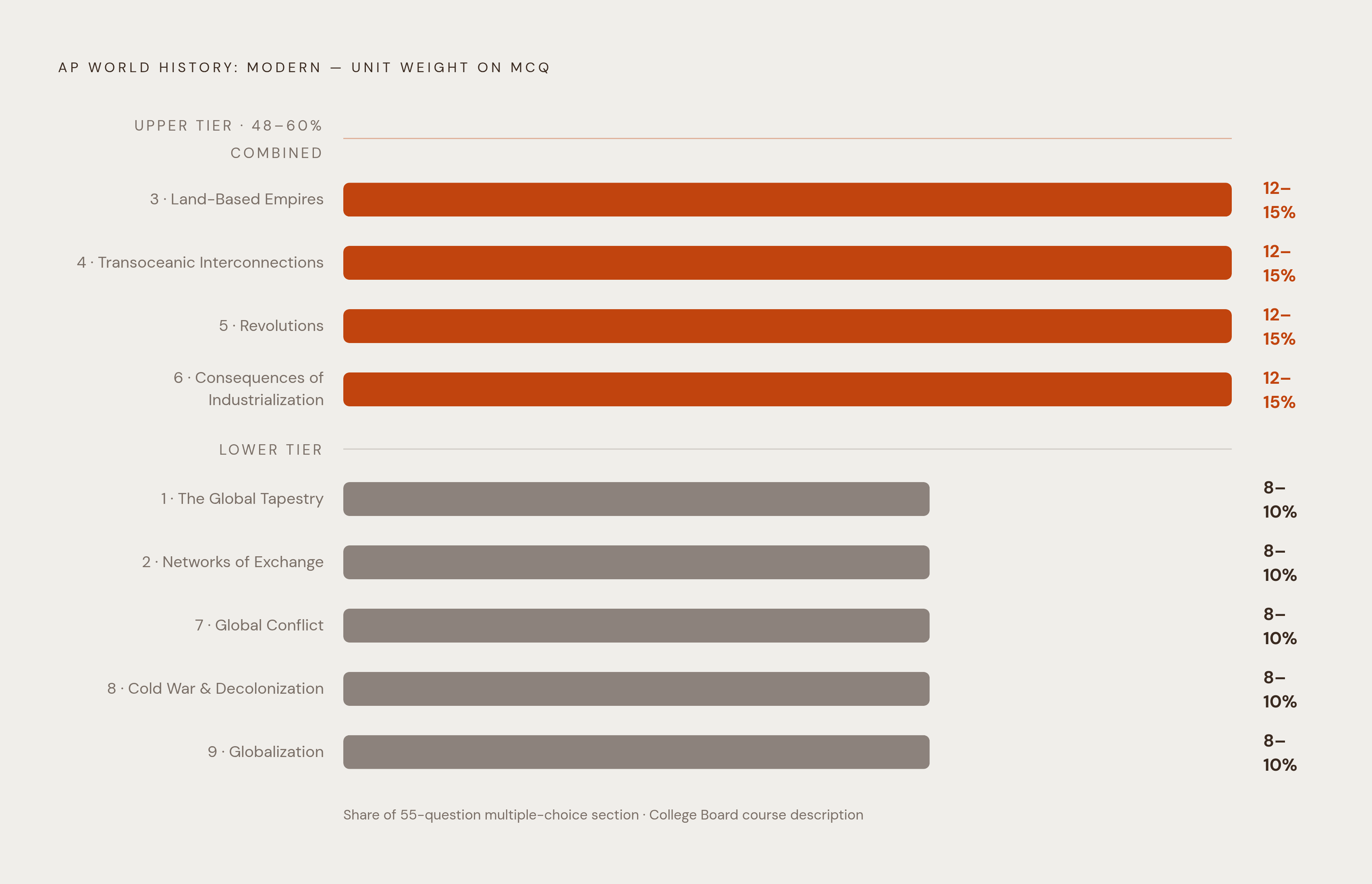
The nine units split into two tiers, and the gap between them is bigger than most students expect. Units 1, 2, 7, 8, and 9 sit in the lower tier, each worth 8 to 10% of the exam. Units 3, 4, 5, and 6 sit in the higher tier, each worth 12 to 15%. Add up that higher tier and four of the nine units account for 48 to 60% of the entire multiple-choice section.
Turn those percentages into actual question counts and the gap gets sharper. A 12–15% unit is worth roughly 7 to 8 questions out of 55. An 8–10% unit is worth roughly 4 to 6. A single high-weight unit can be worth nearly double a low-weight one, on the same test, in the same amount of study time.
That doesn't make Units 1, 2, and 7 through 9 safe to skip. They still show up in short-answer questions, they still feed the document-based essay's broader chronological range, and they're often exactly what a strong contextualization paragraph draws on. But an hour spent mastering Unit 3's land-based empires is worth more, in raw scoring terms, than an hour spent memorizing every treaty in Unit 9. It's just the math of a 55-question test. It's just the math of a 55-question test.
Units 1 and 2: the medieval foundations that anchor everything later
Units 1 and 2 both cover 1200 to 1450, and both are 8 to 10% of the exam. Unit 1, The Global Tapestry, covers state-building and belief systems across different regions, and it leans on comparison. Unit 2, Networks of Exchange, covers the Silk Roads, Indian Ocean trade, and Trans-Saharan routes, along with what happens when goods, ideas, and diseases start moving long distances.
Neither unit rewards exhaustive memorization. What they reward is familiarity, because their content quietly underpins contextualization paragraphs for essays set in much later periods. A student writing about 18th-century revolutions who can casually reference earlier trade and exchange patterns is doing exactly what a strong DBQ or LEQ response rewards.
Three themes appear constantly here: environment (disease spread, environmental impact), economics (trade networks), and culture (diffusion of ideas across regions). None of these are unique to Units 1 and 2, but they get established here and repeat for the rest of the course. The short-answer section often anchors its earliest-period question in this window, so a working knowledge of these two units, not mastery of every detail, matches their 4-to-6-question weight.
Units 3 and 4: the high-leverage core of the 1450–1750 period
This is where the studying needs to get serious. Units 3 and 4 both cover 1450 to 1750, and both are at the top weight tier, 12 to 15% each. Unit 3, Land-Based Empires, covers the expansion and administration of empires like the Ottomans, the Mughals, the Qing, the Russians, and the Safavids, and how each one held onto power. Unit 4, Transoceanic Interconnections, covers European exploration, the Columbian Exchange, and the social and economic fallout of contact across oceans.
What makes this pairing so useful is that they cover the same 300 years from two different angles: one is about consolidating power on land, the other is about expansion across water. That overlap makes cross-unit connections a genuinely productive essay strategy. A response linking Ottoman administrative methods to the economic ripple effects of the Atlantic trade is doing real historical thinking, not just listing facts.
Governance runs through empire administration here. Economics appears in the silver trade and the early Atlantic economy. Culture covers missionary work and the blending of belief systems. Social organization covers the racial hierarchies and shifting gender roles that came out of colonial contact. And the Columbian Exchange deserves specific attention as a recurring anchor point, since it touches environmental, economic, and social themes at once and appears across multiple question types.
This is also where causation chains pay off directly. Understanding why empires expanded when they did, and how they managed it, is essay prep and direct multiple-choice preparation. It's exactly the reasoning multiple-choice answer choices are built to test.
Units 5 and 6: revolutions and industrialization as the exam's second high-weight cluster
Units 5 and 6 form the second half of the high-weight core, both covering 1750 to 1900, both worth 12 to 15%. Unit 5, Revolutions, covers Enlightenment thought and the wave of Atlantic revolutions (American, French, Haitian, Latin American), along with rising nationalism and the earliest stages of industrialization. Unit 6, Consequences of Industrialization, picks up from there: imperialism, migration, and the wide-ranging social and environmental consequences of industrial growth.
The same logic from Units 3 and 4 applies here. These two units share a timeline, and the exam rewards students who can trace how revolutionary ideas fed into industrial-era state-building, and how industrialization then drove a new wave of imperialism. That kind of synthesis is a high-value skill for essay writing specifically.
Governance (nationalism, state-building), economics (industrial capitalism, global trade networks), social organization (class, race, and gender under industrialization), and environment (resource extraction and its consequences) all recur heavily in this stretch. Causation questions and continuity-and-change-over-time questions cluster here too, since the exam wants a student to explain what shifted between 1750 and 1900, and why. Unit 5's political revolutions are also a frequent long-essay topic, precisely because they invite comparison across regions.
Combined, Units 3 through 6 make up that 48 to 60% share of the multiple-choice section. That's the clearest possible argument for spending the bulk of study time here, and not, say, on Unit 9.
Units 7, 8, and 9: the twentieth century and why these units still matter for essays
Units 7, 8, and 9 all fall under the broad label of 1900 to present, and each is worth 8 to 10%. Don't lump them together just because they share a date range. Unit 7, Global Conflict, covers the World Wars, interwar tension, and the conflicts that reshaped the global order. Unit 8, Cold War and Decolonization, covers the structure of Cold War rivalry, proxy conflicts, and the wave of newly independent states. Unit 9, Globalization, covers modern technology, environmental challenges, and global economic integration.
These units matter more for essays than their individual multiple-choice weight suggests. Long-essay prompts can span broad chronological ranges, so a prompt about empire or economic change can require pulling evidence from Units 7 through 9 right alongside material from Units 3 or 4. The document-based essay covers the full 1200-to-2001 range, so twentieth-century material can appear as document context even in a prompt that isn't primarily about the modern era.
Skip the temptation to memorize every date and treaty here. The payoff comes from the big causation chains: why decolonization unfolded the way it did, how Cold War rivalry shaped the choices newly independent states made. That reasoning earns evidence points and complexity credit on the free-response sections, even when a unit's raw multiple-choice weight is at the low end.
The six SPICET themes across all nine units
The six themes, environment, cultural developments, governance, economics, social organization, and technology, aren't separate content to cram. They're lenses. Applying them to material already studied is how patterns across time and region become visible, and skipping this step is why some students can recite facts but still struggle to build an argument.
That matters in specific ways on test day. A stimulus set built around a graph of trade data is almost always testing the economic theme. A political cartoon is almost always testing governance. On the document-based essay, the strongest complexity points tend to go to essays that connect the documents through a thematic thread, not just answer the prompt's surface question. Long-essay arguments hold together better when they're built around a theme rather than a chronological march through events.
The economic theme runs through the entire high-weight core, from the silver trade in Units 3 and 4, to the Atlantic economy and industrial capitalism in Units 5 and 6, and finally to globalization in Unit 9. Governance does something similar, running from empire administration through nationalism to Cold War state structures. After finishing each unit, go back and label every major development with its primary theme. That habit builds the connective vocabulary essay graders are actually looking for.
What the exam measures: historical thinking skills beyond content recall
The exam is really testing six historical thinking skills beneath the nine units and six themes: causation, comparison, continuity and change over time, contextualization, sourcing, and argumentation, because these are what every question type, including essays, is built to measure. These skills appear across every question type, not just in essays.
Multiple-choice questions come in stimulus-based groups built around a primary source, a graph, a map, or an image, with three or four questions built around it. The skill being tested is interpretation. Someone who has every fact about the Columbian Exchange memorized but can't read a primary source document about it loses points, and this is most visible on the document-based essay, where sourcing, thinking about a document's context, audience, point of view, and purpose, carries real rubric weight.
Scoring is rubric-driven, not a general impression of quality. The document-based essay runs on a 7-point rubric covering thesis, contextualization, use of documents, sourcing, outside evidence, and complexity. The long essay runs on its own rubric covering thesis, contextualization, evidence, and reasoning skill. Short-answer questions are worth 3 points each and don't need a formal thesis, just concise, evidence-backed answers.
Contextualization is the rubric point most often missed on both the document-based essay and the long essay. Restating the prompt doesn't satisfy it. It requires placing the topic inside a broader historical development, something happening before, during, or after the period in question.
Building a study plan around the weight distribution
Most students who do well start preparing somewhere between four and eight weeks out. Given everything above, the time allocation should follow the weight distribution directly: Units 3 through 6 deserve the largest share of study hours because performing well on that 48-to-60% multiple-choice cluster moves the final score more than anything else on the test.
A reasonable sequence looks like this. First pass: build basic familiarity with all nine units, so nothing on exam day is a complete surprise. Second pass: go deep on Units 3 through 6 specifically, focusing on causation chains, cross-regional comparison, and theme connections. Third pass: shift to practicing free-response skills directly, document sourcing for the document-based essay, thesis construction for the long essay, drawing on content from across the entire course, not just the high-weight units.
Pacing on exam day follows the same logic. Multiple-choice questions run at roughly a minute each. Short-answer questions get roughly 13 minutes apiece. The document-based essay splits into a 15-minute reading period followed by the remaining time for writing. The long essay gets a short planning window before sustained writing begins.
The 2025 numbers point to where most students actually land. A 64% pass rate and a mean score of 3.16 suggest a lot of test-takers cluster right around the 3 threshold, the line between passing and not. But 13.9% scored a 5, and 33.4% scored a 4, putting 47.3% in the top two score bands. Nearly half the pool performed at the strong end of the scale, and the students landing there aren't necessarily the ones who studied longer. They're the ones who studied Units 3 through 6 like they're worth double, because on this exam, they are.
Sources
- AP World Score Calculator 2026 | Predict Your 1-5 – NUM8ERS
- AP World History Study Guide 2026 | Units 1–9 – NUM8ERS
- AP World History Exam Format 2026 | Timing, Sections, and Weights | GradGPT
- collegeprep.uworld.com
- How to study for AP World History: A method built around the CED and the DBQ
- AP World History Modern Exam: Format, Topics, and Timing
- en.wikipedia.org
- innovatives.blog