AP Exam Prep Strategies for Multiple AP Classes Simultaneously
Balancing multiple AP exams requires separating subjects and protecting recovery time between tests.

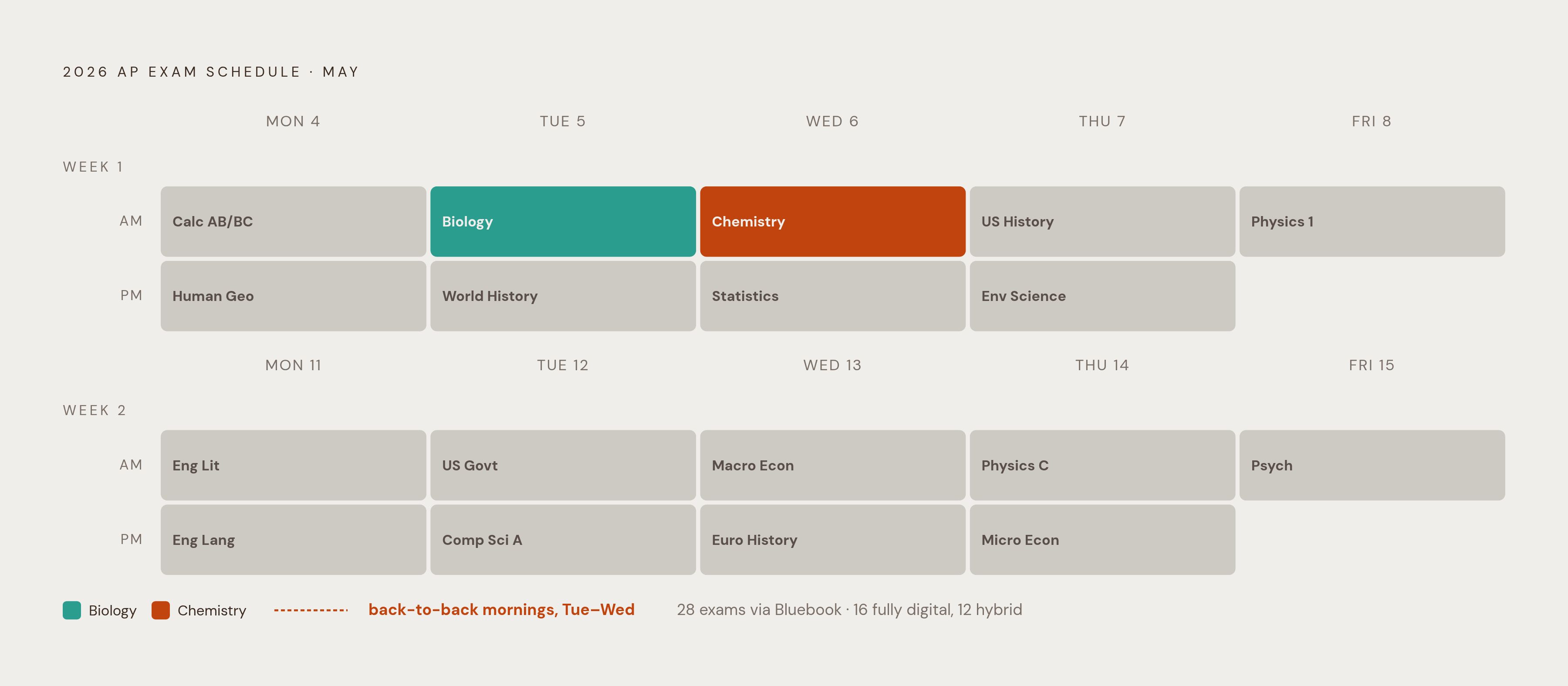
Taking several AP exams in the same May is not a bigger version of taking one. Start with the calendar. The 2026 AP Exams run May 4 through 8 and May 11 through 15, with morning sessions starting between 8 and 9 a.m. and afternoon sessions starting between noon and 1 p.m. A student taking four or five AP courses can end up sitting two exams in the same day, and in Week 1, Biology and Chemistry land on back-to-back mornings. It's two content-heavy exams with almost no space between them to reset, not a scheduling inconvenience.
Layer onto that the Bluebook shift. For 2026, 28 AP exams run through the Bluebook digital app, 16 of them fully digital and 12 in a hybrid format. Fully digital exams ask students to type their free-response answers directly into the app, while hybrid exams put multiple choice on a device but keep the free-response section on paper. Each setup changes how a student paces an exam, annotates a passage, or goes back to revise an answer under time pressure. On top of that, 2026 brings a built-in Desmos calculator for every calculator-permitted exam, and keeps the 2025 change that cut multiple-choice answer options from five to four on both AP English Language and AP English Literature. None of these changes are hard on their own. Taken together, these compound in ways that ask a student to hold platform logistics in mind at the same time as content, which is a second mental task riding on top of the first.
The answer is mostly about how AP course counts read on a college application. Admissions pressure is driving a lot of this behavior, but the academic payoff flattens out fast: students with five advanced classes and students with ten show close to the same college freshman GPA, according to Jenova's AP Exam Tutor resource, even as the number of students taking ten or more AP exams has grown 156.5 times over the last three decades, per Summit Prep's analysis. That gap between effort and return doesn't mean students should scale back their AP load. It means the strategy question for students already carrying four or five exams isn't whether to do it, but how to prepare for all of them without one subject quietly eating into another.
Schedule Compression and Cognitive Interference
Two things drive most of the underperformance students see when they take several AP exams at once: a packed schedule and study sessions that mix subjects without a plan. Treating these as separate problems matters, because the fix for one isn't the fix for the other.
Schedule compression is the specific problem of high-stakes exams stacked back to back with no buffer in between, and that compression can hurt a student's score even when the content is genuinely learned. Unstructured review sessions cause a different kind of damage. Working memory only holds so many pieces of information at once, and mixing AP Chemistry nomenclature with AP U.S. History argumentation in the same study block makes both harder to recall later. Reviewing a year's worth of content at the last minute is a well-known way AP scores fall, and cramming without practicing actual test strategy does the same thing to SAT scores.
The SAT adds a sharp seasonal wrinkle to all of this. The May SAT date lands right at the start of AP exam season, so prep for one competes directly with prep for the other, and students who try to run both at full intensity at the same time tend to underperform on both. Part of the reason is that the two tests ask for opposite mental modes. AP exams reward content mastery and synthesis, the kind of thinking that goes into a long essay or a worked problem, while the SAT runs on strategy: pacing, smart guessing, spotting how a question is trying to trick you. Jumping between those two modes without a deliberate plan to separate them adds another layer of interference on top of mixing subjects in the same study block.
None of this hits students evenly. First-generation students, and anyone without a parent or tutor who already knows how AP season works, face a compounding version of this gap, because schedule compression and subject interference are harder to catch and correct without someone who's seen the pattern before. That's a diagnosis, not yet a fix. The next question is what a study schedule looks like once it's built to answer these specific problems instead of just "study more."
Building a rotation schedule that separates subjects and protects recovery time
The clearest fix for both problems named above is a rotation schedule, one that assigns each subject its own days rather than letting subjects blend together in the same sitting. The basic rule: give the two weakest subjects three dedicated sessions a week each, give the strongest subject two sessions, and keep every session to one focused block of review followed by a short break. One subject per evening is the whole point. Mixing subjects in a single sitting is exactly the behavior that causes the interference described above.
During the window when SAT prep and AP prep overlap, the schedule needs to bend without breaking. Cut SAT prep down to two or three short sessions a week, redoing missed questions or working through a small mixed set, and pause full-length SAT practice tests until the AP pressure passes. That keeps SAT strategy sharp without it competing for the same mental space AP content needs that week.
Why does spacing subjects out actually work better than cramming them together? The research backs up what the rotation schedule is built on. Spaced practice, shorter sessions spread across several days, produces stronger retention than one long cram session, and a study in Frontiers in Education by Córdova Zurita and colleagues found that students given personalized, distributed study plans outperformed students using traditional study methods, with gains in both how fast they completed tasks and how accurate their answers were. It's the mechanism the whole rotation system leans on, not a minor edge.
AP and SAT skills overlap more than most students assume. AP English Language prep doubles as direct prep for SAT Reading and Writing, and AP Calculus or Statistics strengthens the math foundation the SAT tests. Taken seriously, rigorous AP coursework is already deep SAT prep.
The schedule should also tell a student when it's wrong. If a subject's sessions keep feeling like plain review instead of real practice, that slot can shrink. If a session keeps turning up new gaps, that subject needs more time, not less. A rotation schedule built this way adjusts itself as the weeks go on instead of staying frozen from the day it was written.
Mapping what you know across subjects before committing study time
A rotation schedule only works if it's pointed at the right targets, and that's where a lot of students get it wrong. Splitting study time evenly across subjects feels fair, but it's usually the wrong move, because the units that need the most attention are rarely the ones that feel hardest in the moment.
AP exam weight isn't spread evenly across a course. Certain units carry outsized weight on the free-response section, and a student who drills whatever feels familiar instead of what the exam actually prioritizes ends up leaving points on the table without realizing it. Multi-AP students carry a heavier version of this problem, because they're trying to hold an accurate read on their own readiness across several courses at once, and switching between Calculus techniques, historical argumentation, and lab reasoning in the same week distorts how ready a student actually feels compared to how ready they actually are.
Rubrics score a DBQ or a Chemistry free-response question point by point, so a "pretty good essay" can still miss the thesis point, the evidence point, or the sourcing point entirely, and that kind of miss is invisible unless someone checks the work against the actual rubric. Jenova's AP Exam Tutor shows what that kind of diagnostic intake looks like in practice: if a student is scoring at a 4-level in AP Chemistry but only a 2-level in AP U.S. History, the tool shifts coaching time toward historical argumentation and document analysis while keeping Chemistry at maintenance level, and it keeps track of which units are solid and where free-response points keep slipping away.
There's a useful idea from outside the AP world that explains why this matters so much. Research on detecting knowledge gaps from conversational AI interactions, using what's called curriculum prerequisite graphs (arXiv:2606.10736), shows how a gap in one foundational concept cascades into what looks like a separate gap in a more advanced topic. A student who seems weak in AP Chemistry thermodynamics might actually be missing an earlier concept that thermodynamics depends on, and drilling thermodynamics itself won't fix that. Anyone who's ever gotten stuck on a math problem only to realize the real issue was something from two chapters back already understands this pattern.
Getting this diagnosis right changes what the rotation schedule looks like. A student who correctly figures out that their History struggle is about argumentation and sourcing, not content knowledge, builds a very different set of study sessions than a student who assumes the fix is just reading more. Diagnosis has to come before scheduling, or the schedule is just evenly distributing effort across the wrong targets.
Using AI tools to get rubric-based feedback at the frequency multi-AP prep requires
Knowing where the gaps are is one problem. Getting enough feedback to actually close them is another, and it's the harder one for students juggling several AP courses at once. A student managing four AP classes might write free-response answers in History, English, Chemistry, and Calculus in the same week, and getting rubric-specific feedback on all four from a single teacher or tutor just isn't realistic at the pace multi-AP prep demands. Without that feedback coming often enough, students end up repeating the same essay structure mistakes or the same misconceptions across every practice attempt. A lot of practice can build confidence in the wrong answer instead of mastery.
This is the specific gap AI tools that grade against official rubrics are built to close. A few different tools take different angles on it. Jenova's AP Exam Tutor covers all 40 AP subjects, generates AP-style multiple choice and free-response questions, including DBQs, LEQs, and lab-style science items, and returns feedback broken down point by point, with evidence mapping and specific rewrite targets; it also coaches the Bluebook-specific skills, like typed-essay strategy and navigating the app, that fully digital and hybrid exams now require. Historia AP covers 11 AP courses and evaluates SAQs, LEQs, and DBQs against official rubrics, returning a point-by-point breakdown with targeted feedback, with all content aligned with the 2026–27 curriculum. PrepStar offers instant AI feedback along with personalized guidance through AP exam prep. And one tool in this space builds its approach around unlimited practice problems paired with a diagnostic layer that tracks not just what a student got wrong, but where their thinking actually broke down and which specific gaps stand between them and mastery across subjects.
A fair objection to all of this is that years of teacher calibration against official released AP samples can't just be handed over to a model, and that concern is legitimate wherever a tool runs without any human checking its work. The answer isn't to throw out AI grading but to build it with a human in the loop, where nothing is treated as final until a teacher or tutor reviews it, and the AI's job is to surface rubric-level analysis fast, not to replace the judgment a trained teacher brings.
For first-generation students, or any student without someone at home who already knows how AP rubrics work, AI tools that explain a DBQ rubric in plain language, showing what separates a high-scoring response from a mid-range one, and that walk students through practice in stages (untimed with detailed feedback first, then timed with full rubric scoring) fill a support gap that traditional tutoring often can't reach at scale.
Making frequent FRQ practice sustainable for whole AP classes
Everything described above from the student's side has a mirror image in the classroom. Students run into a feedback-frequency wall because getting rubric-level attention from one teacher, across several subjects, is slow. The same wall exists for teachers, for a plainer reason: manually grading free-response questions just takes a long time, and AI grading tools are changing that math enough to make weekly FRQ practice realistic again.
Grading one free-response question by hand takes a teacher a meaningful chunk of time, and multiplied across a full class, that adds up to a significant part of a day spent grading a single assignment in a single subject. Teachers handling multiple AP sections feel this multiplied again: assigning FRQs often enough to actually help students, while also giving quality feedback on each one, has historically meant choosing between burning out and cutting back on practice, and neither choice helps the students sitting in those classrooms.
This is where tools built for grading at scale change the equation. Gradescope, owned by Turnitin and originally built at UC Berkeley, handles a wide range of assessment types, including essays, exams, problem sets, handwritten work, and programming assignments, which makes it a good fit for large classes and AP courses that run closer to a college-level pace; pricing depends on the plan, and LMS integration requires an institutional license. What tools like this actually unlock is weekly FRQ practice with real feedback attached, something that used to be out of reach without wearing teachers down. Teachers using AI grading platforms report getting back more than 10 hours a week, time that goes straight back into more frequent practice for students. Gaps get caught and closed faster than they would otherwise.
Sources
- Historia AP — AI-Powered AP Exam Prep & Study Platform
- Detecting Knowledge Gaps from Conversational AI Interactions Using Curriculum Prerequisite Graphs
- AP Prep Without the Panic: How to Study for AP Tests While Balancing SAT/ACT & Everything Else
- toptieradmissions.com
- 2026 AP Exam Schedule: Smart Planning Strategies Most ...