How AI FRQ Graders Score Your AP Answers Against College Board Rubrics
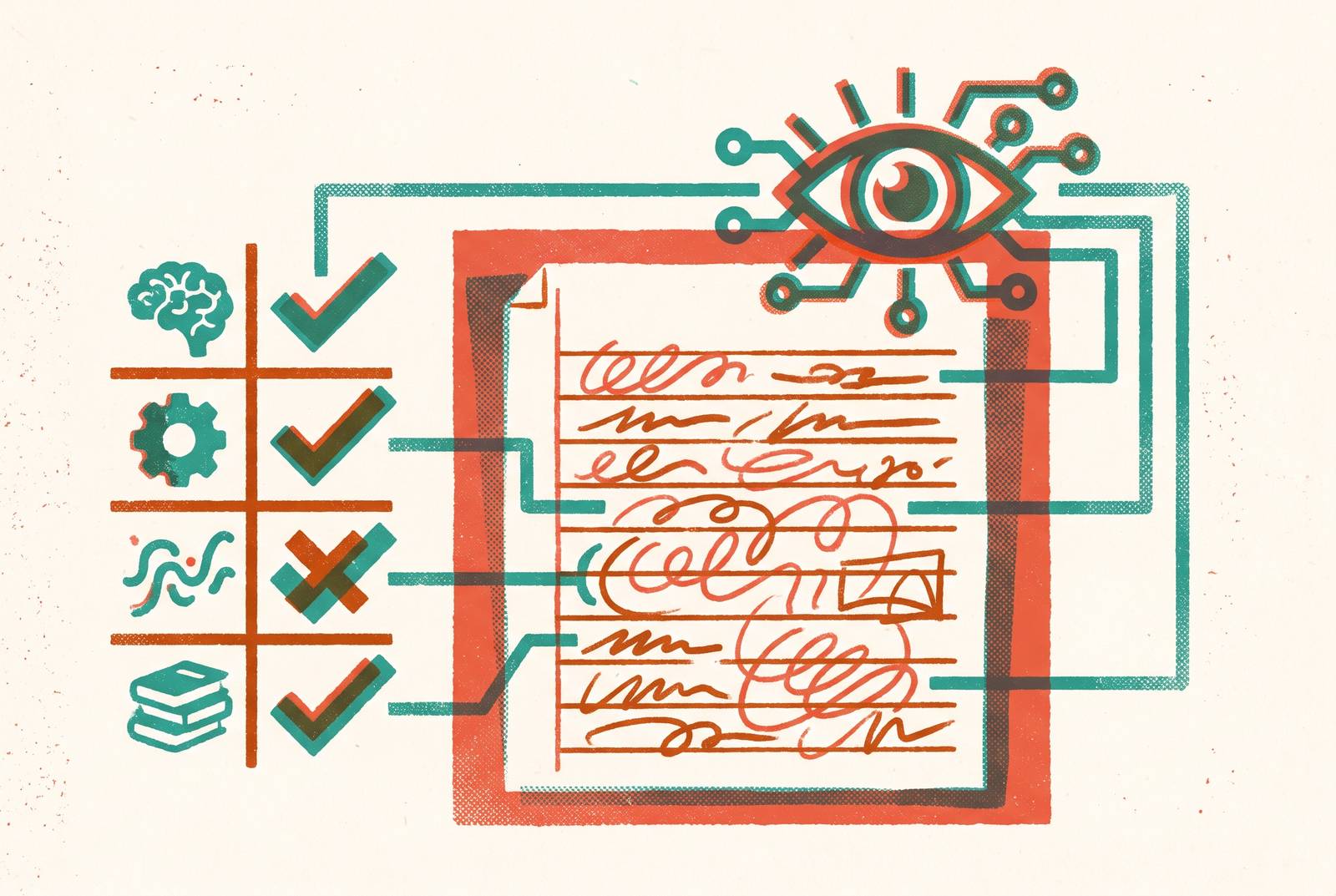
AI-powered AP practice with FRQ grading and feedback works by breaking published scoring rubrics into separate criteria, then checking an answer against each one. Alongside a practice score, students receive an explanation of which required moves earned credit and which did not. Knowing how that process works helps students use fast feedback to learn what they missed.
Why AP FRQs are scored the way they are — and why it matters for practice
An AP free-response score comes from discrete, criterion-referenced requirements, with each point earned or missed. Most points are independent, although some rows depend on requirements elsewhere in the rubric. A strong thesis cannot rescue a missing sourcing sentence, while a weak argument does not erase credit legitimately earned elsewhere.
Most AP rubrics have one of three shapes. Some use one analytic rubric with fixed rows, while others give points for separate tasks or labeled parts. A third group combines those approaches. AP Lang and AP Lit use a 6-point structure for each of their three FRQs, in which Thesis is worth 0–1, Evidence and Commentary is worth 0–4, and Sophistication is worth 0–1. The architecture stays constant across those tasks, but the criteria change with what the question asks.
Other subjects divide the work quite differently. AP Gov FRQs 1–3 award points by labeled part and command verb, although FRQ 3’s Part B is scaled at 1 or 2 points. FRQ 4 instead uses a 6-point analytic rubric covering Claim/Thesis, Evidence, Reasoning, and Responds to Alternate Perspectives. AP History DBQ and LEQ rubrics are worth 7 and 6 points respectively, with separate requirements for historical reasoning and evidence.
In AP Human Geography, scoring depends on the command verb, and credit from one part cannot carry over to another. In AP Macro and Micro, students earn credit for graphical modeling, concept identification, and causal explanation in one long FRQ and two short ones. The long FRQ accounts for half the FRQ score. The rubric rewards the knowledge the answer actually puts to work.
How an AI FRQ grader decomposes a rubric into checkable criteria
An AI FRQ grader starts with that scoring structure. Before it checks a student’s answer, it breaks the published guidelines into labeled criteria based on the rows, parts, and command-verb tasks. Each criterion becomes a separate scoring question. Did the response make the required move? The grader produces an earn-or-miss verdict and a short explanation for each element.
This decomposition also explains how partial credit works. A row worth several points contains requirements that can be assessed separately, so partial credit comes from earning particular elements. AP Physics substitution points and AP Chemistry labeled-calculation points illustrate that distinction. A response can complete an intermediate step without completing everything that follows. The scoring needs to preserve that earned credit.
Scoring isolation keeps credit for one element from affecting how the next is scored. It mirrors the rubric application AP Readers are trained to use, while respecting any stated dependencies between criteria. A correct identification does not establish that the explanation is correct. An identification point earned on its own should also hold even when the explanation fails.
For example, an AP Biology FRQ might distribute ten points across Identify/Describe, Explain/Justify, Predict/Analyze Data, and Design Experiment/Evaluate. Those groups might be worth 2, 3, 2, and 3 points in that order. The grader evaluates their requirements separately rather than treating the response as one impressive or disappointing whole. That separation is the mechanism behind detailed feedback. It lets a student distinguish knowing what happened from explaining why it happened.
What the rubric actually requires at each row — and where students lose points
The hard part is often the verb. In AP Human Geography, “identify” asks for a named term, “describe” asks for observable detail, and “explain” asks for causation. A description can be accurate and still fail an explanation task because it never supplies the causal link. AP Psych AAQ and EBQ responses expose a related mismatch. A correct definition without application to the prompt forfeits the application point.
In AP Lit and AP Lang, Evidence and Commentary is where most points are lost, often because evidence appears without enough explanation of what it proves. For AP Lit, commentary that stays general or leans on paraphrase earns 1–2 points, while commentary that consistently connects literary choices to meaning and sustains a line of reasoning earns 3–4.
Sophistication in AP Lit requires a clearly demonstrated move. That can mean exploring complexity or tension, using broader context to illuminate an interpretation, accounting for alternative interpretations, or employing a consistently vivid and persuasive style. AP History asks for a different contextual move. Its distinct Contextualization point requires explaining the broader development that makes the prompt’s event or change possible. Mentioning a related topic in passing does not supply that explanation.
AP Gov FRQ 4 separates evidence from reasoning and responding to alternate perspectives. Its evidence requirement includes specific, relevant support, with a piece drawn from a foundational document listed in the prompt required for full credit in that row. Naming a document is not the whole task. The student also has to develop and support a defensible claim through the rubric’s separate requirements. Treating the essay as one undivided argument can hide which of those jobs remains unfinished.
Graphical responses make the same lesson visible. In AP Macro and Micro, an unlabeled axis or curve forfeits the graphical-model point even if the curve shapes are correct. AI grading of the written portions can address concept identification, explanation, and calculation reasoning, but the graphical-model point requires self-checking against official scoring guidelines. An accurate-looking graph can still omit a required label. Across these subjects, the recurring failure is a mismatch between what the student supplied and what the criterion requests.
What AI FRQ feedback looks like after grading — and how to read it
Useful AI feedback looks like an AP Reading scoring sheet, with a verdict and a short explanation for each row or part. Its value lies in the specificity of each explanation. A total score tells a student how many points were earned, but not what to change. The criterion-level comment should name both the requirement and the response’s success or failure against it. Otherwise, a detailed-looking report may leave the student with little more than a number.
What makes a comment genuinely useful to students? “Needs more analysis” names a broad weakness but leaves the missing action unclear. A comment identifying that an explanation restates a concept instead of supplying causal reasoning points to a particular repair. More sentences will not fix an answer if they keep doing the wrong job.
Quantitative feedback can locate the break even more narrowly. It might identify correct setup and substitution, followed by a sign error at the discriminant that forfeits the answer point. That is different from saying the whole solution failed. The student can check the step that went wrong without assuming every earlier step needs to be redone. Because the comments are tied to published criteria, the target is the required work rather than a shifting preference for how an answer should sound.
Rubric-matching alone cannot establish whether an argument is genuinely persuasive, reliably recognize every subtle sophistication move, or account for a student’s growth across a year of writing. The report has a narrower purpose than that. For students reading it, the practical move is to connect each flagged criterion to the relevant sentence or step in the response. A comment becomes actionable when it identifies something specific to re-examine.
Where rubric-matching breaks down and what that means for students who rely on it
Discrete tasks give AI scoring its firmest footing. Evaluating argumentative quality, nuance, or sophistication is less reliable because the criterion itself requires judgment about meaning. Whether a thesis is “defensible” or commentary “sustains a line of reasoning” cannot be settled by recognizing an expected shape. A response may contain a claim, evidence, and commentary without making the evidence support the claim. The scaffold can stand while the argument falls through it.
That gap creates errors in both directions. Over-penalization occurs when a system rejects a valid approach because the rubric does not explicitly list it. Undue leniency occurs when a response follows familiar rubric-shaped steps but contains reasoning a human reader would reject. Criterion-level feedback can still be useful despite these errors. Both mean that apparent structural compliance and actual correctness need to remain distinct in the student’s mind.
Other failures can happen before that judgment begins. FRQ rubrics change regularly, so a tool that uses an old structure may check for requirements that AP Readers no longer use. Handwritten responses introduce another dependency through optical character recognition, or OCR. Legibility problems can produce errors before scoring even starts. A verdict about the answer is only useful if the system is assessing the right text against the right rubric.
A missed-point flag is a provisional signal to re-examine the required move. Likewise, awarded credit is not proof that the reasoning would withstand a human reader’s scrutiny. The appropriate role is a fast first-pass diagnostic. It is most useful where the criterion is explicit, and more provisional where interpretation does the heavy lifting.
How to turn criterion-level feedback into a real plan for closing knowledge gaps
Write an FRQ under timed conditions, read the criterion-level feedback, and identify one or two rows that fail consistently. Then study the content or skill needed for those rows before writing again. The gap determines the next study session. Contextualization, sourcing, causal explanation, and alternate perspective are different tasks, so treating every miss as “essay practice needed” throws away the feedback’s precision.
Multiple attempts help distinguish a pattern from an isolated result. Missing Sophistication on one essay might not show an ongoing weakness, but three misses in a row on the same Evidence and Commentary sub-criterion point to a gap that needs work. Fast feedback lets students make that comparison during a study session. A teacher with many students may be unable to return a DBQ the same night. Speed is useful because it shortens the learning loop.
Structural misses are especially productive targets for that loop. A restated thesis, evidence without commentary, a missing sourcing sentence, or an answer pitched to the wrong command verb names a learnable action. Criterion-level tracking and adaptive practice can keep the next attempt focused on that action rather than send the student through unrelated repetitions. Knowing that someone struggles with causal explanation gives a clearer sense of what to work on than knowing that their last response earned a low score.
Human feedback has a complementary role in this plan. Teachers and other readers add the most irreplaceable judgment on sophistication and argumentation, where AI scoring is least reliable. Teachers also need consistent rubric application across responses and calibration across sections, while students need a specific change to make next time. A tool that meets both needs should show its criterion-level reasoning. That visibility allows the score to become a starting point for discussion.
The student’s job is to inspect the flagged move, decide what the response actually demonstrates, and use the next attempt to test the repair. That may mean learning content the student missed or spelling out what the student already understands. Either way, the student remains responsible for the reasoning. Understanding how the grader works makes it possible to use its feedback without mistaking its judgment for the final word.