How Teachers Verify Real College Board Alignment in AI AP Study Tools
Teachers can verify AI tool alignment through four concrete tests beyond vendor claims.
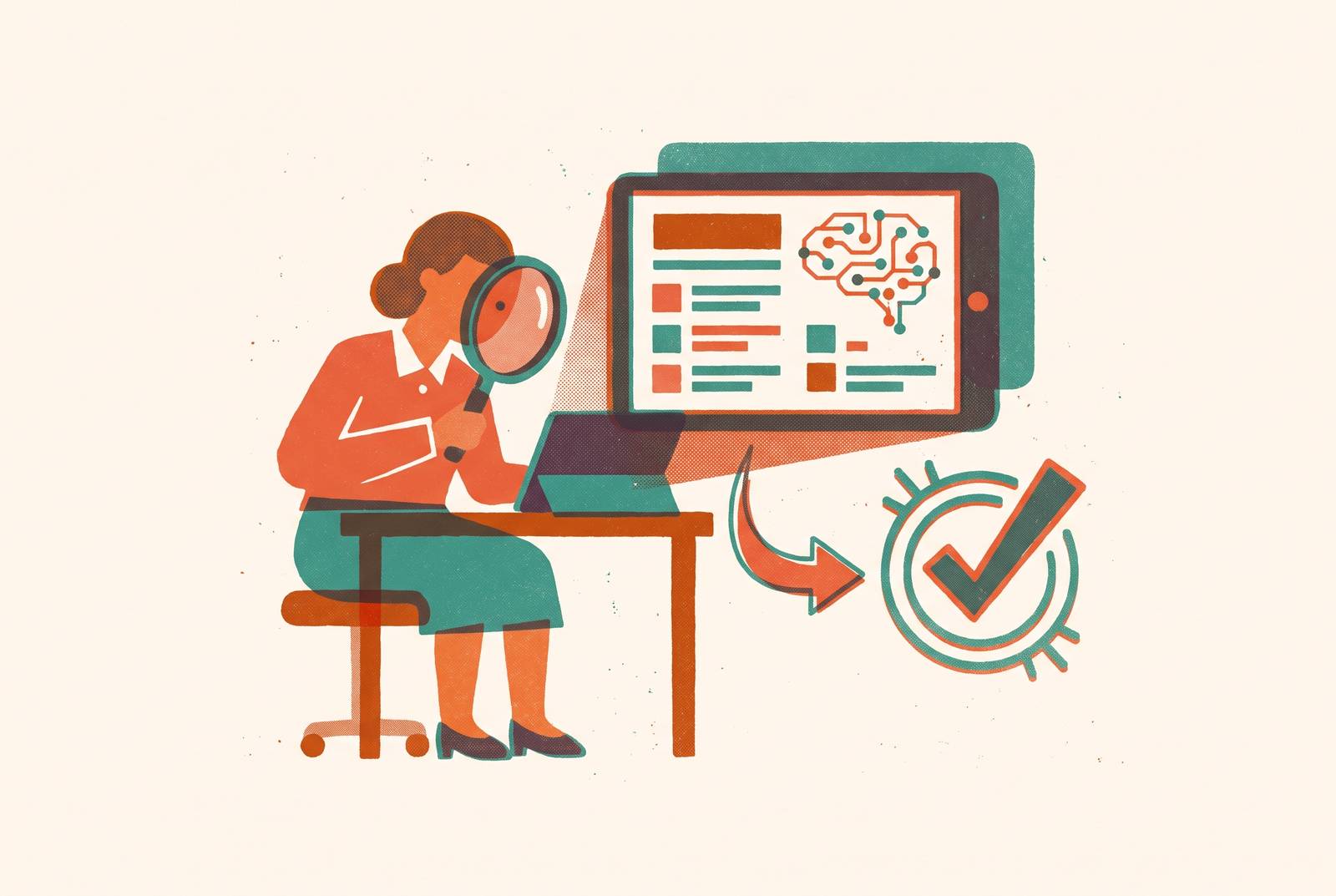
An AI study tool for AP classrooms and teachers should be judged by four things, namely current CED traceability, rubric fidelity, subject-expert review, and clear boundaries between study help and submitted work. This guide explains how teachers can test those claims. With no official certification process for third-party AP alignment, the strongest evidence is not an “AP-aligned” label but content and feedback that withstand course-specific checks.
Why teachers, not vendors, must verify AP alignment
“AP-aligned” claims appear across the market, but no official body validates those claims for third-party tools. Vendors can use the label without getting it certified or endorsed. A teacher evaluating a tool has to establish what evidence supports it.
That gap reflects how AP oversight is structured. College Board’s regulatory scope is limited to submitted work and exam conduct. Its published AI guidance covers five course families, including AP African American Studies, AP Art and Design, AP Capstone, AP Computer Science Principles, and AP World Languages and Cultures. There is no broader AP-wide AI policy for third-party study tools.
What "College Board alignment" actually means across different AP contexts
Alignment has different meanings across three contexts, which are exam-day work, submitted performance tasks, and study preparation. Exam rules set out what students may do during an exam, while each course has its own rules for submitted work. Preparation sits outside that AP policy scope. Permission to study with a tool does not establish permission to use its output in a scored submission.
For content alignment, the operative document is the Course and Exam Description, or CED. It defines the units, skills, and topics the exam tests. A tool claiming alignment should make its content traceable to that document, rather than merely offering questions on the same broad subject. Biology content and AP Biology content can cover some of the same ground without teaching the same tested skills.
Context also changes the answer within a single course. A tool suitable for AP Seminar research exploration is not thereby suitable for AP Seminar scored writing. “Aligned for what use?” requires an answer. How well the content fits and whether its use is allowed are separate tests, so a tool can pass one and fail the other. This is why an evaluation needs both the course name and the intended activity.
Why AI hallucination is the central alignment risk teachers must understand
Even with the right policy context, a tool can give students incorrect information with complete confidence. Incorrect information can occur without vendor dishonesty. General-purpose language models are built for conversational flexibility, and their output involves a degree of randomness. That flexibility helps them explain and rephrase ideas, but it makes it harder to get the content right and score answers by the rubric every time.
Specificity makes the problem harder. A model may explain biology in a way that sounds right yet get a particular enzyme regulation pathway in AP Bio Unit 3 wrong. Similarly, a specific date in APUSH Unit 6 can expose a weakness that a broad historical overview conceals. The danger is that the student receives the error in the same assured voice as the correct explanation.
“But what if it was trained on AP materials?” Training on relevant content does not eliminate hallucination on niche details, and teachers can rarely audit the provenance of the training data. Hallucination is an inherent risk of how these models work. Even with a claim about training, the output still needs to be checked against an outside source.
AI can reorganize a chapter, draft flashcards, explain a difficult idea, or generate extra questions, but it cannot guarantee a match to the current CED or scoring guidelines. Students should cross-check CED-specific details against official course notes or a CED-aligned resource. Otherwise, convincing AP Biology practice may teach incorrect mechanisms.
The four things a teacher should actually check when evaluating an AI AP tool
The first check is CED traceability. Can the tool connect its questions and explanations to specific units and skills in the current CED? To test that claim, take a released AP question from a known unit, find the corresponding CED skill, and compare the tool’s coverage of that skill. A question about the right topic may still fail to exercise the skill the course tests, and a vendor unable to name its CED version cannot make a defensible alignment claim.
The second check is rubric fidelity on free-response, or FRQ-style, questions. Submit an answer to an FRQ prompt that is weak on purpose and check whether the feedback names the specific rubric points it missed. Does it explain what the response failed to earn, or merely suggest clearer writing and more detail? Generic encouragement is not a scoring guideline. A tool that cannot distinguish a Level 1 from a Level 2 response on a DBQ has not demonstrated the required rubric alignment.
A student needs to understand where an answer falls short of the scoring requirements. A check by experienced AP exam scorers carries more weight than a vendor’s own claim of alignment. It provides evidence about scoring expertise, though it does not make every future judgment infallible. The teacher’s weak-answer test still has a job.
The third check is disclosure of content-expert review. Ask who built the question bank, what their qualifications are in the specific AP subject, and when the content was last updated relative to the current CED. Expertise needs a subject attached to it. General educators and AI engineers may contribute to a tool without supplying the course knowledge needed to review its questions. Because AP courses are revised, an older bank may include material no longer tested or omit material now required.
The fourth check is the boundary between study support and submitted work. Examine whether the tool clearly communicates its intended uses, including retrieval practice and concept explanation, and distinguishes them from generating submitted performance-task work. This boundary should not be left to guesswork. A tool that neither communicates nor enforces it creates policy risk in AP Capstone, Art and Design, and Computer Science Principles. Designing around that distinction signals an understanding that the same assistance can be appropriate in practice and inappropriate in a submission.
Why AI grading and detection tools require their own separate evaluation
A tool can cover the right content and still do a poor job of judging a student’s response. Grading is a separate claim to test. Research on essay scoring has found mixed results, with only fair to moderate agreement between AI and human scores and results that depend on the model and how good the rubric is. Wetzler et al. (2024) found proportional bias, with AI more lenient on low-performing essays and stricter on high-performing ones. Such patterns make generative AI unsuitable as the sole grader for nuanced writing tasks involving creativity and depth.
For teachers evaluating grading tools, the lesson is to ask how accuracy was measured, whether subject experts validated the scoring, and whether teachers review feedback before publication. A rubric label is not an accuracy method. Teachers should ask whether the disclosed evaluation supports the judgment the tool is being asked to make. Content alignment alone cannot answer that question, because knowing what should be taught is different from reliably assessing what a student has demonstrated.
Stanford University research found that AI detectors wrongly flagged a large majority of essays written by non-native English speakers. A detection signal is therefore not a finding. Teachers should treat it as one data point requiring corroboration. College Board’s process-based approach in Capstone, including checkpoints, interim drafts, and teacher affirmation, offers a different basis for evaluating authorship. These limitations call for scrutiny and human review.
How teacher readiness shapes what verification is actually possible
Applying these checks takes knowledge and institutional backing that many teachers have not been given. College Board’s surveys and focus groups, held April 2025 through June 2026, found that AI literacy is becoming a skill people need. The same research found teachers were far more likely to use generative AI for preparing materials and planning lessons than for feedback, grading, or assessment. Those uses demand different levels of trust. Comfort with drafting a lesson does not automatically provide confidence in evaluating a tool that will judge students.
Educators have also reported a lack of content-aligned AI tools and concerns about hallucinations. A tool considered broadly safe for students may still be unreliable in the subject a teacher teaches. Safety and subject accuracy are not interchangeable. A teacher without institutional policy backing who applies the four checks is taking on work beyond what that setting explicitly requires. That is a consequence of the support gap.
Schools and districts can make this work less solitary by establishing shared evaluation criteria and documentation templates for tool reviews. They can also build AI literacy into professional development rather than expecting each teacher to learn verification independently. The framework then becomes a repeatable practice. Shared support gives teachers a common way to record what they found, explain a limitation, and justify the conditions under which a tool can be used.
Applying the verification framework in practice — what good looks like, and what to do when a tool falls short
The result of verification should be a decision about a use. Which claims held up, for which students, and in which course context? A tool that passes CED traceability and rubric fidelity checks but does not say whether experts reviewed it can still help with retrieval practice while teachers watch for errors in the subject. Missing evidence should remain in the record and narrow the use.
A tool that fails the submitted-work check should not be used in AP Capstone, Art and Design, or Computer Science Principles contexts without teacher-established guardrails communicated to students. Requiring students to show their own notes, annotated sources, and draft answers adapts the Capstone model of checkpoints and teacher affirmation to ongoing tool use. The teacher then has evidence of the student’s work beyond the finished answer.
When a check fails, the teacher should document the failed criterion, what went wrong, and the compensating practice put in place. That record leaves an audit trail if questions about academic integrity come up later. Sharing findings with department colleagues also reduces duplicated effort. It builds a school-level knowledge base about which tools withstand scrutiny in particular AP subjects, without pretending that success in one course proves suitability for another.
Purpose-built tools can reduce this burden when they work within the CED structure, distinguish study support from submitted work, and identify gaps in understanding. They do not eliminate verification. The durable gain is the teacher’s method, which transfers from one tool to the next and from one course to another. As vendor claims change, that method gives teachers a way to judge the evidence.