Personalized Learning Technology in K-12 Classrooms
Distinguishing truly adaptive systems from dressed-up worksheets matters.
There is a question I keep coming back to every time someone shows me a new "personalized learning" tool: is this actually doing something different, or did someone just put a progress bar on a worksheet?
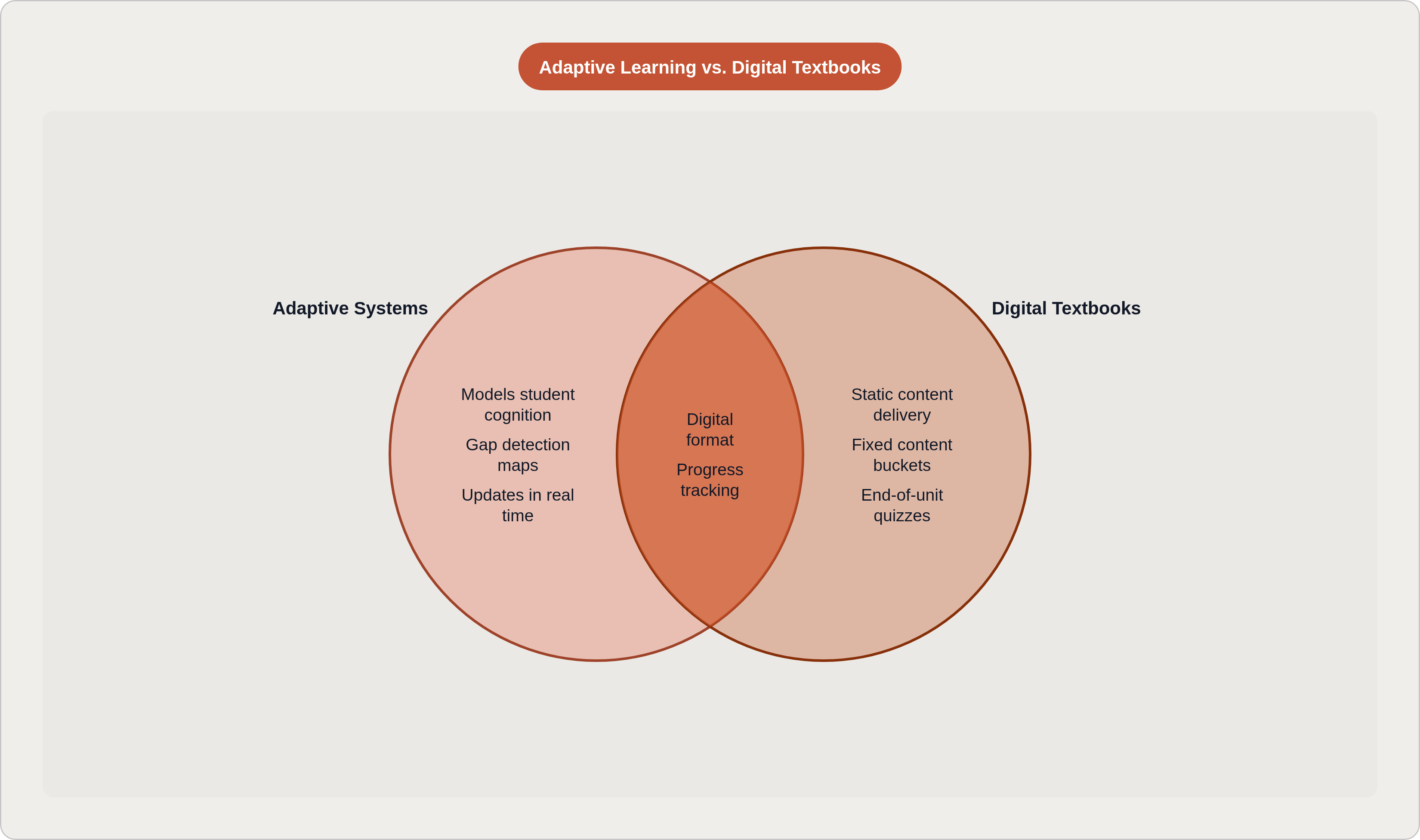
That question matters more than it sounds. Because the gap between an adaptive system and a digital textbook dressed up with dashboards is enormous. One of them continuously models what a student understands and changes what comes next based on that model. The other routes students to different content buckets and calls it personalization. If you can't tell them apart, you can't evaluate them. And if you can't evaluate them, you're probably buying the wrong one.
So let's walk through how these tools actually work. Not the marketing version. The real version.
The Engine Underneath Is Not What You Think It Is
Most people assume adaptive learning tools work like a branching quiz: get it right, move forward; get it wrong, try again. That's not what the good ones do.
The core loop is more like this:
- Student responds to a problem
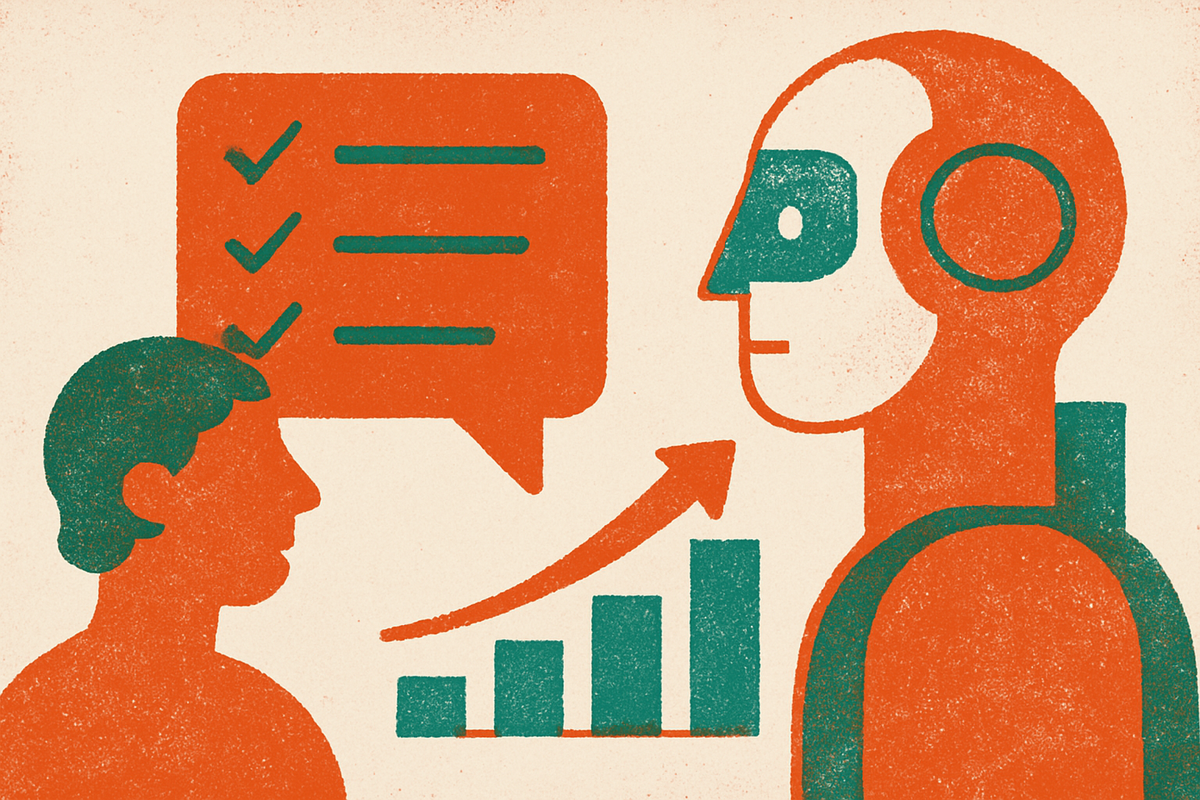
- System interprets the response (not just right or wrong, but how they reasoned)
- System updates its internal map of what the student understands
- System selects the next problem or explanation based on that updated map
The key word is "interprets." A student who gets the wrong answer because she misunderstood a core concept is a completely different diagnostic signal than a student who got the wrong answer because he misread the question. Same outcome, totally different instructional need. The systems worth paying attention to are built to tell those two students apart.
Platforms like Century Tech do this by assessing knowledge, skills, and gaps in real time, continuously revising the model of what each student knows. Knewton Alta operates on a similar principle: it identifies gaps and maintains a feedback loop so that educators can track progress and actually adjust instruction. These aren't static assessments. They're moving targets.
Intelligent Tutoring Systems (ITS) are the most developed version of this approach. They're purpose-built to model student cognition, not just deliver content. The ITS segment was valued at roughly $1.27 billion in 2024, with projections reaching around $6.5 billion by 2030. That growth isn't happening because these tools look good in demos. It's happening because they're doing something the old model couldn't.
Then there's the Socratic variant. Tools like Khanmigo and PowerBuddy don't hand students answers. They ask questions and offer hints, forcing students to surface their own reasoning. This is actually a different diagnostic method. It captures where thinking breaks down mid-process, not just at the answer. That's a harder thing to measure, and arguably more valuable.
How AI Grading Fits Into the Feedback Loop
Here's the dirty secret about traditional grading: by the time a student gets their work back, it's too late. The moment for correction has passed. The student has moved on. The misunderstanding is already compounding.
What AI grading changes is the timing. Feedback arrives at the moment of submission, while the problem is still live in the student's mind. That's not a small improvement. That's a structural change in how learning works.
Now, the scope of what's automatable today is real but limited:
- Multiple-choice and structured problems: well-handled
- Open-ended and essay scoring: harder, but not hopeless. Automated essay scoring has reached a correlation with human scores in the low 90s in vendor studies. That's meaningful. It's also not perfect, and the ceiling matters
- Large language models are now being tested as the next step for open-ended responses
But here's where it gets interesting. A 2025 co-design pilot with 19 K-12 teachers found that teachers valued rapid narrative feedback from AI for formative assessment. They also distrusted automated scoring and wanted human oversight to remain in place. Students appreciated immediate feedback. They were skeptical of AI-only grading.
That's not a contradiction. That's a sensible division of labor. AI handles the first pass. It flags patterns, surfaces errors, feeds the adaptive system. Teachers handle the consequential judgments. The tools that are designed around that division are the ones that actually work in practice.
One more thing worth saying out loud: teachers spend somewhere between 10 and 15 hours a week on grading. That's a real number, attached to a real burnout problem. AI tools that handle routine scoring don't just save time. They return that time to direct student interaction, which is where teachers can do things no algorithm can.
What Gap Detection Looks Like When It's Actually Working
The meaningful promise of these tools isn't remediation after a unit test. It's catching misunderstanding before it compounds into something bigger. Early warning, not late rescue. Those are fundamentally different problems.
What does this look like in practice? Wichita Public Schools has been using Microsoft 365 Copilot Chat to support differentiated instruction for students with IEPs, with gap detection feeding directly into individualized support plans. Albuquerque Public Schools made Google Gemini available to instructors in 2024 to identify and address learning gaps, then rolled it out to high school students in 2025. These aren't pilots. These are district-scale deployments where gap detection is built into routine instruction.
For the student, it feels like this: an adaptive math module, working at her own pace, getting immediate feedback, not moving to new material until prior gaps are actually closed. Not just attempted. Closed.
For the teacher, it surfaces something more useful than a list of wrong answers. It produces a map. Which concepts are breaking down. Which reasoning steps are failing. Which students need attention right now, before tomorrow's lesson builds on a foundation that isn't there yet.
A case study published in the GESR Journal found that after AI-powered products were implemented, math scores rose an average of 15% over six months, with the largest gains among students who had previously struggled. That's the signal you want. Not just improvement at the top. Improvement where the gaps were deepest.
Where These Tools Are Actually Being Used (And Where They Aren't)
Here's a number that surprised me. Teacher AI adoption doubled from 25% to 53% between the 2023–24 and 2024–25 school years, according to RAND Corporation research. That's a fast move.
But here's the catch. Adoption doesn't mean personalized learning. By 2025, about 61% of teachers reported using AI in some capacity, per EdWeek Research Center. Ask what they were using it for, and the top answers are brainstorming lesson ideas and creating or updating lesson plans. Those are teacher productivity tools. They are not student-facing diagnostic systems.
That distinction is everything for this conversation.
The clearest adoption story on the student side is Khanmigo. Its user base grew from roughly 68,000 in 2023–24 to over 700,000 in 2024–25. It's free for teachers in more than 34 languages through a Microsoft partnership. That's scale without a direct cost barrier, which is rare.
MagicSchool AI reached over 6 million educator users by October 2025, which actually exceeds the total number of K-12 teachers in the United States. But it's primarily a teacher tool. Not a student-facing adaptive system.
One more data point worth sitting with: 69% of high school teachers reported using generative AI, compared to 42% of elementary teachers. That gap matters for thinking about where personalized learning tech is actually taking root and where it isn't.
The Training Gap Is the Real Problem
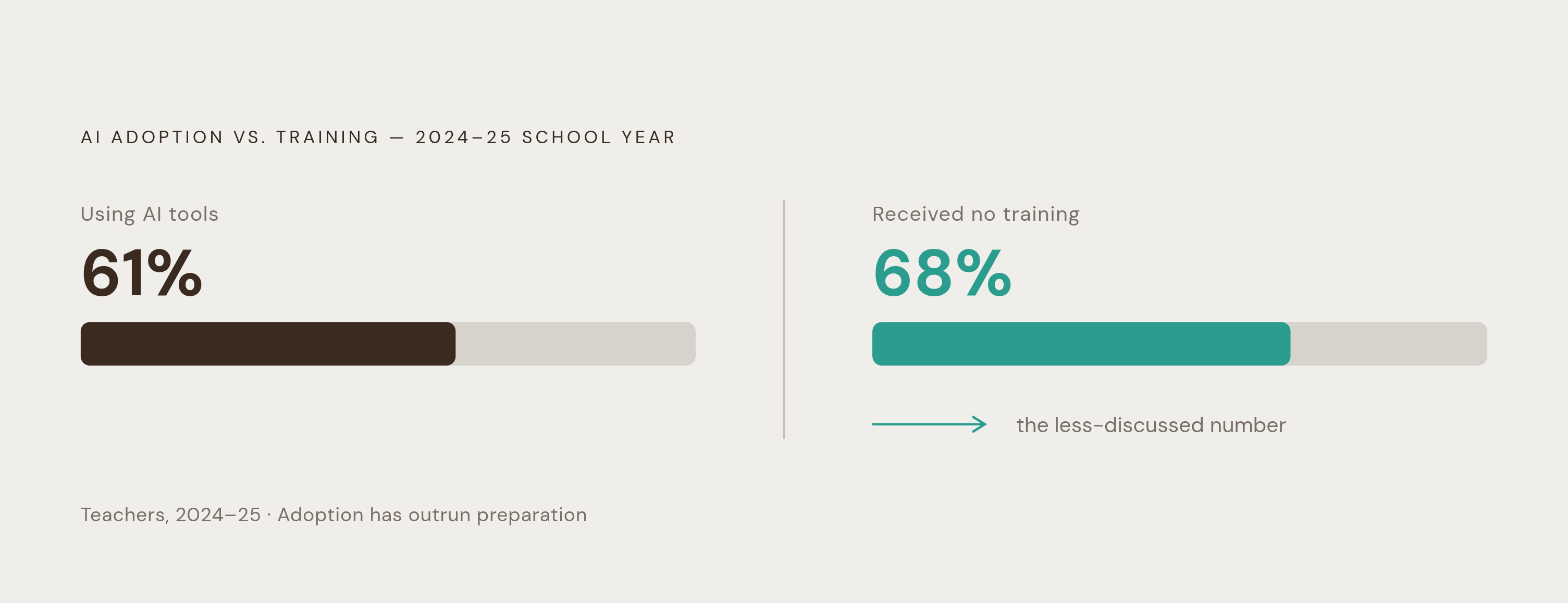
Here's the paradox that should be keeping district administrators up at night: 61% of teachers use AI tools. 68% say they received no training on how to use them during the 2024–25 school year.
What does untrained use look like? Teachers default to the tool's easiest affordances. Content generation. Quiz creation. Surface-level tasks. The diagnostic and adaptive features. the ones that actually close gaps. go untouched because nobody showed them how.
Professional development is improving. In 2025, about 50% of teachers had at least one PD session on AI, almost double the rate from early 2024. But one session is not enough to change instructional practice. Not even close.
What teachers actually need to know to use these tools for gap detection is specific:
- How to read the dashboards the system produces
- How to interpret the gap maps, not just the scores
- When to intervene and when to let the system do its work
- How to connect what the system surfaces to tomorrow's lesson
About 55% of teachers reported in 2025 that AI tools gave them more time to interact directly with students. That's real. But that benefit only materializes if the tool is doing meaningful diagnostic work. If it's just generating content, the time savings go to content generation, not students.
High-Stakes Prep Is Where the Gap Problem Gets Concrete
In 2025, 73% of AP test-takers scored a 3 or higher. The highest rate since the pandemic. That sounds good until you flip it: more than one in four students still failed to earn qualifying credit.
Why? It's probably not effort. It's probably not content exposure. Students in AP courses are working hard and sitting through plenty of material. The more likely explanation is that specific gaps in understanding weren't identified and closed before test day. That's a diagnostic failure, not a motivation failure.
The digital SAT shift actually creates a real opportunity here. The fully digital format means automatic scoring and richer response data, faster than ever before. The raw material for adaptive prep is now built into the official testing infrastructure.
Khan Academy's partnership with College Board is the clearest example of what this can look like. Full-length practice tests scored automatically through Bluebook, with results feeding directly back into Khan Academy's adaptive recommendation system. That's a closed diagnostic loop. Practice, gap identification, targeted study. Not just more practice.
The difference between an adaptive prep system and a content library is this: a content library lets students keep practicing what they already know how to do. An adaptive system identifies where their understanding breaks down and routes them there instead. Those are not the same experience. They don't produce the same results.
Look at pass rates for specific exams: AP Latin, AP Statistics, AP Music Theory all came in around 58 to 60% in 2025. Students in those courses are not being well-served by generic practice. Those are exactly the subjects where gap detection tools could have the highest marginal impact.
What the Evidence Actually Supports
Let's be clear about what we know and what we don't.
The positive signal is real. One widely cited figure from AIPRM points to a 62% increase in test scores among students using AI-powered instruction systems, attributed specifically to identifying and addressing knowledge gaps before they compound. That's directionally consistent with the 15% math score gains over six months from the GESR Journal case study.
But the evidence base has real limits. A peer-reviewed study published in January 2026 in MDPI Applied Sciences noted that the effectiveness of generative AI in mitigating learning gaps remains underexplored. Most of the current evidence is vendor-produced or observational. That's not nothing. But it's not a randomized controlled trial either.
The Khanmigo test is worth watching closely. A J-PAL randomized controlled trial, one of the first rigorous independent tests of whether Khanmigo specifically improves learning outcomes, was expected by mid-2026. That result will be the clearest signal yet of whether the diagnostic promise actually translates to measurable gains at scale.
The same MDPI study found something else worth noting: how students engage with AI-driven education varies by learning style. Hybrid models combining AI and teacher mediation may actually produce better outcomes than AI-only delivery. That should shape how schools think about implementation, not just tool selection.
And here's the implied evaluation question for anyone buying one of these tools: when a vendor claims their platform closes gaps, ask what evidence they have that the diagnostic model is accurate. Not whether students improved on the platform's own assessments. Whether the underlying gap detection actually works.
Vendor-reported gains and peer-reviewed results are not the same thing. Schools evaluating tools should weight them accordingly.
How to Actually Tell If a Tool Is Doing Real Diagnostic Work
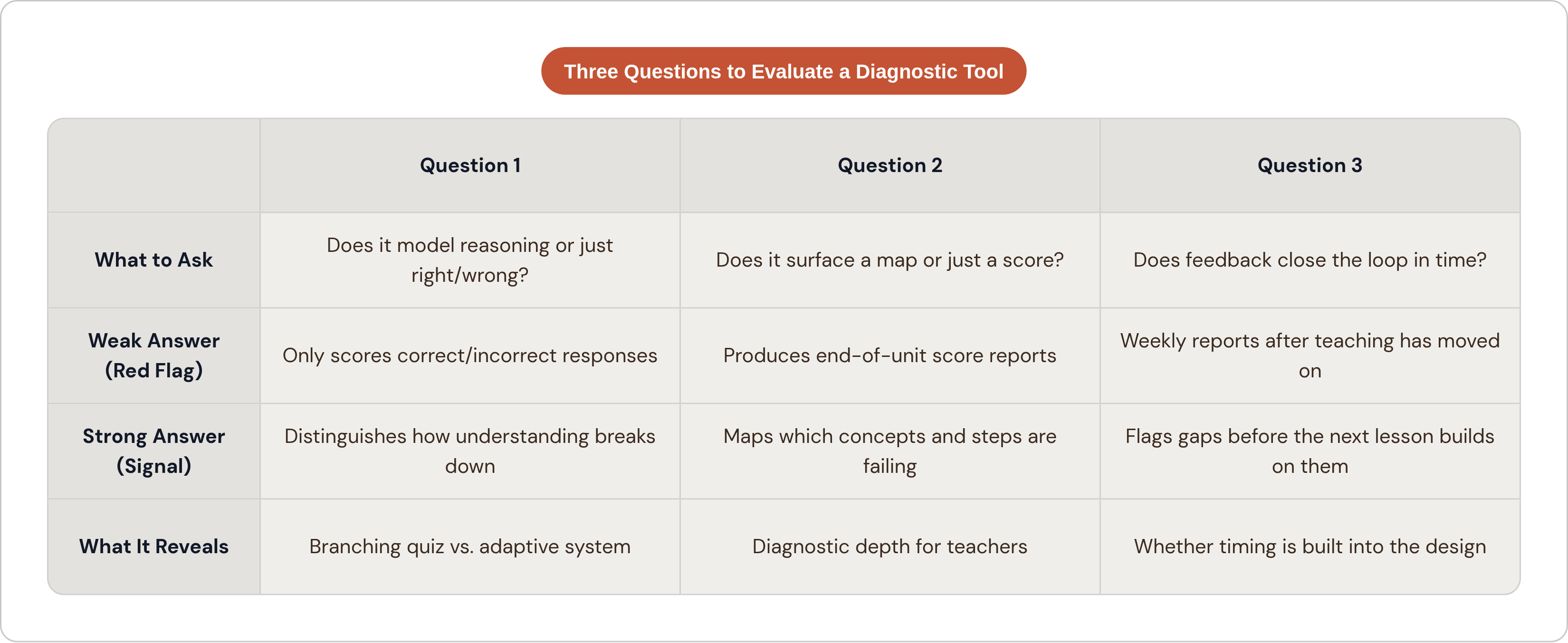
Three questions. Ask them in this order.
First: Does the tool update its model of student understanding based on how students reason, or only on whether they get answers right? If the answer is the latter, it's a branching quiz. Not an adaptive system. Those are different products.
Second: What does the tool surface for the teacher? A score, or a map of where understanding breaks down? Scores tell you something is wrong. Maps tell you what to do about it. Only one of those is useful for instruction.
Third: Does the tool close the feedback loop in time to change instruction? Reports that arrive at the end of the week don't change what happens on Tuesday. Timing is part of the diagnostic design, not a feature you can add later.
Watch for digitized tradition. Content libraries with a quiz at the end. "Adaptive" in the sense that harder questions appear after correct answers. These replicate the one-size-fits-all model in digital form. They look different. They're not.
And don't evaluate a tool without evaluating the professional development that comes with it. Even well-designed diagnostic tools underperform when teachers don't know how to read and act on what the system surfaces. The tool is only half the implementation. The training is the other half. If a vendor can't tell you what teacher onboarding looks like, that's a red flag.
The MDPI 2026 study and the teacher attitudes in the NCME pilot both point the same direction. AI handles the diagnostic layer. Teachers handle the relational and judgment layer. The tools designed around that division of labor are more likely to produce measurable mastery than tools that try to replace one with the other.
That's the frame. Now go ask your vendors some uncomfortable questions.