Teacher Adoption Barriers for AI Classroom Tools
Real barriers stop teachers from using AI tools repeatedly, not lack of interest.
Adoption numbers for AI in classrooms look great on a slide. Dig one layer down and the story falls apart. Most teachers who try a tool use it once, maybe a handful of times, then quietly stop. I've watched this happen in district after district, and it's never because the teacher is lazy or scared of change. The barriers are structural. Time, training, policy, trust, and the tools themselves are often working against sustained use, sometimes all at once, sometimes in the same week.
Stanford tracked thousands of teachers and found a large share were single-day users who never came back, and an even bigger share used AI tools only minimally before dropping off. Add those two groups together and you've got the majority of what gets counted as "adoption" on somebody's slide deck. RAND's 2025 report backs this up with subject-level detail: only about 25% of ELA, math, and science teachers used AI for instructional planning, with math and elementary teachers closer to 20% and ELA and science teachers closer to 40%. That's not a wave lifting every classroom. That's a patchwork. And patchworks tell you something if you look at where the holes are.
So forget "did adoption happen." The better question, the one nobody puts on the slide, is what's stopping it from sticking.
How the teaching day makes sustained AI use structurally difficult
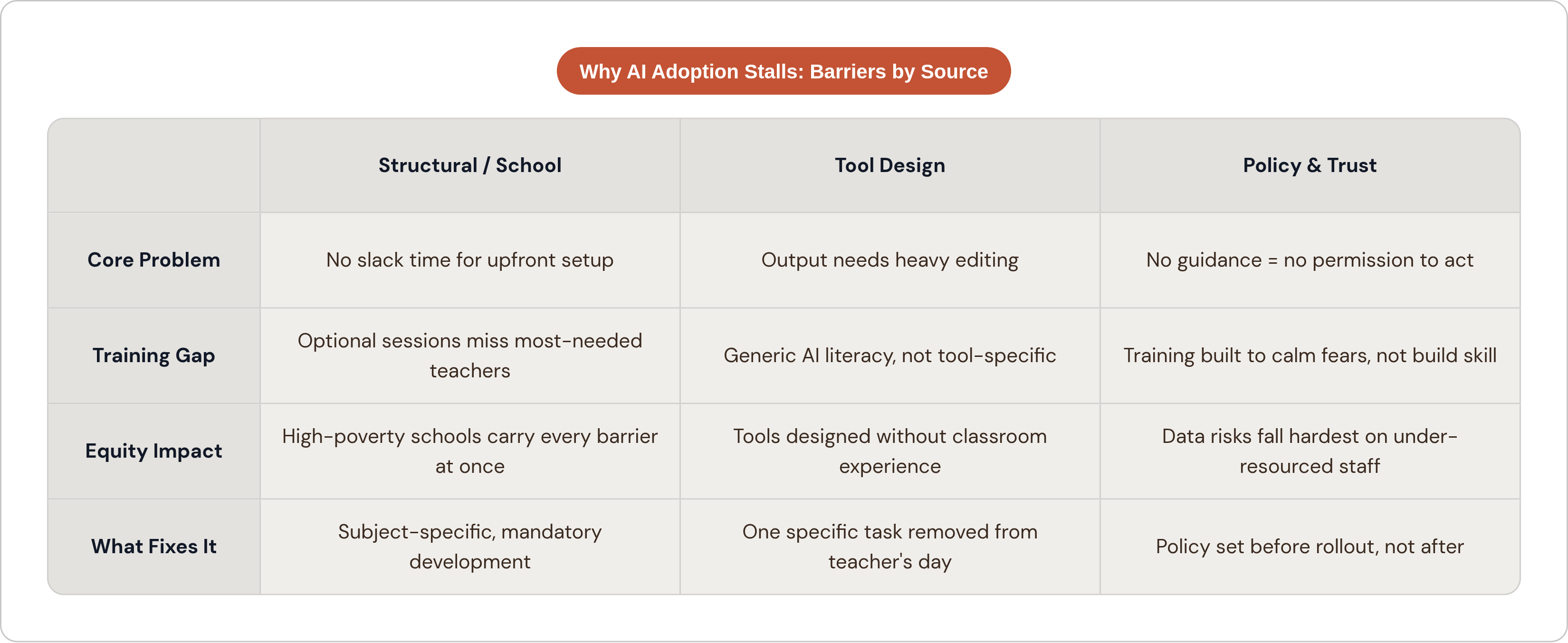
Time isn't the soft, sympathetic excuse people assume it is. It's the single most consistently cited barrier in every study I've seen on how teachers actually relate to these tools. NSF-funded research tracking thousands of teachers found that lack of time outranked fear of cheating and fear of job loss as the biggest obstacle to AI confidence. Sit with that for a second: teachers are more worried about not having enough time than they are about a machine taking their job.
Makes sense once you look at the actual day. A teaching day is built on constant task-switching: prep, instruction, grading, a parent email, hallway duty, an IEP meeting, back to prep. There's no slack in that schedule for anyone to absorb.
Most AI tools ask for time upfront before they hand any back. Before it saves you a minute, you have to:
- Figure out what the thing actually does
- Decide if it fits tomorrow's lesson, not some hypothetical future lesson
- Learn to read its output without just trusting it blindly
- Troubleshoot when it gets something wrong, which it will
That's real cognitive work, done for free, on spec. Give a teacher a full course load and a 40-minute planning period, and that math just doesn't clear. So they try the tool once, in a rare window of curiosity, get a shrug of a result, and move on. They don't conclude the tool is bad. They conclude it isn't worth the setup cost this week. Next week looks the same. So does the week after that.
Why training hasn't closed the confidence gap
You'd think more training would fix this. It mostly hasn't, and the reason is worth chewing on. By spring 2024, roughly seven in ten teachers had gotten zero AI training. That's the hole districts are still climbing out of.
And when training did happen, it often aimed at the wrong thing entirely. District leaders admitted early sessions were built to calm fears and clear up confusion, not to show a teacher how to actually run a tool inside a real lesson. Knowing what AI is and knowing when to reach for it with 25 kids in front of you on a random Tuesday are two completely different skills, and only one of them got taught.
Almost all districts made the training optional, too. Sounds reasonable on paper. In practice, it means the people who show up are the ones already comfortable with AI. The training reaches the people who need it least and misses the people who need it most. It's swimming lessons for people who can already swim.
You can see it in the confidence numbers. The 2024 Classroom of the Future Report found only about 30% of teachers felt moderately confident using AI tools. A bigger chunk landed at slightly confident or not confident at all, even with some exposure under their belt. A good number said their real struggle wasn't operating the tool. It was connecting what the tool does to what they're actually trying to teach that day. That's a design problem with the training, not a motivation problem with the teacher. A generic "here's what AI is" session doesn't turn into classroom judgment. What seems to actually work: subject-specific examples, room to try something and fail a little without consequence, and follow-up support instead of one workshop nobody revisits.
What happens when schools have no AI policy at all
Only a small share of principals said their school or district gave staff any guidance on AI use during the 2023-2024 school year. For the vast majority of teachers, there is no institutional answer to the basic questions: which tools are okay, what data is safe to share, how AI-assisted work should even be graded.
So the teacher becomes the policy. Every individual has to make a judgment call that, frankly, shouldn't sit on their shoulders alone. And judgment calls with no backup have a predictable outcome: risk-averse people just stop making them. A teacher who isn't sure if a tool could get them in trouble later will often just... not use it. That's not caution born of a bad opinion about AI. That's a rational response to zero cover.
It also produces a strange patchwork inside a single building. One teacher is all-in on an AI writing tool. The teacher next door won't touch it. Students bounce between wildly different practices depending on which classroom they walk into, and nobody planned that. It just happened, by default, because nobody decided otherwise.
Here's the part that should get more attention: districts that put out guidance, even rough, imperfect guidance, saw higher teacher engagement with AI tools. The guidance didn't have to be good. It just had to exist, because it gave teachers permission to act without wondering if they'd get burned for it later.
The data privacy problem that no one has fully solved
This is the barrier that should probably worry people more than it does. A lot of AI tools used in classrooms aren't built to be FERPA-compliant, and they don't always say clearly where student data goes or how it gets reused. A teacher generating feedback on student essays through a general AI tool might be uploading actual student writing into a system that stores or reuses that content. Most teachers have no idea that's even happening.
The ground keeps shifting, too. The FTC strengthened COPPA requirements in early 2025, which directly changes which tools can be used with younger kids. That's a pretty clear signal from regulators that this isn't settled. It's not just cautious paperwork.
The U.S. Department of Education has urged districts to treat student data with the same seriousness as medical or financial records. Most districts don't have the staff to actually audit whether a given AI tool clears that bar. So a teacher using an AI grading tool often has no way to know, with any real certainty, whether they just created legal exposure for their school. That's a strange amount of risk to hand one person prepping a lesson at 9 p.m. on a Sunday.
The stakes climb higher for students with IEPs or other sensitive records, where a data slip carries real weight. This is one spot where product design can genuinely fix the problem instead of just managing it: tools built from day one with real FERPA compliance, clear data practices, and no third-party sharing remove this barrier instead of leaving it for a school to sort out later. Purpose-built edtech with actual data governance (Passionfruit is one example) sits in a structurally different position than a general-purpose AI platform that got repurposed for classrooms after the fact.
How poverty shapes which teachers and students benefit from AI at all
Adoption isn't just uneven by subject. It's uneven by wealth, and the gap is stark. Teachers and principals in higher-poverty schools report lower AI use across the board than those in lower-poverty schools. By fall 2024, low-poverty districts had provided AI training at roughly twice the rate of high-poverty districts. That gap is projected to hold through at least 2025.
Why? Stack the barriers on top of each other and look at who's carrying all of them at once. High-poverty schools are more likely to have older devices, spottier internet, and fewer instructional coaches around to help a teacher figure out how a new tool fits their lesson. Teachers in these schools are also carrying heavier non-instructional loads (more students with acute needs, more administrative paperwork), which makes the time barrier from earlier hit that much harder.
And federal support for closing this gap has gotten weaker, not stronger. The Office of Educational Technology, which spent three decades working specifically on tech access gaps, was shut down by the current administration. That's infrastructure that used to exist and now just doesn't.
Here's the irony worth sitting with: AI tools get pitched as the thing that personalizes learning and closes gaps for kids who need the most support, and yet the schools serving those kids are the least equipped to actually run the tools. So equity-minded design (low-cost tiers, tools that run fine on an old Chromebook and a slow connection, interfaces simple enough that nobody needs a coach hovering over their shoulder) isn't a nice-to-have feature. It's often the entire difference between these tools reaching the classrooms that need them and reaching everywhere else instead.
When the tool itself is the barrier
Sometimes the barrier isn't the school. It's the product. Plenty of AI classroom tools got built by teams without much teaching experience, then sold into schools anyway. The gap between what the tool does and what a teacher actually needs shows up as quiet, repeated disappointment.
The common failure patterns:
- Output that still needs heavy editing before anyone can use it
- Interfaces that don't match how teachers actually plan a lesson
- Feedback that isn't tied to any curriculum standard a teacher can point to
General-purpose AI, the kind you get through a plain chat box, just hands the pedagogical translation work back to the teacher. The technology can do a lot. The teacher still has to turn that into something usable for Tuesday. That's the exact time cost from earlier, just relocated inside the tool instead of removed by it.
Grading makes this obvious fast. AI graders do fine on multiple-choice and rubric-based work. Accuracy drops noticeably on open-ended writing, and it drops further on work from English language learners, which is exactly where a teacher most needs a tool they can trust without checking. A University of California, Irvine study found AI graders matched a human grader's exact score less often than two human graders matched each other. Human graders don't even fully agree with each other, and the AI agreed with them less than that. Which means every AI-scored assignment needs a second look, and there goes the time savings the tool was supposed to provide in the first place.
There's also drift. The model behind a grading tool can update mid-year, and a tool that worked fine in September can behave differently by March without the teacher changing a single thing. That's a strange kind of unreliability to build trust on top of.
None of this is happening in a vacuum, either. Teachers have already sat through wave after wave of new classroom tech: learning management systems, digital assessment platforms, remote learning tools shoved in overnight during the pandemic. Plenty of it promised "less work" and delivered more work first. So the skepticism is earned, not stubborn. The lesson for anyone building this stuff: a tool has to remove one real, specific task a teacher already does. Proving the AI is impressive and leaving the classroom part to the teacher is not the same as being useful.
What distinguishes tools that teachers actually keep using
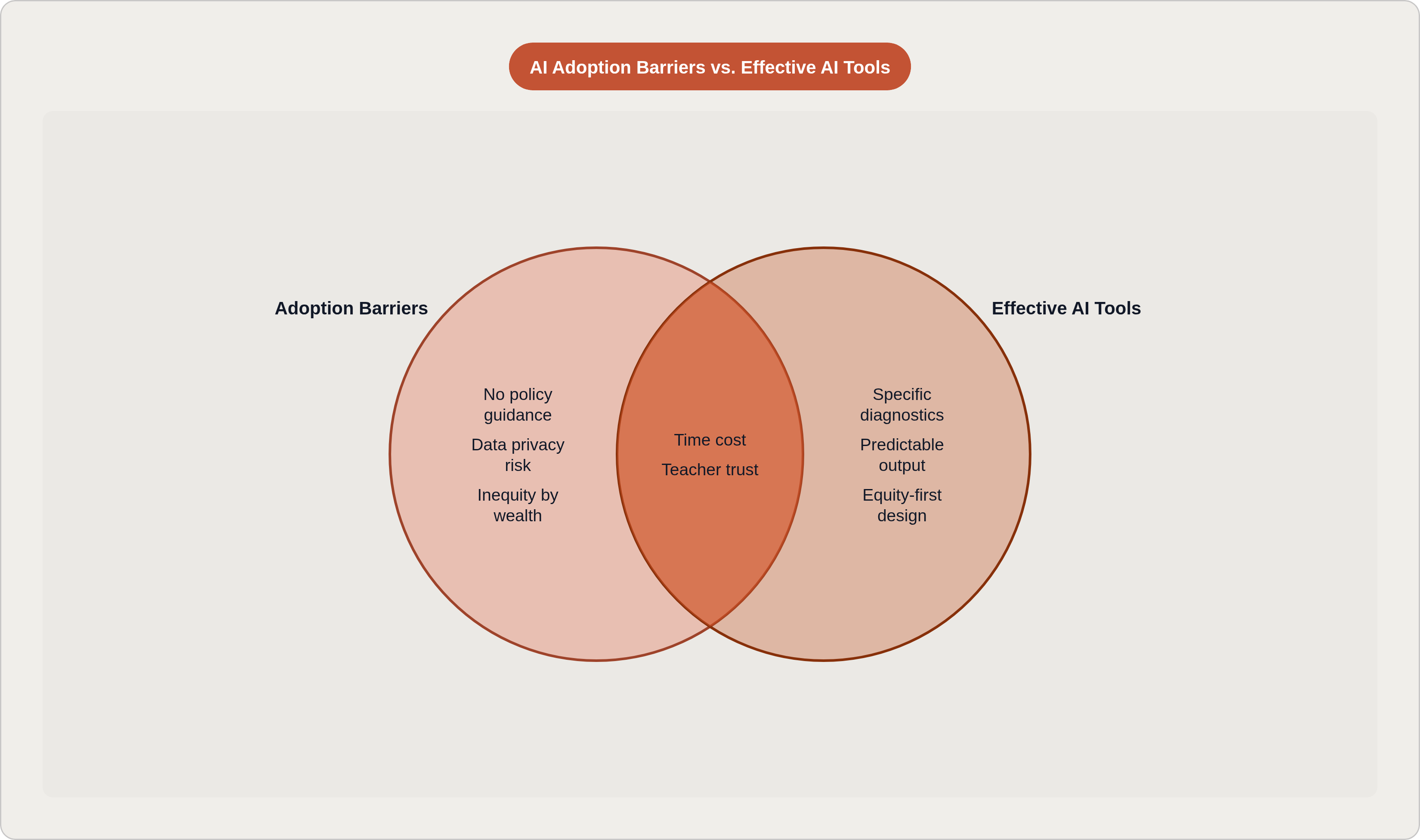
So what actually works? The pattern is narrower than you'd guess. Tools that do one specific thing well, inside a workflow the teacher already has, beat the sprawling platforms that ask teachers to rebuild how they plan and teach from scratch.
Speed to payoff matters more than people think. If a teacher can't point to a clear win within the first use or two, the tool is now competing against habits that already work, under time pressure that has zero patience for experimentation.
On the student-facing side, the evidence for AI-supported personalized learning actually holds up. A 2025 review in the International Journal of Education and Humanities found adaptive systems can cut learning time by 30 to 50% while improving outcomes by 15 to 25%, compared to traditional instruction. Real numbers. But a teacher won't trust an outcome they can't see the reasoning behind. A tool that just spits out a score with no visibility into why is asking for blind trust, and teachers, reasonably, don't hand that out for free.
Tools that show a teacher exactly where a specific student's understanding breaks down, before that crack turns into a real gap, earn a different kind of trust. That's information a teacher can act on right now, and it matches how teachers already think about their kids: not a test score, but a specific student stuck on a specific concept. That's the ground Passionfruit works from. Instead of generating content at volume, the design centers on figuring out what a student actually understands, where their reasoning falls apart, and what practice would close that exact gap. Different job than most AI tools in this space are trying to do, and it lines up with what teachers say they actually want.
Predictability matters too. Tools that flag their own uncertainty, behave the same way today as they did last week, and don't require fact-checking every single output get used again. And training tied to the specific tool a teacher is holding, not some abstract "AI literacy" session, is what decides whether that tool survives past month one.
What sustained AI adoption would actually require from schools and developers
Put it all together and the fix isn't complicated to describe. It's just hard to actually do, and it takes both sides moving.
From districts:
- Drop the optional, one-time training session. Replace it with structured, subject-specific development tied to tools the district has actually approved
- Set policy before the rollout, not after. Clarity up front produces more consistent behavior than clarity bolted on later
- Treat data governance as a contract term, not a footnote. Vendor agreements need explicit FERPA compliance, data minimization, and no secondary-use clauses before anything touches a classroom
- Put real, extra money into high-poverty districts. Equal access to the same resources isn't equity when the starting line was never the same
From developers:
- Design around the time a teacher actually has. A tool that needs heavy setup before it pays off won't survive a teacher's first rough week, and every teacher has a rough week
- Do the pedagogical translation inside the tool, not after it. The tool should already know the subject, the standard, and what useful feedback looks like in that context
- Build student-facing tools that produce specific, personal diagnostic detail: what a student understands, where the reasoning breaks, what to practice next. That's something a teacher can't easily produce alone, and it's a real reason to keep the tool around
Enthusiasm doesn't close this gap. Neither does a mandate. It closes when the structural barriers get removed one at a time, and when tools stop asking teachers to do extra work just to prove the technology is impressive. The tools that stick around will be the ones that actually earned it.