AI Tools for Teachers vs AI Tools for Students
The education AI market hit $7.57 billion in 2025, up 46% from the year before. Many products in that market get pitched as something "educators and students alike" will love. That framing is doing quiet damage: teacher tools and student tools aren't cousins. They're built to solve different problems.
Both groups have jumped on board. 85% of teachers and 86% of students used AI during the 2024-25 school year. But scratch the surface and the reasons split in two directions. Teachers are trying to claw back hours. Students are trying to close gaps in what they actually understand. Those are not the same job, even though they get sold with the same three words: "AI for education."
Hand a teacher a student-facing tool and watch them burn time on something it was never built to do. Hand a student a teacher's productivity tool and watch them get little from it. The tool wasn't designed with them in mind.
So here's the question worth sitting with before you download anything: what job is this tool actually built to do?
What teacher AI tools are actually designed to solve
A 2025 RAND Corporation study found the average U.S. teacher works 54 hours a week. About 11 of those hours go to admin work, lesson prep, and grading. Not teaching. Just the machinery around teaching.
That's the problem teacher AI tools exist to solve. They are, at their core, load-reduction tools. Their pitch isn't "better instruction." It's "here are your hours back." That shows up in a few specific places:
- Grading and feedback, done at scale
- Lesson and material generation
- Differentiation for different reading levels, IEPs, English learners
- The endless writing: parent emails, report card comments, policy documents
Notice what's missing from that list. These tools rarely sit down with a student. They don't diagnose what a specific kid understands or misses. They don't adapt in real time to how a student is performing on Tuesday afternoon. That's not a flaw. It's just not the job.
The teacher is still the one teaching. The tool just handles the paperwork orbiting around that role. Gallup's 2025 survey found teachers who use AI weekly get back about 5.9 hours a week — across a school year, close to six full weeks handed back to actual instruction.
The teacher tools worth knowing: what each one actually does
It's more useful to sort these by the specific headache each one is aimed at than to rank them.
MagicSchool AI goes after planning and admin load head-on. It packs in 80+ specialized tools: differentiated reading generators, IEP writers, parent email drafters, report card comment builders. Education Week found nearly 60% of school principals already use AI to draft emails and policy documents. MagicSchool is chasing that same time sink at the classroom level.
Brisk Teaching lives inside the tools teachers already use, like Google Docs and Microsoft Office. It gives feedback directly on student work, in a style the teacher sets. The company calls this "Classroom Intelligence," and the real value is cutting out the context-switching between grading mode and whatever platform students actually submit their work in.
Diffit is built for differentiation. It takes a text and adapts it across multiple reading levels, then generates vocabulary lists and comprehension questions for each version. If you're managing a room with a wide range of abilities, or a mix of English learners, this is the tool solving that exact headache.
Eduaide.AI handles lesson and assessment design: learning objectives, activities, writing prompts, assessments, rubrics, all built around subject, grade, and what you're actually trying to teach.
Google Gemini for Education plugs into Google Workspace for Education, with more than 30 AI tools including quiz generation and interactive diagrams. Free base tier, Pro version at $15 a user.
Canva for Education is free, full stop, for K-12 teachers and students in the U.S. Its AI features, Magic Design, Magic Write, the Presentation generator, make it a useful visual tool for building classroom materials without a design background.
An analysis of hundreds of thousands of teacher prompts on SchoolAI found that teachers overwhelmingly gravitate toward one flexible assistant instead of juggling five specialized ones. Teachers who try to run too many tools at once tend to abandon most of them; the ones who stick with AI long-term settle on roughly three tools, total.
AI grading specifically: what it handles well and where it still needs a human
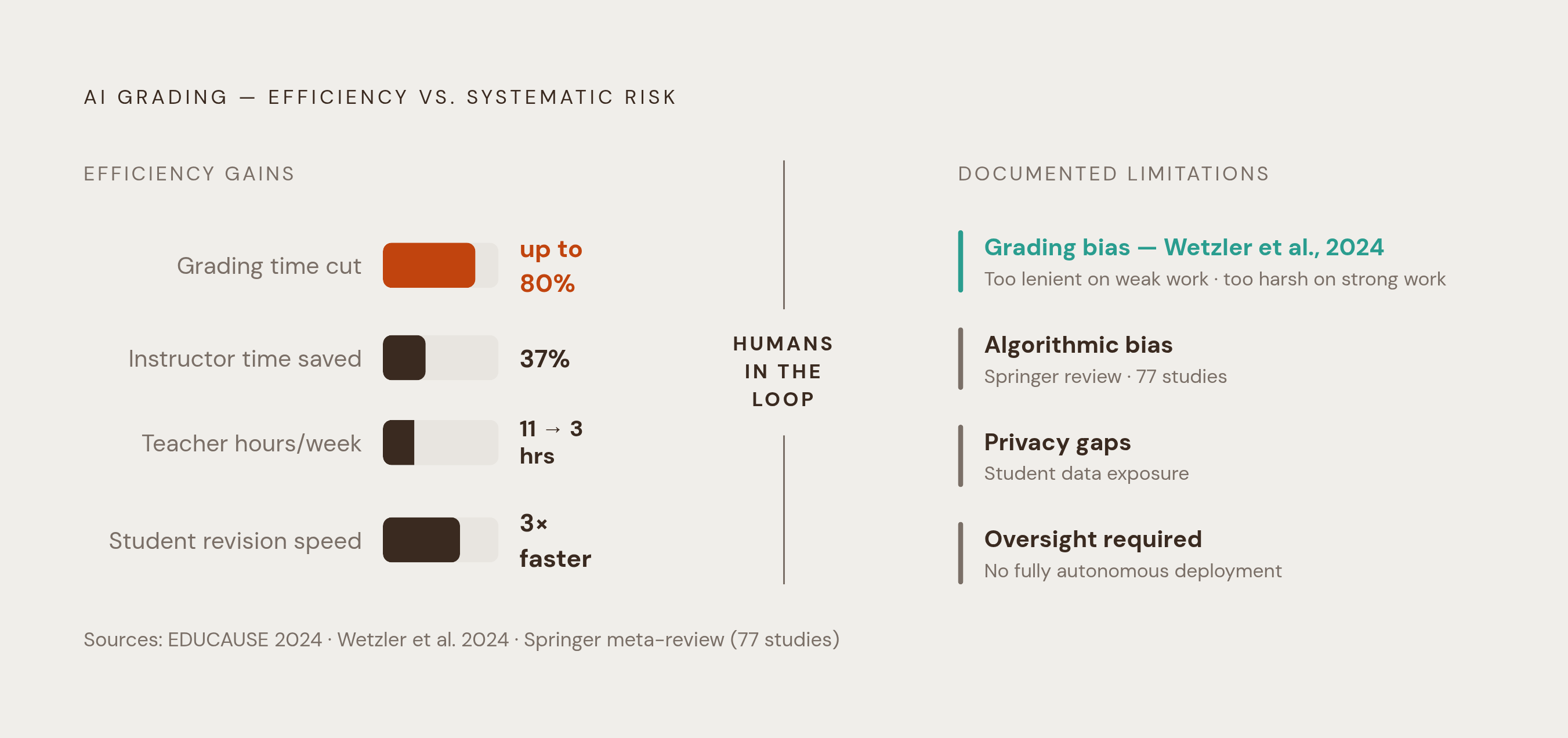
Grading is where AI adoption in schools is furthest along, and the scale is hard to overstate. 72% of schools globally use AI grading systems in 2025. In U.S. public schools, AI now auto-grades 48% of all multiple-choice assessments. Essay-scoring AI is in use at 63% of universities.
The efficiency case is not hype. Rubric-based grading tools cut grading time by up to 80%. Instructor grading time overall dropped 37% due to automation. One group of middle school teachers went from 11 hours of weekly grading down to 3. On the student side, AI feedback let students revise essays up to 3 times faster than with manual review turnaround.
But the evidence gets messier the closer you look. A 2025 study by Flodén, published in the British Educational Research Journal, found AI essay grading produced results somewhat comparable to human grading, but teachers flagged real concerns about whether AI can judge creativity and nuance. Research by Wetzler and colleagues in 2024 found something more specific: AI tends to grade low-performing essays too leniently and high-performing essays too harshly. That's a bias pattern that makes standalone use risky.
A 2025 Springer review covering 77 studies from 2018 to 2025 landed on a similar conclusion from a different angle: algorithmic bias, data privacy, lack of transparency, and the ongoing need for human oversight are persistent, not shrinking, problems.
The EDUCAUSE 2025 Horizon Report puts it in a phrase worth keeping: faculty need to stay the "humans-in-the-loop." Grading AI compresses time; it does not replace judgment. One more data point worth flagging: automated grading systems flagged 12.7% of assignments for potential plagiarism in 2025, a secondary use case that's quietly becoming a primary one.
What student AI tools are built to do — and why it's a different problem entirely
A student's problem isn't administrative. It's cognitive. Gaps in understanding. Uneven knowledge across topics. Not knowing what they don't know, which is a much harder thing to fix than a messy inbox.
55.4% of college students used AI to help with assignments or exams in 2025. But "used AI" is a wide net. It covers a student who had ChatGPT write their essay and a student who used AI to figure out exactly where their algebra breaks down. Those are opposite outcomes wearing the same statistic.
That's the real fork in the road for student tools:
- AI-as-shortcut: the task gets done, but the student is left with what researchers call an "illusion of mastery." The thinking got outsourced. Little sticks.
- AI-as-learning-tool: the AI surfaces exactly what the student doesn't understand, and makes them work through it anyway.
So the design question that actually matters here isn't "is this AI good?" It's: does this tool make the student think, or does it think for them?
A review of 41 studies found that 59% of students improved their grades using personalized adaptive learning. But the mechanism is the whole story. It works when the tool adapts to what a student actually understands, not when it just fires the same content at everyone. Platforms that recommend personalized learning paths showed 28% faster progression through curriculum benchmarks in 2025. Knowing where a student actually is matters more than handing every student the same worksheet.
How student-facing AI detects and targets knowledge gaps
Detecting a knowledge gap is harder than it sounds. In a room of 30 students, even a great teacher can't track every individual gap in real time. Research from December 2025, published on arXiv, found that existing classroom response systems rely on the teacher initiating the interaction, which means they miss the spontaneous gaps that actually matter, the moment a student gets quietly lost mid-lesson.
Adaptive systems try to close that gap differently. What they actually do:
- Track patterns in right and wrong answers, not just a final score
- Build a model of what a student understands versus what they've merely been shown
- Adjust what content comes next based on exactly where understanding breaks down
Concretely: a student who's strong in geometry but consistently wrong on algebra gets fed more algebra, not more geometry. The system stops rewarding what's already mastered, which sounds obvious until you realize most static worksheets do exactly that.
The research backs this up. An adaptive deep reinforcement learning platform built by Ruan and Lu in 2025 hit 87.5% accuracy in adjusting learning paths on the fly. A January 2026 study in MDPI, using AI-generated Personalized Learning Pathways built on Gemini 2.5 Pro and ChatGPT 5, found this kind of personalization significantly reduces gaps in lower-order skills, the basic recall-and-apply stuff. Higher-order skills, analysis, synthesis, evaluation, stayed stubbornly hard to build through AI alone.
The KG2M approach, published on ScienceDirect in 2025, used large language models and retrieval-augmented generation to mine student-AI dialogue logs and spot class-wide knowledge gaps. Across 3 computer science courses, 1,355 students, and 2,878 unique posts, the pattern-finding worked at a scale a single teacher could rarely match by hand.
The catch that undercuts all of it if ignored: gap detection only helps if the student is the one doing the thinking. A tool that just answers the question isn't closing a gap. It's training dependence and calling it personalization.
Student AI tools in practice: what the current landscape offers
Rather than sort these by marketing category, it's more useful to ask what kind of learning support each one is actually giving.
Google Gemini Study Notebooks, rolling out in 2026, has students upload class material or describe what they're studying. Gemini runs a diagnostic quiz to find weak spots, then builds a plan of short, interactive lessons that update automatically as new quiz results and new material come in. Early testers praised it specifically for surfacing knowledge gaps and pushing active recall, rather than passive review.
Khan Academy's Khanmigo takes a conversational tutoring approach, asking questions instead of handing over answers, built specifically to keep the cognitive work on the student's side of the table.
Flashcard and practice apps remain strong for pure recall and memorization, but tend to be weaker at diagnosing why a student got something wrong in the first place. Knowing that a student missed a question isn't the same as knowing what misunderstanding caused it.
Passionfruit, built specifically for AP exam and SAT prep, is a useful case study here because it tries to close the two things most practice tools split apart: unlimited volume of practice problems, and AI-powered grading that actually explains the miss. It doesn't stop at "you got this wrong." It models what the student actually understands, where their reasoning breaks down, and what specific gap stands between them and mastery. It's also built to work for both individual students and for teachers or schools trying to close knowledge gaps across a whole classroom, which puts it in a useful, less common spot: a subject-specific tool bridging both sides of this divide at once. Drilling a hundred more problems only helps if the student understands why the wrong ones were wrong. Otherwise you're just building faster ways to make the same mistake.
The thread running through nearly every tool that actually produces learning gains, not just engagement: make the student think first, then adapt based on what that thinking reveals.
Where teacher tools and student tools are supposed to connect
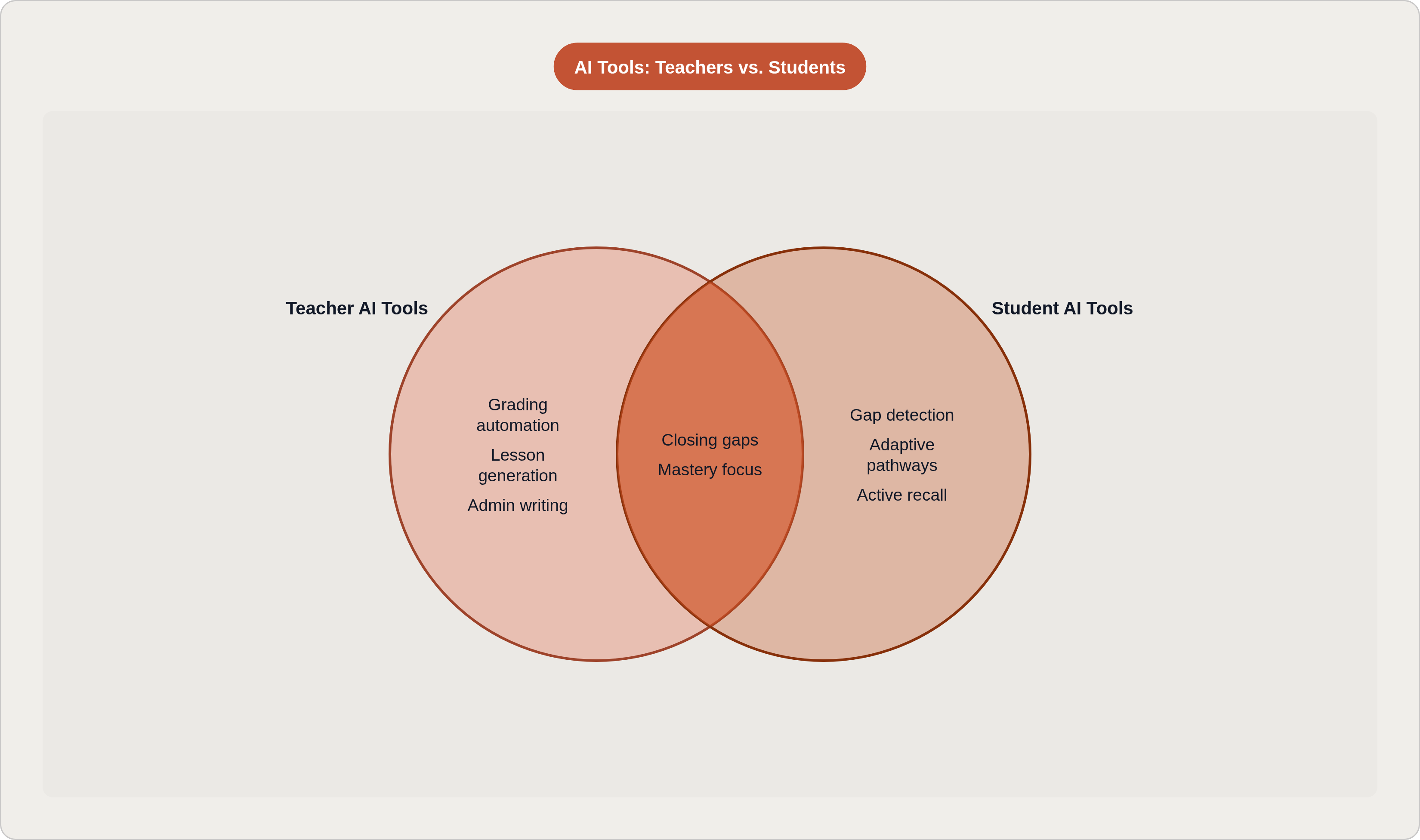
Both sides of this market are aimed at the same target: closing knowledge gaps and moving students toward mastery. They just approach it from opposite directions. Teacher tools work from the top down, looking at the whole class. Student tools work from the bottom up, through one student's specific misunderstanding.
The data suggests these aren't separate stories. Research from SchoolAI found teachers using AI-personalized feedback tools reported a 34% drop in the need for remedial instruction time. Separately, those same tools correlated with students scoring 54% higher on tests compared to traditional assessment methods. That's a loop.
Here's how the loop is supposed to work:
- Teacher tools surface the class-wide pattern: which concepts most of the room is missing, where the curriculum needs another pass.
- Student tools act on the individual version of that pattern: giving each student targeted practice on exactly what they, personally, haven't gotten yet.
- With both running, the teacher spends less time on logistics and more time actually in front of students. A 2025 UNESCO report tied AI-assisted classrooms to a 22% increase in direct student interaction.
But the loop breaks in predictable ways. A teacher adopts a productivity tool, but the students are still stuck with generic, one-size-fits-all practice, so the gaps the teacher identifies have nowhere useful to go. Or flip it: students are using a sharp adaptive tool, but the teacher has little visibility into what it's finding. The class-wide pattern stays locked inside individual student accounts, invisible to the one person who could act on it at scale.
Schools using AI-enhanced LMS platforms saw a 34% jump in assignment completion among students with learning disabilities — not one tool doing the work, but teacher-side coordination and student-side adaptivity producing something neither one gets you alone.
How to choose: matching a tool to the actual job it needs to do
Before buying, downloading, or mandating anything, ask one question: who's doing the work here, and what work are they trying to do less of, or do better?
If you're a teacher, start with your highest-friction task, not the flashiest tool.
- Grading eating your week? Look at grading-specific tools with rubric support, and treat the output as a first pass, not a final grade. The research on grading bias makes that hard to ignore.
- Differentiation your bottleneck? Something like Diffit, which adapts material you already have instead of asking you to start from a blank page.
- Buried in admin writing? MagicSchool AI or Brisk Teaching, ideally built into whatever you're already using, Google or Microsoft.
- Remember the ceiling: teachers who stick with roughly three tools stay consistent. Teachers who chase every new release tend to burn out and drop most of them.
If you're a student, the question to ask before you open any app is simpler and more uncomfortable: does this tool answer for me, or does it make me answer first, then tell me what that answer says about what I actually know?
A tool that hands you the answer feels productive in the moment and leaves you no better off next week. A tool that makes you sweat through the wrong answer first, then shows you exactly where your thinking broke, is doing something slower and much more valuable. For something like AP or standardized test prep, where the gap between "practiced a lot" and "actually improved" can be enormous, that distinction is the entire reason to pick one tool over another.
The market will keep pitching everything as useful to "educators and students alike." Maybe some of it truly is. But the smart move is asking, every time, whose hours this saves and whose understanding this actually builds. Those are two different questions. Good tools answer one of them clearly. The best situations answer both, on purpose, together.