Metacognitive Strategies Students Can Use During Test Prep
Distinguishing between recognition and mastery closes the gap where test scores disappear.

Metacognition means thinking about your own thinking. In test prep, that translates to three specific habits: taking stock of what you actually know, noticing how you learn best, and checking whether you've truly mastered something or just recognize it. Most students get that last distinction backwards. They treat recognition as mastery. It isn't, and the gap between the two is where AP and SAT points quietly disappear.
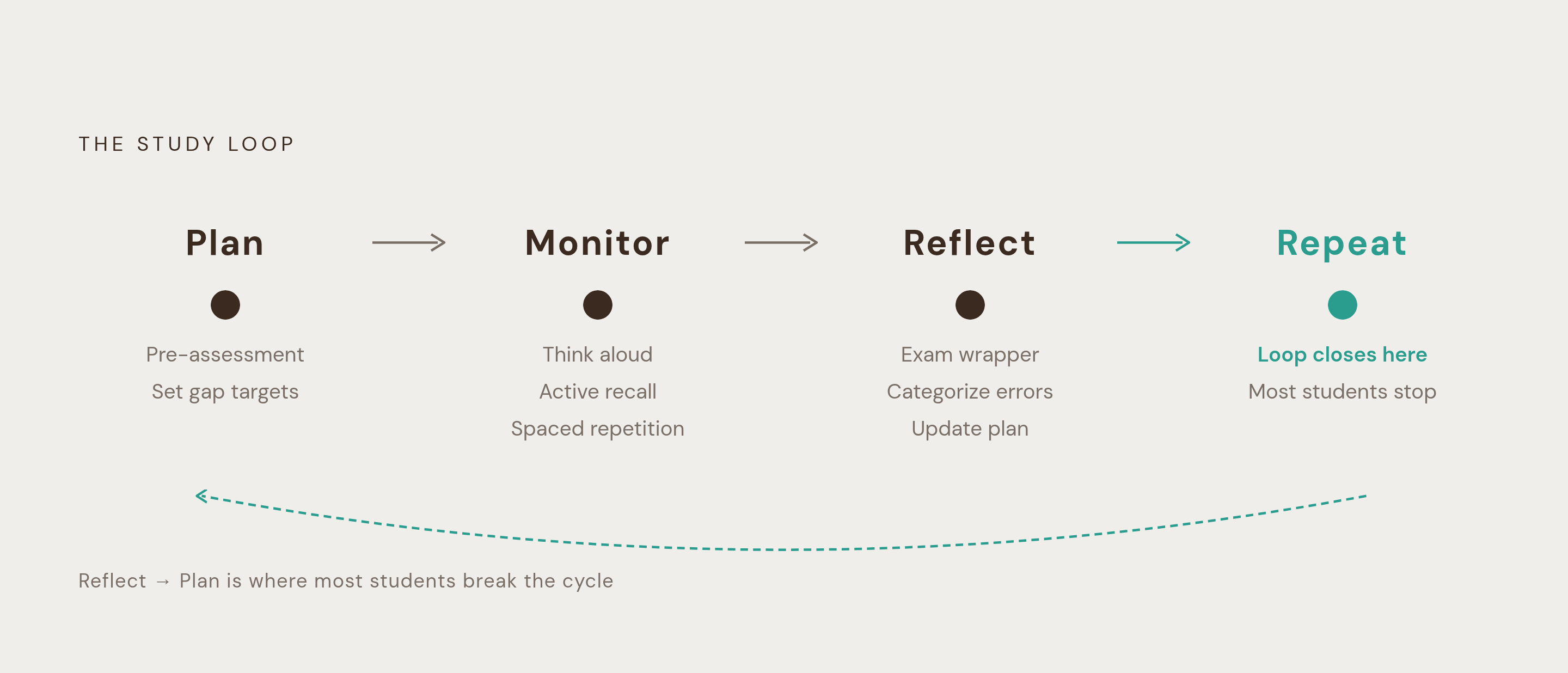
Researchers split this into two layers. One is knowledge of cognition: knowing your own strengths, weaknesses, and which study strategies actually work for you. The other is regulation of cognition: the real-time work of planning, monitoring, and adjusting while you study. Expert learners do both automatically. They size up what a test demands, size up their own readiness, and close the gap between the two. Most students don't do this naturally, but it's learnable, and it follows a repeatable cycle: plan before you study, monitor while you study, reflect after you test, then start over.
High-stakes exams don't reward hours logged. They reward students who know what they don't know and have a plan to fix it. Grinding flashcards for six hours a night is not that plan, and treating it like one is the single most common way students burn a study season without moving their score.
Why most students' intuitions about studying work against them
Rereading a chapter feels like learning. It isn't. Rereading produces familiarity, the sense that the words look correct on the page. It does not produce the ability to pull that information back out of your head with nothing to lean on. Recognizing a fact and being able to recall it cold are two different skills that happen to feel identical in the moment. This is why so many students walk into a test overconfident.
Research cited in AP exam prep guidance has rated passive techniques like rereading and highlighting as low utility for meaningful learning. They feel productive. Passive techniques like these feel productive, but they mostly aren't. That mismatch between feeling and fact is the entire problem metacognition exists to catch.
Then there's the calibration issue. Students who haven't practiced metacognition tend to overestimate how ready they are for a test, and the effect is worse for lower-achieving students. A 2024 St. Olaf study, published in CBE Life Sciences Education, examined students who tended to overestimate their readiness. The hopeful part: when students completed metacognitive exam assignments, exam scores improved specifically for the students with lower ACT scores. Metacognitive ability isn't a fixed trait. The gap is fixable, and assuming it isn't is the mistake that keeps students from bothering to close it.
Stress makes all of this worse. Neuroimaging research cited by Edutopia shows that high-stress environments disrupt both memory acquisition and memory retrieval. Under stress, the brain's threat-response systems become more active, and that shift can interfere with the executive function and judgment needed to think clearly. Under real threat, or the feeling of one, which a test can absolutely produce, the brain narrows toward fight, flight, or freeze. Not the mental state anyone wants while parsing a tricky free-response question.
What follows is a cycle built specifically to correct for these blind spots, one stage at a time.
The planning phase: what to do before a single study session begins
Before opening a single book or app, answer a few questions honestly:
- What will actually be on this test, and what format does it use?
- What does the student already know? Sitting the exam right now, cold, would produce what grade?
- How much time needs to be set aside, and are the materials and a quiet place available to use it? (This comes straight from Overlake's metacognition handout, and it's more practical than it sounds.)
- What strategies will actually get the student there? Rereading rarely qualifies. Timed practice tests, active writing, or explaining material out loud usually do.
A pre-assessment, even something as short as a five-question cold quiz before cracking open a review guide, shows the real distance between what a student assumes they know and what they actually know. The study plan should target that distance rather than the chapter list. Building a plan around the table of contents instead of the pre-assessment is the most common planning mistake, because it studies what's easy to schedule instead of what's actually missing.
Goal-setting works the same way. "I want to do well" is a wish. Alliant CTE frames a real goal as one that moves beyond vague ambition toward concrete targets and specific actions that close identified gaps.
For AP students, the syllabus or the official Course and Exam Description is the roadmap. Check how much weight each unit carries on the multiple-choice section. Don't skip the free-response section's share: on many AP exams, free response accounts for half or more of the final grade. That should shape the study split from day one, not get bolted on afterward.
For SAT students, chasing the overall score during planning wastes time that could go toward something useful. Look at the subscore breakdowns and let those point to which skill areas actually need the work.
A workable structure for AP planning works backward from the exam date: complete core content first, then shift to full practice exams, then use the final weeks for targeted review of whatever practice exposed. Across eight to twelve weeks, that works out to a consistent but manageable number of hours per week per AP subject. Not a sprint. A build.
Monitoring comprehension while studying, not after
Planning sets the direction. Monitoring is what happens once you're in the material, and it's the stage most students skip entirely, which is a shame, because it's also the cheapest one to fix. The core habit is simple to describe and hard to do consistently: pause periodically and ask whether what just happened in your head was real understanding, or just a feeling of familiarity.
One of the most reliable diagnostics is the think-aloud. Explain the concept out loud, to a study partner, a tutor, or nobody. Silent reading hides gaps. Speaking exposes them immediately. If a step can't be explained without glancing at notes, it isn't known yet, a method the Florida Poly metacognitive strategy guide points to directly.
A related trick: memory-first note-taking. Read a short section, close the book, write down what's remembered before checking it against the source. That single move turns note-taking from passive copying into an active retrieval check, a very different cognitive task from transcription.
While studying, run a short set of questions on yourself, again from the Florida Poly guide:
- Does this answer actually make sense given the information provided?
- What strategy was used here, and did it actually work?
- How does this connect to, or conflict with, what was already thought to be known?
- What's still confusing about this?
Drawing a concept map from memory, no notes, no peeking, is another form of self-testing. It shows whether the facts learned are actually wired into a framework, or just floating around independently, waiting to be forgotten separately.
Build in scheduled timeouts, too. Instead of studying until worn out, stop periodically and ask, honestly: is this being learned, or is this just going through the motions? Metacognition needs deliberate breaks from forward momentum, separate from the fatigue-based kind.
For AP free-response practice specifically, download the scoring guidelines before grading your own answer. Applying the rubric to your own work functions as a monitoring exercise in its own right. The score itself matters less than finding exactly where the thinking diverged from what the question actually wanted.
Active recall and spaced practice as the engine of the monitoring phase
Two techniques do most of the heavy lifting here, and research consistently points to them as the most effective study methods available, per NotesMakr's AP exam guide: active recall and spaced repetition.
Active recall means testing yourself instead of rereading. The effort of trying to remember something, even getting it wrong, strengthens the memory trace in a way passive review can't match. Spaced repetition means spreading that practice out over time, so each session checks that the material has actually stuck instead of merely confirming it's sitting in short-term memory for the next hour and nowhere else.
Self-corrected practice tests combine both, and they're arguably the highest-leverage version of this work. Grading your own test forces a judgment call on your own accuracy, a check on what you thought you knew, then a revision or reinforcement of that memory. Edutopia's building-metacognition piece supports this approach: self-spotting an error redirects attention toward the mistake on the next pass, and progress becomes visible across repeated attempts.
For AP prep, that means weekly timed free-response writing, followed by rubric self-scoring. This format mirrors what the actual exam demands more closely than any other practice method. Students who skip timed FRQ practice are leaving a major section of the exam under-prepared, full stop.
For the Digital SAT, the format itself creates a specific challenge worth training for directly. The test is adaptive: students who do well on Module 1 get a harder Module 2, while others get an easier one. That shift in difficulty can catch students off guard on test day. Practicing with first-module and second-module style sets ahead of time, rather than meeting that shift cold on test day, dampens the psychological hit when it happens for real.
Self-correcting complex exam-style questions is harder than it sounds, because spotting exactly where reasoning broke down, not just whether the final answer landed right, takes a level of detail most students don't have the patience or training to self-administer. That gap is precisely what targeted feedback tools aim to close, pointing to where the thinking went wrong rather than just marking the answer incorrect.
Error logs and what patterns of mistakes reveal
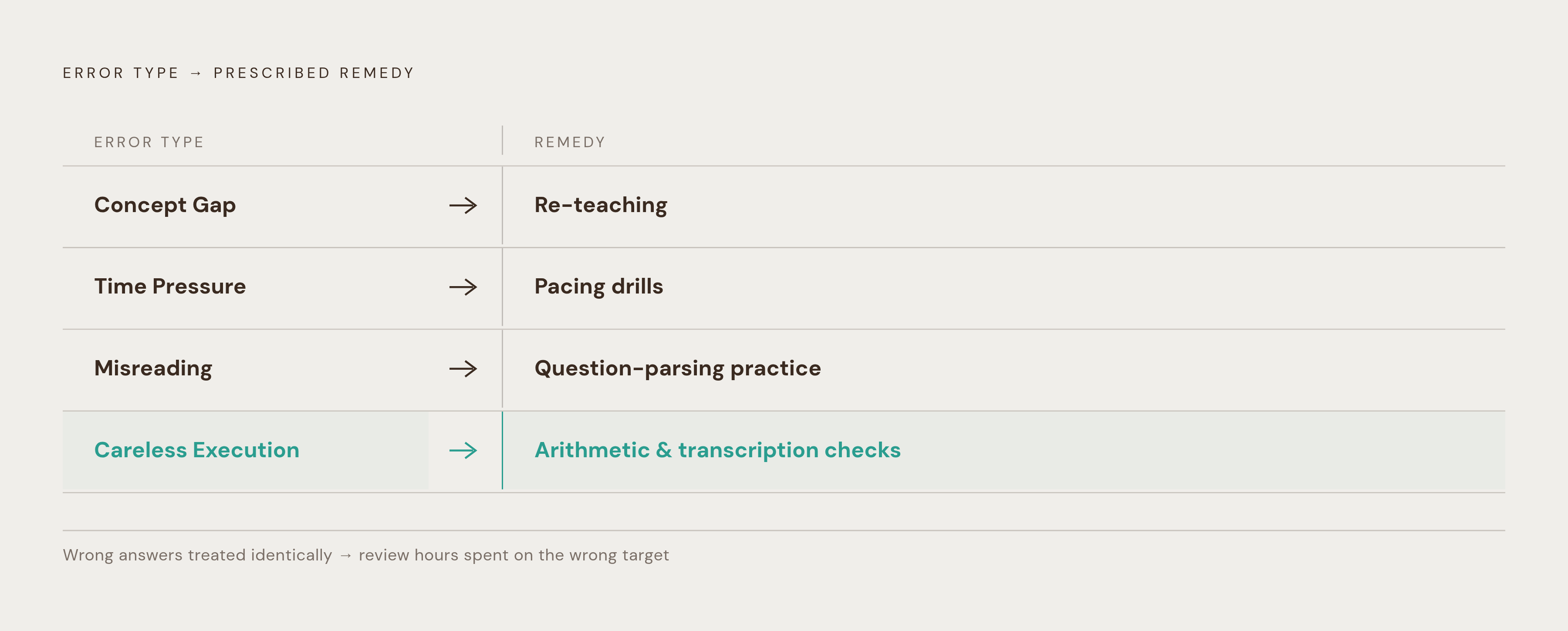
Not every wrong answer means the same thing, and treating them all the same is a quiet, expensive way to waste study time. When something goes wrong, sort it into a category:
- Concept gap: the underlying idea wasn't understood.
- Time pressure: the answer was known, but time ran out.
- Misreading: the concept was understood, but the question was misread.
- Careless execution: the right approach, undone by an arithmetic or transcription slip.
Weekly error review, categorized by type, is a core metacognitive tactic. Different error types need different fixes. A time-pressure problem needs pacing drills. A concept gap needs re-teaching. Lump them together, and the review time goes to the wrong target every time. That's the real cost of skipping the error log: not the missed points on the last test, but the wasted hours reviewing the wrong thing on the next one.
The principle holds the same way: track what was missed and why, then build a plan that targets those exact gaps. Reviewing errors without a follow-up plan creates the illusion of progress without any of the substance, making it worse than skipping the review.
What makes an error log more useful than any single test score is the pattern across time. A student who keeps misreading questions under time pressure needs pacing practice, not more content review. A student who keeps missing inference questions in SAT Reading needs targeted work on that specific reasoning skill. One test shows what happened once. A log shows what keeps happening.
Watch for a few recurring traps: not identifying what the question is actually asking, picking an answer before reading all the options, skipping the "does this answer make sense" check on a math or science result, and misaligned numbering on the answer sheet itself, a mistake that has nothing to do with content knowledge and everything to do with carelessness under pressure.
None of this requires anything fancy. A running document, date, question type, subject, error category, and the correct reasoning, reviewed once a week, does the job. Consistency beats sophistication here every time.
Post-practice reflection: exam wrappers and the questions that close the loop
An exam wrapper is a short, structured set of prompts filled out right after a graded exam comes back, aimed at getting students to look at their performance with an eye toward changing what happens next time, a method described by Alliant CTE. It typically asks:
- How was the studying actually done, and which strategies seemed to help?
- Which content areas or question formats were hardest?
- What was surprising about the result?
- What will be done differently before the next exam?
One caveat matters a lot here. Doing this once doesn't move the needle. Research cited by Alliant CTE found no measurable improvement in performance or metacognitive skill from a single exam wrapper. It has to be a repeated habit; a one-time worksheet filled out after the first practice test and then forgotten does not work.
A simpler version, from the Overlake metacognition handout, asks nearly the same questions without the formal structure: What was gotten wrong, and why? Were there any surprises? Was the preparation actually adequate, or did it just feel that way going in? What would be done differently?
The reflection only earns its place if it changes the next planning phase. A completed worksheet sitting in a folder means the loop broke somewhere. The output has to be an updated study plan rather than a filed piece of paper.
For AP and SAT students, that means a reflection after every full-length practice exam, tied directly to the error log. That combination turns the practice test from a one-time performance event into a planning event, with the next study session's goals set before the reflection sheet ever gets put away.
Managing test-day anxiety as a metacognitive skill, not a soft skill
Test anxiety is not a character flaw to push through with willpower, and treating it as one is why so many students never actually address it. Under threat, the amygdala restricts how much information reaches the prefrontal cortex, cutting into exactly the stored memory and judgment a student needs mid-exam, a mechanism documented in Edutopia's building-metacognition research.
The fix starts with self-awareness. Recognizing the physical or mental signs that stress is climbing is the first step toward interrupting that amygdala-driven shutdown. Because the brain has neuroplasticity, each time a student practices recognizing, naming, and predicting their own stress response, and deciding what to actually do about it, that circuitry gets a little stronger and a little more automatic, as Edutopia frames the research.
One tactic with real research support: a short writing exercise before a high-stakes test, aimed at addressing fear of failure directly, can help students manage the stress that would otherwise interfere with performance. A small intervention with a specific target.
A few other practical, test-day moves, both drawn from Edutopia, can help:
- If the test format allows it, jot down frequently missed error types on scratch paper, and separately, jot down key formulas, dates, or procedures, before starting. Getting it out of working memory and onto paper frees up bandwidth for the actual problem in front of you.
- Build a quick mnemonic for common mistakes. Edutopia's example is WREN: What is actually being asked, Read all the answer choices, Estimate if a math or science result is reasonable, Numbering matches on the answer sheet.
None of this works as a last-minute fix pulled out of a hat on test morning. Students who've already practiced self-corrected testing and error logging throughout their prep have built the recognition habits these tactics depend on. Test-day strategy reinforces something already trained, and skipping straight to the mnemonic without the months of error-log practice behind it is like memorizing a fire escape route for a building you've never entered.
Applying the full cycle to AP exam prep in 2026
The format itself has shifted, and it changes what "prepared" actually means. Most AP exams are now given through Bluebook, the digital testing app. The move to digital is nearly universal for 2026, but not complete. Subjects like English and History are fully digital, while a number of math and science exams remain hybrid, FastWeb and BreakawayPrep report.
Hybrid means students view the questions on screen through Bluebook, but write free-response answers by hand in a paper booklet. That split-attention setup, reading digitally while writing on paper, is its own specific skill. It needs deliberate practice under those exact conditions. General content review doesn't touch it, and students who assume it will are in for an unpleasant surprise on test day.
The 2026 AP exam dates run May 4 through 8, and May 11 through 15. Planning should work backward from those dates, not forward from whenever studying happens to start.
Over 1.3 million students in the Class of 2025 sat for at least one AP exam, and participation grew 7% from 2024 to 2025. At the same time, roughly 40% of students scored below a 3. The exams are more mainstream than ever, but nowhere near an easy pass, and the sheer volume of test-takers makes the gap between prepared and merely familiar even more consequential.
A weekly structure that applies the full cycle looks like this:
Through March: finish core content, using pre-assessments and active recall throughout. Rereading stays off the table. April: run full-length, timed practice exams. Immediate error-log review and an exam-wrapper-style reflection should follow each one. May: go back to what April's practice exposed. Targeted review of specific gaps beats a broad re-read of everything covered since March.
Planning, monitoring, and reflection are the same loop, run over and over, each pass narrowing the gap between how ready a student feels and how ready they actually are. That gap is where most points get lost on exam day, and it's also the one part of test prep that stays fully within a student's control.
Sources
- Metacognition and Test Prep
- Building Metacognition Into Test Prep
- Metacognitive Strategies | Alliant University Center for Teaching Excellence
- Metacognitive Exam Preparation Assignments in an Introductory Biology Course Improve Exam Scores for Lower ACT Students Compared with Assignments that Focus on Terms
- floridapoly.edu
- How Metacognition Boosts Learning
- blogs.iu.edu