Digital SAT Adaptive Testing and What It Means for Practice Apps
One routing decision in Module 1 determines your entire score ceiling for the section.

The Digital SAT is not a digital copy of the paper test with a timer bolted on. Here's the mechanical picture, stripped down to what actually happens on screen.
The test has two scored sections: Reading and Writing, and Math. Module 1 in each section is identical for every student who sits down that day. It mixes easy, medium, and hard questions at a fixed level, and it exists to measure where a student actually stands before the test decides what to show them next.
After Module 1, the test makes a single routing decision that sets a student's score ceiling, which is what makes this test different from a standard exam. Based on how a student performs on that first module, the test makes one routing decision: send the student to a harder version of Module 2, or an easier one. One decision, made once per section, not adjusted question by question. A student who does well on Module 1 gets a harder Module 2, with access to higher scores. A student who struggles gets an easier Module 2, with a lower score ceiling built in from that point forward.
Inside any given module, students keep some freedom. Smarter Balanced, another adaptive assessment, permits review within a segment under certain time conditions, somewhere between the two.
Scoring doesn't just tally correct answers. It runs on item response theory, an algorithm that weighs the difficulty of each question a student got right, not simply how many they got right. A concrete case shows how sharp this gets: a student who makes more than ten errors in Math Module 1 has their section score capped, even if their Module 2 performance afterward is flawless.
Why Module 1 matters most
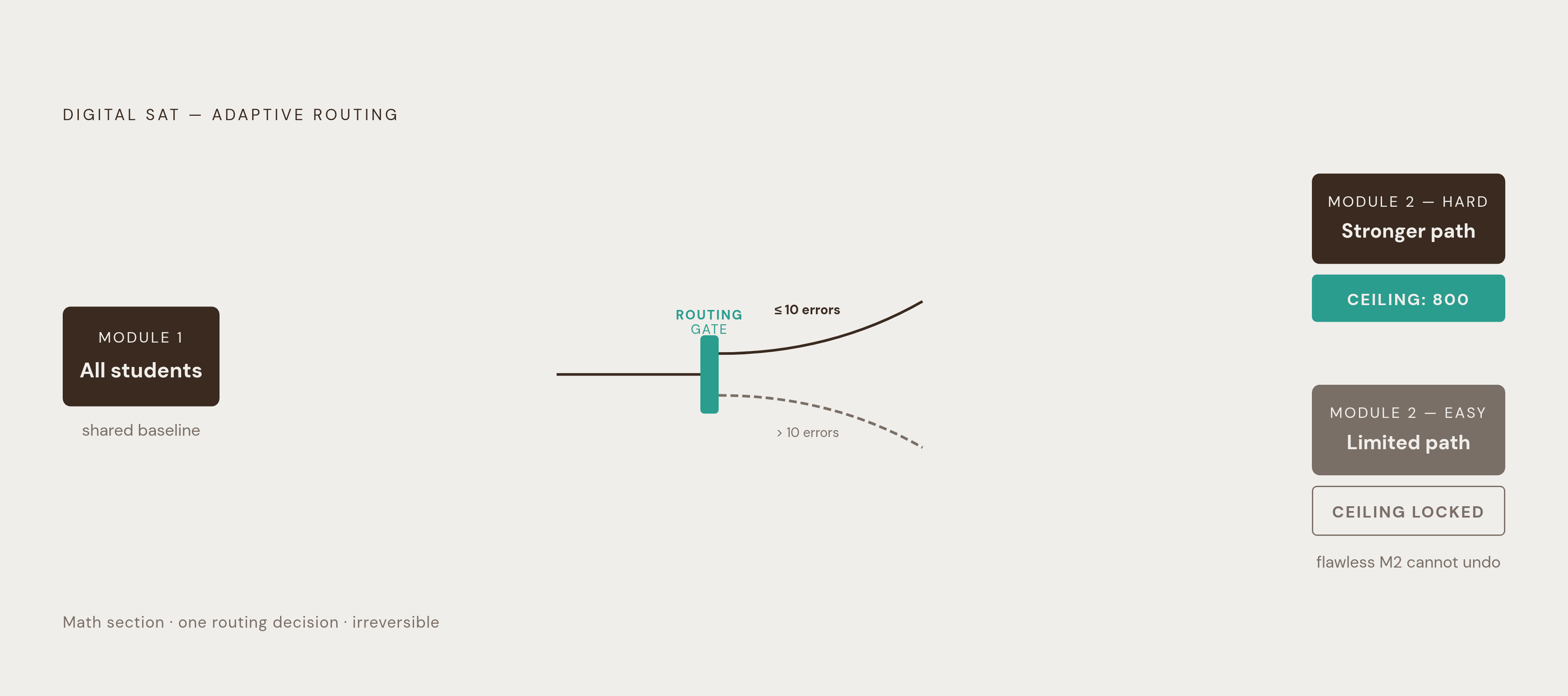
Do the math on that structure and a strange fact falls out: Module 1 is only half the questions in a section, but it determines the entire range of scores still available to a student. Once the routing decision fires, the ceiling is set. Nothing in Module 2, however well a student performs there, can undo what Module 1 already locked in.
That changes what a wrong answer costs. Lose that access and every strong answer in Module 2 is now capped by a ceiling that was set before Module 2 even started.
This has a direct, practical consequence for how a student should sit through the test. Speed matters in Module 2, where the clock is the enemy and pushing pace is the right move. Module 1 calls for the opposite instinct: slow down, check the work, treat every question like it's the one deciding the section. Students who carry the same pacing habit through both modules are applying the wrong strategy to half the test.
For a student aiming at a score above a given threshold, generic content review isn't enough. Platforms like Passionfruit Learning use performance analytics to show students exactly where their early-question accuracy starts breaking down, so they can build that deliberation habit before test day arrives, not during it.
There's a second, related trap. A student drilling only easy and medium questions in practice is preparing for a test that doesn't match the one they're walking into if they're aiming high. Difficulty targeting in practice has to match the Module 2 a student is actually trying to unlock, the one they're working toward rather than the one they'd get by default.
What practice apps get wrong about adaptive testing
Most SAT prep apps still run on a static question bank. Open the app, get a batch of questions, answer them, see a score. Every student gets roughly the same experience regardless of how they perform, and none of the structural conditions that govern real Digital SAT scoring appear anywhere in the session.
That's a mismatch with where students actually sit for the real test now. Most apps simply haven't rebuilt their architecture to catch up with that shift.
A static bank can't simulate the one decision that defines the real test: the routing call after Module 1. It can't show a student what it feels like to get bumped to a harder set of questions, or to get stuck with an easier one and a lower ceiling. Without that simulation, a student can grind through hundreds of practice questions and never once feel the specific pressure Module 1 creates. They build volume, not readiness for the stakes attached to their early answers.
Feedback compounds the problem. A student sees "you got this wrong" without ever learning that the wrong answer, early in the section, closed a door that stayed closed for the rest of the test.
Some will argue that none of this matters much, that content mastery is the real driver and any decent question bank builds it over time. Content mastery alone doesn't help a student who hasn't internalized Module 1 discipline or practiced at the difficulty level the harder Module 2 demands. Knowing the material and knowing how to sit through this specific test are two different skills, and the second one only gets built through practice that mirrors the real structure.
The three functional requirements an app must meet to be genuinely useful
Strip away the marketing copy and three capabilities separate apps that prepare students for the Digital SAT from apps that digitize an old-fashioned question bank. Each one maps directly to a part of how the real test is built.
The first is module-aware adaptive simulation. Students need to feel that routing consequence in practice, long before it happens for real on test day with a score on the line.
The second is IRT-informed feedback. An app that treats every wrong answer the same way is giving a student information they can't actually use to adjust their prep.
The third is gap detection that tells error types apart. Not every mistake comes from the same place. An app that only shows which answers were wrong can't tell these apart, and can't point a student toward the right fix.
None of these three sit on top of each other as bonus features. Each one guards against a separate way a student can be misled about how ready they actually are: practicing against the wrong test structure, measuring the wrong outcome, or being told to fix the wrong problem. For teachers and tutors, a fourth need follows close behind: a way to see gap patterns across a whole group of students and assign targeted practice without rebuilding an assessment from scratch every time.
How current apps measure against this standard
Measured against that three-part standard, the platforms that come closest are the ones built from the ground up around the test's adaptive logic, built specifically for its routing structure rather than adapted from a paper-based bank with a digital screen bolted on.
Passionfruit Learning starts from the idea that drilling more problems doesn't help much if nobody can see where a student's understanding is actually breaking down. It sorts mistakes into conceptual gaps (the student doesn't know the content), procedural errors (the student knows the method but slips in execution), and strategic errors (mismanaged time, misread question types). That three-way split is built to mirror the same diagnostic logic that drives IRT-based scoring on the real test, which makes it the closest architectural match among the options here to what the actual scoring engine is measuring. Passionfruit Learning also gives teachers and schools a way to see gap patterns across a group and close them systematically, rather than treating each student's prep as its own isolated project. It works for an individual student studying alone and for a classroom running prep at scale.
LearnQ.ai takes a different angle, built around a large library of Digital SAT questions paired with adaptive technology that adjusts difficulty based on how a student performs in real time. Whether its module-level routing matches the real test's two-stage structure as closely as the framework above calls for isn't clearly established in what's publicly available about the product.
Google Gemini entered this market in a way that changes the competitive picture more than any single feature does. Google CEO Sundar Pichai announced free SAT prep inside the Gemini app in January 2026, including full-length practice tests and AI-generated explanations available on request at no charge. What matters most about Gemini's entry is that paid prep apps now sit next to a well-resourced, zero-cost alternative for the first time, which raises the bar for what a paid product needs to deliver to justify its price.
The content quality problem that undermines adaptive apps
None of the three requirements above matter if the questions feeding them are bad. Adaptive routing and gap detection are only as good as the content driving them, and fully automated question generation introduces a failure that no amount of clever routing logic can patch over.
Community reviews of AI-generated SAT prep questions have flagged real problems: logical inconsistencies, punctuation anomalies, and a general sense among advanced students that machine-written questions feel machine-written. A practice question with an internal contradiction or a shallow explanation doesn't just waste a few minutes. It can teach a student the wrong intuition about what correct reasoning looks like on the actual test, a cost that becomes visible later, on test day, when it's too late to unlearn.
A 2024 arXiv survey of personalized learning systems, reviewing platforms including Knewton and DreamBox, found a related pattern. The survey also flagged limited transparency in how these systems generate their recommendations, which raises questions about reproducibility and whether the content holds up consistently across different groups of students.
Students who practice heavily on one AI-driven platform and perform well there sometimes find their predicted score diverges sharply from their results on an official Bluebook mock test. That gap points to something concrete. Adaptive difficulty calibration isn't standardized across providers, so doing well inside one app's internal scale doesn't guarantee the same performance against the real test's scale.
None of this is an argument against AI-adaptive prep as a category. It's an argument for telling apart platforms whose questions and explanations get human review or editorial oversight from platforms that run entirely on automated generation with no check on the output. High-quality AI feedback, built and checked against the real test's structure, is what separates a tool that actually speeds up learning from a tool that only looks like it's doing that.
What the AP digitization adds to practice apps
The same pressure reshaping SAT prep is spreading across AP exams at the same time, and that doubles the stakes for any practice platform trying to stay useful.
As of 2025, most AP exams had moved to a digital or hybrid format, a shift pushed faster by security concerns tied to the paper version. The other 12 use a hybrid setup: multiple-choice answers go into Bluebook, but free-response answers still get written out in a paper booklet, a format used for subjects built around equations, graphs, or scientific notation, including calculus, chemistry, and physics.
In 2026, a fresh batch of exams joined the fully digital list: AP Art History, AP Comparative Government and Politics, AP Human Geography, AP Latin, and AP United States Government and Politics. After that round of migration, more than half of all AP exams administered will run exclusively in digital format.
What that means for students is straightforward. The same Bluebook interface now shows up for the SAT and for a growing list of AP subjects. A prep app that trains students in its own separate environment, never touching the actual Bluebook interface, leaves them unfamiliar with the screen they'll actually sit in front of on exam day, regardless of how good its questions are.
For teachers, this digitization adds its own kind of workload. The bar the Digital SAT set for practice apps isn't a one-test phenomenon; it's becoming the standard across the entire test prep market, SAT and AP alike.
What to look for when choosing a practice app
Most prep apps market themselves on question volume, price per week, and how prominently they can put the word "AI" on the homepage. None of those three numbers predict whether the app will actually help a student on test day. What predicts that is whether the app replicates the structural conditions that govern real Digital SAT scoring.
Before committing to a platform, check whether its explanations are built or checked by people who know what the real test's reasoning demands look like, rather than generated entirely by an automated system with no review layer.
Treat a few common claims with real skepticism. And the word "adaptive" gets stretched to cover tools that only vary difficulty at random, with no real routing decision behind it.
For a student aiming at the top of the score range, the real test is simple to run: does the app actually expose them to the difficulty level of the harder Module 2, and does it build the specific discipline Module 1 demands, rather than just general accuracy across a pile of questions? An AI-powered platform like Passionfruit Learning draws that distinction directly in its feedback, separating content gaps from procedural errors so a student learns not just that a question was missed, but which specific kind of understanding needs rebuilding before the next attempt.
For teachers and schools, one more requirement sits on top of everything above: a group-level view. Individual performance data is useful, but the real value for a classroom comes from seeing which gaps recur across many students at once and assigning targeted practice to close them, without rebuilding an assessment from scratch for every new group that walks through the door.