How SAT Practice App Question Quality Varies
Most SAT prep apps use AI-generated questions filled with hidden flaws.

The Digital SAT finished its move to a multistage adaptive format in spring 2024 for U.S. students, with international students making the switch a year earlier in spring 2023. That shift changes what practice questions are for: each section runs two modules, and how a student performs on the first module determines how hard the second one gets. Practicing on a question bank that's miscalibrated doesn't just teach the wrong content. It rehearses the wrong routing decisions, so a student can walk away from a study session having trained on a version of the test that doesn't route the way the real one does.
That's the structural reason question quality outranks every other factor in SAT prep. College Test Coach's 2026 comparison of prep apps puts question quality and authenticity at the top of its evaluation criteria, ahead of features and ahead of price. It's also the reason that comparison is hard to do by reading marketing copy. Nearly every app on the market now describes itself as "personalized," "adaptive," and "AI-powered," which means those words have stopped functioning as useful signals. What actually separates one app from another, invisibly, is whether its questions match official SAT style, match the real difficulty curve, and use the same traps the actual test uses. That gap is visible in the questions themselves rather than on a landing page.
The three-tier hierarchy of SAT question quality
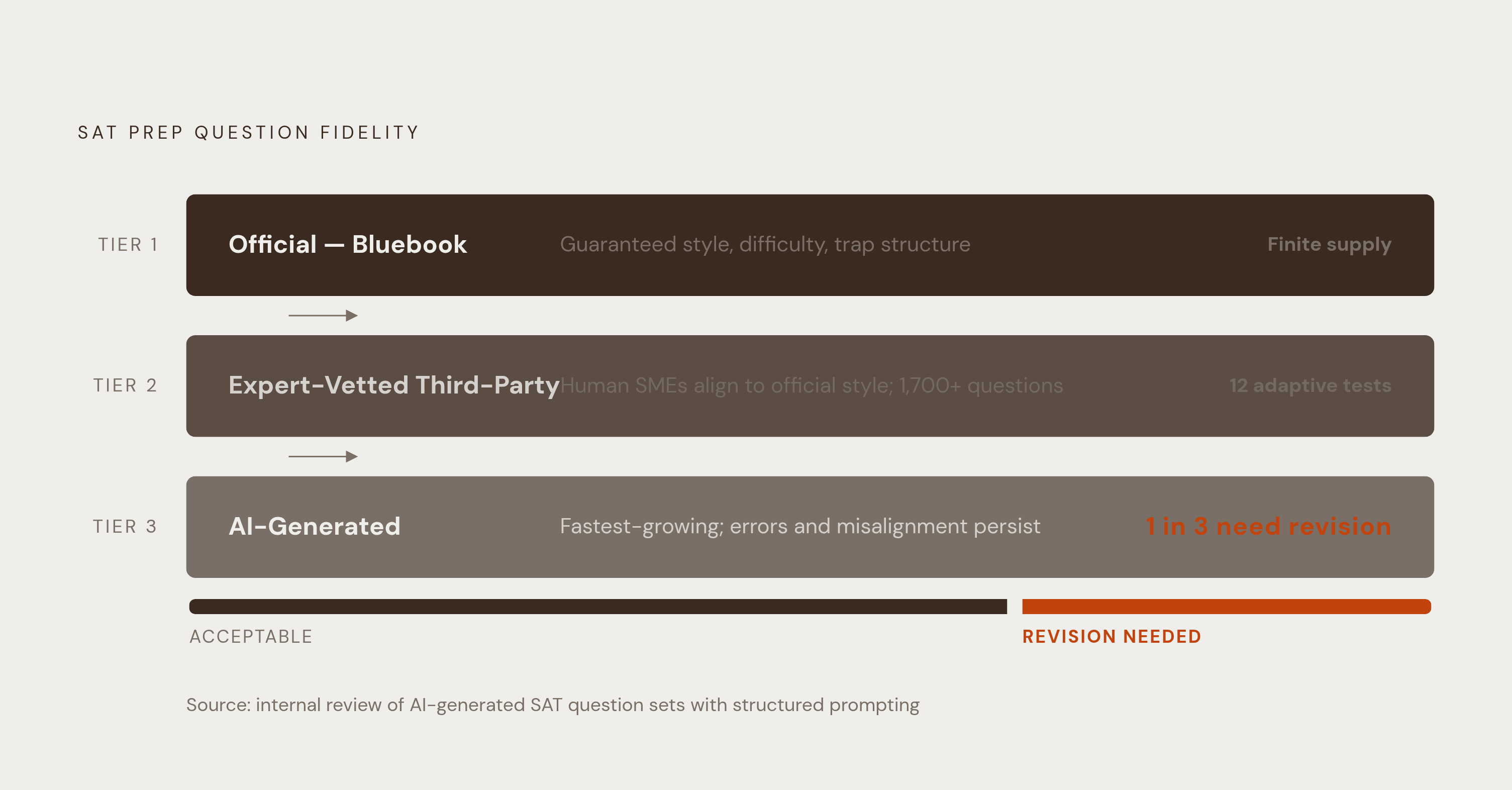
Question quality in SAT prep breaks down into three tiers, and the distance between them is large enough to shift where a student's score actually lands.
Tier 1 is official content: questions written or retired by the test maker, the only questions that are guaranteed to match official style, the real difficulty curve, and the exact trap structure the SAT uses. The official Bluebook app is the clearest example of this tier in practice, and College Test Coach's comparison is direct about what it's good for and what it isn't. Bluebook is the best tool available for simulating an official practice test, but it isn't a coaching platform. It won't tell a student which skills are weak, and it won't explain why a wrong answer is wrong. That's a limitation built into what Bluebook is designed to do. The deeper problem is supply: official content is finite, and any student preparing seriously enough will burn through it and need to go somewhere else.
That somewhere else is Tier 2: expert-vetted third-party questions, written and reviewed by human subject-matter experts who deliberately align their work to official SAT style. Test Innovators is the clearest example of this tier. A tutor quoted on the platform's own site calls it "basically the only place we go" once official material runs out, pointing specifically to the careful construction behind the questions as the thing that separates it from the "mediocre or downright incorrect" AI-generated material flooding the rest of the market. Test Innovators backs that up with volume: 12 adaptive practice tests plus more than 1,700 additional targeted questions, skewed toward the harder end of the difficulty range, which makes the platform especially useful for students aiming at the top of the score scale. Expert vetting isn't a guarantee against every possible error, even in a human-reviewed product.
Tier 3 is AI-generated or AI-rephrased content, questions produced by large language models, sometimes with careful structured prompting, sometimes without any structure at all. This is also the fastest-growing part of the market, and the most consequential quality problems occur here. A research benchmark testing AI-generated SAT questions found that even with structured prompting and an explicit goal of SAT alignment, roughly a third of the generated questions needed revision because of errors or misalignment with what they were supposed to test. One in three questions needing a rewrite is the baseline a student is working with on an unreviewed AI-generated platform, and those failures happen in specific, identifiable ways before trusting any app that sits in this tier.
How AI-generated questions fail before test day
AI-generated SAT questions tend to fail in three specific ways, and each one is harder to catch than a question with a simple wrong answer key.
The first is construct failure, most visible in Reading and Writing's Words in Context questions. A generated question can look exactly like an official one in structure and formatting while actually testing something different: whether a student already knows a word, rather than whether they can infer a word's meaning from the surrounding context, which is the actual skill the SAT is trying to measure. A student can miss that kind of question, or answer it correctly for the wrong reason, without ever realizing the skill being tested wasn't the one they thought they were practicing.
The second failure appears in math, and it's more mechanical. AI tools often generate new math questions by taking an existing problem and swapping out the numbers, without checking what that swap does to the underlying math. Change a constant in a quadratic equation without checking the discriminant, and the result can be a problem with no real solutions at all, a type of question the actual SAT would never include. A student who drills on problems like this isn't just wasting time: they're building a distorted sense of what a genuinely hard SAT math question looks like, which can make real test-day problems feel unfamiliar in the wrong way.
The third failure is distributional. The SAT tests specific skill domains in specific proportions, and AI generation doesn't naturally reproduce that distribution. A platform can over-generate questions in one domain and under-generate in another without anyone designing it that way. A student can then over-prepare for the domains the app happens to favor and walk into the real test under-prepared for the ones it doesn't, with no warning sign until the test itself.
What makes all three failures dangerous is that they're invisible on the surface. AI-generated questions tend to follow official SAT formatting closely enough that they look legitimate, and spotting the underlying problem requires the kind of content expertise most students, and even some educators, don't have on hand. A question can be wrong in a way that only a specialist would catch; the student has no real way to know they're practicing on flawed material until the gap appears somewhere that actually matters.
The score inflation trap: how Tier 3 apps produce misleading practice scores
Miscalibrated questions don't just teach the wrong content. They produce scores that look real but aren't, and students tend to discover the gap at the worst possible time, right before or during the actual test.
The harm here isn't evenly distributed. A student who already suspects their practice scores might be unreliable can factor that in and adjust their expectations. A student who trusts the number the app gives them makes real decisions based on it: when to schedule a retest, whether to bring in a tutor, which schools to put at the top of a list. Those decisions depend on the score being accurate, and if the underlying questions are miscalibrated, the score isn't measuring what the student thinks it's measuring.
What makes this worse is that score inflation doesn't announce itself. A rising practice score inside an app can reflect the student getting better at that app's specific question patterns rather than getting better at the actual SAT, and there's no built-in signal to tell the difference. The obvious fix, cross-checking against an official Bluebook test, sounds solid in theory but tends to fall apart in practice. Most students simply don't take enough official practice tests, often enough, to catch a systematic drift between what an app reports and what the real test would show. By the time the gap becomes visible, it's usually too late to do much about it.
Well-resourced AI partnerships and the quality problem
A natural response to all of this is to assume the problem only applies to small, unbranded AI tools, and that a known company backing an AI product is a reliable quality signal. That assumption doesn't hold up. A brand name attached to an AI tool doesn't protect its output from the same failure modes that occur in unbranded generators.
The analysis turned up questions covering math topics that don't even appear on the real SAT, including imaginary numbers and logarithms, along with grammar errors inside the questions themselves, missing on-screen exam tools, and question ordering that didn't match the structure of the actual test. None of that is a small cosmetic issue. It's the same category of failure described in the Tier 3 breakdown above, happening inside a tool with serious resources behind it.
This happens because "built with expertise from a known test-prep company" doesn't mean what it sounds like it means. That kind of partnership typically means the company reviewed and shaped the process the AI follows, not that a human reviewed every single question the AI then generated. Generative AI output can vary in quality even within a single session of the same tool, so a partnership review upstream doesn't guarantee consistent quality downstream.
None of this makes Gemini's tool worthless. Its price point (free) genuinely changes the equation for students who don't have the budget for a paid platform and previously had little beyond Bluebook to work with. The honest read is that the accuracy issues make it a reasonable supplement rather than a primary prep tool, best paired with other material rather than relied on alone. The real lesson is to judge the questions a tool actually produces.
What adaptive difficulty routing requires
Most third-party apps that call themselves "adaptive" haven't actually built the thing that word describes, and a small number have.
The real SAT's adaptive logic is structural. The second module gets harder or easier based on how a student performed on the first, and the resulting score is computed statistically rather than judged by an AI reading the student's answers. An app that labels itself adaptive while just serving up randomly varying questions hasn't replicated that structure. It's applied the word to a different, and potentially misleading, kind of system.
A few platforms have built something closer to the real thing, each taking a different approach. Test Innovators builds adaptive routing directly into its 12 practice tests, simulating the actual computer-adaptive module structure rather than faking the feel of it. EdisonOS takes a different route, rebuilding the Bluebook interface screen-by-screen, including the two-module adaptive routing, with the whole product aimed at tutors and coaching institutes managing multiple students at once. LearnQ.ai works at a finer grain, adjusting difficulty in real time within a single session. Answer three algebra questions correctly in a row, and the next one gets harder automatically. College Test Coach takes yet another approach, building a proficiency profile across all eight SAT skill areas and routing every practice session toward whatever a student's weakest areas happen to be. Its question bank is human-reviewed before anything goes live, with AI helping draft and flag content but never serving questions directly to students.
None of these approaches is strictly better than another. They're solving different parts of the same problem, from different angles, and a student's choice between them depends more on what kind of practice structure fits their situation than on any single feature being objectively superior. What they share is a real limit. Each of these systems can detect that an answer is wrong and route a student toward more practice in that area. Diagnosing why a student keeps making the same kind of reasoning error, why one particular question structure consistently trips them up, is a harder problem, and it remains largely unsolved at scale across the industry.
Reading an SAT prep app's question quality before committing
Most of what distinguishes a good app from a bad one is visible before a student ever pays for a subscription, as long as they know what to look for during a free trial.
Start with disclosure. A trustworthy app will state whether its questions are official, written by humans, or generated by AI, and an app that stays vague about this is telling a student something by staying quiet. College Test Coach's comparison makes the same point from the other direction: apps built mainly on official content have a real advantage, and unofficial questions can diverge sharply from official ones in style, difficulty, and trap structure. Run a small audit during a free trial session: count how many questions fall into each of the SAT's four math domains (Algebra, Advanced Math, Problem Solving and Data Analysis, Geometry and Trigonometry) and each of the four Reading and Writing domains. If Problem Solving and Data Analysis questions dominate the sample, that's a fairly reliable sign of Tier 3 generation rather than careful curation.
The explanations attached to each question matter just as much as the questions themselves. A strong explanation names the actual concept being tested, explains why the wrong answers are wrong, and shows a student how to approach similar questions going forward, a core evaluation criterion in College Test Coach's framework. Run a direct comparison rather than trusting any single score. Taking one full-length official Bluebook test and one full-length test on the app under consideration, in the same week, gives a clean read on whether the two scores line up. A large gap in either direction is a calibration warning worth taking seriously.
Finally, it helps to look at who else is using the platform. Tools used at scale by tutors and schools, the way Test Innovators is cited by tutors working across dozens of students, or the way EdisonOS is built specifically for tutor and coaching institute workflows, carry a kind of validation that self-reported student reviews simply don't. Use AI tools for what they do well: conversational explanation, walking through the same concept five different ways, generating fresh examples, answering a student's follow-up questions in plain language, is exactly the kind of task large language models tend to handle well. It's knowing precisely where in the process it belongs, and where it doesn't.
Sources
- 7 Best SAT Prep Software & Apps for the Digital SAT in 2026 (Compared)
- Best SAT Prep Apps in 2026: An Honest Comparison
- SAT Practice Tests - Test Innovators
- Gemini SAT Practice Tests: Are AI-Generated SAT Questions Actually Helpful? — Rath Tutoring
- Does ChatGPT-Generated Practice Match Official SAT Difficulty? A Benchmark Study
- The lowdown on Gemini-powered SAT practice tests
- Boost SAT Score With Adaptive & Gamified Digital SAT Prep