Using SAT Prep Apps Alongside School Coursework
Affordable apps can match the gains of expensive tutors when paired with classroom learning.

The SAT is coming back. Brown, Harvard, Yale, Cornell, Dartmouth, UPenn, Stanford, and Georgetown have all reinstated testing requirements over the past few years, and the University of Miami joins them starting Fall 2026. More than 2 million students in the Class of 2025 took the test, most on the new digital format. The test-optional era is winding down. For a huge number of students, a good SAT score is back to being a hard requirement, not a nice-to-have.
That matters because the score gap between high- and low-income students runs past 300 points. That gap has nothing to do with talent. It comes down to who can afford prep. SAT courses run $1,000 to $3,000. Private tutors charge anywhere from $45 an hour to over $1,000 an hour for the top names. Most families can't touch those numbers.
For most students, an AI-powered prep app beats a traditional course, and not just on price. The SAT has turned into a format-and-pattern problem, and adaptive software is built exactly for that kind of problem in a way a $3,000 course, run at one fixed pace for a room of thirty kids, isn't. This piece looks at how that works, which apps do what, and how to fold one into a school schedule without it turning into a second job.
What the digital SAT actually tests, and why it demands a different kind of practice
The SAT went fully digital in 2024. Same 1600-point scale. Completely different test.
It's now 98 questions in 2 hours and 14 minutes, tighter than the old paper version. But the real change is structural: the test adapts. Each section has two modules, and how a student performs on Module 1 decides how hard Module 2 gets. The score ceiling locks in early, shaped by performance on the first module. Miss too many in Module 1, and the top scoring band may be off the table before Module 2 begins.
A Desmos graphing calculator is built into the math section, available the whole time. Knowing how to use it well is an essential skill. It's part of the test.
Students take the actual exam on College Board's Bluebook app. Its timer, its answer-eliminator tool, its mark-for-review feature: all of that is material now, not an interface detail to figure out on test day.
A printed prep book can't replicate any of it. It can't simulate adaptive branching. It can't mimic Bluebook's screen. It's still fine for drilling grammar rules and math formulas, but it can't put a student inside the actual shape of the test. That gap is the entire reason app-based practice exists.
What classroom instruction gives students and where it stops short
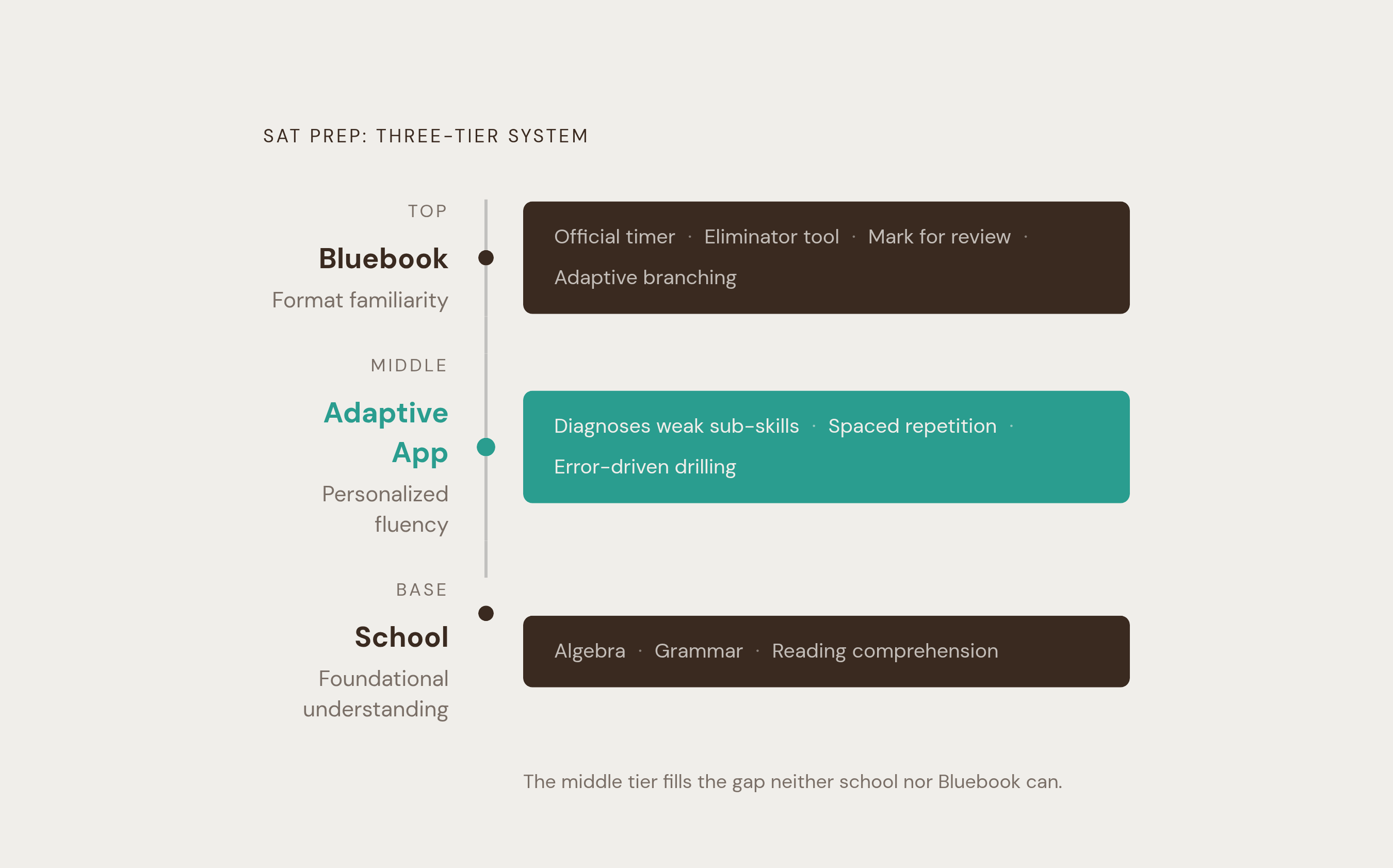
School does the heavy lifting on fundamentals. Algebra, grammar, reading comprehension, critical analysis: all the raw material the SAT eventually tests gets built in the classroom. No app replaces that.
But a classroom moves at the pace of the group, not the individual. A teacher working through nonlinear functions can't stop to fix one student's specific confusion about exponential graphs while 25 other students wait. One teacher, one pace, thirty different skill gaps. Teaching is not being knocked here. It's just math.
A 2026 study in Applied Sciences (MDPI) backs this up: AI-generated personalized learning pathways meaningfully reduce lower-order learning gaps, the basic skill-level stuff. But the same study found hybrid models, AI paired with a teacher, may optimize outcomes beyond either one alone. Neither side does the whole job by itself.
So where exactly does the classroom fall short? Three places: real-time diagnosis of which sub-skill is weak, difficulty that adjusts session to session, and instant explanation of why one specific answer choice is wrong. That's a design limit of teaching thirty people at once, not a failure of any individual teacher. It's exactly the gap the apps were built to fill.
How adaptive practice apps close the personalization gap
The mechanism is simple, even if the tech behind it isn't: diagnose first, then practice what's actually weak.
Most platforms start with a baseline test that maps a student's strengths and gaps across every tested domain before any studying begins. From there, the software tracks more than right and wrong. It tracks patterns, like a student who keeps misreading graphs, or who bombs one specific question type over and over. That's a different kind of insight than a raw score gives you.
As a student improves on something, the app notices and moves on. No time wasted drilling a skill that's already solid. Spaced repetition brings older material back at intervals designed to stop it from fading. A fixed workbook can't do any of that, because a workbook doesn't know what a student already knows.
Does it move actual scores? According to College Board research, 20 hours of practice on Khan Academy's Official SAT Practice correlated with an average 115-point increase. That's the kind of jump that changes scholarship eligibility and opens up a different tier of schools.
And layering tools beats using just one. Research suggests that pairing a concept-explainer with a practice platform can produce better results than relying on either tool alone. Explanation plus repetition beats either alone.
Cost is the part that should actually change how families think about this. AI-powered SAT tools can run well under $30 a month, compared to traditional tutoring that can run $200 an hour and up. Comparable score gains, a fraction of the price. That's not a marginal difference. That's a different category of access, and it shows up in every score report that follows.
A practical look at the main SAT prep apps and what each one is built for
Khan Academy / Official SAT Practice Free, and officially partnered with College Board. A 30-minute adaptive diagnostic maps skill level across every SAT domain, then builds a study plan around test date, current score, and target score. It covers all 42 math and 28 reading and writing question types, with spaced repetition built in. What it doesn't have: full-length tests on the platform itself (those live on Bluebook) and the deeper analytics or live feedback paid tools offer. If a student can only use one free tool, use this one. It's official, it's aligned to the real test, and it costs nothing. There's no real argument against starting here first.
College Board Bluebook This is the actual exam software, not a teaching tool. Students take the real SAT here, so practicing inside it, the timer, the eliminator, mark-for-review, the built-in Desmos calculator, is the only way to get comfortable with the exact environment they'll test in. Pair it with something else for instruction. On its own, it won't teach a single concept, and treating it like a study app is a mistake.
SAT Prep 2026 (Smartschool) Built to mirror Bluebook's format, with 50 full-length practice tests and over 5,000 questions across every question type. Two AI tutors, Mark and Ivy, are available around the clock for step-by-step explanations, and a dashboard breaks performance down by domain and subdomain. Smartschool reports students who finish their learning plan see an average gain of over 200 points within six weeks. There's a 7-day free trial; subscription runs around $200 by one reviewer's account. Good fit for students who want high-volume, testing-format-realistic practice with explanations on tap.
LearnQ.ai Its AI tutor, Mia, has answered over 73,000 digital SAT questions from users, available anytime. The platform has 200,000+ completed practice tests from users across 139-plus countries. It also offers live 1-on-1 or small-group coaching from mentors who scored 1580+, layered on top of the adaptive AI practice, so it's a genuine human-plus-machine hybrid rather than a pure app. Worth the extra cost for a student who wants both the software and a real person checking their work.
HighScores.ai Every test adjusts to the student's current level, and every practice set gets built specifically from questions the student got wrong. Real-time exam simulations and targeted insights come at a price point where six months of adaptive practice costs less than a single hour with a private tutor. Built for students who want error-driven, cost-efficient simulation.
Google Gemini + Princeton Review As of January 2026, Google added free full-length SAT practice tests directly inside Gemini through a partnership with The Princeton Review. A student just types "I want to practice for the SAT" and gets a full test with feedback. Zero cost, almost zero setup. This is the lowest-friction way to take a first practice test, full stop.
Whiz.study Covers SAT, ACT, and AP prep in one place, which matters for students juggling more than one exam. It focuses on both what the SAT tests and how to approach each question type, addressing the common problem of students not knowing what they don't know. Good for students who'd rather manage one platform than three separate logins.
One platform Its diagnostic approach goes past "got it wrong" into "why the thinking broke down," surfacing the actual knowledge gap behind a missed question. It's also built to work inside school coursework, so teachers can use it to close gaps at the classroom level, not just for individual students prepping solo. Good fit for a teacher who wants gap detection woven into regular class time rather than treated as a separate track.
How to actually integrate an app into your school schedule without doubling your workload
Start with a diagnostic, not a practice test. Knowing which sub-skills are actually weak before opening a single practice set is the step most students skip, and the step classroom prep almost never covers.
From there, sync app time to what class is already teaching. If school is deep in linear equations, use the app to drill linear equations, just under timed, adaptive conditions instead of on a worksheet. Let school build the concept. Let the app stress-test it.
Short daily sessions beat weekend cram sessions for retention. Short daily sessions, some apps suggest as little as 15 minutes, can fit into a school week without eating into homework time.
After each session, actually read the error report before moving to the next one. Skipping that step is the single most common way students waste an app's whole advantage: the report showing which sub-skill or pattern tripped them up is often worth more than the practice questions themselves.
Two weeks out from test day, shift toward full-length, timed simulations: the full-length practice tests, the full adaptive test runs. Short daily drills build skill. They don't build the stamina needed to survive Module 2 after two hours of testing. That has to be trained separately, on purpose, close to test day.
And for teachers: College Board's AP Classroom already assigns progress checks that give teachers visibility into student performance. Pairing that teacher-side data with a student-facing app creates a feedback loop neither one builds alone.
What equity looks like when the prep gap is a cost gap
The score gap between high- and low-income students runs over 300 points, and that gap tracks prep quality, not raw ability. Most families cannot afford a $1,000 to $3,000 prep course. A free or $25-a-month app opens up a different conversation, the one that should be happening.
Khan Academy is free. Gemini's practice tests through Princeton Review are free. Several other platforms offer free tiers. The ceiling on accessible, rigorous, adaptive practice has moved further than most people realize, and most families haven't caught up to that fact yet.
That 2026 Applied Sciences study found AI-generated learning pathways meaningfully close lower-order skill gaps, the exact mechanism that used to require an expensive tutor sitting next to a student. Now it scales without the price tag attached.
School is the one part of this system every student gets, regardless of income. Layer a free or cheap adaptive app on top of that, and the equalizing effect compounds. When a school or teacher adopts one of these platforms classwide, the benefit doesn't stop at the students who'd have found the app on their own. It reaches the student who never would have paid for it, which is the whole point.
The limits of app-based prep and what it still cannot replace
None of this makes apps a full substitute for a teacher or a tutor, and it's worth being blunt about where they fall short. The same 2026 Applied Sciences study that found AI narrows lower-order gaps also found it struggles with higher-order skills, the analysis, evaluation, and synthesis work that adaptive drilling doesn't build well on its own.
Apps are good at flagging what a student got wrong. They're not as good at diagnosing why the underlying mental model is broken. A teacher or tutor can ask a follow-up question, watch a student think out loud, and catch a misunderstanding no algorithm has surfaced yet. That's a real limit, not a minor one, and no update cycle fixes it.
Test anxiety, pacing under real pressure, the emotional weight of a high-stakes exam: none of that lives inside an app either.
The data on combined tools makes the point clearest. Research suggests students who paired a concept-explainer with a practice platform tended to perform better than those using either alone. That single result captures the whole argument. Apps don't replace a teacher's explanatory role, and they don't replace Bluebook's role as the official simulation. They sit between the two, doing the one job neither of the others can: personalized, repeatable, judgment-free drilling.
School builds the understanding. Apps build personalized fluency. Bluebook builds familiarity with the actual format. Stack all three, and the result holds up better than any single piece could on its own, because each one does the job the other two can't.