SAT Prep App Recommendations by Starting Score Range
Pick the right app based on where your student actually scores, not marketing promises.

Most families pick a study app based on what it promises at the high end: huge point jumps, elite scores. That's the first mistake worth naming. If a kid is nowhere near that range yet, none of that marketing applies to them, and the gap between where a student actually sits and where the ads aim is the whole reason so many families end up with the wrong tool.
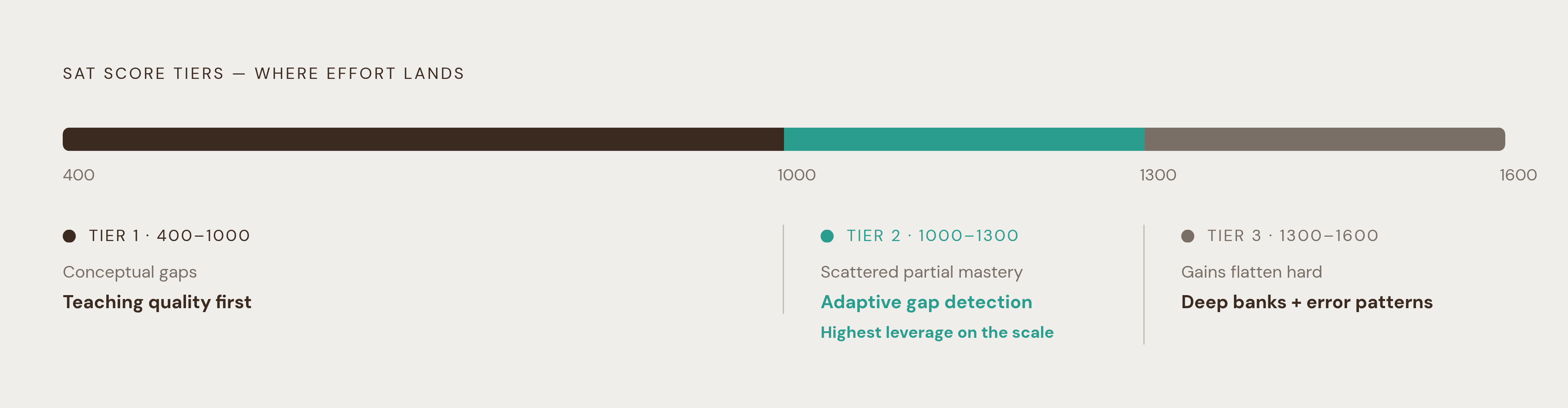
Split the score range into three tiers instead, and the right approach for each one gets obvious fast.
Tier 1: 400-1000. The gap here is conceptual. Jumping into full practice tests before locking down fundamentals like linear equations or comma usage is a bad trade. Build the base first, or every practice test just measures the same holes over and over.
Tier 2: 1000-1300. Every point here buys more ground than anywhere else on the scale. Students in this range rarely have one big blank spot. What they have is partial knowledge scattered across many topics: they half-know a comma rule, half-remember a formula, and miss questions for a different reason every time. That's exactly why an app that hunts down specific gaps matters more here than at any other tier. Random drilling wastes time when the problem isn't a missing topic, it's a thin layer of understanding spread across all of them.
Tier 3: 1300-1600. Gains flatten out hard at the top, and they come from stamping out specific error patterns and mastering edge-case content, not relearning concepts. A platform's question bank and explanations matter more than anything else here, because a shallow one runs dry before the work is done.
The Digital SAT's own structure backs this up: the second math or reading module adapts based on performance in the first one. The test itself is adaptive by design. Prep tools that copy that logic, routing practice toward what a student actually needs next, end up feeling closer to the real thing on test day than tools that just push everyone through the same material in the same order.
Apps best suited to students starting below 1000
At this stage, teaching quality matters more than a fancy analytics dashboard. If an app can't explain a concept clearly, its dashboard is decoration.
Khan Academy (Official SAT Practice) is free and built directly with the College Board, so its questions look and feel like the real test. Link a College Board account, and it pulls in PSAT, SAT, PSAT 10, or PSAT 8/9 scores to build a study plan automatically. The catch: Khan Academy drills skills well but explains the reasoning behind a concept less well. Students who need the "why," not just more reps, will need to supplement it.
Magoosh SAT includes a library of video lessons, a good fit for students who need a concept walked through rather than repeated. Its score guarantee applies to students starting at 1350 or below, which covers this whole tier. The tradeoff: a smaller question bank, and practice tests that don't mirror the real testing interface as closely as some competitors.
LearnQ.ai, with its AI tutor "Mia," takes a gamified, mobile-first approach. Its gamified, mobile-first approach is designed to lower the barrier for students who find plain drilling boring, with a free tier available.
Lumist AI builds personalized study plans, adjusts practice questions on the fly, predicts scores, and keeps an "error bank" so students can review exactly what they got wrong and why, not just that they missed it. Lumist backs this with a refund if scores don't improve.
Here's where most families get the sequencing backwards: they pay for Magoosh or Lumist before ever touching Khan Academy. Given Khan Academy's direct partnership with the College Board, and the fact that it's free, there's no good reason to spend anything before running through it first. Paying up front at this stage means buying a solution to a problem nobody's confirmed exists yet.
Apps best suited to students in the 1000–1300 range, where every point moves the needle most
Students here don't have one or two glaring weak spots. What works is a platform that routes practice straight to the specific gaps, not one that just throws more questions at the whole test.
Khan Academy still works at the lower end of this range, and its score-linking feature makes it genuinely adaptive for students with test history to feed in. But past 1200, its gap detection stops being fine-grained enough to keep up. This is where families need to graduate off the free tool, not stay loyal to it out of habit.
Magoosh SAT fits well here too. Its score guarantee still applies up to 1350, and the platform is designed to set realistic improvement targets.
PrepScholar Complete Online SAT Prep is a paid annual program. It opens with a diagnostic test, then builds a custom study plan that adjusts as strengths and weaknesses show up in practice. Its 160-point score improvement guarantee is the strongest in the market, backed by a full refund if a student doesn't hit it. It's the right call for a disciplined self-studier who wants structure with real accountability behind it, not just a promise. Live classes and 1-on-1 tutoring options exist at higher price points, but the base self-paced tier has no live instruction.
AlphaTest AI, around $9.99 a week, runs a system called "Weakness Conqueror" that finds a student's hardest topics and recurring mistakes, then serves up drills on exactly those. Its study plan syncs to the actual test date and adjusts as mastery improves.
SAT Test Prep 2026 App, built by SmartSchool with AI tutor "Yoko," runs free or about $200 for the paid tier. It's aligned with the College Board's Bluebook format and covers more than 5,000 questions across all 42 math and 28 reading and writing question types. It also advertises an average gain of 200+ points in six weeks. There's no independent study behind that number, so treat it as a marketing claim, not a fact.
Passionfruit takes an automated-grading approach with unlimited practice, built around finding where a student's thinking actually breaks down, not just which answers were wrong. That's precisely what this tier needs: the problem isn't a few missing topics, it's partial mastery spread thin across all of them. The AI grading gives feedback quality that used to require a human tutor, at a fraction of the cost.
The SmartSchool tier is the one that's overpriced for what it delivers. An unverified 200-point claim is doing most of the selling at $200, and PrepScholar gets more defensible results for a comparable cost. Skip the paid tier unless the question bank alone justifies the cost.
Apps best suited to students targeting 1300 and above
The conceptual gaps are closed by now. What's left is narrower: specific error patterns, edge-case content, and holding up under pressure. A platform with a shallow question bank runs dry before the real work is finished, and running dry at this tier costs more than it does at Tier 1, since there's so little runway left to find a replacement tool.
Every gain from here on is earned the hard way, one error pattern at a time, so depth of content matters far more than raw question volume.
PrepScholar still holds up well. Its 160-point guarantee matters less to a student already at 1350 (there's simply not that much room left to gain), but the diagnostic-driven system and full practice-test library still do the job. For a student at 1300 aiming for 1450 or higher, PrepScholar's ability to zero in on narrow, specific gaps is exactly what's needed.
Passionfruit may fit even better here than at Tier 2. At 1300+, the issue is almost never "I don't understand this topic." It's "I lose points somewhere in this topic and I can't tell where." That's exactly the kind of problem Passionfruit's gap-detection model was built to catch. Unlimited practice with AI grading also means content doesn't run out the way a fixed question bank does. The AI feedback starts doing the job a skilled tutor would do: pointing out exactly where the reasoning broke down on a missed question, not just marking it wrong.
For a student working independently at this tier, pairing PrepScholar's diagnostic tracking with Passionfruit's gap detection covers both ends: structured, guaranteed improvement on one side, granular error analysis on the other.
How to use these apps together rather than choosing just one
Treating this as a single-app decision is the biggest mistake a family can make at any tier. Each platform is built for one job: teaching concepts, adaptive drilling, full-length practice, or error review. No single app does all four well. Used together, they cover more ground than any one app can alone.
Tier 1 stack: Start with Khan Academy for concept-building and free practice tests. Layer in Magoosh's video lessons for any topic that isn't clicking through Khan Academy's text-based explanations alone.
Tier 2 stack: Use a diagnostic-driven platform, PrepScholar or Passionfruit, to find gaps and steer study time toward them. Pair that with the College Board's own Bluebook app for official full-length practice tests. The adaptive tool handles the targeting. The official test handles the calibration, showing where a student actually stands under real conditions.
Concept teaching, adaptive drilling, full-length simulation, and error analysis are four different jobs. Pick one or two tools per job, let them work together, and the target score gets a lot less abstract.