Free vs Paid SAT Practice App Tradeoffs
Free tools give you questions; paid apps show you which skills are actually costing you points.
The Digital SAT adapts by module. Nail the first Reading and Writing module and the second one gets harder. Same deal with Math. That means every student sits down to a slightly different test, and any app claiming to prep you for "the SAT" has to actually handle that: adaptive logic, real timing, content pitched to your score range. Skip any of that and you're not practicing the test you'll take. You're practicing a different one that happens to share a name.
Quick numbers, because they matter later: Reading and Writing is 54 questions in 64 minutes, Math is 44 questions in 70 minutes, total time 2 hours 14 minutes. The Class of 2025 averaged 1029 (521 Reading and Writing, 508 Math). The top scorers start around 1350. That gap doesn't close by grinding more questions. It closes by knowing exactly where your points are leaking. So that's the question worth asking about any app: does it show you the leak, or just hand you more water?
What free apps actually give you
Free SAT prep is quite good now, and it's worth saying that plainly before picking it apart.
College Board's own Bluebook app gives you four full-length practice exams built by the people who write the real test. Same format, same adaptive structure. There's rarely a more authentic simulation available, paid or otherwise.
Khan Academy's Official SAT Prep, built with College Board, runs a diagnostic, imports your existing SAT or PSAT scores if you have them, and builds a schedule around your test date. Students who logged 20+ hours improved by 115 points on average. That's a meaningful gain for a free tool.
Same story on the AP side. AP Classroom gives you Topic Questions with instant feedback, Progress Checks your teacher unlocks, and progress charts, all written by the exam writers themselves. Khan Academy's AP courses cover most major subjects with official alignment too.
So no, the question isn't whether free tools work. They clearly do. The real question is whether they're enough for what you specifically need.
The structural gaps free tools share
Khan Academy is good. It's also missing a few things that matter more than they sound like they should:
- It doesn't talk to Bluebook. Two separate systems, no shared data.
- Plenty of explanations don't walk through the reasoning, they just show the answer.
- Nothing resurfaces the question you missed last week to see if it stuck this time.
- Every skill gets weighted the same, even though the real SAT doesn't test every skill equally.
- Most practice is untimed, which doesn't train you for the clock you'll actually be racing.
Here's the real issue underneath all of that: free tools give you questions, not a map. They don't tell you which unit is actually costing you points, so they can't route your hours toward it. The schedule is personalized. What's inside the schedule is not.
Study it cover to cover and you end up re-drilling stuff you already have cold, which is just an expensive way to feel busy. Time is one resource you can't get back before test day.
Plenty of students use free tools not because they're the best fit, but because paid prep is out of reach financially. Worth sitting with that for a second: for a lot of students, there's no backup plan if the free tool comes up short. That's not a footnote, that's the whole ballgame for them.
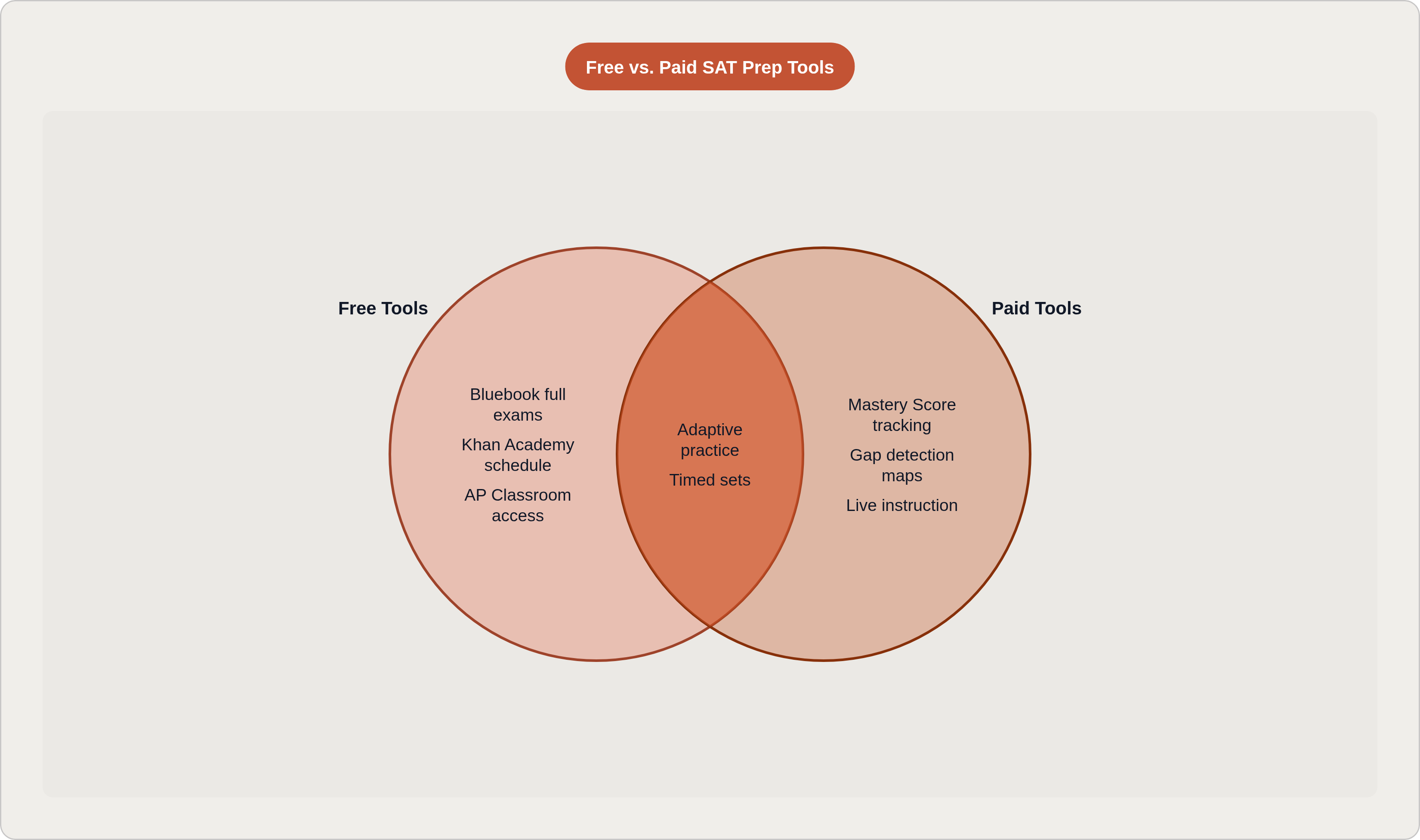
How paid apps address personalization and gap detection differently
Not all paid platforms are equal, but the decent ones share one habit: they diagnose before they drill.
The better ones map your performance across every major domain (Heart of Algebra, Advanced Math, Problem-Solving and Data Analysis, Information and Ideas, Craft and Structure, Standard English Conventions) and spit out two numbers: a Mastery Score (what you actually know) and a Projected Score (what that gets you on test day). The gap between those two numbers becomes the study plan. Free tools don't build that gap at all, let alone close it.
Some platforms do this with visual skill maps, showing weak spots topic by topic. Others start with a full assessment across every domain, and if you've already got a score report, let you upload it so the app starts drilling weak spots on day one instead of re-covering ground you don't need. Others build daily tasks that shift as your mastery shifts, tracking projected score in near real time.
"Adapts to your learning style" shows up in a lot of marketing copy, and it's worth being a little suspicious of it. If the algorithm keeps steering you toward what you're already good at, that feels like progress. It usually isn't. The good adaptive systems push you into the stuff you're avoiding, not around it.
That's also why "paid" isn't one category. A student stuck at a score ceiling, missing hard questions inconsistently, needs something completely different from a student with foundational gaps. Hand that second student a massive question bank with no instruction, and you've just given their confusion more room to spread out.
What paid apps cost and what the price buys
The price range is wide enough to be almost meaningless on its own. Low end, around $129. High end, full courses past $2,000, and private tutoring in a market like New York City running $150 to $300 an hour.
Roughly, here's the middle:
- ~$129 gets an entry-level program, sometimes with a 100-point guarantee attached.
- On-demand access runs around $199 for six months; live instruction with real class time runs closer to $699.
- Some programs price from the high $300s into the thousands, guarantees tied to a set point gain, capped at some score ceiling.
- Top-end full courses run $949 to $2,199, private tutoring above $400 an hour.
Read the guarantee fine print. They don't all promise the same thing, not even close. Some promise "a higher score" with no minimum stated, which is a bar so low it's basically on the floor. Others promise a specific point gain, but only up to a capped score, and only if you complete certain requirements. Some don't guarantee anything. Eligibility rules and starting-score requirements swing wildly from program to program, so read past the headline number.
Price and personalization don't move together the way you'd expect. A $199 on-demand course might have less real adaptive logic under the hood than a cheaper, AI-native app built specifically around finding gaps. So skip "what does this cost" and ask instead: what does this exact price level add that the free tier doesn't already hand me for nothing? The answer changes student to student.
Where AI feedback creates a real difference (and where it doesn't)
AI earns its keep when it catches a pattern a person would easily miss by hand. Say a student consistently loses time on geometry questions in the last ten minutes of a section, test after test. A tutor sitting across the table for an hour a week probably won't catch that. A system logging every attempt will, because that's exactly the kind of pattern-across-hundreds-of-data-points thing computers are built for.
AI also does quiet, unglamorous work behind the scenes for tutors, cutting down the hours it takes to build custom practice sets by hand. That's a real win for classrooms and tutoring practices even when the student never sees it happening.
What AI mostly can't do is explain a concept the way a person can, and it usually can't tell if a student is anxious, burned out, or just having a bad Tuesday. So the useful framing isn't AI replacing a teacher. It's AI doing the repetitive pattern-spotting so the teacher can spend their limited time on the part only a person can do.
This gap shows up hardest on AP free-response questions. In subjects where very few students land the top score, a trained reader's judgment is usually the deciding factor, not whether some automated system marked a box right or wrong.
Here's the real test for any of these apps: does the AI tell you what you got wrong, or why you got it wrong and what to do about it? A red X is not feedback. It's a scoreboard. Knowing where your thinking actually broke down is the difference between practicing the same mistake for another month and fixing it this week.
How to match app type to actual student situation
Forget "which app is best." Ask what this specific student is missing right now that the free tier structurally can't give them.
Free tools are probably enough if:
- You need real, full-length, timed practice under real conditions. Bluebook does this better than most paid tools even try to.
- You're self-directed and fine building your own plan around Khan Academy's content.
- You've got 20+ hours before test day and can actually put in the volume.
Paid tools start earning their price when:
- You've got a specific score target and limited time. Gap detection focuses the hours instead of spreading them thin over everything.
- You've plateaued. A flat score despite steady practice usually means something structural is missing, not that you need to try harder.
- You've got foundational gaps. A giant question bank with no instruction just repeats the confusion at higher volume. You need worked examples first.
- You're stuck near a ceiling, somewhere in the 1250-1350 range, and need real analytics on hard questions and timed sets to figure out why the number won't move.
There's a documented score gap of roughly 388 points between the highest- and lowest-income families. Access to paid tools has rarely been equal, and it isn't getting more equal on its own. Which is exactly why Bluebook and Khan Academy deserve to be treated as essential prep, full stop, not as the consolation prize for kids whose families can't write a check.
I work on Passionfruit, so take this as a disclosed interest rather than a neutral aside: it's built around the same gap-detection idea described above, minus the price tag, unlimited practice with AI grading aimed at figuring out what a student actually understands rather than just what they missed, built to work for one kid or a whole classroom.
But whatever you use, the question that actually matters is the same one: what's missing for you right now that the free tier can't structurally fix? Answer that plainly and the rest sorts itself out.