SAT Practice Apps for Math Section Improvement
Most apps miss the adaptive structure that actually caps your score.
Let me open with something that should bother you more than it does.
The average SAT math score for the class of 2025 was 508. The pre-pandemic average, back in 2019, was 528. We are still below that baseline. Only 39% of 2025 test takers met both college readiness benchmarks. And yet, SAT participation just crossed 2 million students for the first time since 2020, with 97% taking the digital format. More students are taking the test. Fewer are ready for what comes after it.
Meanwhile, the Ivies are quietly abandoning test-optional policies. As of 2025-2026, only Columbia, Princeton, and Cornell still hold that position. Scores matter again, officially and publicly. Private tutoring runs $50 to $200 per hour, with premium packages climbing past $4,000. For most families, that's not prep. That's a semester of something else.
So the app question is less "which one is fun to use" and more "which one actually works." And the answer, after spending a lot of time in this space, is that most apps are solving the wrong problem.
The test itself has a design most apps quietly ignore
To understand why most apps miss, you have to understand what the digital SAT math section is actually doing.
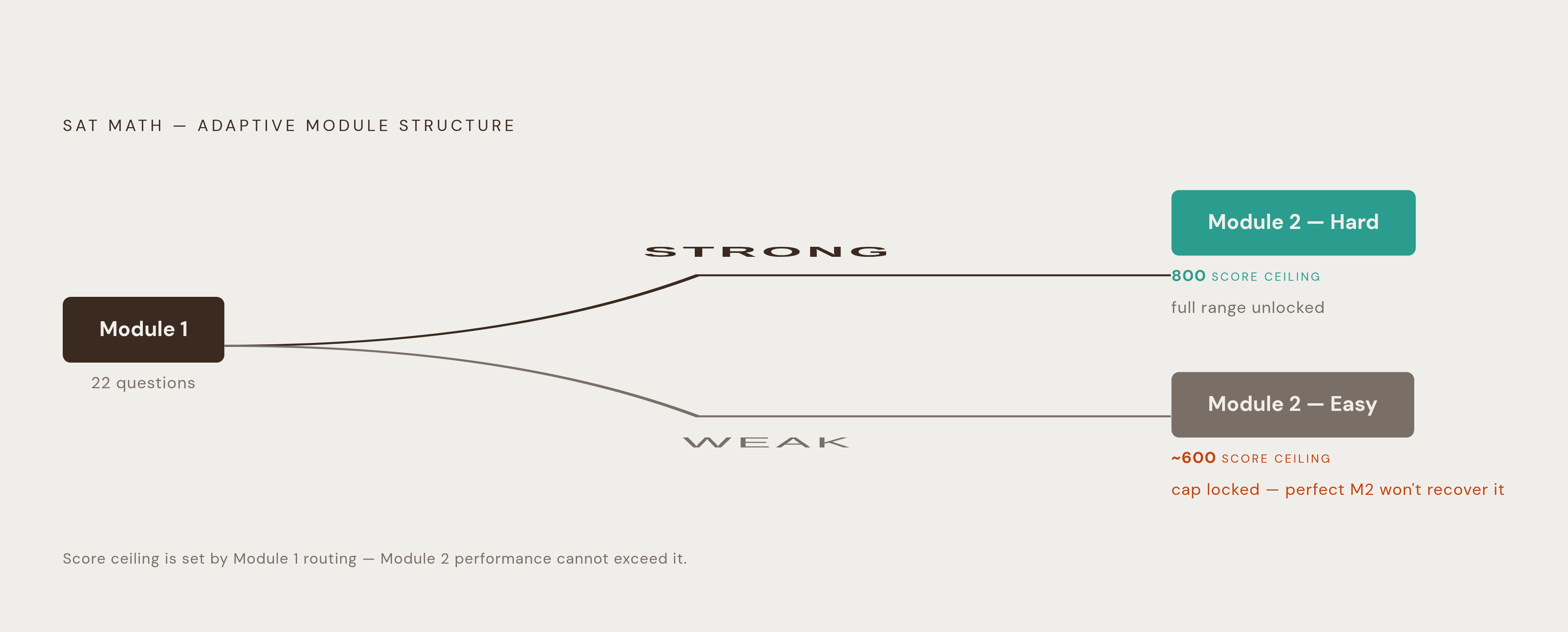
It's adaptive. Two modules. Your performance in the first module determines which version of the second module you receive. Perform well, and you're routed to harder questions with a higher score ceiling. Perform poorly, and you get an easier second module — with a capped maximum score, regardless of how well you do from that point forward.
Early mistakes have structural consequences that follow you into the second half of the test. Think of it like a river that forks early: take the wrong branch and no amount of hard paddling downstream will get you to the other side.
The built-in Desmos graphing calculator is available for the entire math section. That's not a small detail. It shifts the emphasis away from computation and toward strategy. The test is less interested in whether you can grind through arithmetic and more interested in whether you understand what you're looking at.
Here's what this means for practice: any app that doesn't replicate this adaptive module logic is training you on a test that doesn't exist. Worse, if an app scores your practice results without accounting for module-level capping, it's giving you inflated readiness data. You think you're at a 680. You might be capped at 620.
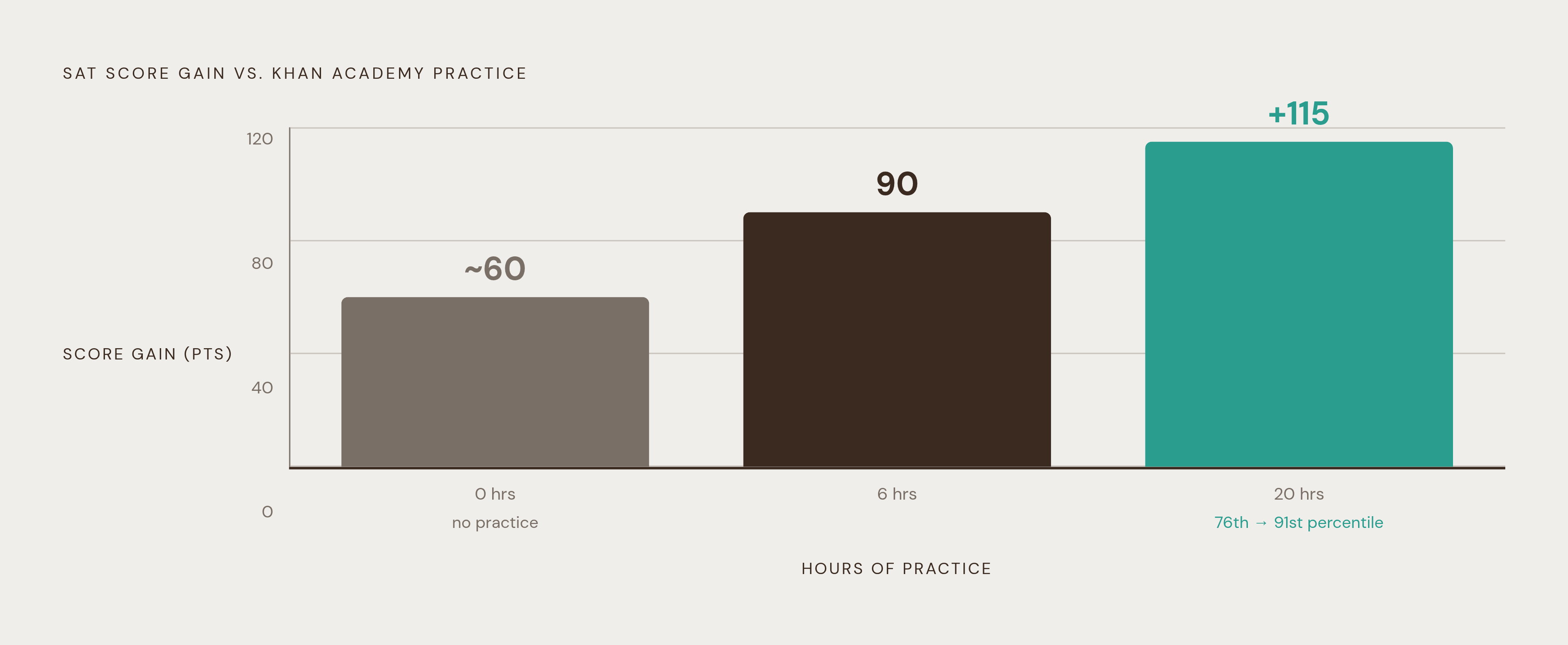
The math curve also rewards upward movement significantly. A 100-point gain can shift a student from the 76th to the 91st percentile. That's not a rounding error. That's a different pool of schools. So the stakes of accurate practice are high, and the cost of inaccurate practice is real.
More problems is not the same thing as better preparation
Here's the failure mode I've watched play out more times than I can count.
A student downloads a practice app. They do 200 algebra problems. They feel productive. Their score doesn't move. They blame themselves. They weren't lazy. The app just wasn't doing the right job.
Most apps measure right versus wrong. That is useful data. But it's incomplete in a way that matters. What most apps won't tell you is where in the reasoning process the error happened. Was it the setup? The equation structure? A misread of what the question was asking? A calculation error at the final step on a problem they otherwise understood completely?
Those are different problems. They require different fixes. And if you don't know which one you have, you'll keep drilling the same territory without closing the actual gap.
There's also a subtler trap. Some "adaptive" systems will actually steer you away from your weakest areas, not toward them. The algorithm optimizes for engagement and forward momentum. Struggling with a concept doesn't feel good. So the app quietly routes you back to things you're decent at. Your session feels productive. Your weak spots stay weak. This is not an edge case. It's a design pattern to watch for.
What real gap detection looks like isn't "you got 4 of 10 algebra questions wrong." It's "you consistently misidentify the structure of systems of equations problems before you've written a single number." Concept-level feedback and reasoning-step-level feedback are not the same thing. One tells you what broke. The other tells you where and how.
Khan Academy is the floor, not the ceiling. But what a floor it is.
Khan Academy is built in partnership with the College Board. It is the only officially sanctioned free SAT prep platform in existence. Students can link their PSAT or SAT scores directly to their Khan account and get a personalized practice plan generated from real test data. That is a meaningful advantage no paid app can replicate at that price point.
The question library is enormous, covering all four major math domains. Diagnostic quizzes identify weak skill areas and queue targeted practice automatically. And the score impact data is striking: 20 hours of Khan Academy practice is associated with an average 115-point gain. Six hours, roughly 90 points. Nearly double the average gain compared to students who don't use it.
One important note: as of January 2024, Khan no longer provides full-length digital SAT practice tests. For those, you'll need to go to the College Board's Bluebook app. That's not a knock on Khan. It's just how the ecosystem is divided now.
Khanmigo, their AI tutor, is available for $4 a month. It guides students toward answers rather than just handing them over, which is the right instinct for a learning tool.
Here's the real limitation. Khan's personalized queues are strong. But the feedback on wrong answers tends to stay at the concept level. "You need to review linear equations." That's true. But it doesn't tell you whether your linear equation problem is a translation issue, a slope-intercept issue, or a sign error under pressure. That gap matters more than most people realize.
Bluebook and Magoosh each do one thing really well
Bluebook (free, from the College Board) is non-negotiable. It is the only place you can take a full-length adaptive practice test scored with real digital SAT logic. That module-jump mechanic, the one that caps your score ceiling, is built in. No other platform can say that with confidence. The limitation is volume: there are four mock tests. Use them wisely, not constantly.
Some paid options earn their price for a specific kind of student: someone who has a handle on the fundamentals but needs to go deeper on test-specific question types. The best of these offer thorough, step-by-step explanations where every wrong answer becomes a mini-lesson. Teachers also get meaningful classroom data tools, which we'll come back to later.
Magoosh leans on video explanations more heavily than the others. If a student needs to understand a concept before they can productively practice it, Magoosh's approach fits that learning style well. It's less useful for someone who already understands the concept but keeps making errors in execution.
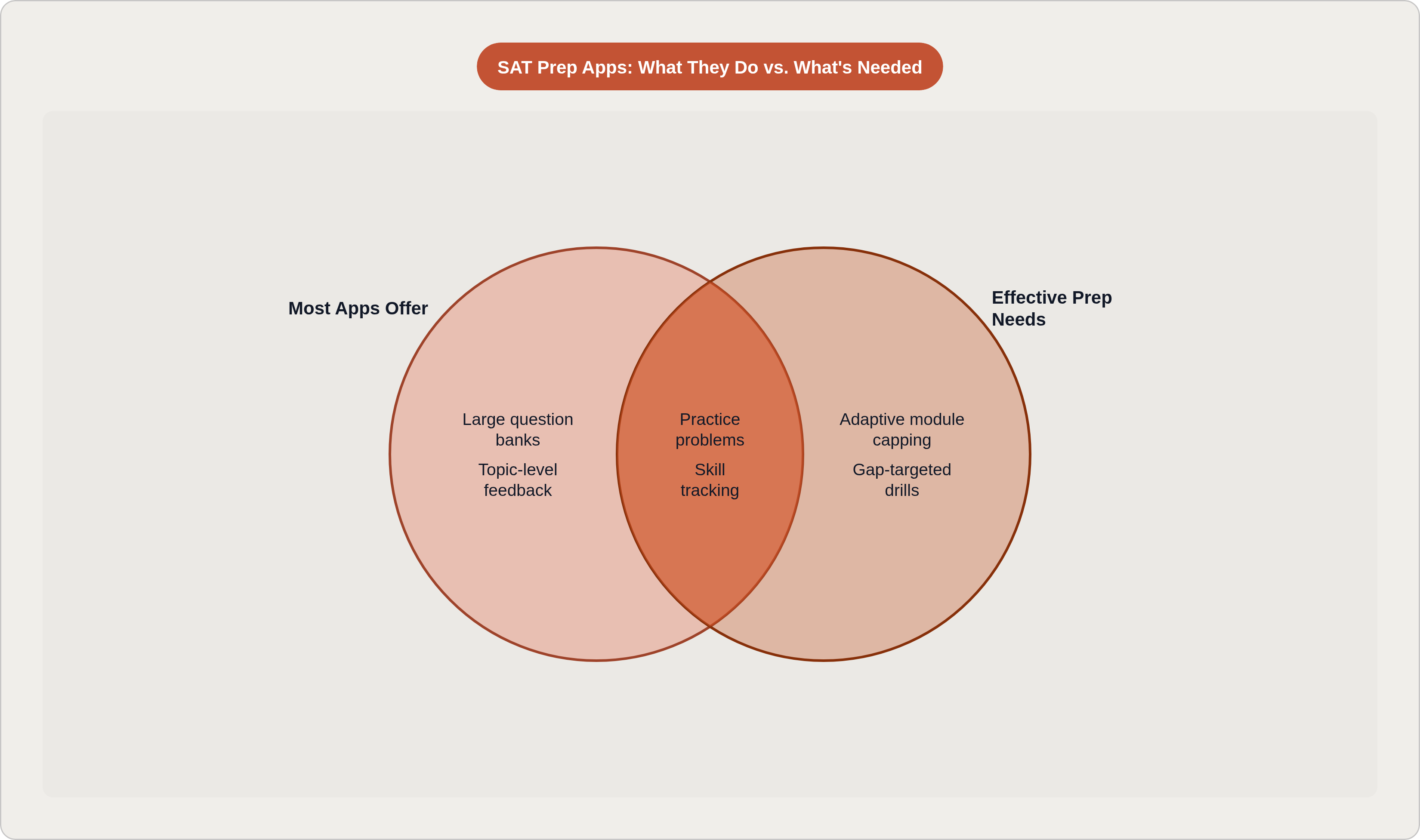
But here's the pattern across all three. Each is strong in one dimension. Authentic format. Question depth. Concept explanation. None of them systematically diagnoses where your reasoning breaks down. They identify what you got wrong. The "why" is still mostly on you.
The AI-first apps are asking a better question. Whether they answer it is another matter.
A newer class of apps has entered the space with a different premise. Not "more practice" but "smarter targeting."
AlphaTest's "Weakness Conqueror" system attempts to auto-detect error patterns and serve focused drills on the specific gaps dragging a student's score down, not the topics they already handle. Their adaptive study plan also syncs to an exam date and adjusts daily tasks if a student misses sessions or moves faster than expected. That's a more dynamic model than a static curriculum.
LearnQ.ai builds what it calls a real-time knowledge graph from student performance, attempting to map what a student actually understands versus what they've merely seen before. "Seen before" and "understand" are not the same cognitive state, and conflating them is exactly how students walk into test day overconfident.
Smartschool's SAT Prep 2026 app offers a high volume of full-length adaptive tests that mirror the module-jump logic, covering all 42 math question types. If format fidelity and volume are your priorities, that's a serious offering.
But here's the question these apps need to answer before you commit to one. "Adaptive" and "AI-powered" are marketing defaults now. Every app uses them. The real test is whether the system is serving your weakest reasoning patterns or just your weakest topic labels. A student might struggle with linear equations because of algebra gaps. Or because they can't translate word problems. Or because they rush the setup step on anything time-pressured. Same topic. Completely different root causes. Does the app know the difference?
Four questions that tell you whether an app is worth your time
Before you pay for anything, or commit serious prep time to anything free, run it through these.
First: does the app explain why an answer was wrong, or just that it was wrong? Step-level feedback and concept-level feedback are not the same. "You got this wrong, review systems of equations" is not the same as "you set up the first equation correctly, then switched variables in the second."
Second: does the adaptive system push you toward discomfort, or away from it? Take a session and notice how it feels. If practice feels easy and productive most of the time, something is probably wrong. Growth happens at the edge of competence. If the app is keeping you comfortable, it's optimizing for engagement, not improvement.
Third: does the practice test scoring replicate adaptive module capping? This one is easy to test. Take a mock, intentionally perform poorly on module one, then ace module two. Does your score reflect a ceiling? If the app gives you a high score anyway, it's giving you data that will mislead you on exam day.
Fourth: can the app use prior diagnostic data to skip what you already know? Time is the scarcest resource in test prep. An app that starts every student at zero, regardless of their PSAT results or prior test history, is wasting that resource.
For teachers evaluating classroom tools: does the platform surface individual error patterns at a granular level, or only aggregate right/wrong percentages by topic? The latter tells you almost nothing actionable.
This is also a classroom problem, not just an individual one
Individual students get the most attention in the prep conversation. But teachers are sitting on a structural opportunity that most aren't fully using.
The College Board's Skills Insight tool maps SAT score ranges to specific demonstrated skills. That gives a teacher a starting map of where a class cohort's reasoning is actually breaking down, before a single practice session.
Some paid platforms include classroom tools with real-time polling that can surface gaps during instruction, not just after a test. Dashboards track performance at the student, class, and even district level. That's the kind of granularity that lets a teacher make a different instructional decision on Tuesday based on what happened Monday.
Khan Academy's District program goes further by including teacher professional development on classroom SAT integration, so test prep isn't a bolt-on activity but something woven into regular math instruction.
The practical version of this doesn't require a lot of infrastructure. A question-of-the-day bell ringer. A 15 to 30 minute weekly practice block. A structured error-analysis discussion where the class walks through not just what the right answer was but where the reasoning went wrong. The app provides the data. The teacher uses it. That division of labor is the model.
And it's worth saying plainly: students from lower-income households are far less likely to access private tutoring or expensive prep courses. School-based integration of free tools like Khan Academy is one of the few structural mechanisms available for closing that gap. But it only works if teachers know what to do with what the data shows.
What a practice routine built around gap detection actually looks like
Here's the version that works. Not in theory. In practice.
Start with a diagnostic. Link your PSAT or prior SAT scores to Khan Academy or an AI-first app to generate a baseline map before you touch a single practice problem. Don't guess where your gaps are. Let real data show you.
Use Bluebook for full-length adaptive tests on a scheduled cadence. Not constantly. Space them out enough that prep work between tests can actually move the needle. Use them to track whether what you're doing is working.
Between full tests, drill your two or three weakest skill areas from the last error review. Not a general rotation across all topics. The specific things that are costing you points right now.
After every session, build one habit: review not just which questions you got wrong, but at what step the reasoning broke. This is the behavior that separates students who gain 115 points from students who gain 30. It's not more time. It's better attention to the specific place where things went sideways.
Use spaced repetition for concepts you've learned but haven't yet solidified. The goal is durable understanding, not recognition in the moment. The test knows the difference.
More practice time only compounds if it's aimed at the specific places where your thinking actually breaks down. Volume directed at comfort is just expensive wheel-spinning. Volume directed at your actual gaps is how scores move.
The apps that understand this are worth your time. The ones that don't are just selling you more problems.