SAT Score Improvement Roadmap for Beginners
Identify your target score before studying, then take a practice test to find your gaps.

Setting a realistic score target before studying anything
Most students start with anxiety and a highlighter. They grab a prep book, do some practice problems, maybe sign up for a class, and then show up on test day hoping something stuck. Some improve. Most don't improve as much as they could have.
The reason isn't effort. It's sequence.
Before you touch a single practice problem, you need a number. Not "do better." Not "as high as possible." A specific number. And that number doesn't come from gut feeling or ambition. It comes from your college list.
Look up the middle 50% score range for the schools you're actually applying to. Aim for the midpoint or above. Why? Because you want the score to work for you, not just technically clear a bar. A few reference points:
- National average in 2025: 1029
- 75th percentile nationally: around 1200
- Competitive range for selective schools: 1400 and up
- 98th to 99th percentile: 1500 and above
Now here's where your target starts shaping your actual strategy. Many schools superscore, meaning they take your highest Reading and Writing from one sitting and your highest Math from another. If your schools do this, you don't need to peak in both sections on the same day. You can point early prep energy at whichever section has the bigger gap, lock that in, then shift focus before your next sitting.
That raises a practical follow-up: how many sittings should you plan for? Two to four is a reasonable range. Most students don't peak on their first try, and pretending otherwise just adds pressure that doesn't help anyone.
The gap between your target and your starting score is the only honest way to figure out how much time you actually need. Block out at least 12 weeks. Meaningful improvement tends to show up after six to eight weeks of consistent, structured work. Not occasional work. Consistent.
Taking a full-length practice test as the first real action
You have your target. Now you need your starting point.
That starting point comes from exactly one thing: a full-length, timed, official practice test. Not a quiz. Not a handful of sample questions. Not a shortened diagnostic your tutor put together over a weekend. The whole test, timed accurately, completed in full.
Why does this matter so much? The Digital SAT is adaptive. Module 1 of each section determines whether you get an easier or harder Module 2. If your practice conditions don't mirror the real thing, your baseline is basically a number you made up.
Use College Board's official practice materials. The questions are built to the actual skill targets of the Digital SAT, and that's something a third-party quiz generator can't fully replicate, no matter how polished the branding looks.
When you sit down, track three things:
- Your score by section
- The moments where you felt real time pressure building
- The question types where your errors clustered
Don't fixate on the total score yet. The error patterns are what actually matter at this stage.
One more thing worth knowing before you start: the Digital SAT has no penalty for wrong answers. Guess on everything you're uncertain about. A completed test with some educated guesses gives you cleaner, more honest data than one you left partially blank.
Turning diagnostic results into a specific list of knowledge gaps
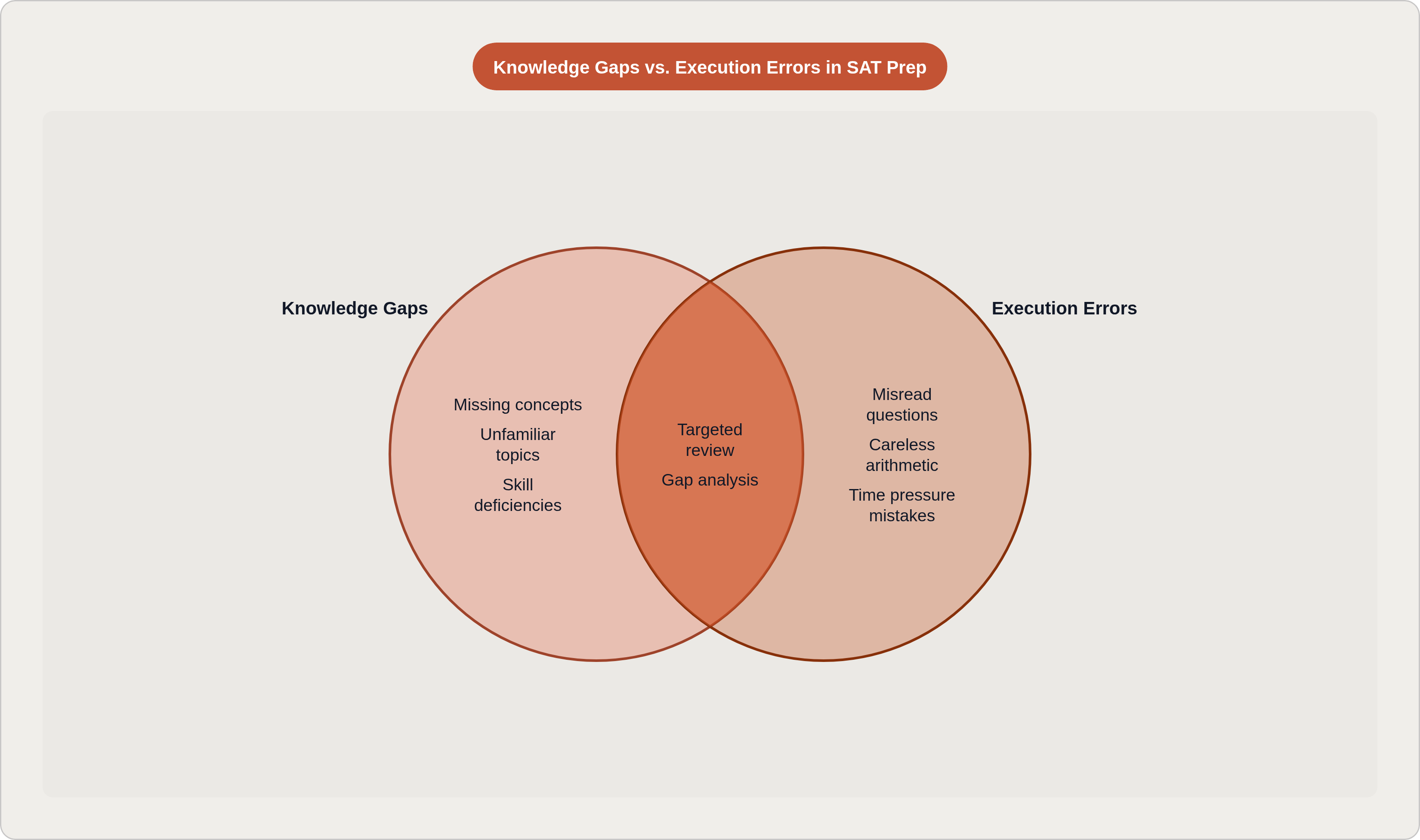
You have a test. You have errors. Now comes the part most students skip: figuring out what those errors actually mean.
Not all mistakes are created equal. Some are knowledge gaps. You didn't know the concept, full stop. Others are execution errors. You knew the concept but rushed, misread the question, or made a careless arithmetic mistake you'd catch on a second look. These two categories need completely different fixes. Mixing them up is one of the most reliable ways to waste weeks of prep.
Before you do anything with your results, go back through every wrong answer and ask yourself honestly: did I not know this, or did I know it and fumble it anyway? Most students undercount their execution errors. It's easier to say "I just don't know that topic" than to admit you blew a question you were fully equipped to answer. The diagnosis changes the prescription, so be honest.
Once you've sorted the errors, prioritize by leverage. Algebra makes up somewhere between 55 and 60 percent of the Math section. A gap there costs you more points than a gap in a topic that shows up two or three times per test. Plug the big holes first, not the most comfortable ones.
College Board's Skills Insight tool maps score ranges to what students at those ranges tend to know and can actually do. It's worth ten minutes of your time. It gives you a starting framework without having to build one from scratch.
The output of this whole step should be a short list. Two to four specific skill areas, no more. Not a sprawling syllabus of every topic you've ever felt shaky on. The two to four things that, if you actually fixed them, would move your score the most. That's the list you work from.
How to practice the gaps you've identified without wasting time on what you already know
Students who spend the most time on SAT prep don't always improve the most. Worth sitting with that for a second. Spending hours reviewing things you already understand isn't studying. It's just comfort dressed up as productivity.
High scorers tend to put in around 10 to 12 hours of focused prep per week. But the number of hours matters far less than where those hours actually go. Every session should start with your gap list and stay there.
What does deliberate practice on a specific gap actually look like? It's not running a full practice test every session. It's pulling targeted problem sets in the exact skill area you're trying to close, then analyzing every wrong answer before moving on to the next problem. Not after the whole set. After each problem. That distinction matters more than it seems like it should.
One thing worth drilling deliberately: when you're uncertain on a question, can you eliminate two obviously wrong answer choices before you guess? It's one of the highest-leverage habits you can build for uncertain questions, and it sharpens with repetition, not just by reading the tip once and nodding.
Time management is also a practiced skill, not a personality trait. Getting stuck on a hard question in Module 1 costs more than just that single question, because your Module 1 accuracy shapes which Module 2 you receive. Moving on isn't giving up. It's the adaptive play. But you can only train yourself to recognize the moment to cut bait if you practice making that call under real time pressure, not just in theory.
AI-powered practice tools can be useful here. The good ones track question type, accuracy, and response patterns over time and show you whether a gap is actually closing or just appearing to close. That's more reliable than your own self-assessment, which tends to skew optimistic when you're tired and want to feel like things are going well.
But watch out for AI-generated questions that mimic SAT style without being built to the same underlying standards. They can build false confidence in a way that only shows up on test day, which is the worst possible time to find out. Use official College Board materials as your quality benchmark. Use other tools to explain concepts and track patterns. There's solid evidence that pairing a good explanation tool with a high-quality problem set outperforms using either one alone.
What good feedback on practice problems actually does for learning
Getting the right answer explained to you is not learning. Learning happens when you understand where your reasoning broke down, not just which answer was correct.
This is easy to miss in self-directed prep because checking your answers feels productive. But if you're marking things right or wrong and moving on, you're grading yourself, not building anything durable.
Good feedback has a specific quality. It identifies the step in your reasoning that failed, not just the conclusion you got wrong. If you missed a question because you misidentified what was being asked, that's a completely different problem than not knowing the underlying concept. The fix is different. If the feedback can't tell you which one it was, it's not actually useful.
The better adaptive systems don't just mark responses correct or incorrect. They track your specific pattern of errors over time and adjust what you see next based on what you still need work on. That adaptation makes a real difference in outcomes.
But what about questions you got right? Students who got the right answer for the wrong reason show up constantly in self-directed prep. They guessed correctly, or they eliminated down to two choices and picked the right one on instinct without understanding why. A score alone doesn't catch this.
The practical test, after reviewing any answer you're not fully confident about: can you name the concept being tested, and can you identify the specific step where your reasoning broke down? If you can't do both, you haven't actually reviewed it. You've just looked at it.
How to structure the weeks between baseline and test day
Twelve weeks is the minimum. Here's how to actually use them.
Weeks 1 and 2: Diagnostic and gap list. Don't rush through this phase to get to what feels like "real" studying. This is the most important part of the whole sequence, and compressing it is where most self-directed prep falls apart.
Weeks 3 through 8: Targeted gap work by skill area. Pull problem sets from your list. Review every wrong answer the right way. Track whether the gaps are actually closing, not just whether you feel better about the material.
Weeks 9 and 10: Full-length timed practice tests. You're testing whether your gaps have closed under real conditions. Some errors only surface under time pressure, and this is when they show up.
Weeks 11 and 12: Review persistent errors. Light maintenance on what's already solid. No new material. Focus on timing habits, guessing strategy, and a short mental list of the specific mistakes you know you tend to make.
A few things worth flagging before you commit to this timeline.
Score gains are not linear. Most students hit a plateau somewhere in the middle of prep. This is a normal part of the process, not a sign the plan is broken. Students who abandon a working plan during a plateau almost always regret it. Sit through it.
After each full-length practice test in weeks 9 and 10, re-run your gap analysis. New errors should be shrinking the list. If the same gaps keep appearing, the problem probably isn't volume of practice. It's method. Try a different approach to that specific gap before you just add more hours.
A College Board and Khan Academy joint study found that students who completed the recommended adaptive practice plan averaged 120 points of improvement. The key variable wasn't the tool. It was actually completing the structured plan.
Final week: close the books on new content entirely. Walk in well-rested, with clean timing habits and a short mental list of the mistakes you know you tend to make under pressure.
The prep cost landscape and how beginners can evaluate their options
The SAT prep industry is expensive, and it is not shy about it. Princeton Review's top-tier courses run over $2,000. Other major test prep companies offer tutoring packages that approach similar numbers. Private tutors range from $50 to $200 per hour, with premium packages pushing past $4,000. Those are real numbers, and many students simply cannot absorb them.
What the price tag doesn't tell you is this: cost does not automatically equal structure. An expensive course built around generic content won't outperform a cheaper tool that actually tracks which skills remain unmastered, adapts to your specific gaps, and gives you real feedback on your reasoning. You can spend a lot of money on something that doesn't know what you need.
Khan Academy's free SAT prep is built in direct partnership with College Board, held to the same standards as the test itself. That's not a consolation prize for students who can't afford better. For students who use it with genuine structure and discipline, it's a strong baseline that many paid products don't meaningfully beat.
Before spending anything, run three questions on any tool you're considering:
- Does it use official or officially aligned content?
- Does it adapt to what you specifically get wrong, not just what a generic struggling student tends to struggle with?
- Does it explain where your reasoning broke down, or does it just hand you the right answer?
If the answer to any of those is no, you're mostly paying for branding.
A live tutor adds something no tool can match: real-time feedback, human intuition, and someone who will actually hold you accountable when you want to skip a session. But only if the tutor is diagnosing your specific gaps and targeting those, rather than walking through a scripted curriculum at your expense. Ask that question directly before you hire anyone. A good tutor won't be offended.
The sequence described throughout this piece works regardless of what tool you use. Baseline, gap identification, targeted practice, repeated testing, gap re-analysis. Pick a tool that fits your budget and passes those three questions, then run the sequence.