SAT Score Improvement Plateaus
Higher scores demand different fixes: error patterns, not content drilling.

What a Plateau Actually Looks Like Across Different Score Bands
A plateau isn't a failure to improve. It's improvement that stalls despite continued effort. Most students don't realize it's happening until they've burned through weeks of the same routine, fully expecting something different to happen this time.
Where you plateau is predictable. What it looks like depends almost entirely on where you're starting.
Students in the 1000–1200 range are hitting a wall because the foundation has cracks. Missing algebra concepts, shaky reading comprehension. The stuff that feels obvious in hindsight, but really isn't when you're in it. Students in the 1200–1400 range usually know the material well enough. They're bleeding points to careless errors, pacing issues, habits that fall apart under timed pressure. The 1400+ plateau is a different problem almost entirely.
Here's something I noticed after running enough students through the same prep programs. Students starting around 950–1050 regularly walk away with massive gains. Students starting around 1450–1520, using the exact same program, move the needle by much less. Same resources. Wildly different outcomes. That gap isn't random. It's the plateau effect, showing up right where you'd expect it.
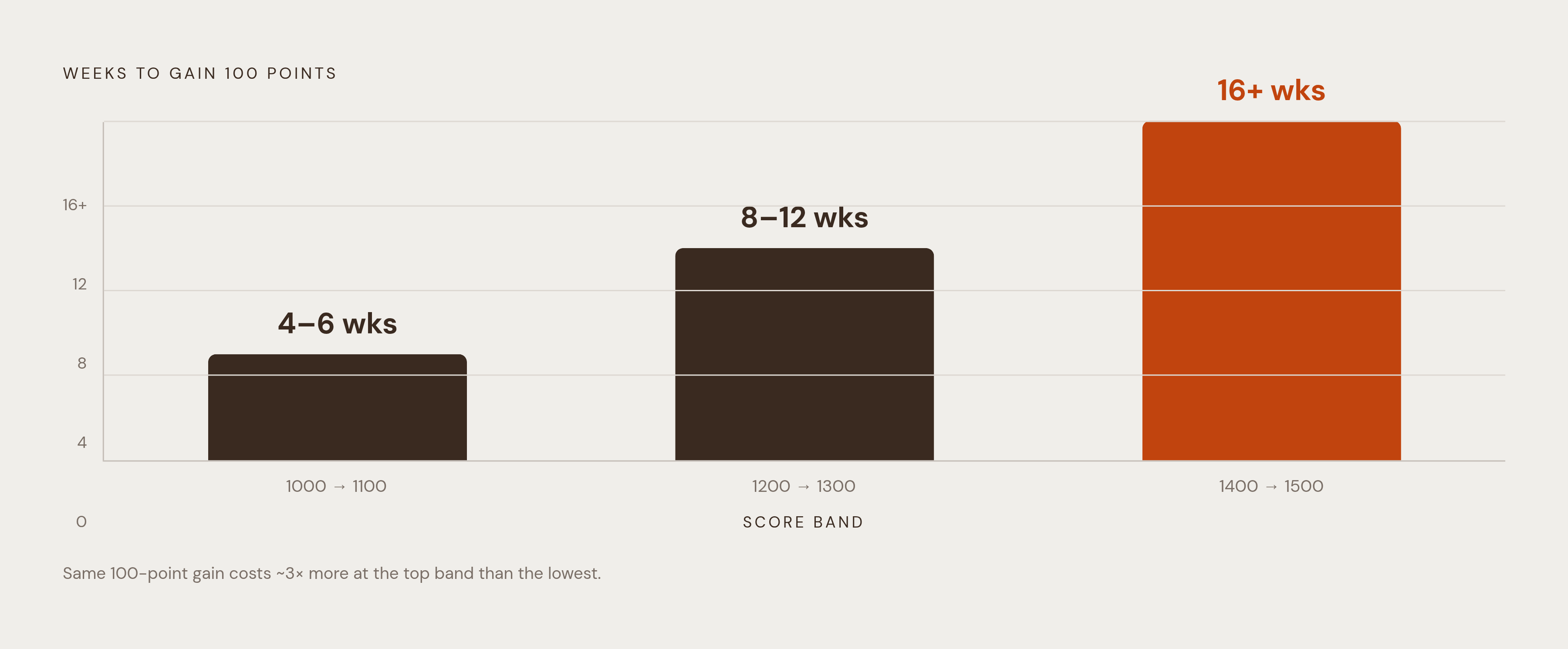
Timelines follow the same logic. A student going from 1000 to 1100 can often get there in four to six weeks of focused work. The 1200-to-1300 jump usually takes eight to twelve weeks of real error correction. Getting from 1400 to 1500 can take sixteen weeks or more, sometimes longer depending on what exactly is stuck. The higher you climb, the more you're paying per point, and the more precise the work has to be.
Why the Study Habits That Built Early Gains Stop Working
Think about how most students prep. Take a practice test. Glance at what went wrong. Move on. Repeat.
That loop gets a lot of students from 1100 to 1350 without much friction, which is exactly why it's so hard to abandon. It worked. So why would you change it?
Below roughly 1400, improvement is mostly about learning content you didn't know and building speed through repetition. Above 1400, content usually isn't the problem anymore. So what actually is?
At higher score levels, the questions students miss are specifically designed to punish plausible-but-wrong reasoning. They catch careless reading. They surface the hardest ten percent of question types. And reviewing the right answer afterward doesn't fix the underlying thinking error. It just confirms you got it wrong, which you already knew.
There's also something specific to the digital SAT that most prep routines ignore entirely. The test is section-adaptive. Your Module 1 performance determines how hard Module 2 gets. I've had students with real ability get rattled mid-test because nothing in their prep had ever put them in front of what hard actually feels like on this version of the exam. They'd practiced plenty. Just not the right kind of plenty.
The real failure is diagnostic. Students keep drilling volume when the actual limiting factor has already shifted from how much they practice to what they're fixing. More practice tests don't answer that question. They just generate more data you haven't figured out how to use yet.
The Percentile Reality That Makes Upper-Range Plateaus Especially Frustrating
Here's the part that feels absurd once you see it.
The gap between roughly 1450 and 1600 spans only a few percentile points at the very top of the distribution. That same raw score distance lower on the scale, say between 1100 and 1250, covers dramatically more percentile ground. Same number of points. Very different movement on the actual ranking.
This is structural. It reflects the distribution of test-takers, not something you're personally doing wrong. But it does mean a plateau at 1480 feels more defeating than the math warrants, because you're working hard for movement in the most crowded part of the scoreboard.
Admissions context matters here too. Returns on admission probability tend to taper off somewhere in the upper score range. Above a certain threshold, additional points tend to produce smaller and smaller changes in how selective schools weigh an application. That said, specific programs, scholarship cutoffs, and merit aid thresholds can make every single point matter in ways general data won't show you. Worth thinking through carefully depending on what you're actually shooting for.
For mid-range students, every point gained moves the percentile needle in a real, visible way. A plateau in the 1100–1300 range has direct consequences for college options. The urgency is real, and the upside of breaking through is equally real.
What Distinguishes Preparation That Breaks Plateaus From Preparation That Maintains Them
Most prep resources work fine for building a foundation. They cover material at a fixed pace regardless of what a specific student actually needs. Fine early on. Once the plateau sets in, that approach breaks down.
A 1050 student and a 1450 student need fundamentally different things. The 1050 student gains the most from drilling foundational algebra and building reading comprehension habits. The 1450 student needs error pattern analysis. Detailed, granular, relentless error pattern analysis. The same prep product cannot reliably serve both students well. Most of them don't really try to.
So what type of gap are you actually dealing with?
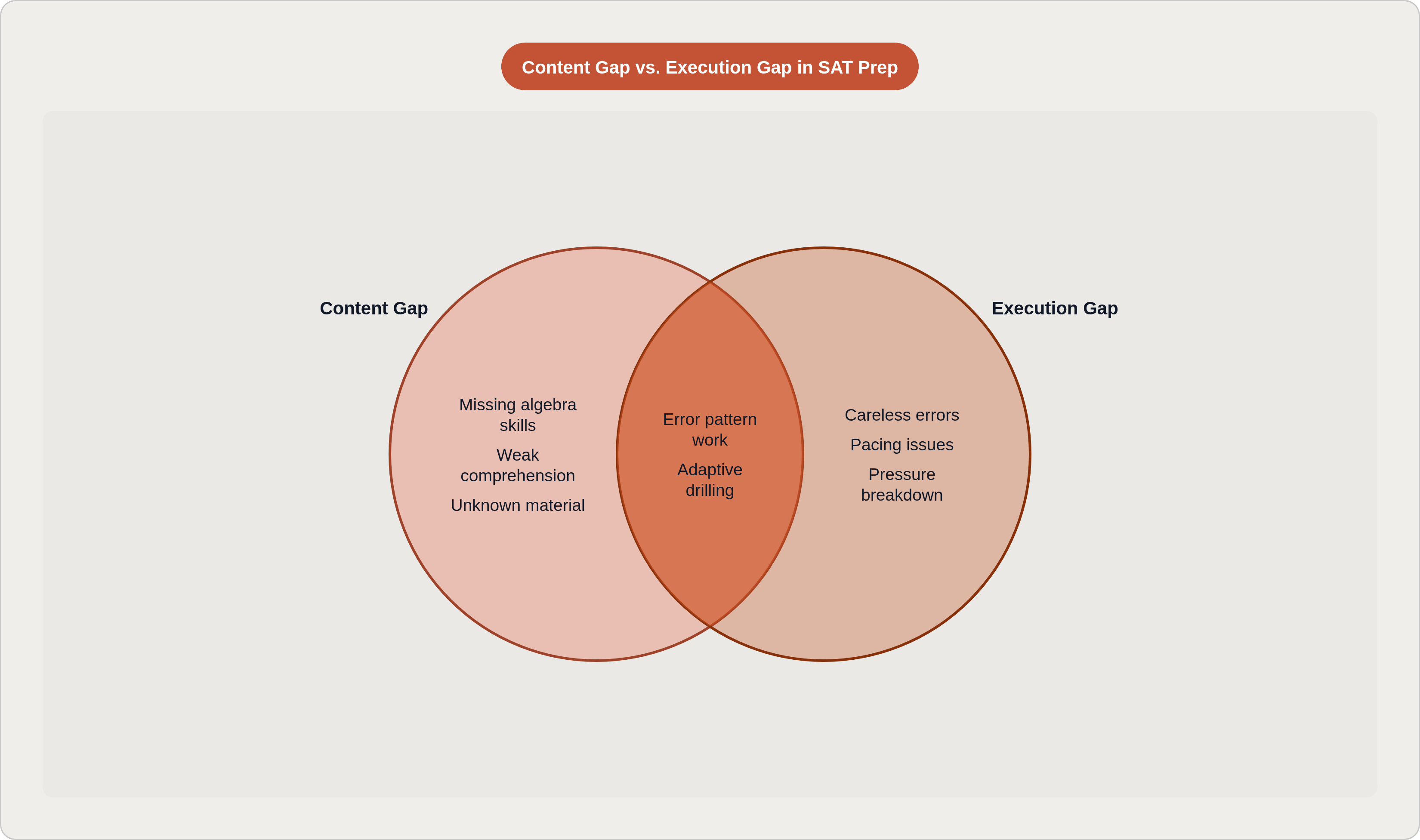
- A content gap means you don't know the material.
- An execution gap means you know it but make consistent errors applying it under timed pressure.
These require completely different responses. And most students haven't stopped to ask which one they have. I've watched students spend three months hammering content review when their real problem was execution under pressure. The problem was simply a mismatch between the diagnosis and the fix.
A few questions worth asking before picking an approach:
- Does the prep adapt to what this specific student struggles with, or is it just a curriculum on a schedule?
- Is there a structure keeping the student working consistently over time, or is it sporadic bursts right before each test date?
- Does the student understand why they got something wrong, not just that they did?
Official practice tools connected to the College Board are a reasonable starting point. But average gains across a broad population don't tell you much about your specific gaps. Most free tools lack the error analytics that a higher-range plateau actually demands, and that gap matters more the higher you climb.
How to Actually Identify the Gaps That Are Holding a Score Back
Taking more full practice tests and calling it a diagnostic is the first move to stop making.
A casual review of a timed practice test tells you that gaps exist. Actual gap identification tells you where your thinking breaks down. Those are very different things, and confusing them is how students spend months circling the same problems without ever closing them.
The digital SAT's adaptive structure makes this harder than it sounds. A student who underperforms on Module 1 may not even see the harder Module 2 questions. Which means they might not know which question types are their real ceiling. Prep tools that replicate adaptive logic can surface this. Tools that don't, can't. Most students never think to ask which kind they're using.
When reviewing a missed problem, the useful question isn't "which answer was right." It's "what reasoning led me to the wrong one." Recurring wrong-reasoning patterns are what need to be dismantled and rebuilt, and that work is uncomfortable in a way that re-reading answer explanations is not.
The College Board offers a Tailored Practice tool that provides targeted questions based on real test performance. It works well as a gap-identification layer on top of full-length practice. On top of. Not instead of.
Growth happens at the edge of current ability. Drilling comfortable material over and over isn't studying. It's going through the motions in a way that feels productive enough to keep you from doing the harder thing.
Why Retaking the Test More Often Doesn't Substitute for Fixing the Underlying Gap
This is the most expensive mistake in SAT prep. Not expensive in registration fees, though those do add up. Expensive in time. The months spent retaking instead of addressing the actual gap are months you don't get back.
Retaking without changing the preparation is, by definition, a plateau. Same inputs. Same outputs. And yet this is what a lot of students do, mostly because sitting for another test date feels like forward motion. It has the shape of action without actually being action.
When a score is consistent across retakes, most students read that as a ceiling. It's more accurately read as a signal that the gap hasn't been identified yet, or hasn't been addressed, or both. The score isn't telling you that you've maxed out. It's telling you something more specific than that, and the work is figuring out what.
Retaking has a legitimate role. Once a specific gap has been addressed and a student wants to confirm the gain on an official test, retaking makes complete sense. That's an endpoint, though. Not a preparation strategy.
One more thing worth flagging: as more schools reinstate test requirements, students who can no longer choose to withhold a score need their preparation to actually move the number. More test dates without better prep just produces more evidence of the same problem, now sitting in the official record.
A Realistic Plan for Students Who Are Stuck at Different Score Levels
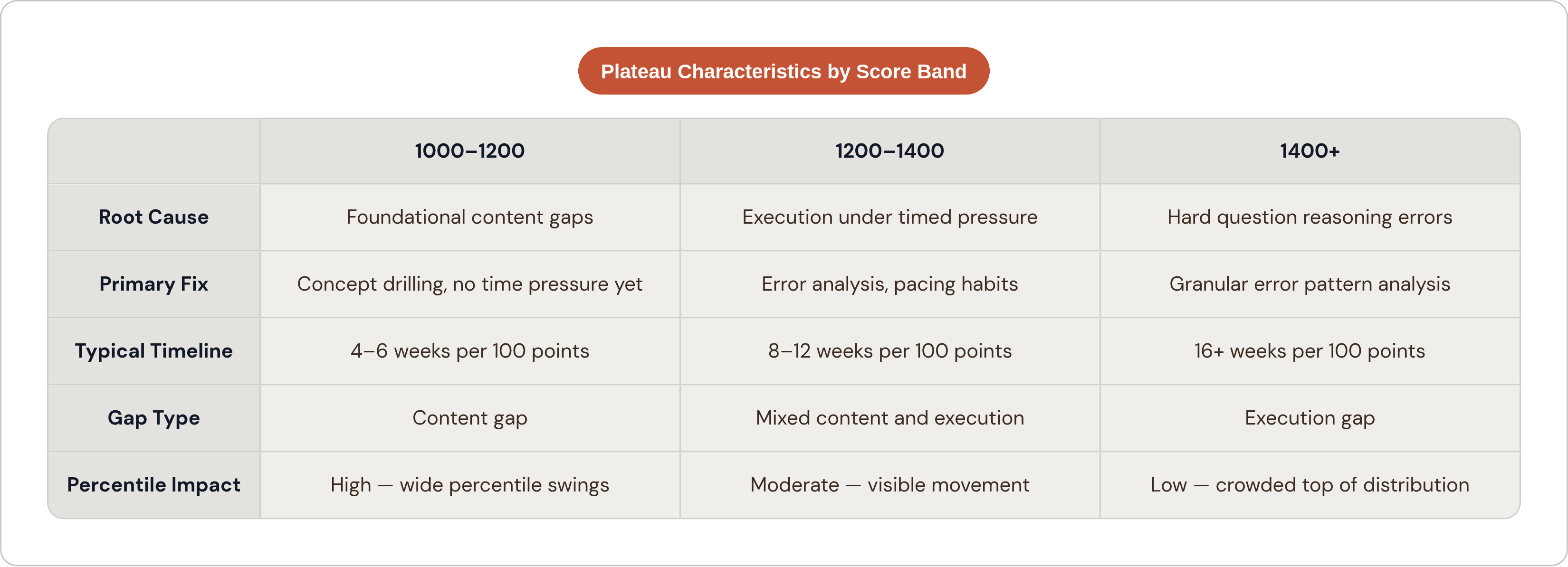
The right intervention depends on where the plateau is, not just that one exists.
Stuck in the 1000–1200 range: The priority is foundational content. Find the specific algebra and reading comprehension concepts that are missing, and build those before adding timed pressure. Volume of practice matters less than targeted concept work here. Adding speed to broken mechanics just makes the errors faster.
Stuck in the 1200–1400 range: Shift from content acquisition to error analysis. Are missed questions coming from careless execution or actual concept gaps? These require different responses. Pacing and test-taking habits become real factors here in ways they weren't at lower score levels.
Stuck at 1400 and above: Error pattern analysis is the primary lever. Focus on the specific question types you're missing, the reasoning patterns that consistently pull you toward wrong answers on hard questions, and simulate Module 2 difficulty before test day. Know what the adaptive structure throws at you before you're sitting in the testing room for real.
Across all bands: Consistency beats cramming. Prep that tracks what you actually understand, not just what you got right, closes the feedback loop that makes improvement stick.
One note for students at very high starting scores: average gains at that level tend to be modest, and knowing that isn't defeatist. It helps you direct energy toward the interventions with the highest actual return for your situation. Sometimes a plateau is telling you where to stop pushing on the score and start pushing on other parts of the application. That's not giving up. It's reading the situation clearly.