Digital SAT Format Changes Students Must Know
Shorter test, adaptive scoring, and a different strategy—here's what changed.

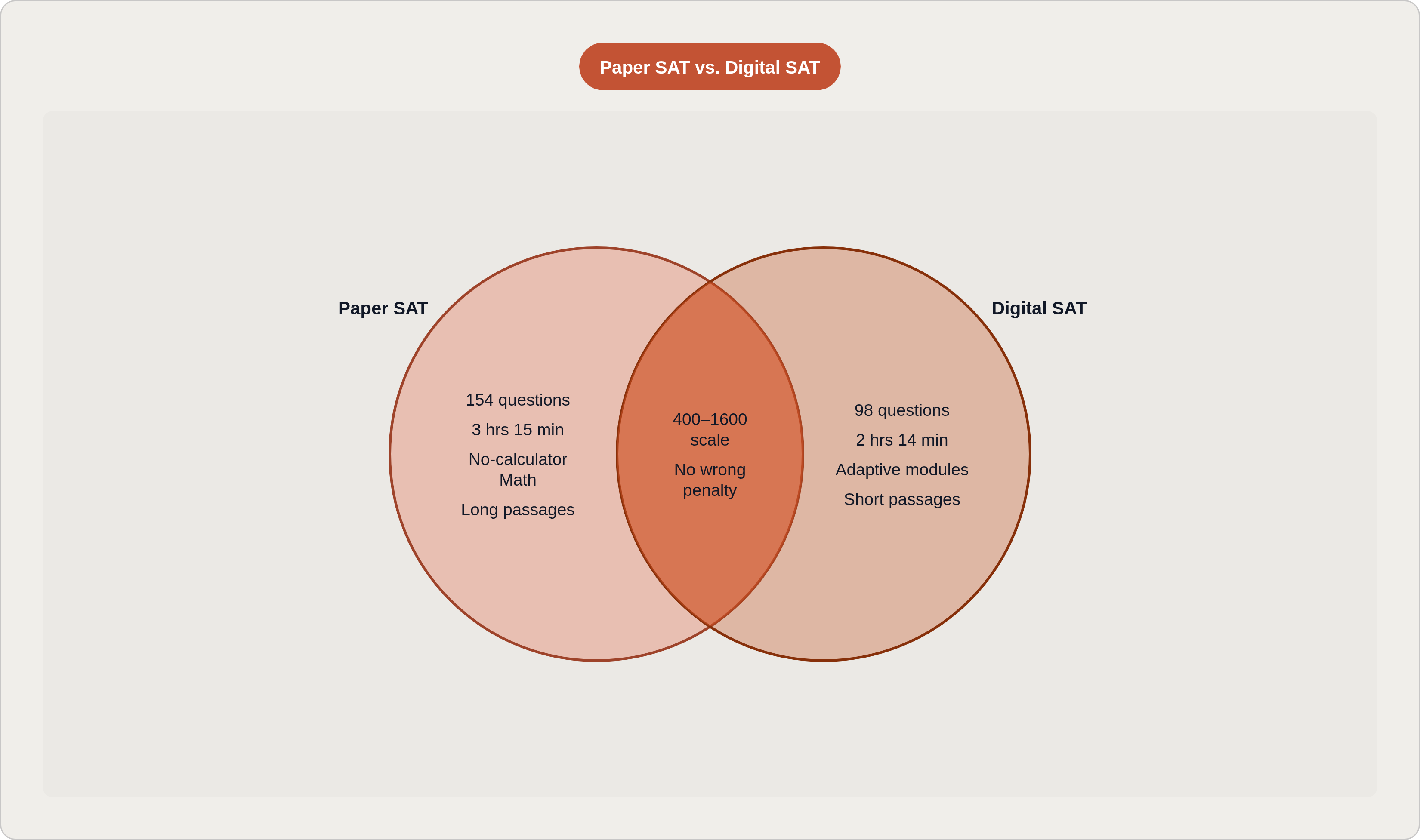
Start with the raw numbers. The paper SAT had 154 questions and ran for 3 hours and 15 minutes. The digital SAT has 98 questions and runs for 2 hours and 14 minutes.
That's not a small trim — that's a fundamentally different test.
The paper format was partly an endurance event. Could you hold focus across three-plus hours of dense reading and problem-solving? The digital version doesn't care about that. It wants to know if you're accurate. Those are different skills, and students who trained for the long version don't automatically have what this one rewards.
Here's the structure:
- Two scored sections: Reading & Writing and Math
- Each section split into two modules (four modules total)
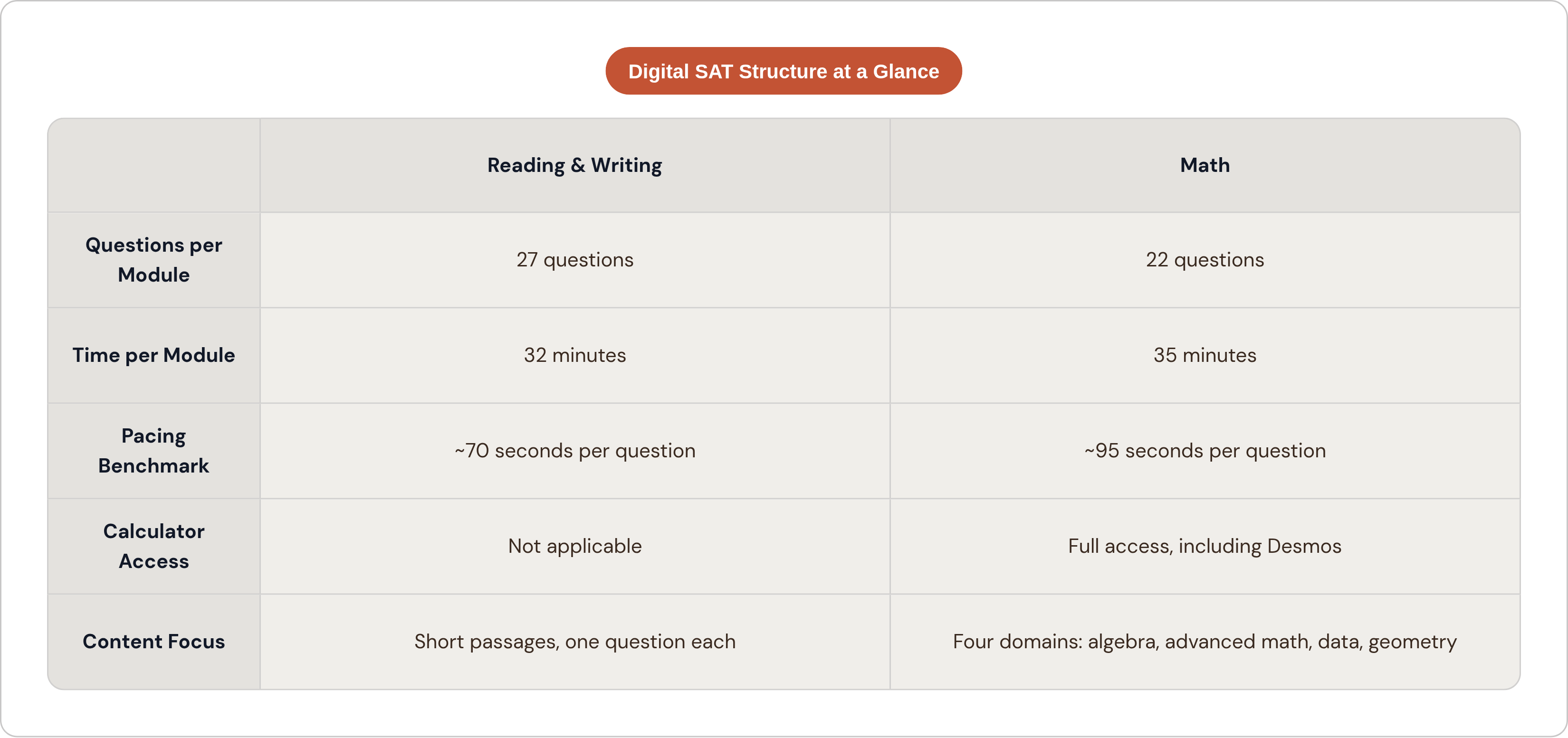
- Reading & Writing: 27 questions per module, 32 minutes each
- Math: 22 questions per module, 35 minutes each
- One 10-minute break between Reading & Writing and Math
- Two unscored experimental questions buried somewhere in each module. You won't know which ones.
The 400–1600 scoring scale hasn't changed. The national average sits around 1,000–1,060, which is a reasonable anchor when you're setting targets.
So what does the compression actually demand? Under two and a half hours, 98 questions, no margin for drift. Students who trained for the paper format need to recalibrate — not just run shorter practice sets. The mindset is different.
How adaptive testing works. Why Module 1 is where the test is actually won or lost
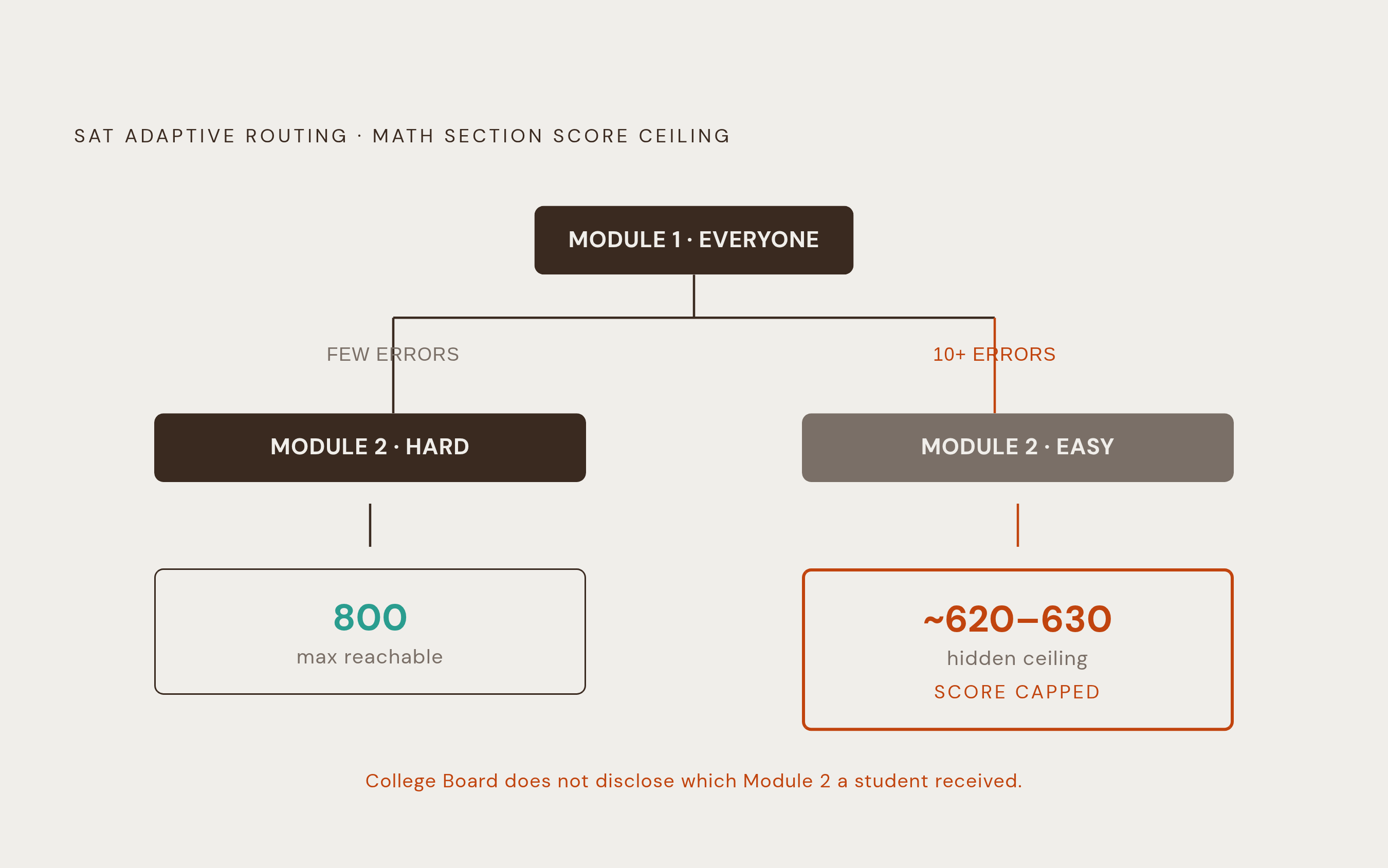
The digital SAT uses what College Board calls Multistage Adaptive Testing. Module 1 is the same for everyone. How you perform there determines which version of Module 2 you get. Stronger Module 1 performance routes you to the harder Module 2. Weaker performance routes you to the easier one. Both sections work this way.
Here's what most students don't realize until it's too late: if you're routed to the easier Module 2, your maximum possible score is capped. Answer every single question correctly on the easier Module 2, and you still cannot score above approximately 620–630 on that section. In Math specifically, making around 10 errors in Module 1 puts a ceiling on your score around 680, no matter what you do in Module 2.
That ceiling is invisible. College Board doesn't tell you which Module 2 you received. It doesn't appear anywhere on your score report. You get a final number with no indication of whether you were bumping against a limit you didn't know existed.
Students who rush through Module 1 to "save time" for harder questions later are misreading the test. By the time Module 2 starts, your ceiling may already be set. The student sitting next to you is probably seeing different questions. The test is individualized on purpose.
Accuracy in Module 1 isn't just important — it's the whole game.
Same number of right answers, different scores. Here's why that's not a bug
No penalty for wrong answers. Guess on everything you don't know. Leaving a question blank is rarely the right call.
The raw-to-scaled score conversion depends on which Module 2 path you traveled. Getting the same number of questions right on the harder module yields a higher scaled score than getting that same number right on the easier one. Two students with identical correct-answer counts can finish with meaningfully different scores, and neither of them would know why just from looking at the number.
One thing that actually changed for the better: scores come back within days, not weeks. If you're retaking on a tight timeline, that turnaround changes how you plan.
Score improvement also isn't linear. Moving from 1100 to 1200 is typically more achievable than moving from 1300 to 1400. Gains from 1400 to 1500 require targeted, specific work on the hardest question types. The higher you go, the more precise your prep has to be. That's useful to know before you set your target.
What changed in Reading and Writing: short passages, one question each, and why that flips the old strategy
The long reading passages are gone. Every question is now paired with a short text — 25 to 150 words. One question per passage.
On the paper SAT, misreading one long passage could damage your performance across 10 or more related questions. Now each question stands alone. One misread costs you one question. That's a meaningful shift in risk.
But it's not easier, exactly. The section is now testing whether you can extract precise meaning from very short texts, very quickly. Tone, purpose, word choice, the relationship between two sentences. Close reading with a timer.
Vocabulary is tested in context too. You have to infer what a word means from the passage surrounding it. Memorizing word lists won't help. You have to read your way to the answer, which is a different skill than flashcard prep builds.
Pacing benchmark: roughly 70 seconds per question.
What changed in Math: a calculator the whole time, and four content domains to know cold
The old SAT had a no-calculator Math section, and that section is now gone entirely. You can use a calculator throughout the entire Math section now.
A Desmos graphing calculator is built directly into the Bluebook app. You can also bring your own approved external calculator if that's what you're used to.
The four content domains:
- Algebra
- Advanced math
- Problem solving and data analysis
- Geometry and trigonometry
Pacing benchmark: roughly 95 seconds per question.
One thing worth flagging about the calculator access: it doesn't make the math easier. A lot of the questions are designed so that students who actually understand the underlying concept will move faster than students leaning entirely on computation. Knowing when to reach for the calculator and when to just think it through is half the skill being tested. Students who use the calculator as a crutch often run out of time.
The Bluebook app: what to expect on test day, and why getting familiar with it beforehand isn't optional
The test runs through the Bluebook app on a laptop, tablet, or school-provided device. If you need to borrow a device from College Board, that request has to go in at least 30 days before test day.
Each module has a visible countdown clock. You can flag questions and return to them within a module. Once you submit a module, you cannot go back. That last part trips up a lot of students. The instinct to rush through and circle back is a paper-test habit, and it transfers poorly here.
Built-in tools include the Desmos calculator, annotation tools, and question flagging.
Full-length practice tests are available free inside Bluebook, and those are the only practice tests that accurately simulate test-day conditions, including the adaptive routing and the actual interface. After a practice test, Bluebook generates a custom link connecting you to your missed questions, explanations, and Khan Academy practice resources.
Getting comfortable with the interface before test day is its own preparation task. It has to be done on purpose, not assumed.
A diagnostic baseline isn't just a good idea. It's structurally necessary
Because Module 1 accuracy sets your score ceiling, you need to know which content domains and question types are costing you points before you start studying.
A full-length diagnostic in Bluebook is the only starting point that makes sense. Without it, study time spreads evenly across areas where you're already solid, and the score doesn't move. That's a targeting problem, not a preparation problem.
College Board's Tailored Practice tool draws from their official Student Question Bank (real SAT and PSAT questions) and targets practice to your actual performance on official tests. Most students who prepare seriously need somewhere between 8 and 20 weeks of structured study to see meaningful score improvement. That range isn't really about raw hours — it's about how efficiently those hours are aimed.
The adaptive structure rewards students who know their own weaknesses. Module 1 is exactly where those weaknesses either get addressed ahead of time or quietly become permanent score ceilings.
How AI-powered tools find the patterns that manual review misses
Manual review can tell you which questions you got wrong. It can't easily surface which question types you're consistently rushing on, where you're misreading the question stem before you even get to the answer choices, or which content domains produce errors under pressure but not in low-stakes practice.
Those patterns matter more than the individual wrong answers.
AI tracking analyzes patterns across answers, speed, and accuracy. It identifies behavioral tendencies, builds custom practice sets targeting those specific gaps, and adjusts difficulty as performance improves.
Khan Academy's official prep course covers every skill across three levels (Foundations, Medium, Advanced) and links directly to College Board's Tailored Practice data. Given that score reports now come back within days and retake windows are tight, the speed of that feedback loop is meaningful to how you plan your next round of prep.
What teachers and schools can do with the reporting tools. The harder question underneath all of it
College Board's K–12 educator portal provides Knowledge and Skills reports showing aggregate student performance across eight content domains (four in Reading & Writing, four in Math), plus individual scores, percentiles, and downloadable PDFs.
The workflow College Board's educator guide recommends: review Knowledge and Skills Reports, use Skills Insight to build an action plan, use the Educator Question Bank to build targeted practice, then have students work in Bluebook and Khan Academy.
Khan Academy's teacher tools let educators track individual student progress and assign specific content. The same Bluebook platform now hosts many AP exams, so teachers working across both contexts are operating inside a single ecosystem rather than toggling between platforms.
But here's the question worth asking: are schools actually organized to use this reporting? Is there time carved out in the schedule to act on what it shows, or does the data just sit in a portal? The tools exist, but whether the surrounding infrastructure does is a separate problem, and probably the more consequential one.