Digital SAT Format Changes and What They Mean for Prep
Module 1 performance, not raw ability, determines your scoring ceiling on the digital SAT.
Most students hear "adaptive test" and picture something that smoothly adjusts question by question, like a video game that reads the room. That's not what's happening here.
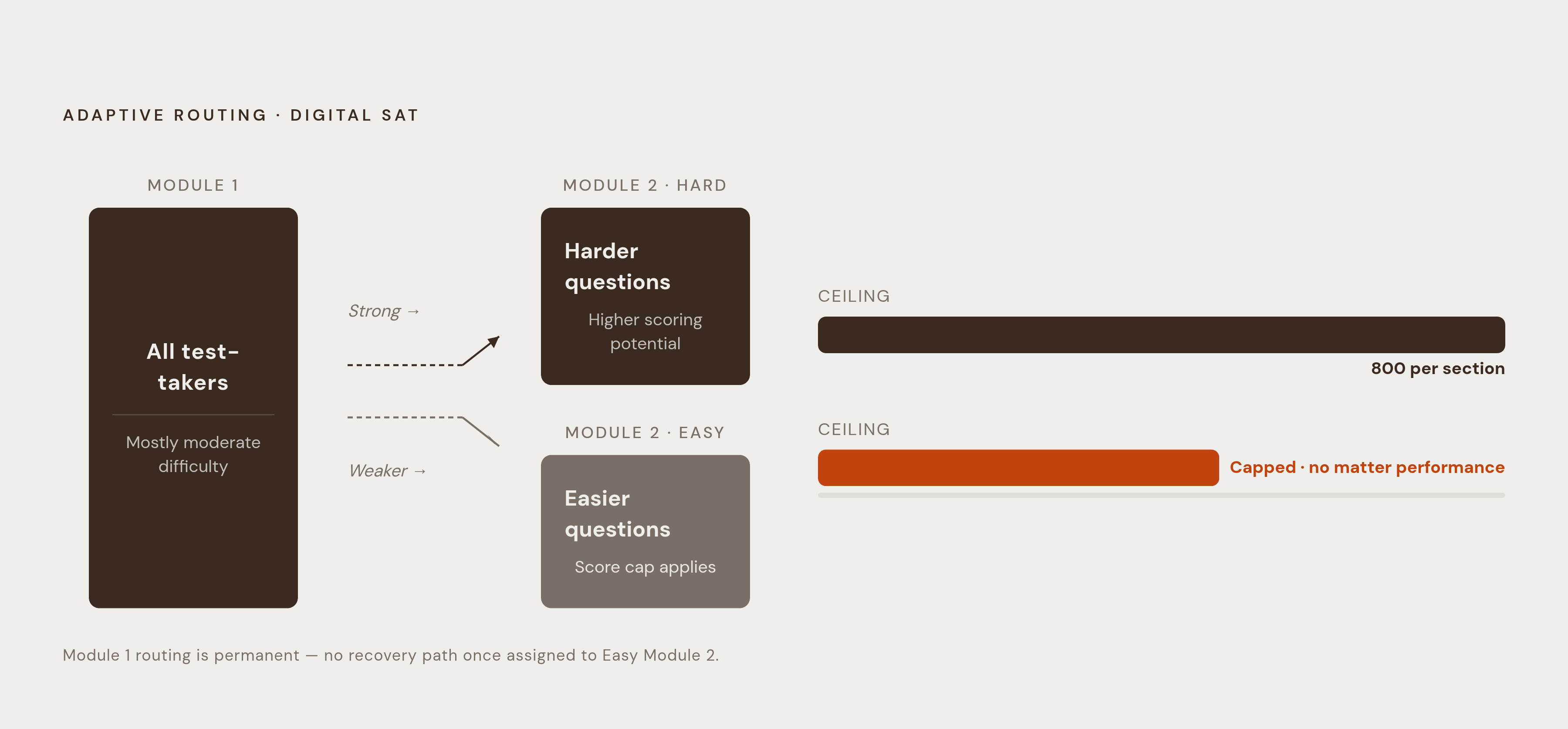
The digital SAT adapts by module, not by question. Each section has two modules. Module 1 is identical for everyone: mostly moderate-difficulty questions. Your performance on that module determines which version of Module 2 you get. There are two options, and only two. A harder set with a higher scoring ceiling, or an easier set with a lower one.
A mistake on a moderate Module 1 question doesn't just cost you a point. It nudges the routing algorithm toward the easier Module 2. And the easier Module 2 caps how high you can go, regardless of how you perform on it. Students who ease in, pace themselves, treat Module 1 like a warm-up lap — they're making a structural error the test is specifically designed to surface. Module 1 is the gatekeeper, and the gate only swings one way.
So what's the skill that actually gets you routed up? Not mastering the hardest question types. It's consistent, high-accuracy performance on moderate questions. That's what opens the ceiling.
One pushback worth taking seriously: a student who can handle hard questions should, by all logic, handle moderate ones just fine. Fair point, in theory. But "should handle" and "actually does" diverge pretty reliably under timed pressure with rapid context-switching between short passages. Module 1 accuracy is a trainable habit, not just a byproduct of general test ability.
The prep implication is specific: practice in timed module blocks that replicate the real routing structure. Random question sets fail to do this. Official full-length practice tests in the College Board's Bluebook app do, and the app is free.
What the Reading and Writing section actually tests now
The old SAT R&W section asked you to hold a 700-word argument in your head while answering several questions about it. That's gone.
Every Reading and Writing question on the digital SAT comes paired with its own short passage. We're talking 25 to 150 words. One passage, one question, next. Fifty-four times.
Shorter text sounds easier. But when a passage is that compressed, every sentence is doing work. There's no throat-clearing, no context-building paragraph to ease you in. The test is asking you to read precisely, read fast, and then completely reset for the next question.
The four question categories are Information and Ideas, Craft and Structure, Expression of Ideas, and Standard English Conventions. The ones that knock students sideways most often are Craft and Structure, particularly Words in Context and the cross-text comparison type. These require reading for purpose and tone in very small windows. Sometimes a single sentence is the entire evidence base for the question.
Standard English Conventions questions (grammar and usage) are embedded in short editorial-style passages. The errors are local, contained. You're not scanning three paragraphs for the antecedent.
Why does this matter for prep? Students who spent real time building stamina for extended passages may actually need to recalibrate. What they need instead is practice reading dense, short texts quickly and precisely. Op-eds. Scientific abstracts. Short literary excerpts. The cognitive task is fast identification of rhetorical purpose and precise vocabulary in context.
That's a real difference, and it's worth checking whether your prep materials actually reflect it.
What changed in Math and what the Desmos calculator does and doesn't solve
Math is 44 questions across two adaptive modules. The content areas are Algebra, Advanced Math, Problem-Solving and Data Analysis, and Geometry and Trigonometry. About three-quarters are multiple choice; the rest are student-produced responses where you enter your own answer with no choices to lean on.
The big structural change: the no-calculator section is completely gone. Desmos, a built-in graphing calculator, is available for all of Math. Students hear this and think the hard part got easier. It did — conditionally.
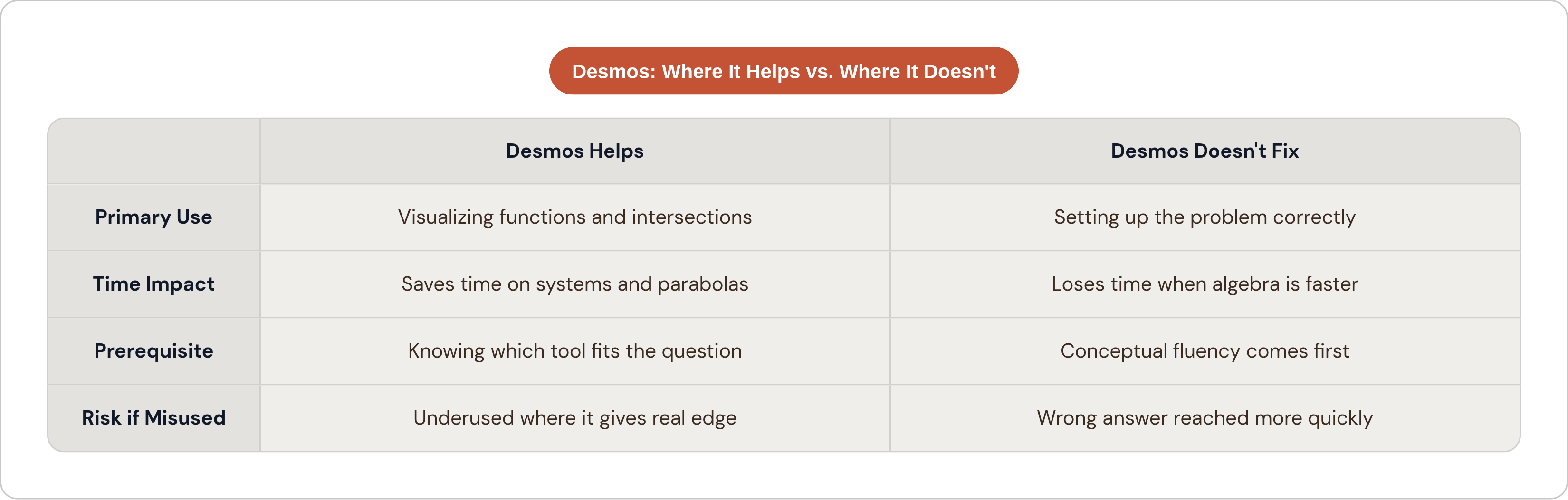
What Desmos actually helps with:
- Visualizing functions and spotting intersections quickly
- Checking algebraic work before committing to an answer
- Systems of equations and parabola problems that used to eat real time
What Desmos doesn't fix:
- You still have to set the problem up correctly before you touch the calculator. Desmos executes your setup. It doesn't generate one.
- A lot of questions are structured so that clean algebra is faster than graphing. Students who reach for Desmos reflexively lose time on exactly these.
- Conceptual fluency is the prerequisite. Desmos is an efficiency tool. Without the underlying algebra, it just produces a wrong answer more quickly.
Worth flagging for students who relied on the old no-calculator section as discipline for mental math: that forcing function is gone now. If you neglect to rebuild it intentionally in prep, test day is when you find out it's missing.
Also: the built-in Bluebook version of Desmos has its own interface. It's not identical to the standalone app. Practicing with a different graphing calculator and assuming the skills transfer is a small inefficiency, but it's one you can eliminate before the test.
The admissions context that makes these format changes matter more now
More than 2 million students sat the SAT in 2025, the highest number since before the pandemic, with the vast majority on the digital version.
The admissions landscape around it has also shifted. Brown, Dartmouth, Harvard, Yale, MIT, Caltech, Georgetown, and Stanford have all reinstated score requirements for Fall 2026 admission after years of test-optional policies. That's a meaningful cluster of schools moving in the same direction at the same time.
Cornell published a data point worth looking at directly: in fall 2023, students who submitted SAT or ACT scores to the College of Arts and Sciences made up about 24% of applicants but roughly 50% of acceptances and 62% of enrollments. That gap doesn't tell you scores caused admission. But it does tell you something about who was in the admit pool.
That said, more than 80% of U.S. four-year institutions will not require scores for fall 2025. The shift is concentrated at the schools where individual score differences carry the most weight in decisions.
The College Board has also noted that average scores remain substantially lower than pre-pandemic levels. Large pool, meaningful high-score threshold at selective schools, and a real gap between well-prepared and under-prepared students. The format being new is an advantage for students who understand what it rewards, because a lot of the competition hasn't caught up.
Where prep efforts tend to go wrong when students don't account for the format shift
Stamina training for long passages that aren't on the test anymore. The most common mismatch. Extended reading comprehension of 700-word passages practiced a real skill. It's just not the skill R&W is testing now.
Treating Module 1 as a slow start. Students who pace themselves for a longer test often drop points on moderate-difficulty Module 1 questions. That's exactly where the routing decision gets made.
Ignoring Desmos or over-relying on it. Both extremes cost time. Students unfamiliar with the tool miss efficiency where it helps. Students who reach for it on everything lose time on questions that clean algebra handles faster.
Drilling volume without diagnosis. More practice problems don't help if the same conceptual error keeps showing up. The adaptive format punishes unaddressed gaps more than the paper test did, because errors on moderate-difficulty questions have routing consequences.
Using prep materials built for the old test. Old paired-passage questions, extended evidence chains across long texts. These don't map to the discrete-passage format. Students using older materials may not notice the mismatch until they're actually sitting the exam.
What a prep approach built for the digital SAT's actual structure looks like
Start with official full-length practice tests in the Bluebook app. It's free. It's the only practice environment that replicates the adaptive routing. Paper practice sets, no matter how well-designed, can't simulate that. Everything else is supplemental.
From there:
Skill-level targeting over coverage. The test covers a finite set of question types across four R&W domains and four Math domains. Tracking your accuracy by category tells you where practice time returns the most points. A student already solid on Algebra but weak on Craft and Structure questions doesn't need more Algebra review. Craft and Structure is where the points are.
Module-structured timed practice. Not open-ended question sets. Blocks that mirror the actual pacing. Module 1 accuracy is trainable, but only under conditions that surface it.
Desmos fluency as a specific prep task. Use the Bluebook version specifically. Know the interface before test day.
Short-passage reading exercises. Op-eds, scientific abstracts, short literary excerpts in the 25-to-150-word range. Practice fast, precise reading and quick identification of rhetorical purpose.
Diagnosis over drilling. When you review wrong answers, identify the specific breakdown: knowledge gap, misread question, careless step. Each one points to a different fix. Just checking the answer key and moving on turns practice into exposure, not understanding.
For free resources aligned to the digital format: the College Board's Tailored Practice tool surfaces questions based on actual past performance. Khan Academy's Official SAT Prep links to your College Board account for personalized targeting.
For students aiming at the hard Module 2 ceiling specifically: consistent accuracy on moderate questions is the prerequisite. A student who can solve hard problems but drops points on moderate ones due to pacing or carelessness is making a structural error. The ceiling only opens if you get routed there first, and that routing happens in Module 1.