SAT Vocabulary in Context Strategy
Memorizing word lists won't help; learning to read context clues will.
Almost every student I've worked with starts the same way. They see "vocabulary" on the prep syllabus, pull up a word list, and start drilling definitions. It feels productive. It mostly isn't.
Here's the thing: SAT vocabulary questions don't test what you've memorized. They test whether you can read a short passage and figure out what a word means in that specific context. The passage is doing the work. The word is almost beside the point.
And the trap the test actually sets? It targets secondary meanings of words you already know. Not obscure words. Familiar ones. "Assume." "Run." "Conduct." "Significant." You know all of those. That's exactly why they're dangerous. Knowing a word too well is like being handed a map to the wrong city: confident navigation, completely wrong destination.
"Assume" appeared on a recent digital SAT. The correct answer wasn't "suppose" or "presume." It meant "undertake" or "take on." The familiar meaning was the wrong answer. Students recognized the word, picked the definition they'd known since middle school, and lost the point. Repeatedly. Not because they didn't study. Because they studied the wrong thing.
Word lists floating around online make this worse. A lot of them were built for the pre-2016 SAT, which actually tested words like "pulchritude" and "obstreperous." That version of the test is gone. Using those lists now is like training for a 10K by memorizing swimming strokes.
Here's what really gets me: the same word, tested on two different test dates, can have two different correct answers. Because the passages differ. What the test is measuring is contextual reading, and no word list on earth teaches you that.
The repeatable process for working through a Words in Context question
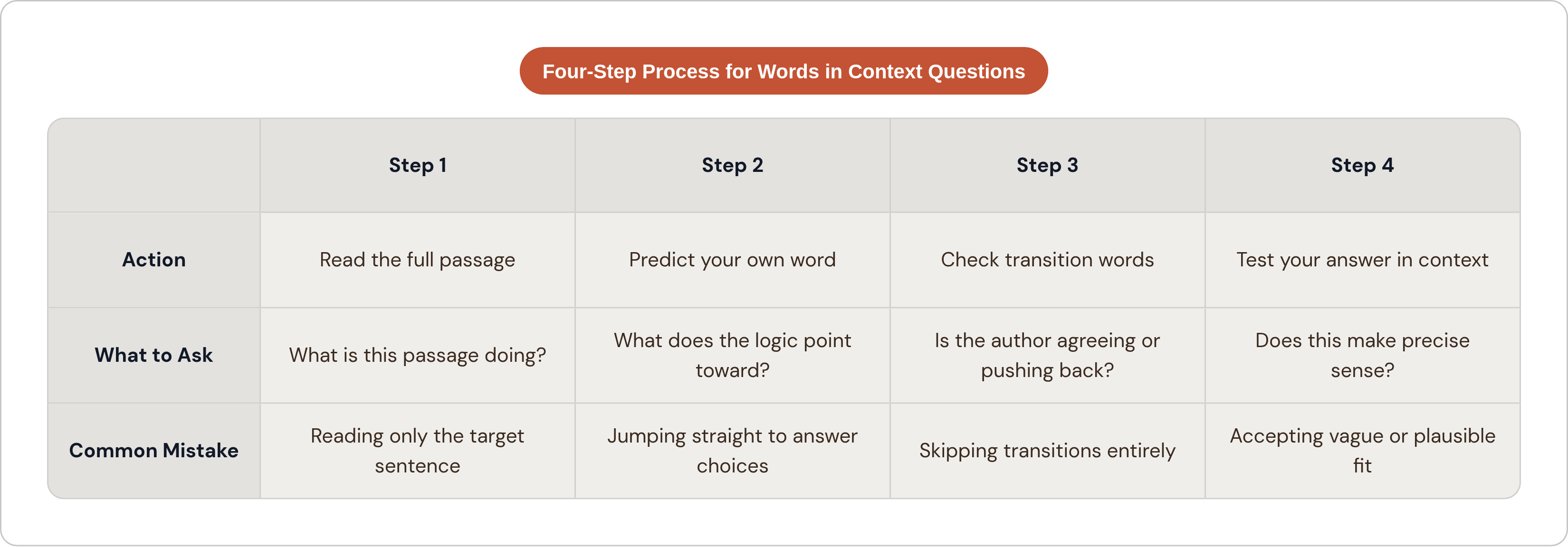
Look, I'm not going to pretend there's some elegant three-word framework here. There are four steps. They're not complicated. The hard part is doing them in order every single time, especially when you're moving fast and the question looks easy. That's exactly when students stop doing them.
Step 1: Read the full passage before you look at the answer choices.
Digital SAT passages are short. Sometimes twenty-five words, sometimes one-fifty. That brevity means every sentence carries real weight. Read the whole thing and ask: what is this passage actually doing? Making a claim? Providing an example? Correcting something? That question matters before you touch the blank.
Step 2: Cover the answer choices and predict your own word.
Fill in the blank yourself before you look at the options. It doesn't need to be sophisticated. "Strengthen." "Show." "Doubt." Whatever the passage's logic points toward. Then look for an answer that matches.
If you predicted "strengthen" and one option is "bolster," that alignment means something. This step forces you to engage with the passage rather than recognize a familiar definition.
Step 3: Read the transition words before you commit.
This is the step people skip most often, and in my experience, the one that separates students who plateau from students who break through.
Transition words are the passage's instruction manual. "However" signals contrast. "Therefore" signals consequence. "For example" signals illustration. A "however" right before the target word tells you the correct answer needs to create contrast with what came before. Tone works the same way. A skeptical or cautious passage narrows the range of words that can fit just as sharply as any transition word does.
Step 4: Test your chosen answer in the original sentence.
Read it slowly. The answer should make precise sense. Not grammatical sense. Not plausible sense. Precise sense.
Vague fit isn't a pass. "Kind of works" probably means it's wrong. The question tests fit, and it's a stricter standard than most students apply.
Reading the refutation pattern, the question structure that trips students most often
There's a specific structure worth naming, and I wish I'd identified it earlier in my tutoring career because students keep falling for it. Every testing window, same trap.
The author introduces a common interpretation of something and then corrects it. The correct answer fits the corrected version of the claim, not the intuitive reading. Students who pick from habit rather than from the passage's logic land on the intuitive version. They lose the point not because they misread the word, but because they misread what the passage was doing.
How do you catch this before it costs you? Look for transitions that signal correction or qualification near the blank. "But," "however," "yet," "while," "this does not mean," "this does not imply." Any of those should put you on alert. Before selecting, ask yourself: is the author agreeing with what came before, or pushing back? That one question tells you which direction the word needs to point.
This is also why reading the full passage in Step 1 isn't optional. The refutation often lives in the sentence before the one with the blank. If you only read the sentence containing the target word, you miss the setup entirely. I've watched students do this in real time. They read one sentence, pick an answer, and look visibly confused when I ask them what the passage was arguing. They were pattern-matching. And the test is specifically designed to punish that.
Using word structure to handle words you haven't seen before
What do you do when you don't recognize a word and context alone isn't resolving it?
Word structure is a tiebreaker, not a replacement for reading the passage. But it's a real one, and students underuse it.
A small set of roots covers a meaningful chunk of the academic vocabulary on the SAT. "Bene" means good. "Mal" means bad. "Dict" means speak or say. "Equi" means equal. Negative prefixes like "un-," "in-," "ir-," and "im-" show up constantly. Recognizing that a word reverses a meaning is often enough to eliminate a wrong choice without knowing anything else about it.
There's an even simpler version of this. Before trying to nail down exact meaning, just figure out a word's charge: positive, negative, or neutral? That question alone can knock out one or two answer choices without requiring you to know the word at all.
A student I worked with once hit the word "ameliorate" mid-passage, on a piece about urban air quality, and froze. She told me afterward she almost guessed. But she noticed "melior" looked like it might connect to something positive, and the passage's tone was clearly optimistic about the policy being described. She crossed off the two negative options, tested what remained, and got it right. She didn't know the word. She knew enough. That distinction matters more than most students realize when they're staring at something unfamiliar with the clock running.
Which words are actually worth studying before test day
There is a vocabulary list worth building. It's just not the one most students are using.
The College Board draws from a pool of roughly two to three hundred Tier 2 academic words across test dates. The passages change. The words recur. That overlap is real.
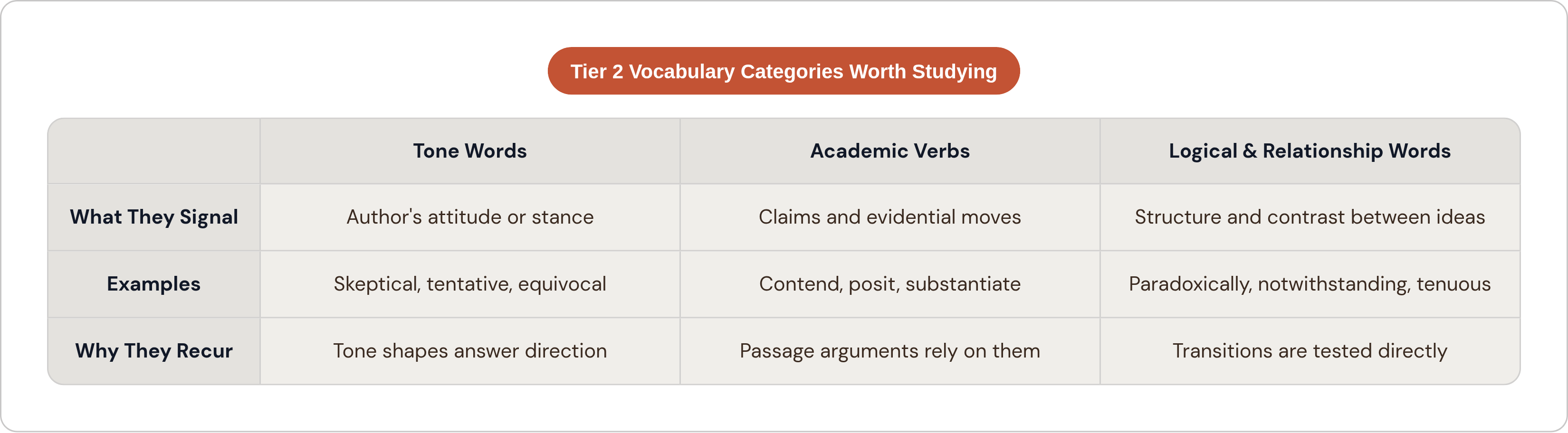
Three categories show up consistently:
- Tone words. Skeptical, tentative, resigned, equivocal.
- Academic verbs. Contend, assert, substantiate, posit, evince.
- Logical and relationship words. Paradoxically, notwithstanding, consequent, tenuous.
Words like "alleviate," "ameliorate," "anomalous," "eschew," "exacerbate," "idiosyncratic," "ubiquitous," and "vindicate" have appeared across multiple testing windows. The College Board appears to reuse word banks. A curated high-frequency list is a legitimate use of your time.
But how you study them matters more than how many you study. Don't memorize dictionary definitions in isolation. For each word, practice using it in a sentence that creates a logical context. That mirrors the actual cognitive move the test requires.
One thing worth knowing if you're also prepping for AP English Language or AP Literature: the same Tier 2 words turn up in those passages and free-response prompts. The overlap is bigger than most students expect. Let those prep efforts reinforce each other.
How to build the skill through practice, not exposure
Reading the passage first, predicting before looking, tracking transitions, testing for precise fit. These are habits. Habits require reps, not information.
You can read this entire process, understand every step, and still miss the next five Words in Context questions. Understanding a method and having it automated are meaningfully different things. I've seen this more times than I can count: students who could explain every step back to me in detail, then immediately skip two of them the moment the clock was running.
After every Words in Context question, regardless of whether you got it right, write down in plain language why the correct answer fits and why each wrong choice doesn't. Not "it sounded better." The specific reason. That forces you to articulate the reasoning rather than just recognize the answer. Recognition isn't transferable. Articulation is.
Highlight every transition word in every passage before answering. Do it every time. At some point you stop needing to highlight because you're already doing it automatically. That's the goal.
One caution about practice materials. AI-generated SAT practice questions can look right without being right. Experts who've reviewed that material have found questions that mimic the SAT's format without testing the reasoning the College Board actually measures. You can score well on those questions and build false confidence that disappears on test day. A well-made practice question requires the passage's specific logic to resolve it. If you can answer it without reading, it's not training the skill.
Track your errors by type. Wrong because the word was unfamiliar? Wrong because you ignored context? Wrong because you misread a transition? The goal isn't to count mistakes. It's to identify exactly where the reasoning broke down so you can fix that specific thing.
The digital SAT is adaptive. Your performance in Module 1 sets the difficulty ceiling for Module 2. That means every question matters, not just the hard ones. Consistent application of this process early, on the questions that look easy, is what determines how high that ceiling goes.