SAT Prep for Students with Learning Differences
Navigating the SAT with learning differences requires specific strategies.

There's an uncomfortable truth sitting underneath the recent wave of test-optional reversals. Schools like Princeton announcing mandatory scores for Fall 2027, with the Ivy League nearly unanimous in following suit, aren't just changing admissions policy. They're changing the stakes for a population of students who never had a clean path to begin with.
Over two million students took the SAT in 2025. The highest number since the pandemic. And roughly one in five U.S. children has some form of learning or attention challenge. Do that math and you're looking at hundreds of thousands of students who find standardized testing considerably harder, now sitting in a world where they can't sidestep it.
The question isn't whether students with learning differences can succeed on the SAT. They can and do. The better question is: what specifically helps them get there?
That's what this piece is about. Not inspiration. Not theory. Practical moves, in order, based on how the test actually works and how neurodiverse brains actually work. Think of this guide as a map through unfamiliar terrain — the landscape is real, the obstacles are marked, and the paths are ones other students have already walked.
The digital SAT's format has already changed some things, but not everything
Let's start with the basics. The digital SAT runs about two hours and fourteen minutes. It's fully adaptive, meaning the difficulty of your second module depends on how you did in the first. Passages are shorter than the old paper version. And Desmos, the graphing calculator, is available for the entire math section, no special request needed.
That last point matters more than most people realize. Students with dyscalculia previously had to apply separately just to use a calculator. Now it's a default. The playing field shifted.
But there's more built into the testing app than just Desmos. Text-to-speech and screen reader functionality is available. Students can adjust speed and replay passages. Speech-to-text and dictation are supported. Font size and color contrast can be adjusted. These used to be workarounds students had to fight for. Now they're baked in.
There's also a less obvious win for extended-time students. Under the old paper format, extended time could stretch across two days. That's not the case anymore. Longer doesn't mean overnight.
So is digital automatically better for every neurodiverse student? No. Students with visual impairments or who find screens disorienting sometimes do better on paper. Students prone to transcription errors face their own calculus. The point isn't that digital is universally easier. The point is this: before you assume what accommodations you need, understand what the format already gives you. Some past workarounds are now built in.
Average scores in 2025 came in at 1029 composite. That's notably lower than 2019 averages, which ran higher in both sections. If you're helping a student calibrate their goals, that context matters.
SAT or ACT: the structure of each test suits different profiles
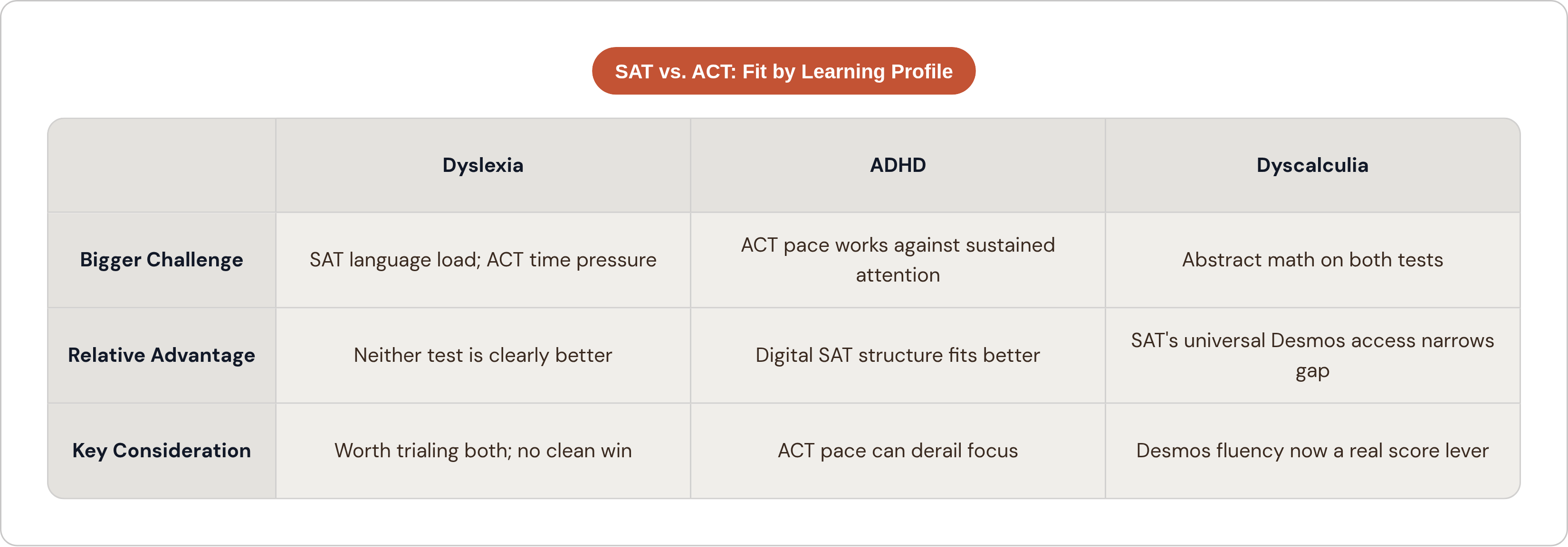
Both tests offer comparable accommodations. That's not the differentiator. The differentiator is what each test actually asks a brain to do.
The SAT doesn't punish processing speed as harshly. You get more time per question than on the ACT. But the SAT rewards a different skill: interpreting what a question is actually asking. Language comprehension is the main lever. The adaptive structure also means pacing and stamina play a subtle role that's easy to underestimate.
The ACT moves faster. It includes a science section. It rewards memorization and speed in ways the SAT doesn't. On the flip side, its math questions tend to be more concrete and less abstract, which some students find more approachable.
So how does this apply to specific profiles?
- Language-based learning disabilities (like dyslexia): The ACT's time pressure is a real obstacle. But the SAT's heavy language-interpretation load isn't trivial either. There's no clean win here. Both tests have friction points. Worth trialing both.
- ADHD: The digital SAT's structure tends to fit better. The ACT's pace can work directly against sustained attention.
- Dyscalculia or difficulty with abstract math: The ACT's concrete math used to have a clear advantage. The SAT's universal Desmos access has complicated that picture. It's closer than it used to be.
One practical thing worth knowing: accommodations are approved per test. Approval for the SAT doesn't carry over to the ACT. So the decision to trial both tests also means two separate documentation processes, which brings us to the part most families underestimate.
How SAT accommodations actually work, and what the process actually requires
Here's where things get logistically messy, and where starting late causes real damage.
Accommodations through College Board are managed through their Services for Students with Disabilities (SSD) program. Requests go through the school's SSD coordinator via College Board's SSD Online system. The most common accommodations are extended time (time-and-a-half or double time), extra breaks, small group testing, and assistive technology like screen readers or text-to-speech.
Extended time is by far the most requested accommodation. A Government Accountability Office review found it made up 55% of all accommodations granted in the 2019-2020 school year. That's not a surprise. Processing speed and working memory are among the most common functional impacts of both ADHD and learning disabilities.
But here's the thing families often don't know. Having an IEP or 504 at school does not automatically mean College Board will approve the same accommodations. College Board conducts its own review. They're not bound by what a school already granted.
Documentation requirements are specific. Educational or neuropsychological testing must be within the last five years. It needs to describe the disability, its functional impact on testing, and why each accommodation is needed. For ADHD specifically, documentation typically includes cognitive and executive functioning measures like the WAIS-IV, Conners-4, BRIEF-2, or CPT-3. It should describe concrete impacts: skipping questions, rereading items, difficulty organizing thoughts under time pressure.
College Board publishes a seven-week processing window once an application is complete. That's after documentation is gathered, submitted, and deemed complete. Families starting from scratch without current documentation should plan a minimum of six months before the intended test date. If testing is sophomore or early junior year, that clock starts even earlier.
One more thing worth knowing: a 2025 rule change affects how extended time actually works in practice. The "Next" button between questions stays inactive until standard module time has elapsed. You can't rush through early, bank time, and use it later. This matters for prep. Pacing practice under real conditions isn't optional anymore.
And one piece of good news on the other end of the process: accommodations approved once carry over to all future College Board tests. That means AP exams too, without re-requesting.
Scores earned with accommodations carry no flag or notation. Nobody knows.
Why standard SAT prep doesn't work well for students with learning differences
Most SAT prep tools were built for a specific kind of learner. One who can move through dense passages quickly, hold multiple concepts in working memory simultaneously, and build fluency by running through the same drill type repeatedly until the pattern sticks.
That model has three problems when applied to neurodiverse students.
The timed-drill problem. Full-length timed practice tests measure processing speed as much as content knowledge. A student who understands the material but reads slowly will get a score that reflects the processing constraint, not the knowledge gap. Repeating timed tests in that case doesn't fix anything. It just confirms the same constraint over and over. The thinking error never gets identified because the test never isolates what's actually breaking down.
The volume problem. More practice problems aren't inherently useful if the student doesn't know which skills to prioritize. The digital SAT's adaptive structure means high-frequency skills compound in importance. Spreading practice evenly across all topics is the wrong approach, but it's the default approach in most generic prep programs.
The feedback problem. Generic score reports tell students what they got wrong. They don't explain why thinking broke down on a specific question type. That distinction is the difference between useful feedback and noise.
What neurodiverse students actually need: shorter, targeted sessions. A clear goal per session. Feedback that identifies the reasoning error, not just the incorrect answer. And a structure that doesn't require a student to generate all of that scaffolding themselves.
Study structures and session design that fit how neurodiverse brains work
Twenty to thirty minutes. That's the session target for students with ADHD or attention-regulation difficulties. Not two hours. Not a full-length practice test on a Saturday morning. Short, focused, with one clear goal per session.
Does that feel too short to be useful? Consider what actually makes a study session valuable: clear purpose, active engagement, and feedback. None of those require ninety minutes. A focused twenty-minute session is like a sharp scalpel — it does exactly what you need without the collateral damage of exhaustion.
Some structural tools that make a real difference:
- Visual timers. Not a clock. A timer where the student can see time shrinking. It reduces the ambient anxiety of "how long is left" and makes time concrete.
- Checklists. Decide what to do before the session, not during it. This offloads executive-function work from the moment when focus should be on the content.
On sequencing, start untimed. Work through question sets with no time pressure to isolate content knowledge from speed. Only once accuracy on a skill is established do you introduce time pressure. This separates two completely different problems: "do I understand this?" and "can I do this fast enough?" Conflating them makes both harder to fix.
Skill prioritization matters more than breadth. The adaptive structure of the digital SAT means weak spots in high-frequency skill areas show up disproportionately in your score. Students should identify their weakest high-frequency skills and work there first, not distribute effort evenly.
On modality:
- Dyslexia: Use text-to-speech for reading passages during practice. Match what you'll actually have on test day from day one.
- Dyscalculia: Build Desmos fluency early. It's available on test day, which means fluency with it is a real, concrete score lever. Treat it like a skill, not a crutch.
- ADHD: Start with module-by-module practice. Build toward full-length tests gradually. Jumping to full practice tests too early creates burnout without proportional benefit.
Students who need external structure don't just benefit from scheduled check-ins. They need them. Self-directed platforms, no matter how well designed, have a ceiling for students whose executive function makes self-direction harder.
What adaptive prep tools offer, and where each falls short
Khan Academy is the starting point for most families, and for good reason. It's free. It's the official College Board partner. Its diagnostic quizzes identify weak skill areas and generate a personalized practice queue. Students who practice twenty or more hours on the platform gain an average of 115 points, per College Board's own data.
But Khan Academy has real limitations for students with learning differences. Personalization is relatively light. It doesn't weight practice toward the highest-frequency SAT topics. And it has no live instruction, no accountability check-ins, no one to call when a student gets stuck. For a student who needs external motivation or someone to explain why their thinking went wrong, Khan Academy has a ceiling.
PrepScholar takes a more algorithm-driven approach. Its study plan updates continuously based on diagnostic results. Its AI Learning Assistant uses guided questioning rather than just supplying answers. Stronger personalization than Khan Academy, and better suited for students who need their weaknesses actively targeted rather than self-identified.
On cost: SAT tutoring runs anywhere from around $45 an hour for entry-level help to over $1,000 an hour for elite specialists, per Private Prep's 2026 pricing data. Premium course programs range from several hundred dollars to over $2,000. Strong AI-powered options exist for under $150. The emergence of AI-driven prep tools has meaningfully lowered the cost barrier to personalized prep, which is worth knowing if budget is a real constraint.
When evaluating any tool for a student with a learning difference, here's what to actually look for:
- Feedback that identifies reasoning gaps, not just wrong answers
- Ability to adjust pace and session length
- Compatibility with the same accommodations the student uses in real prep (text-to-speech, adjustable display)
- Some form of accountability or progress visibility for students who struggle with self-direction
That last one gets underweighted constantly. A brilliant tool that a student can't sustain using is not a better tool.
How teachers and school coordinators can support neurodiverse students through this process
Teachers are often the first people to notice something. Sustained attention difficulties in class, reading pace that doesn't match comprehension, written output that doesn't reflect what a student clearly knows. Those observations are not just useful. They are often the starting point for a formal evaluation process.
That said, there's a meaningful difference between an IEP and a 504 that's worth understanding. Both provide accommodations. Only an IEP mandates specially designed instruction. And 504 protections extend beyond high school, which matters for students who will seek accommodations in college.
The more pressing gap, practically speaking, is between school accommodations and College Board approval. They are not the same thing. An IEP or 504 does not automatically transfer to College Board approval. SSD coordinators should help families understand this early. The documentation College Board needs is specific. It's not the same as what a school requires. Getting ahead of that well before junior year prevents a predictable and avoidable timeline crunch.
Once College Board accommodations are approved, coordinators have one more practical job: communicating that those approvals carry over to AP exams. Students should be using the same accommodations on AP tests they're entitled to. That often doesn't happen because nobody told them it could.
On the classroom side, AI grading tools are becoming a real lever for teachers working with students who need more feedback iterations than traditional grading timelines allow. Tools like CoGrader, which claims an 80% reduction in teacher grading time with rubric-based grading and LMS integration across platforms including Google Classroom, Canvas, and Schoology, and EssayGrader.ai let students write, receive feedback, revise, and resubmit within a single session. For neurodiverse students who need more practice repetitions to consolidate a skill, that feedback speed isn't a convenience. It's a functional advantage. AI essay scoring tools calibrated to SAT and AP standards have shown high correlation with human grader scores in vendor studies, making that feedback reliable enough to be useful.
Putting it together: a realistic prep timeline for students with learning differences
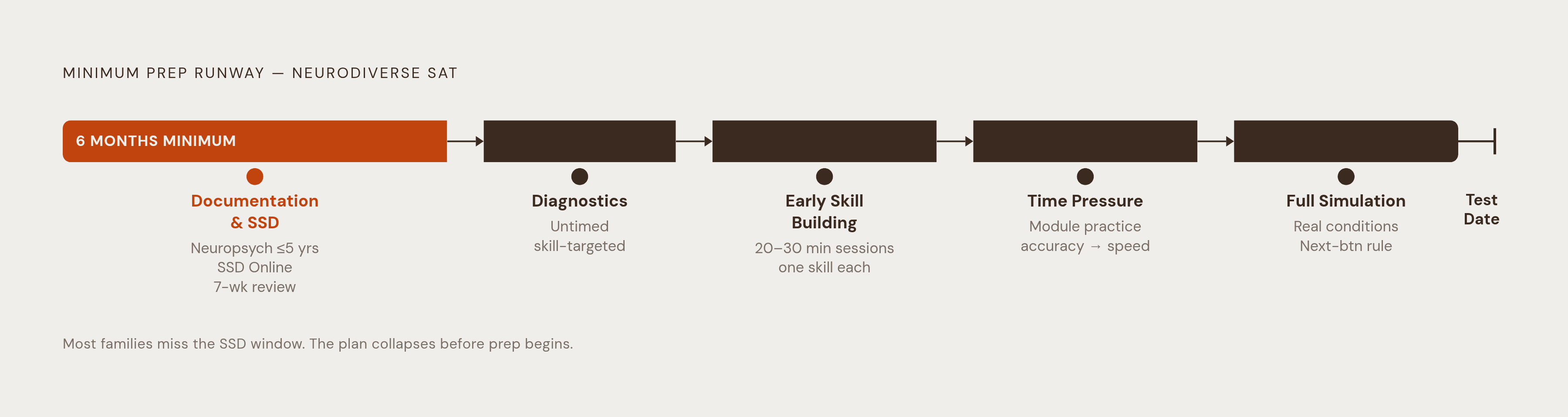
Here's the honest version of this timeline. Not the aspirational one. The one that accounts for documentation lag, evaluation scheduling, and the fact that most families start this later than they should.
Junior year, at least six months before target test date. If documentation isn't current (within five years) or doesn't meet College Board's specific requirements, start the evaluation process now. Not next month. Now. Six months is the minimum buffer when starting from scratch. Coordinate with the school's SSD coordinator early. Understand what College Board requires, not just what the school already has on file.
Once accommodations are approved. Don't wait for a test date to start prep. But don't start with full-length timed practice tests either. Begin with diagnostic work: untimed, skill-targeted, focused on identifying which high-frequency areas need the most work.
Early prep phase: skill building, untimed. Short sessions. Clear goals. One skill area per session. Use the modality that matches how the student will actually test. Text-to-speech for reading practice if that's what test day looks like. Desmos fluency if math is the target. This phase is purely about: do I understand this material?
Mid prep phase: introduce time pressure selectively. Only after accuracy is established on a skill do you add time. Module-by-module practice, not full-length tests. Build familiarity with the pacing constraints without burning out or conflating speed with understanding.
Late prep phase: full-length practice under real conditions. Simulate test day. Same accommodations, same tools, same conditions. The 2025 rule change making the "Next" button inactive until standard time elapses means pacing practice under real conditions isn't optional. Students who haven't practiced pacing will find this disorienting on test day.
Throughout: accountability and feedback. Students who need external structure need it built into the prep timeline, not bolted on after things start slipping. Scheduled check-ins. Progress visibility. Feedback that explains reasoning errors, not just scores.
One thing worth sitting with. The students most likely to benefit from the accommodations and strategies in this piece are also the students least likely to know they exist, or least able to navigate the process on their own. The SSD coordinator, the classroom teacher who flags a student for evaluation early, the parent who starts the documentation process six months out instead of six weeks out — those aren't peripheral players. They're the prep plan.
The test is manageable. The logistics are what actually trip people up.