SAT vs ACT Decision Framework for Students
Pick the test that matches your thinking style, not your gut.

Picking the right test before opening a single prep book gives you a head start. The SAT and ACT are different instruments, and choosing the one that fits your strengths matters more right now than it did a few years ago. A lot of students flip a coin and hope for the best.
That matters more right now than it did a few years ago. Harvard, Yale, Dartmouth, MIT, Stanford, and most of their peer institutions have reinstated score requirements for the 2026–2027 application cycle. Columbia, the last holdout among the Ivies, reversed its test-optional stance in June 2026 and will require scores starting 2027–2028. The domino effect arguably started with Dartmouth's February 2024 announcement, which came paired with research showing test scores actually outperform GPA as a predictor of college academic success. especially for first-generation and low-income applicants.
Now, to be fair: over 90% of ranked four-year colleges in the U.S. are still test-optional for 2026 admissions, and more than 2,000 institutions sit in that camp. UChicago remains test-free. The landscape is split, and it would be wrong to pretend otherwise.
But here is what "test-optional" actually means in practice right now; submitting a strong score is no longer a neutral act. It's an advantage. So the question isn't really whether to test. It's which test to bet on, and why that choice deserves real strategic thought.
The Tests Are Actually Built Differently. That's the Whole Point.
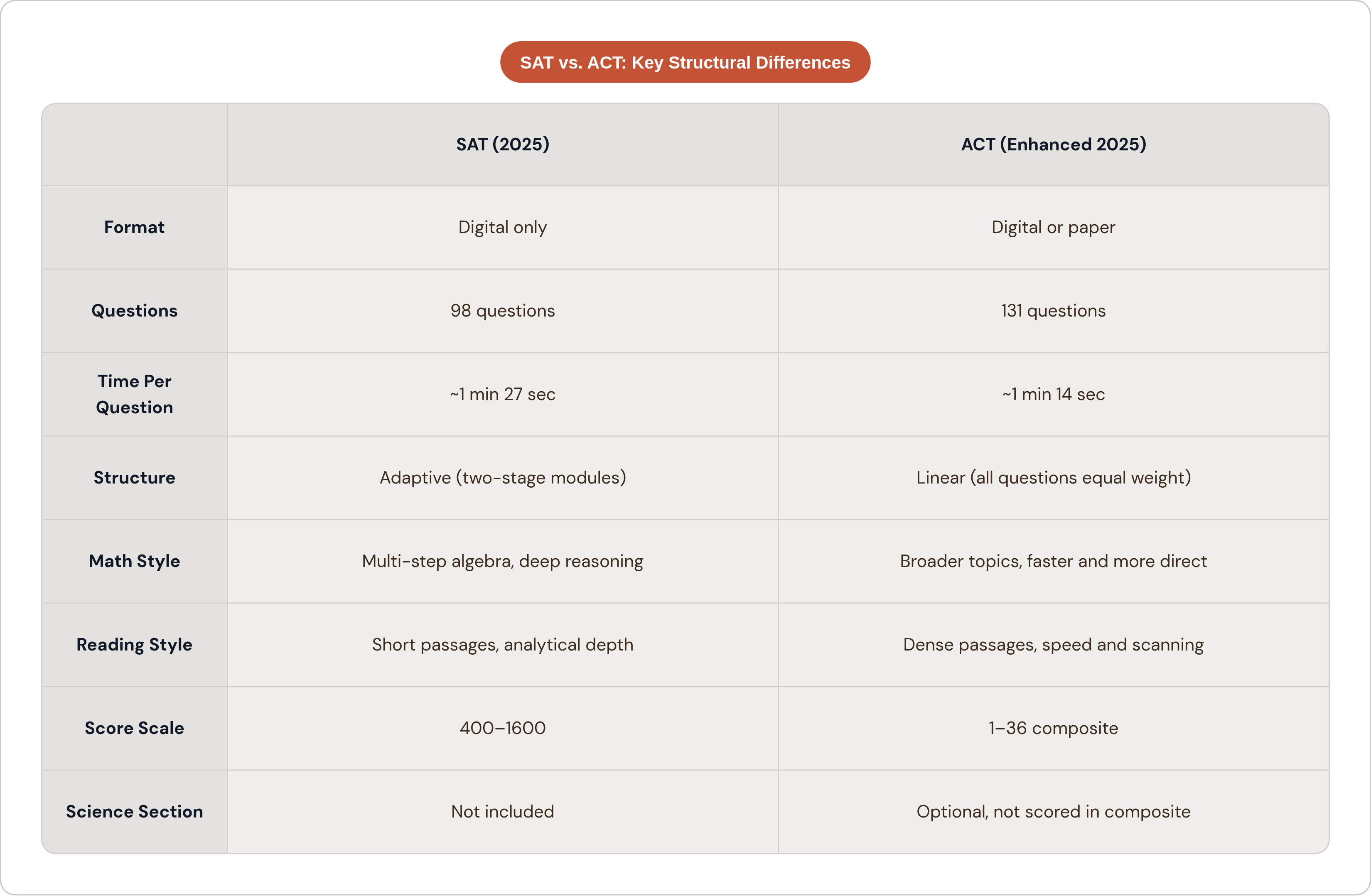
The SAT in 2025 is fully digital, delivered through College Board's Bluebook app. No paper option exists anymore. The test runs about 2 hours and 14 minutes, covers 98 questions, and uses an adaptive structure that a lot of students don't fully understand until it's too late.
Here is how the adaptive piece works. The test has two Reading/Writing stages, then two Math stages. Your performance on the first stage in each subject determines how hard the second stage gets. Do well on module one? The second module gets harder, but your scoring ceiling rises. Struggle on module one? The second module gets easier, but your ceiling drops sharply, even if you recover. That's not a minor wrinkle; it means a rough start isn't just a rough start. It can cap your score for the entire section.
The ACT in 2025 is a different animal. The Enhanced 2025 format runs about 2 hours and 5 minutes for the core test, covers 131 questions, and is available either digitally or on paper. A few things changed in 2025 that are worth knowing:
- The test has 44 fewer questions than the old format.
- Math now has 4 answer choices instead of 5.
- The Science section is now optional and no longer factors into the composite score. Any source telling you otherwise is out of date.
- The new format rolled out on national digital tests in April 2025, paper and international in September 2025, and state/district tests in spring 2026.
The ACT scores on a 1–36 composite. The SAT scores on a 400–1600 scale. Concordance tables exist to compare scores across the two tests. Use them directionally, not as precise conversions. The joint study behind those tables is from 2018, so treat any exact equivalencies with some skepticism.
One more data point worth having: roughly 1.97 million students took the SAT in 2024, compared to about 1.4 million for the ACT; the SAT has the larger national footprint right now.
One Test Rewards Deep Thinking. The Other Rewards Fast Thinking.
This is the part most comparison guides gloss over, and it's actually the most useful distinction.
The SAT was historically positioned as an aptitude test. The ACT has always positioned itself as a test of what you learned in high school. That philosophical difference shows up in the actual questions.
SAT math is algebra-heavy. Questions are multi-step, often requiring you to reason through a setup rather than just execute a procedure. You get a formula sheet and a built-in Desmos graphing calculator for every math question. If you like to think methodically and don't mind working through something with a few moving parts, that structure plays to your strengths.
ACT math covers more ground. Matrices, logarithms, trigonometry, more geometry. But the questions are more direct. Less convoluted. You bring your own calculator (from a restricted list), and you're expected to move faster.
On reading: the SAT's passages are now much shorter, often a single paragraph per question. It rewards careful, analytical reading. The ACT's reading section, along with the optional Science section, asks you to process information quickly. Scanning tables, reading charts, moving through dense passages under real time pressure.
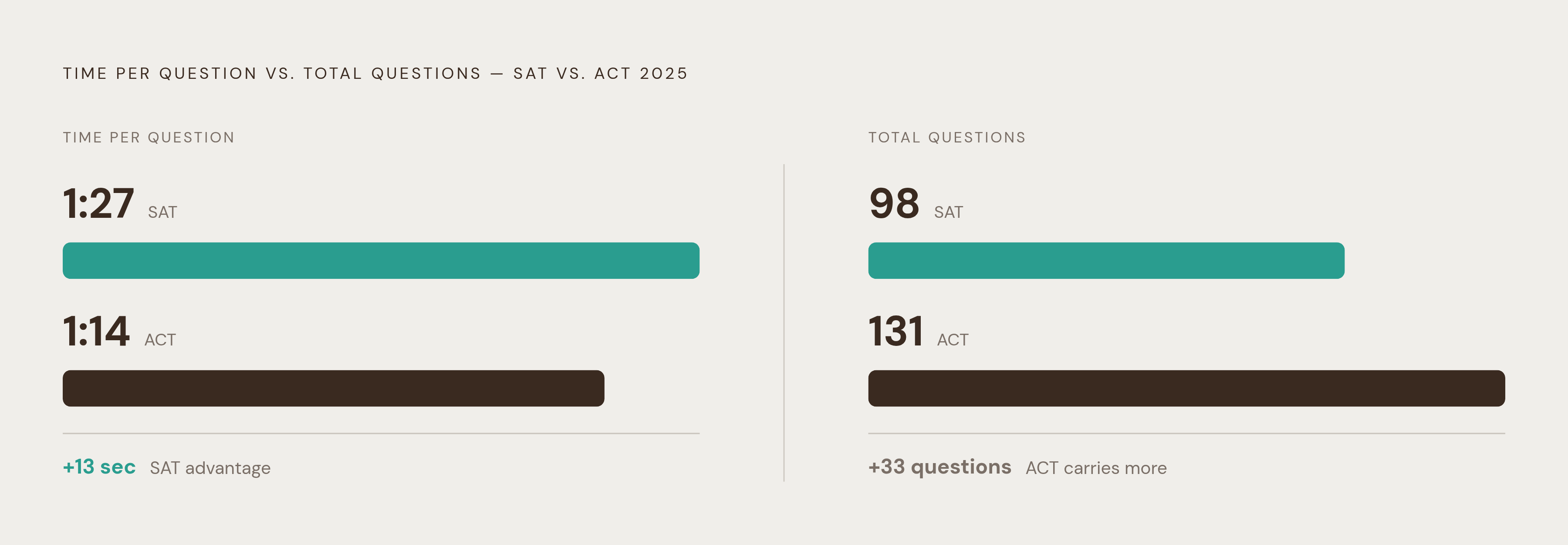
Speaking of time. The SAT averages about 1 minute 27 seconds per question. The Enhanced ACT averages about 1 minute 14 seconds. The 2025 ACT update did close some of the gap by adding roughly 22% more time per question compared to the old format. But the SAT still gives you meaningfully more time per question overall.
One more thing. The ACT is linear. Every question counts equally, and a rough start can be fully recovered. The SAT's adaptive engine means that test anxiety about how you're doing in real time is. actually warranted; the algorithm is watching. Some students perform better knowing they can just grind through without that layer of evaluation happening in the background.
The ACT isn't simply easier. It's faster and broader. The SAT isn't simply harder. It's deeper and more algorithmically unforgiving. Those are different things.
Your Diagnostic Score Tells You More Than Your Gut Does
Here is where I see students make the most avoidable mistake. They pick a test based on a vague sense of what they're good at, or because their friends are taking it, or because they took the SAT once in 9th grade and kind of remember it. That is not a diagnostic; that is vibes.
The steps that actually work:
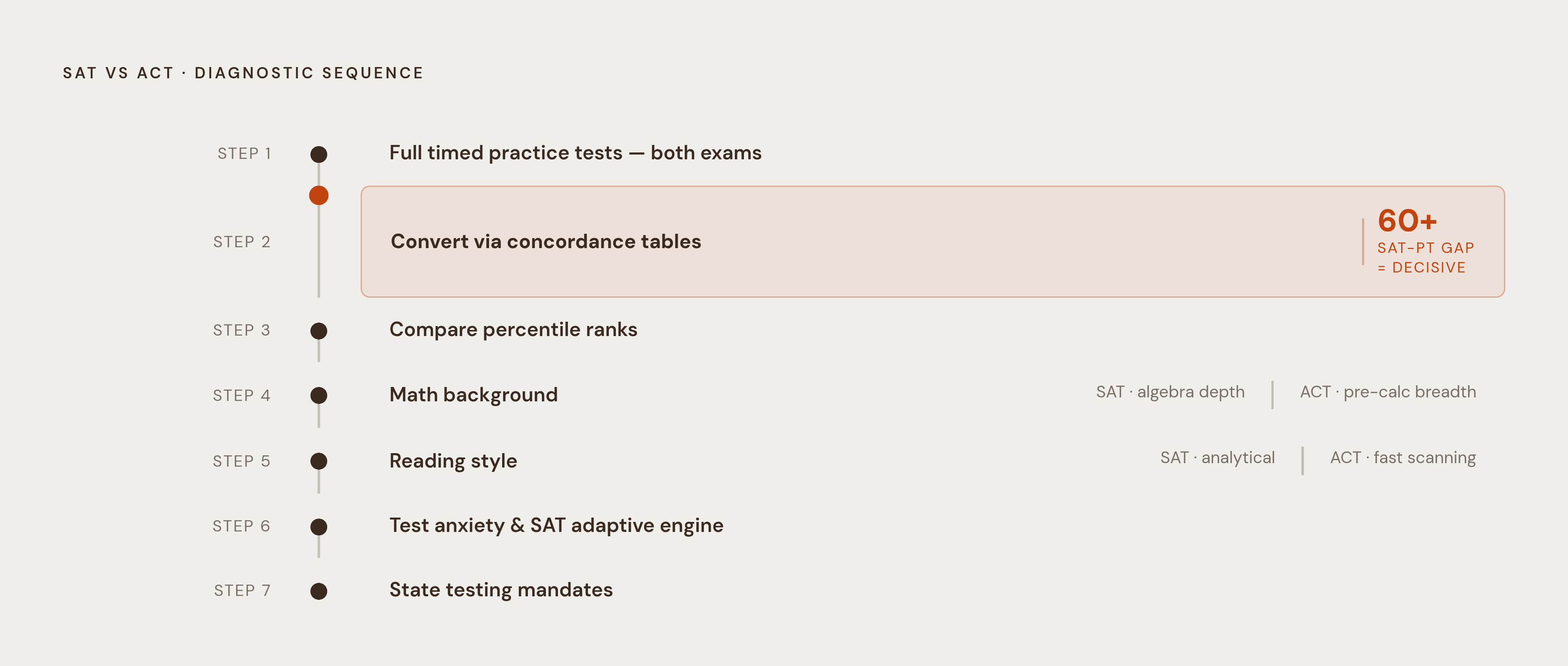
Step 1: Take a full-length timed practice test for both. Under realistic conditions. Quiet room, no phone, real timing. This is non-negotiable. Nothing replaces it.
Step 2: Convert scores using concordance tables and apply a threshold. If one score converts to 60 or more SAT points higher than the other, that test is the clear choice. If scores are close, keep going.
Step 3: Look at percentile rank, not just raw score. An SAT score in the 85th percentile but an ACT score in the 92nd percentile points to the ACT. Even if the raw SAT number looks more impressive on paper.
Step 4: Assess your math background honestly.
- Multi-step algebra, comfortable reasoning through complex setups: SAT math likely fits.
- Solid pre-calc or trig foundation, prefer clean and direct questions: ACT math rewards that.
Step 5: Assess how you actually read.
- Deep, careful, analytical. You don't rush. SAT's shorter passages suit you.
- Fast processor, handles volume, comfortable scanning: ACT plays to that strength.
Step 6: Factor in test anxiety and adaptive structure. If the idea of each question "judging" your performance in real time increases your anxiety, the SAT's adaptive engine is going to be a source of friction. The ACT's linear structure is more forgiving of an uneven rhythm.
Step 7: Check state testing mandates. Many East and West Coast states require in-school SAT testing for juniors. Midwestern states typically mandate the ACT. If your school already requires one, doubling down on that test often makes the most strategic sense.
One last thing on taking both tests: splitting your prep between them almost always dilutes your outcome on each. Focused prep on one test beats divided attention across two.
Junior vs. Sophomore Changes the Whole Game Plan
The stakes of this decision scale with how much time you have left.
Sophomores: Take diagnostic practice tests for both in the spring to get a directional read. But don't start serious structured prep yet. Burnout from starting too early is a real pattern. Begin structured prep the summer before junior year. You have room for multiple test attempts across junior year and into the fall of senior year.
Juniors with the spring 2026 deadline approaching: The timeline is tight, but it's workable.
- Take practice tests for both within the next two weeks.
- Register for a June or August test date.
- Prep through the summer, retake in October or November.
- Most Early Decision deadlines land in November, Regular Decision in January. Scores from an October test date make both.
Early Action and Early Decision applicants should treat October as the last viable test date. That compression makes your initial test selection more consequential, not less; there is no "I'll figure it out and retake the other one."
Regular Decision applicants have a December test date as their practical cutoff.
One path that doesn't get enough attention: Yale, Dartmouth, and Carnegie Mellon allow AP or IB scores in place of SAT/ACT scores. If you've already done well on AP exams, that is a legitimate alternative worth evaluating alongside this whole decision. It doesn't apply everywhere, but where it does, it's real.
Finding the Gap Is Step One. Closing It Is the Actual Work.
Here is a distinction I keep coming back to, because it's where most prep effort gets wasted. Knowing which questions you got wrong is not the same as knowing why you got them wrong. Students who only track wrong answers often end up repracticing the same surface errors without fixing the underlying reasoning gap. The score stays flat. They practice more. Score still flat.
For SAT prep: the College Board and Khan Academy partnership offers Official SAT Practice at no cost, including 7 full-length Bluebook practice tests that score automatically. The data behind this program is worth paying attention to; students who linked their College Board and Khan Academy accounts and studied 20 hours on Official SAT Practice gained an average of 115 points. That was nearly double the gain of students who didn't use it, based on a study of nearly 250,000 test takers. More than 16,000 of those students gained 200 or more points between their PSAT and SAT.
Why does it work? Because linking accounts lets Khan Academy pull your actual PSAT and SAT scores to identify which skill domains need work. It's not self-reported weakness. It's gap detection built on real performance data.
College Board also has a newer feature called Tailored Practice. It generates practice questions based on your performance on real assessments, surfacing the specific skills that need attention before your next test date. Worth using if you haven't looked at it yet.
For ACT prep: ACT's My Answer Key tool provides detailed score reports useful for identifying error patterns. The ACT's prep ecosystem is less tightly integrated than the College Board/Khan Academy pipeline, but the diagnostic information is still there if you use it.
One thing worth naming plainly: private test prep tutoring runs anywhere from $25 to over $150 per hour in 2025, with premium services reaching $250 per hour; free tools with strong gap-detection logic matter, especially for students who can't absorb those costs. The good news is that the free infrastructure for SAT prep in particular is strong right now.
The underlying principle holds regardless of which test you choose. More practice problems without diagnosis is low-leverage work. The students who improve the most are the ones who understand where their thinking breaks down, not just which answer bubbles they filled in wrong.
Pick the right test. Run the actual diagnostic. Then go fix the right things.