SAT Time Management Across Both Sections
Forget the 82-second average—reading and math demand totally different pacing strategies.
There's a number that floats around SAT prep circles like it's gospel: 82 seconds per question. Students hear it, internalize it, and then wonder why they're still running out of time.
Here's the problem; that number is an average across both sections. And averages, as anyone who has coached students through this test will tell you, hide more than they reveal.
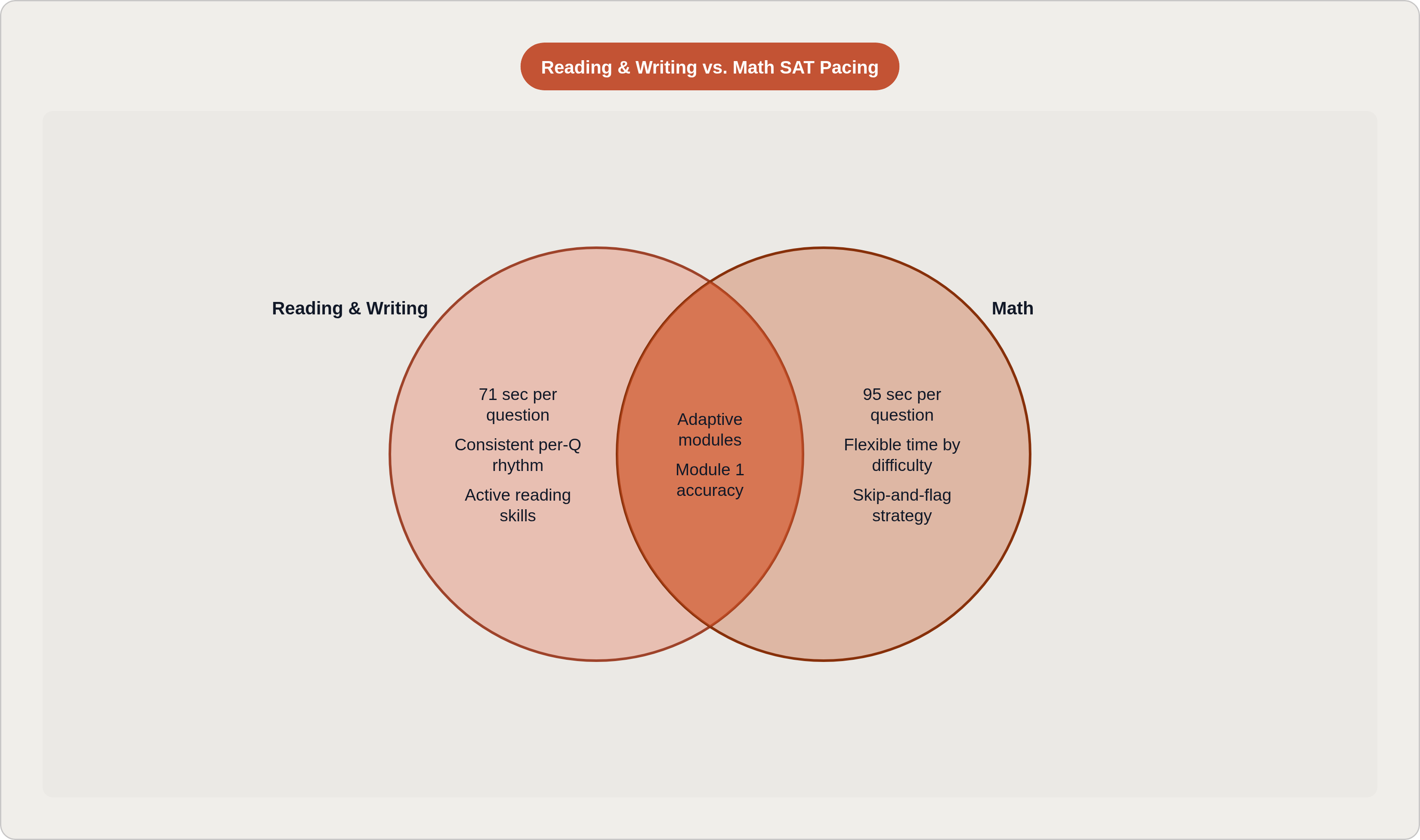
The real numbers: Reading and Writing gives you roughly 71 seconds per question. Math gives you roughly 95. Those sections don't just test different subjects. They test different pacing instincts entirely. A student who cracks both on their own terms stops running out of time. A student who treats the whole test as one undifferentiated clock problem keeps hitting the same wall.
Let's walk through each piece of this.
Accuracy in Module 1 isn't optional. It's the whole ballgame.
The digital SAT is adaptive. That word gets thrown around a lot without anyone explaining what it actually costs you when you ignore it.
Here's how it works; Module 1 of each section is a mix of easy, medium, and hard questions. Your performance in Module 1 determines which version of Module 2 you get, which is the core mechanic of the digital SAT's multistage adaptive testing design. Do well, and you're routed to a harder Module 2. That harder module has a higher score ceiling, meaning the maximum scaled score available to you is determined before Module 2 even begins. Do poorly, and you get an easier Module 2. One that, no matter how perfectly you answer it, cannot get you to the top scores.
So when does this matter for pacing? The moment a student decides to rush Module 1 to "bank time."
Think about the trade-off. You blow through the first module in 25 minutes, pick up a few extra minutes, and make five careless errors in the process. Those errors route you to the easier Module 2. That's not a time management win. That's capping your own score before the second half of the test even starts.
The extra time isn't worth it; in Module 1, accuracy is the variable that matters most. Speed is a distant second.
Both sections share this adaptive structure. But what "accurate and deliberate" actually looks like is different in Reading and Writing versus Math. That's where the section-specific stuff comes in.
Reading and Writing pacing: building a consistent per-question rhythm
If you prepped for the old SAT, forget everything you knew about long reading passages. The digital Reading and Writing section is almost nothing like it.
Most passages are 25 to 150 words. One passage, one question. That's the unit. There are no five-question passage sets where you build momentum over several reads. Every question is its own standalone encounter.
That changes the pacing math entirely. Because every question has roughly the same shape, a consistent rhythm is actually achievable. The target: spend about 30 to 45 seconds answering after you read, and don't let any single passage-and-question unit run past roughly 70 seconds before you move on.
Why does that rhythm work? A few reasons.
Questions within each skill domain are ordered from least to most difficult, a within-domain difficulty progression that holds across both Reading and Writing and Math. That means the early questions in a module genuinely are easier. A student who burns 90 seconds on question 3 out of habit is spending premium time on a question that should have been a 40-second solve. Those seconds compound.
Finishing early questions quickly builds a buffer. That buffer is what you spend on the harder questions that show up later. The math is simple: hustle on the front end, breathe on the back end.
But there's a catch. None of this works if you're a passive reader. Passive reading, the kind where you absorb the passage and then let the question tell you what mattered, is the single biggest time drain in this section. Active reading is faster. Underline the key claim. Predict what the question is probably testing before you look at the answer choices. You'll spend less time second-guessing yourself on the back end.
One small tool worth mentioning: digital annotation in the Bluebook app persists when you flag and return to a question. Highlight the line that contains your answer before you move on. When you come back, you don't re-read from the top. You go straight to the mark.
Reading and Writing traps that break rhythm: what to watch and avoid
Consistent rhythm sounds straightforward until you're actually inside a module. Then it falls apart in predictable ways.
The most common culprit is second-guessing grammar and usage answers. A student reads a sentence correction question, often an Expression of Ideas or Standard English Conventions item, picks an answer, and then spends another 30 seconds talking themselves out of it. Usually they end up back where they started, having spent double the time. First instincts on Expression of Ideas questions are right more often than students think. Revising them rarely improves accuracy. It almost always costs time.
The second trap is re-reading full passages when only a detail is needed. A specific-detail question does not require a full re-read. Skim the first and last sentence of each paragraph to orient yourself, then locate the relevant line. Restarting from the top every time is a habit, not a strategy.
Third, and this one's subtle: treating every question as equally uncertain. Difficulty is ordered. Question 1 is easier than question 25. That's by design. Students who bring the same level of scrutiny to both are misallocating energy. Early questions deserve confidence, not caution.
One more: over-annotating. Highlights are useful as anchors, not as notes. If you're marking up a passage to record your thoughts rather than to flag where the answer lives, you're using the tool against yourself.
The corrective isn't to speed up across the board. It's to save deliberate, slower processing for the questions that actually earn it.
Math pacing: allocating time flexibly by question type and difficulty
Math is a different animal. The questions don't have the same shape. An early arithmetic problem and a late word problem involving systems of equations are not remotely comparable in terms of how long they should take. Applying a uniform per-question budget here is a mistake.
The 95-second average is a planning tool, not a per-question timer. Use it to check your module-level position roughly every 10 questions. At that point, ask: how much time is left, and how many questions remain? That ratio is what you're managing.
Within those intervals, let difficulty drive the clock. Early algebra and arithmetic questions can often be answered in under a minute. The hard problems at the end of a module may legitimately need three or more minutes. That's fine, as long as you've banked time earlier to cover it.
Here's the practical version of that; a student who moves efficiently through the first half of a Math module has two or three minutes of real runway for a hard problem at the end. A student who spent four minutes on question 3 doesn't. Same content knowledge. Completely different outcome.
One thing that does help here: the calculator is available throughout, including Desmos. The old no-calculator section forced time pressure from arithmetic, and students who use Desmos actively for graphing and checking equations recover that time in bulk. That pressure is mostly gone now. The bottleneck is problem-solving strategy, not computation. Students who know their question types cold, especially algebra and advanced math, which make up the largest share of Math questions per College Board's own domain breakdown, move through the early and middle sections faster almost automatically.
The skip-and-flag decision in Math: when to move on and when to stay
There is no penalty for wrong answers on the SAT. Every question is worth one point. A blank is strictly worse than a guess.
That rule should change how students think about hard problems, but it often doesn't. Students who haven't practiced flagging sit on a difficult problem for four or five minutes, work through it, maybe get it right. Meanwhile, two or three questions they would have answered correctly sit untouched at the end of the module.
Here's the decision rule, and it's not complicated; if you've read a problem and can't identify a method within about 60 seconds, flag it, mark your best guess, and move on. Return if you finish with time left. Don't return if you don't.
Why 60 seconds? Because that's long enough to recognize the question type and sketch an approach, but short enough that you haven't spent meaningful time on a problem you might not solve. It's also long enough to make a semi-educated guess rather than a random one.
Hard questions cluster at the end of each module. Students who have never practiced the skip-and-flag habit almost always run out of time at exactly that moment. It's predictable. And it's entirely trainable.
Flagging isn't surrendering. It's the same logic that drives triage in every high-stakes environment: spend your budget where it earns the most.
Using the built-in timer without letting it become a distraction
The Bluebook app gives you a countdown clock. You can show it or hide it. Students almost universally leave it visible. And then a meaningful portion of them check it constantly.
Checking the timer every few minutes does not improve pacing; it does reliably increase anxiety, without any offsetting accuracy benefit.
The smarter approach: check at natural checkpoints. In a 27-question Reading and Writing module, that's roughly every nine or ten questions. Three checks total. Beginning, middle, final stretch. In a 22-question Math module, similar. Every 10 questions or so.
At each checkpoint, the question isn't "how much time is left?" The question is: how much time is left relative to how many questions remain? "14 minutes, 9 questions left" is actionable. You know you have room. "14 minutes" by itself tells you nothing without the question count.
The deeper point here is about trust. Students who have done real timed practice don't need the clock to tell them how they're doing. They've felt what 32 minutes of Reading and Writing feels like. They know when they're ahead and when they're behind without checking every two minutes. The clock should confirm pace. It should not drive it.
How practicing under timed conditions surfaces pacing problems that content review misses
Here's something worth sitting with; the average SAT score for the class of 2025 was 1029 (Reading and Writing: 521, Math: 508). Those numbers are notably below 2019 averages of 531 and 528, respectively, on the same 200-to-800 scaled score range. That's a real gap, and it suggests a lot of students are leaving points on the table even when they know the content.
That raises a question worth examining. Is the gap a content problem, or a pacing problem? And how would a student even know the difference?
Consider this scenario. A student answers 20 out of 22 Math questions correctly but leaves 2 blank because time ran out. On paper, that looks like a time management problem. But what actually caused the time problem? It might be a content issue; one question type consistently takes longer than others because the student's approach is inefficient, not because the student can't do the math.
Untimed practice cannot show you this. It can tell you whether you know the content. It cannot tell you where your time breaks down. Passionfruit Learning, for instance, is an AI-powered AP and SAT exam-prep platform that uses performance analytics to surface not just what students get wrong but patterns in how they work through practice questions.
Timed, module-length practice does; thirty-two minutes, 27 questions. Thirty-five minutes, 22 questions. Full module, start to finish. When you do that, the pacing decisions happen in real time. You have to decide whether to flag a problem. You have to decide how long to sit with a hard question. You find out, concretely, where the back half of a module starts to feel rushed.
And then there's the review. Most students review a timed set by looking at wrong answers. That's useful, but it's incomplete. The review that surfaces pacing problems looks at correct answers that took too long, questions that got skipped and never returned to, and patterns in where the module fell apart. Late-module rushes. Specific question types that eat time. A particular skill domain where the reading is slower than average.
That kind of review turns "I ran out of time" from a vague complaint into a specific, trainable gap. And specific, trainable gaps are exactly the kind of problem that prep actually solves.