Why Timed SAT Practice Alone Does Not Build Mastery
Untimed review of errors, not more timed tests, builds lasting improvement.

Let me start with a confession: I spent years watching students do the exact same thing and expecting different results.
They'd take a practice test, get a score, feel either relieved or panicked, and then schedule another practice test.
Rinse, repeat, and wonder why they scored 80 points lower on test day.
The instinct makes sense. More tests feel like more preparation. They simulate test day, produce a score, and create a tangible sense of momentum. There's something deeply satisfying about finishing a four-hour practice test. It feels like you did something.
But here's the problem worth sitting with: a timed practice test, on its own, is a diagnostic tool. It tells you where you are. It does not move you anywhere. And somewhere along the way, students and parents started confusing the measuring stick with the workout.
So if timed practice isn't enough on its own, what does mastery actually require? That's the question this whole article is trying to answer.
Why Practice Scores and Real SAT Scores Often Diverge
Tutors report this pattern constantly. A student averaging a 1,350 on practice tests walks out of the real SAT with a 1,200. Sometimes even lower.
Why does this keep happening?
A few reasons, and they stack on top of each other.
First, at-home practice conditions are softer than they feel. Students can set their own pace, re-read questions without the quiet dread of a clock running, and take the test in a familiar environment without 30 other people in the room. Those conditions inflate scores in ways that don't show up until test day.
Second, the Digital SAT's adaptive structure introduces a dynamic that flat timed practice simply doesn't train for. Here's how it works: your performance on the first module determines which version of the second module you receive, a design rooted in item response theory. Perform well, and you get harder questions. Only students who reach the harder second module can earn the highest scores. This means a student drilling the same practice questions over and over isn't just building familiarity; they may be training for the wrong module entirely.
A concrete example of this showed up in March 2024, when the College Board completed its full transition to the digital format. Students who had prepared almost exclusively using the four official Bluebook practice tests ran into novel question presentations they weren't equipped to handle. The sample set was too small and too rigid. Format familiarity had masqueraded as readiness, right up until it didn't.
The conditions of practice matter as much as the content. A full-length, distraction-free, no-retake session under real timing will produce a score that meaningfully predicts test day. A casual Sunday afternoon run-through will not.
What the Digital SAT Format Actually Demands from Test-Takers
By 2024, nearly 70% of the more than 1.7 million students who sat for the SAT chose the digital version. This isn't a future transition anymore. It's the current reality.
The multistage adaptive testing structure changes what preparation needs to look like. A student who has only memorized a small pool of question patterns is in trouble, because the test is specifically designed to reward flexibility. Novel presentations. Unfamiliar contexts. Concepts you recognize but haven't seen framed quite that way before.
This is also worth considering about the Bluebook explanations the College Board provides. They cover the answer. They walk through the solution. But they don't go deep enough on the underlying concept to help a student recognize the same idea when it shows up wearing different clothes. Students who treat those explanations as the final word are building on sand.
The test, at its core, is punishing gap-ridden preparation and rewarding real understanding. That's not a flaw in the design. It's the whole point.
The Difference Between a Content Gap, a Process Error, and a Careless Mistake
Here's something that changed how I think about practice test review entirely.
A timed test without error analysis, sometimes called post-test item review, is a score. A timed test with error analysis is a map.
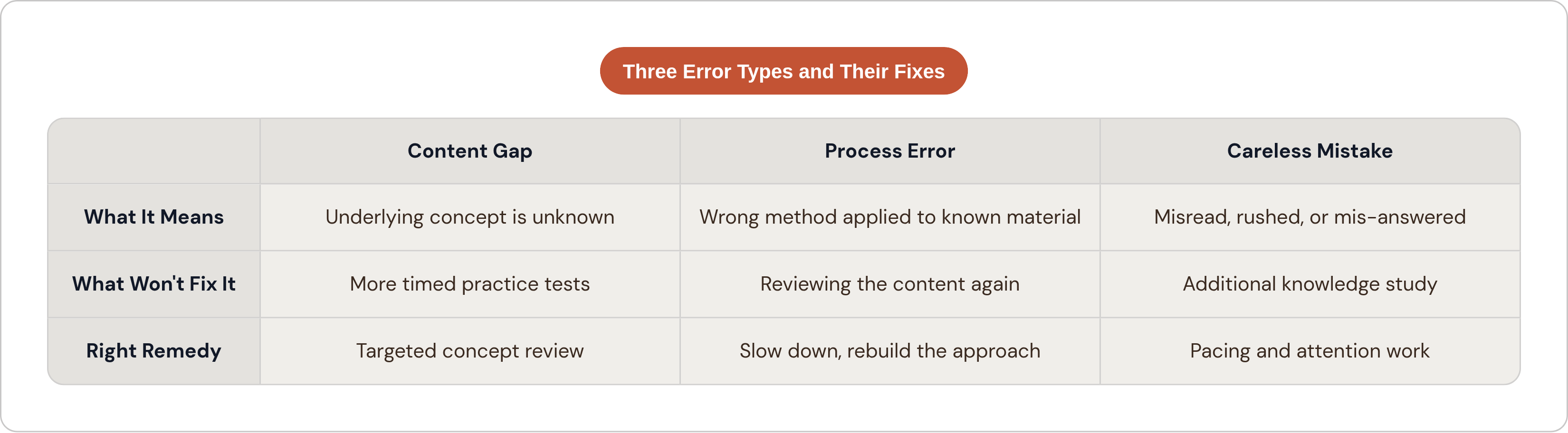
There are three meaningfully different kinds of errors, and each one requires a different fix:
- Content gap. The student simply doesn't know the underlying concept. More timed practice won't fix this. Targeted concept review will.
- Process error. The student knows the material but applied the wrong method. The fix here isn't reviewing the content. It's slowing down and rebuilding the approach from scratch.
- Careless mistake. Misread the question, rushed, bubbled the wrong answer. This isn't a knowledge problem. It's a pacing and attention problem.
Why does this distinction matter so much? Because students who don't make it end up applying the wrong remedy. They study vocabulary when they actually need to work on timing. They drill more problems when they actually need to slow down and rethink their method on a specific problem type.
High-improvers don't just log what they got wrong. They log why. Not "I missed this geometry problem" but "I keep setting up the relationship between the variables incorrectly before I even start solving." That level of specificity is what separates a 1,200 from a 1,400. It's rarely the raw knowledge. It's the quality of the review system sitting behind the practice.
Why Untimed Practice Is Not Optional. It Is Where Understanding Actually Forms.
Bloom's mastery learning framework, developed in the late 1960s, made a point that still holds up: learners need to reach a defined standard of understanding before moving on. The time it takes is irrelevant. Accuracy is the gate, not speed.
Practitioners in the SAT prep world have landed on a practical version of this threshold. Somewhere around 80 to 85 percent accuracy on a problem set, untimed, is the point where introducing time pressure actually makes sense. Below that threshold, timing doesn't convert accuracy into fluency. It just adds pressure on top of confusion.
Untimed reworking of every missed problem, line by line, is where a student moves from "I got this wrong" to "I understand where my thinking broke down."
A structure that works: take a full-length timed test as a diagnostic baseline. Then spend most of your time on untimed, section-by-section practice until the next timed diagnostic. The timed test exposes. The untimed work explains, which is what formative assessment is actually designed to do.
But what if a student just keeps doing timed tests instead? Cognitive science gives us a name for what happens. Massed practice, cramming many timed tests together in a short window, creates an overconfidence effect. The fluency of repeating similar problems feels like mastery. It isn't. Gains built that way tend not to hold.
How Spaced Repetition and Retrieval Practice Do What Timed Drills Cannot
Let's talk about two things that sound academic but are practical.
Spaced repetition means distributing your study of a concept across multiple sessions over time, rather than concentrating it in one sitting, and it works best when combined with interleaved practice across different skill areas. The research on this is consistent: spaced practice dramatically improves long-term retention compared to cramming, even when the total hours spent are identical. Same input. Better output.
Retrieval practice means actively pulling information out of your memory rather than passively re-reading Students using active recall methods retain dramatically more material than those who re-read notes or re-watch explanations, two forms of passive review that share the same weaknesses as massed practice. That gap translates directly into score differences.
One available figure puts it plainly: active recall can improve test scores by up to 20%. And if you look at the retention numbers across studies, students using retrieval practice hold onto roughly twice the material compared to passive review.
Here's the implication for SAT prep. A student who reviews a missed concept once after a timed test and never returns to it is very likely to miss the same concept again three weeks later. Deliberate re-retrieval across sessions is what moves knowledge from "I sort of remember seeing this" to durable, usable memory.
Timed tests measure retrieval under pressure. They don't create retrieval conditions. Only one of those builds the skill.
What the Research on Study Hours and Score Gains Actually Shows
The largest available study on this comes from a 2017 collaboration between Khan Academy and the College Board. The numbers are specific enough to be worth knowing.
Students who spent six hours on Official SAT Practice on Khan Academy gained an average of 90 points. Students who spent 20 hours gained an average of 115 points, with some students exceeding 200-point gains. These results held consistently across race, income, sex, ethnicity, high school GPA, and parental education level. That's a meaningful finding. The gains weren't limited to already-advantaged students.
More broadly, practitioners report that 80 to 100 hours of quality practice can produce improvements in the range of 200 points. But cramming 150-plus hours into a single month runs a real risk of burnout and diminishing returns.
The variable that drove gains wasn't raw hours. It was deliberate, targeted practice. Students who identified specific weaknesses and addressed them outperformed students who simply accumulated test volume.
That raises an important question the data doesn't fully answer: were the hours spent on untimed gap-filling equally weighted to the hours spent on timed tests in producing those gains? We don't know with certainty. But given everything else in this article, it seems worth asking.
What a Real Improvement Plan Looks Like After a Practice Test
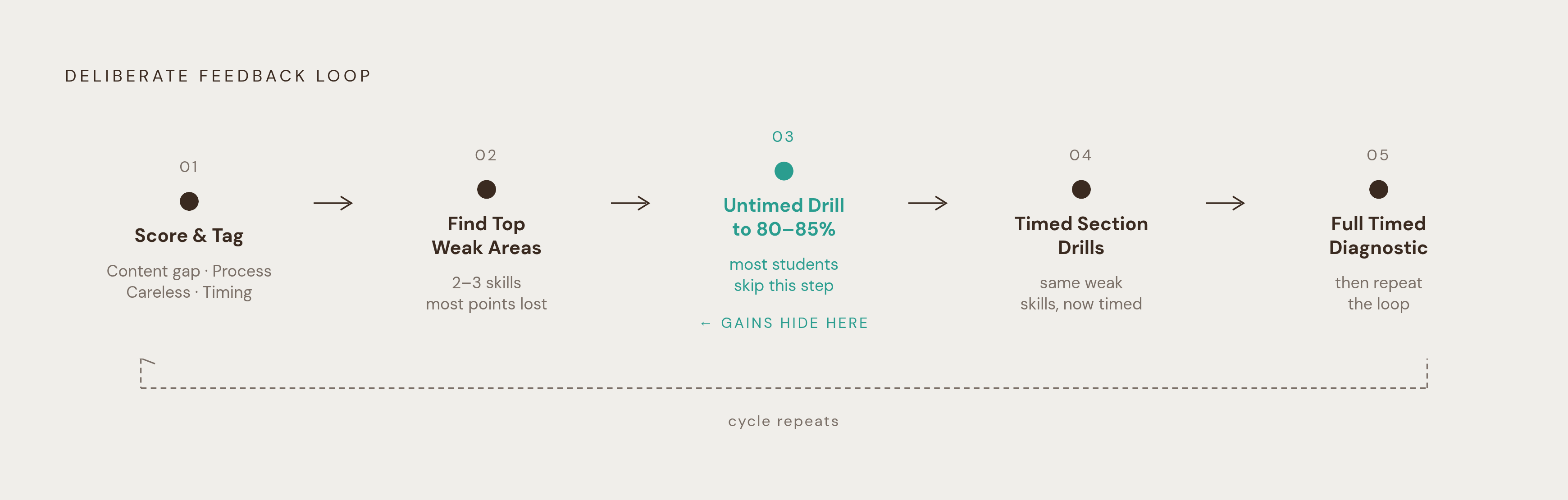
Here's a practical structure, not a theory.
- Score the test, then tag every wrong answer by error type. Content gap. Process error. Careless mistake. Timing issue. Don't let any wrong answer leave the page without a label.
- Identify the two or three skill areas producing the most point loss. Be specific enough to act on. "Systems of equations" or "interpreting exponential functions" or "circle geometry." Not "I need more math."
- Untimed targeted drill on those specific areas until accuracy reaches the 80 to 85 percent threshold. This step is where most students skip straight to step four and wonder why nothing improves.
- Introduce timed section-level drills on those same skills. Now timing converts accuracy into fluency, which is what it's actually designed to do.
- Take the next full-length timed diagnostic and repeat the categorization. Did the previously identified gaps actually close? If not, the untimed work wasn't deep enough, or the error type was misidentified.
The test is a feedback loop. Without the review cycle sitting behind it, each practice test is a standalone event. And a stack of standalone events is not a preparation system.
Where AI-Powered Tools and Teacher Feedback Change What's Possible at Scale
Here's the classroom reality that doesn't get talked about enough.
Providing real, formative feedback to an entire class requires collecting, analyzing, and responding to each student's individual work. That's hard to do consistently. A 2024 RAND survey of K-12 educators found that inconsistent access to formative assessment tools forces many teachers into paper-based workflows, which delays feedback until weekly or biweekly grading cycles. By that point, students have mentally moved on.
Teachers spend up to 13 hours per week grading. Weekly users of AI grading tools, according to a 2025 Gallup study, save nearly six hours per week. That time shifts toward instruction, student conversations, and the targeted intervention that actually moves scores.
What AI does well here is specific. It applies rubrics consistently and surfaces error patterns across an entire class, so a teacher can see not just individual gaps but shared misconceptions. That kind of signal is what drives an instructional pivot rather than just a regrade.
What AI doesn't do is replace the teacher's judgment. Borderline cases, contextual decisions, the instructional moves that reach a specific student in a specific moment all stay human. The best version of this is a clear division of labor: AI handles consistent pattern detection at scale, teachers handle everything that requires judgment and relationship.
Digital tools that tag student responses to specific skills, the way AP Classroom does for AP exams, make it possible to connect individual errors to exact knowledge gaps rather than treating a wrong answer as a single undifferentiated data point. That's the direction the field is moving, and it's worth understanding why.
Why Knowing What You Got Wrong Is Not the Same as Knowing Why You Got It Wrong
A score report tells you what you missed.
It does not tell you where your thinking broke down. It does not tell you what understanding is missing underneath the wrong answer. It does not tell you whether the error was a knowledge problem, a method problem, or an attention problem.
The gap between "I missed three geometry questions" and "I don't understand how to set up the relationship between arc length and central angle" is the gap between format familiarity and conceptual mastery.
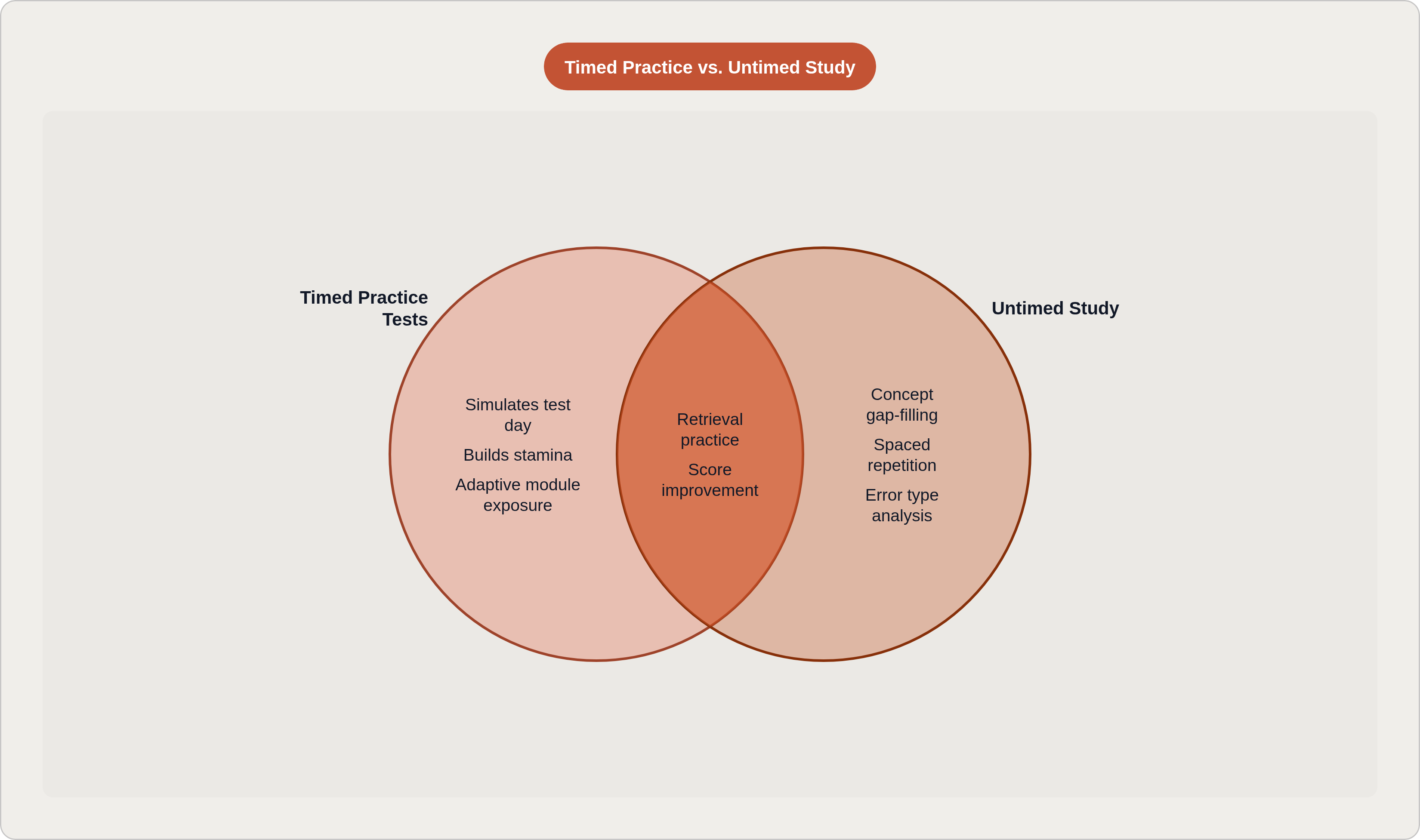
Timed practice is a necessary input. It builds stamina, pacing discipline, and real-condition readiness. But it is a diagnostic instrument, not a teaching method. Treating it as both is where preparation goes sideways.
The students who improve the most are not the ones who took the most practice tests. They are the ones who built a deliberate feedback loop: test, categorize, review deeply, target gaps, retest. That cycle, done with care, is what mastery actually looks like.
Knowing what you got wrong feels like progress. Knowing why your thinking broke down at that specific moment is progress. The distance between those two things is where most students live, and it's also where most of the score gains are hiding.