Building a Personalized SAT Study Plan
How the adaptive digital SAT restructures what students should prioritize.

The SAT went fully digital in the US in March 2024. By the Class of 2025, 97% of test takers sat the digital version. If you're prepping now, this is the test you're prepping for. That part's simple.
What's less obvious is how the structure of this test should change the way you study.
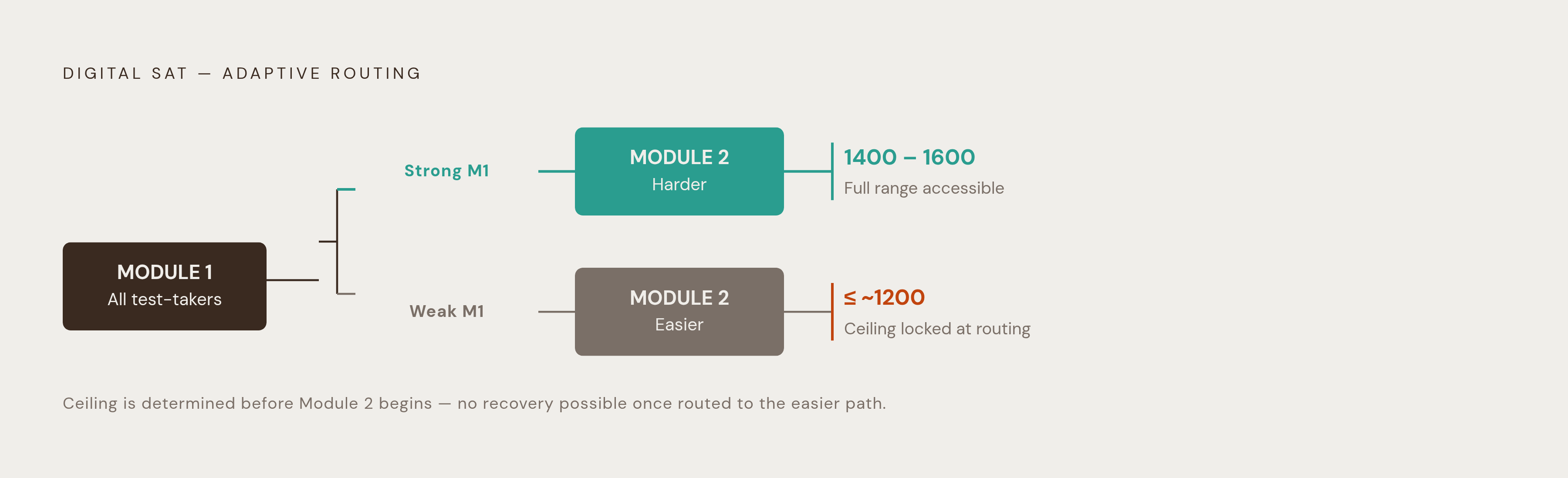
Each section (Reading & Writing, and Math) is split into two modules, a structure known as multistage adaptive testing. How you perform on Module 1 determines which version of Module 2 you get. Do well on Module 1 and you're routed to the harder Module 2, which is the only path to the highest possible scores. Struggle on Module 1 and you get the easier Module 2, which caps your score ceiling before the second half even starts.
So Module 1 accuracy isn't just important. It's disproportionately important in a way most students don't account for. A gap that costs you three or four questions in Module 1 doesn't just drag down that section's score. It locks you out of a higher scoring ceiling entirely. You're on a different road — like taking an exit ramp when you meant to stay on the highway, and wondering why the destination looks wrong.
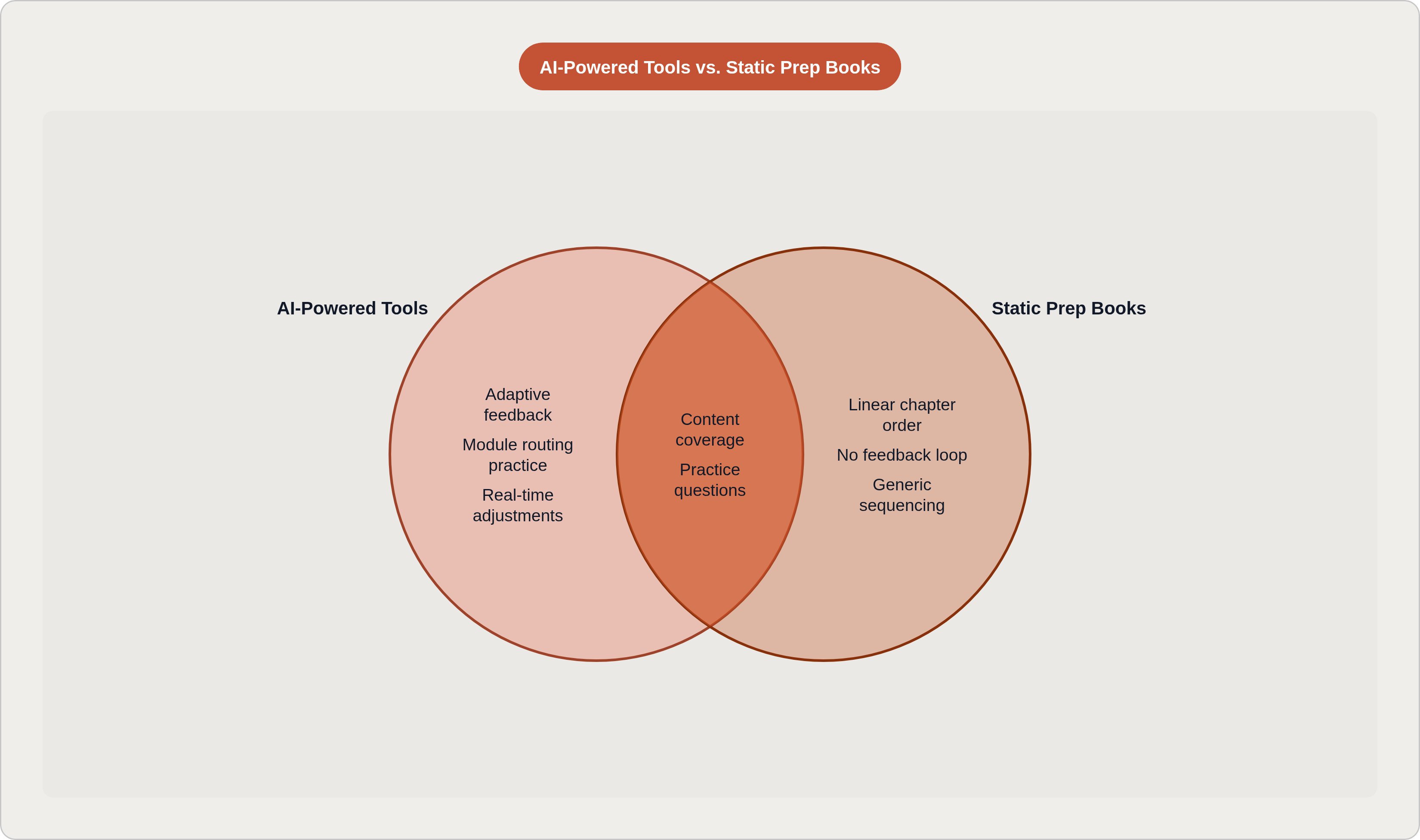
That's why prep books that move chapter by chapter, treating every question as roughly equal, don't map well to this test. The digital SAT has a hierarchy. Certain question types show up in Module 1 more than others, and closing those gaps first is a different strategic priority than what most linear prep materials suggest.
The structure of the test is actually telling you where to focus. Most students just don't know how to read it.
Taking a Diagnostic Test Before Doing Anything Else
The most common mistake I see is also the most understandable one. Student buys a prep book, opens to chapter one, and starts working. Chapter one might be linear equations. Maybe they know linear equations cold. Doesn't matter. Chapter one is chapter one.
That's not a study plan. That's just doing stuff. Without a diagnostic, every hour of prep is a guess dressed up as a plan.
A diagnostic test is the data-collection step that makes every hour after it more efficient. You could be grinding through content you already know while your actual gaps sit untouched.
The gold standard is a full-length official practice test, timed, phone away, taken on a weekend morning when your brain is fresh. That gives you a real baseline score. Some adaptive platforms can run a shorter diagnostic (around 20 questions) and still produce a solid estimate of your ability level and a map of your skill gaps, as long as the diagnostic mirrors the adaptive logic of the real test rather than just pulling questions at random.
Either way, the diagnostic reveals two things:
- Where your current score actually sits relative to your target
- Which specific skill areas are dragging that number down
One more thing worth doing before you start formal prep: pull out old school math and English tests. If you struggled through the quadratics unit in Algebra II, there's a real chance quadratics will show up as a gap on your diagnostic too. Classroom performance isn't a perfect predictor, but it's useful supplementary data, and it's already sitting in a drawer somewhere.
Without all of this, students default to reviewing what they already know. That is the single most common way SAT prep time gets wasted.
Setting a Realistic Target Score and Understanding What the Gap Actually Requires
This part makes people uncomfortable, because it requires being clear about two things at once: where you actually are and where you actually need to be. Both matter, and they have to be in conversation with each other.
Start with research. Look up the average SAT scores at the schools you're targeting, then aim slightly above those averages. You want a margin. Squeaking in at the exact cutoff isn't a strategy; it's a gamble.
A rough orientation for context:
- 1350 and above puts you in roughly the top 10% of test takers
- 1200–1400 is the competitive SAT score range many state universities and military academies are looking for
- 1450–1600 is where Ivy League and top-tier schools tend to concentrate
One thing worth flagging: as of the 2025–2026 cycle, most Ivy League schools have brought standardized testing requirements back. Only Columbia, Princeton, and Cornell remain test-optional at this point. If your plan was to skip the SAT entirely, that window is narrowing.
Once you know your target, the gap size tells you how much time you actually need. Students looking at 200 or more points of improvement are best served by a six-month plan. Trying to close a 200-point gap in four weeks isn't ambitious. It's a setup for disappointment — the test prep equivalent of cramming for a marathon the night before the race.
But here's the part most students skip entirely: naming the gap precisely. "I need to improve in Math" isn't actionable. "I need 80 more points in Math, and based on my diagnostic, most of that is in algebra and data analysis" is. That second version gives you something you can actually build a schedule around. Vague goals produce vague results, and a vague goal also gives you a very easy excuse not to show up.
Reading Your Diagnostic Results as a Map, Not a Score
The number the diagnostic produces is not the point. The pattern underneath it is.
When you review a diagnostic, the question for every wrong answer isn't just "what topic was this?" It's "what actually went wrong?" That distinction is the whole point of error analysis. Those are different questions, and the answers lead to very different fixes.
A few usual suspects:
- Misreading the question. You knew the material but answered the wrong thing.
- Weak underlying skill. You don't know this concept well enough yet.
- Careless execution. You knew how to do it but made a small error somewhere in the work.
- Unfamiliar format. The question type threw you off, even if the underlying concept was there.
Each of those requires a different response. Drilling more practice problems addresses the second one. It doesn't really touch the first or the third. Students who lump all four together and just "do more practice" tend to plateau fast.
There's also a prioritization question here. Not all gaps are equal. A gap in a question type that appears repeatedly in Module 1 is a higher priority than a gap confined to the hardest questions at the end of Module 2. Fix the high-frequency, high-impact gaps first. Everything else waits.
The output of this step should be a ranked list of three to five specific gaps. Not "I'm weak in Reading." Something closer to: "I consistently miss inference questions about the purpose of a paragraph, and I'm losing points on data interpretation graphs in the Math section." That list becomes the spine of everything you do next.
Building a Weekly Schedule Around Your Gap List, Not Around the Test's Table of Contents
This is where most plans fall apart, and usually for a reason that sounds completely reasonable in the moment.
The instinct is to start with the easy stuff. Get some wins, build momentum, then tackle the hard gaps. It sounds sensible. It's also backwards.
Your highest-priority gaps go first. They get the most sessions. They don't get saved for later once you've "warmed up." By the time you get to them in that scenario, you've already burned weeks on material you mostly knew.
Some practical structure that actually works:
- Daily practice: 30–60 minutes, focused on your gap list, ideally with an adaptive tool that adjusts to your performance in real time
- For every hour of practice, budget 30 minutes of review. This is the step most students cut. Every wrong answer is data. Treat it that way.
- Full-length adaptive practice tests every two to three weeks. These serve a different function than daily drilling. They show you whether your gap work is transferring to real test conditions, and whether you're actually getting routed to the harder Module 2.
The schedule should also shift as you get closer to test day. Early weeks are focused on gap closure. Final weeks shift toward full-length simulation and pacing. You don't want to be opening new content areas two weeks out. You want to be confirming that the gaps you already closed are staying closed.
A schedule built around the test's table of contents treats you like a generic student who needs the same thing in the same order as everyone else. You aren't that student, and your prep shouldn't pretend otherwise.
How AI-Powered Tools Accelerate Gap Closure Compared to Static Prep Books
Let's be direct about what AI-powered prep does well, and where it tends not to deliver.
According to the College Board's Digital SAT Impact Report from January 2026, students who used AI-adaptive SAT prep tools in 2025 scored an average of 90 points higher than those using traditional static practice books. That's a real gap, and the reason for it isn't mysterious.
It comes down to feedback speed. When you get a question wrong in an adaptive platform, it flags the error immediately. You see the mistake while the question is still fresh. That compression of the feedback loop is where a lot of the learning actually happens, and a textbook simply cannot do that.
Khan Academy is worth calling out specifically. It's the only officially College Board-partnered free SAT prep platform, and the data behind it is real. Studying 20 hours on Official SAT Practice through Khan Academy is associated with an average gain of 115 points. The platform runs a 30-minute adaptive diagnostic, generates a study schedule, and focuses your drilling on your two to three weakest areas per session. For a free tool, it does a lot of the right things.
Third-party adaptive platforms go further in some cases, mimicking the College Board's adaptive module logic so you're not just drilling content but actually practicing the test's routing structure.
That said, there are real limitations here. AI-generated questions sometimes mimic SAT style without actually testing the reasoning the College Board is measuring. A student can build real confidence working through those questions and then get surprised on test day. Verify that the platform you're using draws from official or officially-aligned content.
There are also things AI cannot reliably do. It can't coach your pacing mid-session. It can't catch the specific pattern of careless errors that shows up when you're stressed and tired. It cannot hold you accountable when you decide to skip a study day. That part is still on you.
AI accelerates the process. It doesn't replace a student who's actually engaged with it.
Adjusting the Plan as New Data Comes In
A study plan is a hypothesis, not a contract. It should update when new evidence comes in.
Every practice test, every drill session, every review pass produces new data. A gap you had four weeks ago might be essentially closed now. A new pattern of errors might be emerging that wasn't visible at the start. If the plan doesn't reflect that, you're not really preparing. You're just executing a document.
One specific trigger to watch for: if a targeted gap hasn't improved after two solid weeks of focused work, something deeper is going on. That's not a signal to drill harder. It's a signal to stop and ask whether you actually understand the underlying concept, or whether you've been repeating practice problems without internalizing why the answers work. Those are two very different problems, and only one of them gets fixed by doing more problems.
There's also the regression trap. Students close a gap, feel good about it, and drop it from rotation. Then test day arrives and the gains have faded. Cycling back to previously weak areas at increasing intervals, even after they feel solid, is spaced repetition in practice, and it's what converts short-term improvement into something durable. Dropping something from rotation too early can quietly undo weeks of work.
Two to three weeks before test day, shift gears entirely. Stop opening new content areas. Move the focus to full-length simulation and timing. The goal at that point is confirming that everything you've worked on transfers under real conditions, not adding more material to the pile.
The students who hit their target scores are rarely the ones who logged the most hours. They're the ones who kept asking what the data said was still broken, and kept pointing their effort there.