Knowledge Gap Detection in Classroom Settings
Four gap types demand different fixes, and gradebooks can't tell them apart.
There's a moment every teacher knows. You get the unit test back, you scan the scores, and you think: okay, a third of my class missed question seven. And then what? You know that they missed it. You don't yet know why. And those are two completely different problems.
That gap between "got it wrong" and "here's where the thinking actually broke down" is what knowledge gap detection is really about. The gradebook shows you the former. Getting to the latter requires something else entirely.
What "knowledge gap detection" actually means in a classroom, versus in theory
In theory, it sounds clean. Identify what students don't know, fix it. Done.
In practice, a low score can mean at least three different things, each of which demands a completely different response:
- A foundational concept was never fully understood in the first place
- The concept was understood but fell apart under time pressure
- The student actually knows the material but misread the question type
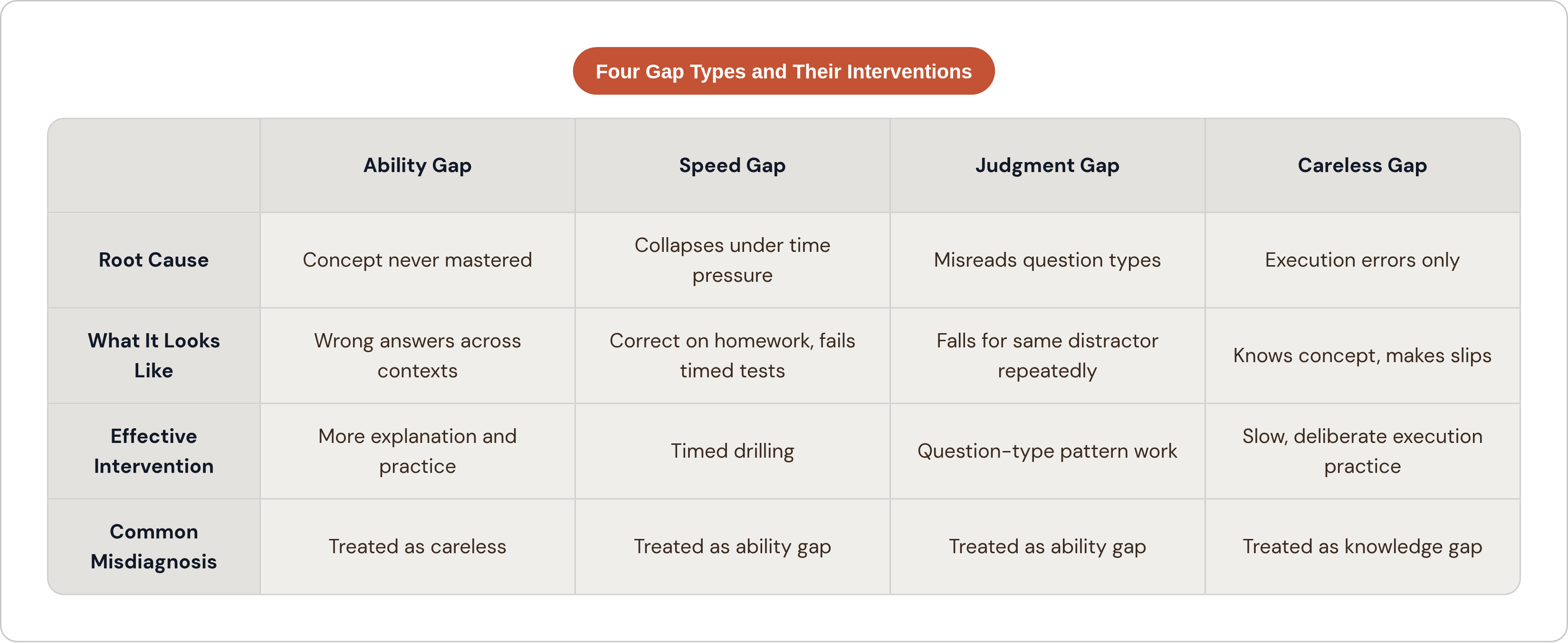
That third one is sneaky. A student who understands conditional probability but consistently falls for the same distractor pattern doesn't have a knowledge gap. They have a judgment gap. Drilling more probability problems won't help them. But that's often exactly what teachers assign, because the gradebook doesn't tell you which kind of gap you're dealing with.
This taxonomy is borrowed from SAT prep research, but it applies cleanly to any AP classroom:
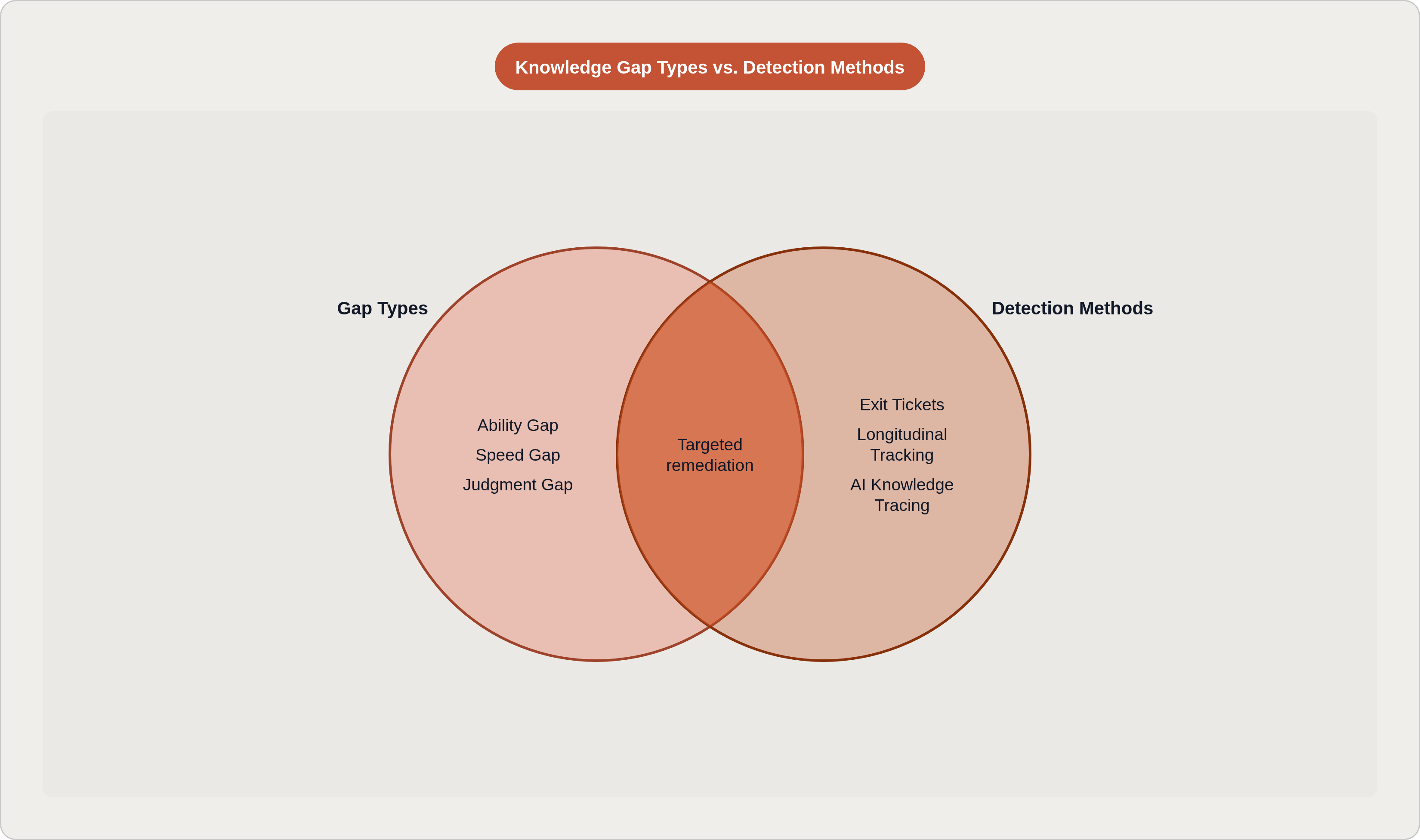
- Ability gap: the concept was never mastered
- Speed gap: the student knows it, but collapses under time pressure
- Judgment gap: the student knows the material but consistently misreads question types
- Careless gap: execution errors with no connection to conceptual understanding
Why does this matter so much? Because the intervention for an ability gap (more practice, more explanation) does nothing for a judgment gap, and the intervention for a speed gap (timed drilling) can actually backfire on a student who's careless under pressure.
A working definition, then: knowledge gap detection isn't just flagging that a student struggles with a topic. It's identifying which specific concept or reasoning step is missing, and understanding how that missing piece connects to what comes next in the curriculum.
That second part is the one most people skip. Knowledge isn't a flat list of topics. It's a structure. Concepts build on other concepts. Gaps don't sit in isolation. They sit at junctions, quietly blocking everything downstream.
This is especially consequential in AP courses, where every class assumes prior mastery. AP Chemistry assumes algebra and stoichiometry. AP US History assumes students can construct a written argument. A weak baseline doesn't stay contained. It compounds across the year, often without anyone naming it until exam season. By then, you're not closing a gap. You're doing damage control.
College Board research puts a number on what that looks like at scale: the gap in AP exam pass rates between white and Black and Latino students, which runs roughly 17 to 30 percentage points depending on the subject, is nearly fully explained by differences in prior academic preparation. AP-level gaps are symptoms of gaps formed years earlier. The structural implication is hard to ignore. Waiting for exam results to surface these gaps is, by definition, too late.
The methods teachers currently use to surface gaps before assessments
The honest answer is that good teachers have been doing informal gap detection for decades. They just don't always call it that.
Exit tickets. Cold-call questions designed to probe reasoning, not just recall. Think-alouds where the teacher listens for where the logic breaks. Low-stakes quizzes mapped to prerequisite concepts, not just current unit material.
These work. They catch common, predictable misconceptions, the ones experienced teachers have seen enough times to recognize on sight. A veteran AP Chemistry teacher doesn't need a dashboard to know that students reliably confuse molar mass with molecular mass. They've seen it a hundred times.
But there's a real distinction between checking for understanding and detecting a gap. Checking for understanding confirms a surface answer. Gap detection probes the reasoning behind it. One tells you whether a student got to the right place. The other tells you how they got there, or where they took a wrong turn.
What formative methods miss:
- Idiosyncratic gaps: the student who understands 80% of a concept but has one specific step inverted
- Unknown unknowns: gaps the student themselves doesn't know they have
That second category is the hardest to catch. A student who doesn't know what they don't know can't ask the right question. They'll sit through a lesson, feel fine, and then hit an exam problem that requires the exact piece they're missing.
There's also a bandwidth problem, and it's worth naming directly. A teacher with 30 students and 50-minute periods has limited diagnostic depth per student per week. Even excellent formative practice is hard to sustain at that ratio. You can run a sharp exit ticket on Monday and have no realistic way to individually follow up on the 11 different misconceptions it surfaces by Friday.
How tracking performance over time reveals patterns a single assessment cannot
A student who misses one stoichiometry problem may have had a bad day. A student who misses every problem involving unit conversion has a specific, mappable gap. The difference between those two situations is invisible on a single assessment. It only becomes visible over time.
This is the core argument for longitudinal tracking over snapshot testing. Tracking performance across multiple assignments and mapping it against curriculum concepts lets you see things a unit test never could:
- Gaps that appear to close after an intervention but re-emerge when the same concept appears in a new context
- Prerequisite gaps that were never addressed and quietly constrain every subsequent unit
- Students whose overall average looks fine but who have one deep gap in a load-bearing concept
That last one is particularly common and particularly dangerous. A student sitting at a B+ average can have a foundational gap that will crater them on the AP exam. The average masks it. Longitudinal concept-level data surfaces it.
The AP Physics 1 results from 2025 are worth pausing on. Pass rates jumped to 66%, up from 47% previously. That kind of shift doesn't happen by accident, and it points toward what targeted, concept-level preparation can actually produce when it's applied consistently. It's a proof of concept at scale.
The practical obstacle is real, though. Maintaining longitudinal, concept-level records across a class of 30 students is nearly impossible to do manually. This is the point where workflow and tools stop being optional and start being the limiting factor.
Where AI-assisted detection adds value teachers' own workflows can't easily reach
Here's what AI can do that a teacher with a gradebook and good instincts genuinely cannot.
It can analyze large volumes of student responses at the concept level simultaneously. It can surface which concept is tripping up most students across the whole class at once, not just which students are struggling overall. It can flag gaps in real time, during the learning process, rather than after an assessment surfaces them.
One research framework worth knowing about: a multi-agent LLM approach that detects knowledge gaps in large-scale learning environments by analyzing students' chat logs with AI assistants. What's notable isn't the technology. It's the data source. Student-AI dialogue captures spontaneous gaps, the ones that emerge naturally when a student is trying to work through a problem, rather than waiting for a teacher-initiated check. That's a different kind of evidence than a quiz score.
The underlying science here is called knowledge tracing. The basic idea is modeling a student's mastery of specific knowledge points by analyzing their problem-solving history over time. More than thirty deep learning models now exist for this task, across multiple architectural approaches. It's a real and growing field.
But it has real limitations worth naming. Current systems still need extensive interaction records to model knowledge states accurately. A new student, or one who engages infrequently with the platform, is harder to diagnose. The data sparsity problem is genuine. And most current systems predict numerical performance rather than generating the explanatory feedback teachers actually need to act on.
K-12 teacher AI adoption climbed from 25% to 53% between the 2023-24 and 2024-25 school years, per RAND Corporation. That's a meaningful shift. But adoption of AI tools is not the same as using them for gap detection specifically. Most AI tools teachers encounter automate grading or flag wrong answers. That's useful. It's not the same as identifying which concept failed and why.
That distinction is the one worth holding onto.
What teachers can do with gap data once they have it — and what gets in the way
So let's say you've run the formative checks, you've got the data, and you know that 14 of your 30 students have a shaky grasp of conditional probability. Now what?
You still have a 50-minute period that's already scheduled. You still have a pacing guide. You still have 16 other students who don't have that gap and are waiting to move forward.
This is where gap detection work often stalls. Not because the detection failed, but because the intervention structure wasn't built before the data arrived.
Three intervention levels, with honest feasibility constraints:
- Whole-class re-teaching: appropriate when the gap is widespread, but it costs instructional time and it's imprecise for students whose gap is specific
- Small-group targeted instruction: more precise, but requires organizing students by gap type rather than overall performance, which most gradebooks don't support
- Individual targeted practice with feedback: most precise, and only scalable if a tool can deliver differentiated problems and feedback without the teacher managing each student separately
One question most systems leave vague is worth making explicit: when does a gap count as closed? This sounds like a minor procedural question, but it isn't. Without a defined threshold, "closed" tends to mean "the student got a few right answers." That's not the same as mastery. One principled approach worth naming sets something like 80% accuracy on standard problems, then 70% on harder variants, before marking a skill complete. The specific numbers matter less than the principle: define the threshold before remediation starts, not after.
The re-emergence problem is real and underappreciated. Gaps that appear closed under familiar problem formats often resurface when the same concept appears in a new context. Real closure requires varied application. Repeated drilling on the same problem type can produce the appearance of closure without the substance.
Structural obstacles teachers actually name:
- Gap data that lives in a platform but doesn't connect to lesson planning
- Intervention time that exists in theory but gets crowded out by pacing requirements
- Students who can't accurately self-report where they're stuck
That third one loops back to the unknown unknowns problem. A student who doesn't know what they don't know will tell you they're fine. They'll believe it.
Research on adaptive learning systems suggests they can reduce learning time significantly while improving outcomes compared to traditional instruction. The consistent caveat in that literature is teacher training and equitable technology access. The tool alone isn't the intervention. The workflow around it is.
Tools teachers are actually using for knowledge gap detection and targeted practice in 2025–26
Before naming tools, it's worth naming the criteria that actually matter. Because "AI-powered" is doing a lot of heavy lifting right now and doesn't mean much on its own.
Questions worth asking of any tool:
- Does it identify gaps at the concept level, or just flag wrong answers?
- Does it give students and teachers explanatory feedback, not just scores?
- Does it track gaps longitudinally across weeks, or only session by session?
- Does it support the teacher's intervention workflow, or just generate reports?
A few categories worth understanding:
AI grading tools (broad category) reduce teacher load on written and multiple-choice work. Useful. But grading speed is not gap diagnosis. Knowing faster that a student got something wrong doesn't tell you why.
Adaptive practice platforms adjust difficulty based on performance. They track partial knowledge, but vary widely in whether they surface the concept behind a wrong answer or just escalate difficulty. Harder problems are not the same as targeted remediation.
Passionfruit is built specifically for AP subjects and the SAT, which matters because those curricula have explicit prerequisite structures that generic platforms don't map. The design is oriented not just toward logging what a student got wrong, but toward understanding what the student actually knows, where their thinking breaks down, and what's standing between them and mastery. It supports both individual students working independently and teachers or schools looking to close gaps at the classroom level. The distinction between recording errors and diagnosing understanding is explicit in how it's built.
The equity dimension here isn't abstract. Traditional tutoring that delivers this kind of diagnostic depth costs real money, and a significant share of students don't have access to it. Only about 25% of low-income students take AP courses, compared to roughly 60% of middle-class and higher-income students. AI-powered tools that deliver similar diagnostic depth at a fraction of the cost change that access equation. But only if the tool is actually doing diagnosis, not just grading faster.
How teachers can build a gap-detection workflow that actually closes gaps, not just records them

The core design principle: detection and intervention have to be part of the same loop. A workflow that surfaces gaps but doesn't connect to a next instructional step produces reports, not results.
Here's a practical loop structure that holds up in real classrooms:
Step 1. Map the prerequisite structure before you teach the unit. Know which concepts are load-bearing. Know which gaps, if unaddressed, will quietly constrain everything that follows. This doesn't require software. It requires thinking through the curriculum the way a skilled teacher already does, just making it explicit.
Step 2. Design formative checks around the gap taxonomy, not just right/wrong scoring. An exit ticket that tells you a student got it wrong is less useful than one designed to distinguish an ability gap from a judgment gap. The question design is the detection work.
Step 3. Assign practice that generates longitudinal data. Session scores tell you how a student did today. Concept-level data tracked across weeks tells you whether a gap closed or just went quiet.
Step 4. Define what "closed" means before remediation starts. A mastery threshold set in advance is a different thing than a gradebook average reviewed afterward. The former is an intervention target. The latter is a record.
Step 5. Review aggregate class-level gap data weekly, not just before unit tests. Patterns across 30 students often point to a teaching gap as much as a learning gap. If 20 students have the same misconception, that's information about instruction, not just about learning.
The teacher's role doesn't shrink in this workflow. It sharpens. AI surfaces patterns. The teacher interprets them in the context of a specific student's history and designs the actual response.
The SAT parallel is instructive here for AP teachers. Diagnostic-driven prep that skips already-mastered material and concentrates on actual gaps can save students more than 100 hours of unnecessary review. The same logic applies to classroom remediation, where instructional time is the scarcest resource in the building. Every hour spent re-teaching something a student already knows is an hour not spent closing an actual gap.
The goal isn't a more detailed error log. It's a shorter distance between where a student's understanding is right now and where it needs to be. The workflow only works if every step, from detection to practice to feedback, is oriented toward closing that distance. Not documenting it. Closing it.