How AI Grading Works in Student Assessment
AI grading runs full rubrics consistently, surfacing specific gaps human fatigue often misses.
Think of a rubric not as a grading guide but as source code. When a teacher uploads one to an AI grading system, the model maps each student submission against each criterion, one by one, and produces a score and explanation for each. Every time. No gut-check shortcuts, no "I've been reading these for three hours and they're all starting to blur together."
That last part is actually the real departure from how rubrics function in most classrooms. In practice, a rubric gets glanced at once or twice before collapsing into a holistic impression. AI grading runs the full checklist on submission one and submission two hundred with identical attention. Whether that's better depends entirely on the quality of the checklist.
The output is criterion-level feedback, not just a total. A student doesn't see "24 out of 30" and spend twenty minutes wondering where those four points went. They see: strong on evidence, weak on analysis, claim not clearly stated. Systems like CoGrader go further, showing the reasoning behind each score and routing every grade through the teacher before students see anything. The human review is built into the structure, not bolted on as an afterthought.
So here's the thing. Rubric quality determines output quality, almost perfectly. A criterion that says "student demonstrates understanding" gives the model almost nothing to grip. A criterion that says "student explains how the evidence supports the central claim and addresses at least one counterargument" gives it something real to work against. The AI is only as precise as the instructions it's running on. Which means if your rubric is vague, you haven't automated grading. You've automated vagueness.
For AP and SAT prep, that precision gap becomes a real problem. A rubric that approximates AP scoring logic, rather than replicating it, produces feedback that doesn't quite match what the exam actually rewards. The effect is subtle but compounds. Students practice against the wrong target and don't find out until test day.
Some platforms, EssayGrader being one, maintain libraries of rubrics aligned to CCSS, AP, IB, and state frameworks, so teachers aren't starting from scratch. That matters more than almost any other feature. Get the rubric wrong and everything downstream is wrong with it.
The accuracy picture: where AI grading performs reliably and where it doesn't
Research puts rubric-based essay scoring accuracy at roughly 95 to 97 percent agreement with expert human graders on the same rubric. That number sounds reassuring until you actually think about what it means at scale.
A 3 to 5 percent error rate across a school district, across a year of formative assessments, across a testing cohort. The question isn't whether the error exists. It's whether it matters for what the grading is being used for.
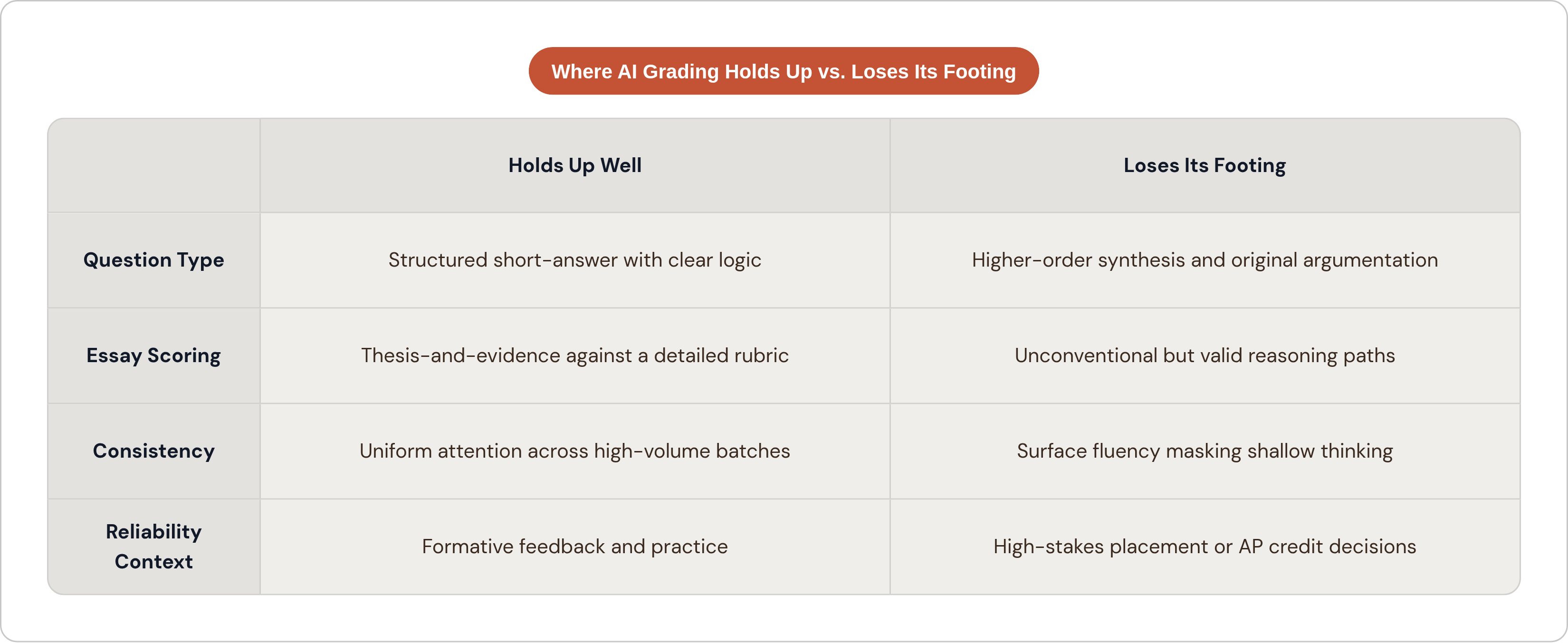
Where AI grading holds up well:
- Structured short-answer questions with clear correct or incorrect logic. Rule-based systems shine here.
- Thesis-and-evidence essays graded against a detailed, specific rubric. When the rubric is tight and the model has seen similar responses, agreement with human graders is high.
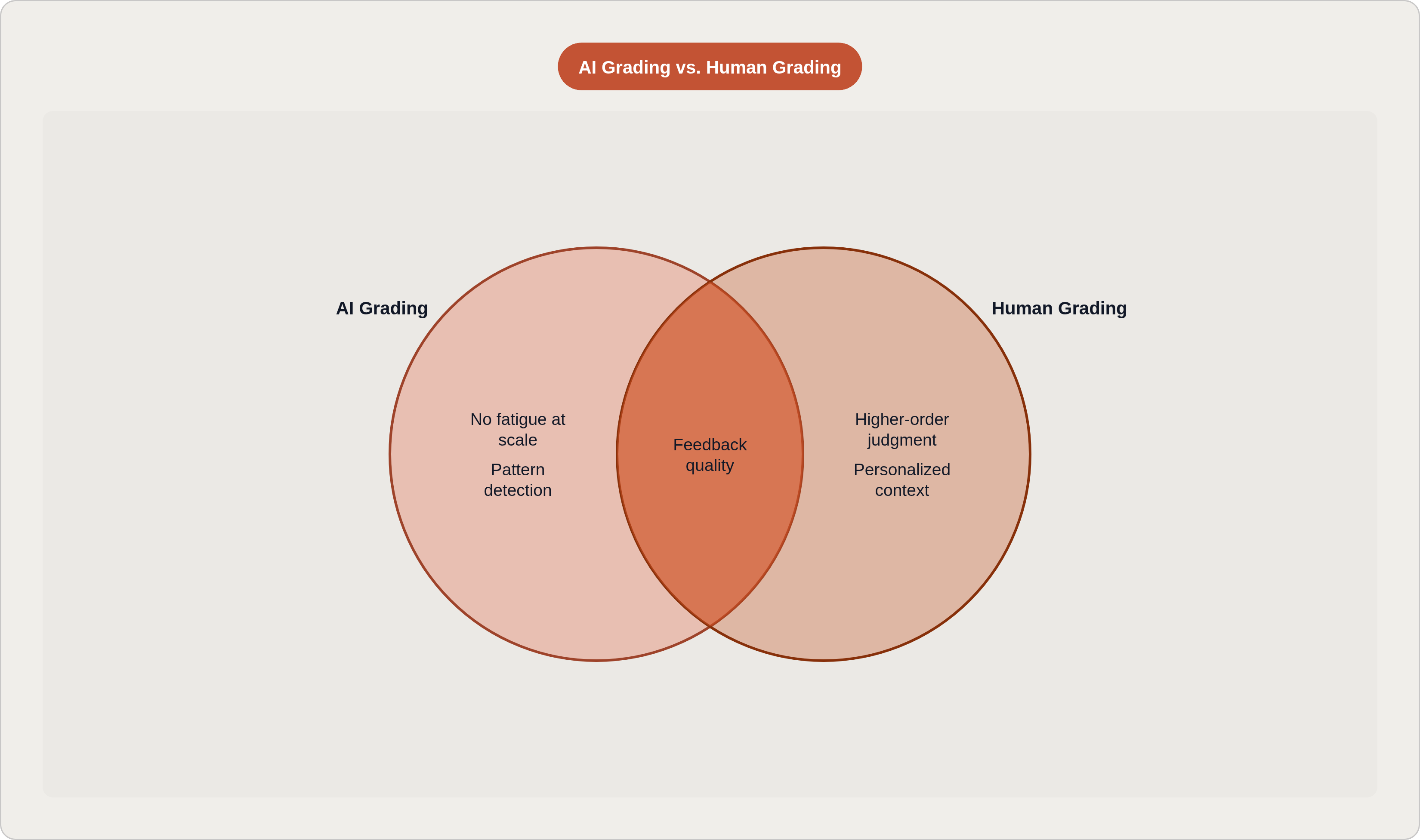
- Large-volume consistency. A human grader's reliability degrades across time and volume. The 200th essay gets different attention than the first. AI grading doesn't fatigue, which sounds like a small thing until you're the student who submitted 197th.
Where it loses its footing:
- Higher-order skills. Evaluating synthesis, original argumentation, and analytical depth is a different problem than detecting whether an argument is present. The model can find the argument. Whether it's any good is harder.
- Unconventional but valid reasoning. A student who arrives at a sound conclusion through an unexpected route may not match any trained pattern. The response gets penalized not for being wrong, but for being unfamiliar. That's a real problem.
- Surface fluency masking shallow thinking. A well-constructed sentence is not a well-reasoned argument. AI systems can have real trouble telling the difference.
The high-stakes caveat is worth naming directly. A 3 to 5 percent error margin that's perfectly acceptable for formative practice becomes a different kind of problem when a score affects college placement or AP credit. The accuracy picture shifts considerably depending on what the grade is actually for.
What AI grading reveals about student reasoning that a score alone cannot
A score tells you how a student performed. That's it. It tells you nothing about where the thinking went sideways or what would actually fix it.
Done well, AI grading can surface something more useful: which part of the reasoning broke down, and in what specific way. That's different information with a different kind of use.
Here's what it looks like when it's actually working.
A student scores low on the "analysis" criterion across five consecutive submissions. Not once as a fluke. Repeatedly. That's not noise. That's a pattern, and it's exactly the kind of pattern a single score buries completely.
Another student provides evidence in every essay but connects it back to the thesis rarely or inconsistently. The argument has all the parts but none of the logic. An NLP-based structural analysis can flag that specifically, rather than folding it into a vague "needs more analysis" deduction that means nothing to the student trying to fix it.
A third student misreads the prompt and answers a different question. Some systems can begin to distinguish between concept confusion (the student doesn't understand the idea) and expression confusion (the student understood but misread what was being asked). These are completely different problems with completely different fixes. A score collapses them into the same deduction.
The University of Arizona framed it this way: the goal is grading thinking, not just text.
For students, feedback that names the actual gap is actionable in a way that a number rarely is. "Your evidence selection is strong, but your analysis doesn't connect back to the thesis" gives someone a specific thing to do. "14 out of 20" does not.
For teachers, the same logic applies at the class level. When a significant portion of students miss the same criterion on the same assignment, that's a teaching signal. The content may need to be revisited. The teacher is now working from data rather than intuition. Those are not the same thing.
Worth keeping in mind, though: AI grading reads written output. It cannot observe the thinking that produced that output. The patterns it surfaces are patterns in text, not direct windows into understanding. Inference, not mind-reading. The distinction matters when the feedback starts feeling authoritative.
How AI grading feeds into knowledge gap detection and personalized practice
The loop is supposed to work like this. AI grades a response, identifies weak concepts or skills, routes the student to targeted practice, re-assesses, and adjusts. Clean, efficient, responsive. The question is whether it actually plays out that way.
Engagement data offers one signal. Students on AI-personalized platforms reportedly reached a 91 percent lesson completion rate compared to 72 percent on traditional platforms. A 19-point gap. The most plausible reading: when content matches actual need, students stay with it instead of disengaging.
The Google Guided Learning randomized controlled trial offers a more concrete data point. Students using the Gemini-powered Guided Learning mode for at least 12 hours over eight weeks moved from the 50th to the 64th percentile in mathematics. The gain was attributed specifically to step-by-step, hint-based feedback rather than direct answers. Why does that structure matter? Because giving a student the answer doesn't close the gap. Walking them through the reasoning does. The question is whether the student is learning the process or just memorizing the output.
But the gap-detection loop has a ceiling, and it's worth being clear about where that ceiling sits. Research suggests AI-personalized pathways do a solid job reducing lower-order learning gaps: factual recall, surface comprehension, procedural errors. Higher-order skills are a harder problem. Analysis, synthesis, evaluation. These are also the skills most resistant to automated intervention, which is inconvenient given that they're the skills that matter most on AP exams and the SAT.
For AP and SAT prep, that distinction is not academic. Surface-level drill will improve scores on recall-based questions. It will not build the argumentation and inference skills that determine performance on AP English or the SAT Reading section. If the gap-detection loop rarely reaches the higher-order work, it's not actually preparing students for what the exam tests. It's preparing them for a slightly easier version of it.
How AI grading changes the teacher's role rather than replacing it
Teachers who use AI tools at least weekly reportedly save an average of 5.9 hours per week. Across a school year, that's roughly six weeks of time returned. Returned to what, exactly? That's the more interesting question.
In the best case:
- Reviewing borderline AI scores. Experts suggest reviewing roughly 40 to 50 percent of AI-graded essays, specifically those falling in ambiguous scoring ranges where the model's certainty is lowest. Not every submission. The contested ones.
- Adding personalized comments where AI feedback stays generic. The AI can flag that analysis is weak. A teacher who knows a particular student can explain why in a way that actually lands for that person specifically.
- Acting on class-level patterns. When AI grading shows that most students missed the same criterion on the same assignment, that's a re-teaching signal. Not a grading outcome.
The human-in-the-loop structure isn't a feature, it's the architecture. CoGrader routes every grade to the teacher before students see it. No bulk-approve option. The AI handles the first pass, and teacher review is the quality gate. Remove that gate and you've built a different thing entirely.
What's maybe more surprising is this: a majority of teachers report that AI improves their grading and feedback quality, not just their speed. The conversation around AI and grading focuses almost entirely on efficiency. The feedback quality finding points somewhere different, toward the idea that systematic, criterion-level analysis helps teachers say more precise things, not just faster ones. Those are worth separating.
One structural reality that tends to get overlooked: schools with formal AI policies see meaningfully larger time savings than schools without them. Adoption without structure doesn't capture the full benefit. That's an administrator problem as much as a teacher problem. Possibly more so.
What AI grading does and doesn't yet know how to evaluate
Text is an imperfect proxy for thinking. In both directions.
A student who writes confidently but reasons incorrectly can score well on surface features. Sentence variety, vocabulary, organizational structure. These are legible to NLP systems and they correlate with score in trained models. A student who reasons well but writes haltingly can score lower than their understanding warrants. The fluency problem runs both ways, and it doesn't announce itself in the score.
Higher-order skills are hard for current systems. It's useful to be specific about why, rather than just waving at "complexity":
Is this argument original, or a sophisticated recombination of common phrases? Hard to evaluate through pattern recognition.
Is this evidence well-chosen, or just present? The system can detect citation. It struggles to assess whether the citation was actually the right one to reach for.
Is this synthesis, or summary that sounds like synthesis? That distinction requires contextual judgment that pattern-matching isn't built for.
There's also a content-accuracy problem worth flagging on the practice side. AI-generated practice materials, including practice tests, sample essays, and sample prompts, have their own reliability issues. Reviewed AI-generated SAT practice tests have shown uneven coverage: some question types over-represented, core concepts under-emphasized. Using AI grading on AI-generated content can compound errors in ways that stay invisible until a student sits for the real exam.
The psychometric gap deserves a clear-eyed look. Official SAT assessments achieve internal consistency scores between 0.90 and 0.95 through years of rigorous validation. Large language models are not designed to meet that calibration standard. That's not a flaw in the technology. It's a different kind of tool built for a different purpose. The problem shows up when it gets used as if it were the same tool.
What this means practically:
- AI grading works best for formative feedback, where the goal is learning rather than a final verdict.
- For high-stakes decisions, AI feedback is a diagnostic input, not a substitute for validated assessment.
- The most useful AI grading systems flag low-certainty scores for human review rather than presenting every output as equally reliable.
How to read AI grading feedback as a student and get the most out of it
The score is the least useful part of what AI grading produces. The criterion-level breakdown is where the actual information lives.
Which skill did you miss? Evidence? Analysis? Argument structure? Claim construction? Answer that question before you do anything else with the feedback. Knowing you got a 14 out of 20 doesn't tell you what to practice. Knowing your evidence is strong but your analysis doesn't connect back to the thesis does.
A few things that actually help:
Look across multiple submissions, not just one. A pattern across three or four essays is more informative than any single score. If you keep losing points on the same criterion, that's your real gap. Not a bad day, not a fluke.
If the feedback is vague, take that as a signal about the rubric, not about your writing. Vague feedback usually means the rubric was too general. Ask your teacher for more specific criteria or more detailed descriptors. The AI can only be as specific as the instructions it was given.
Match your practice to the pattern. Stop re-practicing what you're already getting right. AI grading makes it possible to identify exactly where to direct effort. Actually use that.
Where AI feedback is most reliable:
- Structural feedback. Does your argument have the required components? High reliability.
- Evidence-presence feedback. Did you cite support? High reliability.
- Analysis-depth feedback. Did you explain what the evidence means? Moderate reliability. Worth cross-checking against a teacher's read on at least a few essays before you treat it as a firm conclusion.
For AP and SAT prep specifically, rubric alignment matters more than almost anything else. Feedback generated against an approximation of AP scoring logic is less useful than feedback generated against the actual scoring guide. If those aren't aligned, the practice is pointing in the wrong direction and you won't know it until you see your score.
AI grading can show you the patterns in your writing, name what keeps breaking down, and tell you where. Understanding why those patterns exist, and what to actually do about them, still requires thinking. That part doesn't get automated. And that's probably for the best.