AI-Powered Feedback on AP Free Response Questions
Students can get instant, criterion-specific feedback on essay practice without expensive tutoring.

There is a particular kind of student frustration that doesn't get talked about enough. It's not the frustration of not knowing the material. It's the frustration of knowing it, writing it down, and still losing points.
That's the FRQ problem. And it's a lot more common than the score distributions suggest.
The Scale of What's at Stake for Students Taking AP Exams
More than 1.3 million public high school graduates took more than 4.8 million AP Exams in 2025. That number grew 7% from the year before, across 36 of 40 AP subjects. So the population trying to pass these tests isn't shrinking. It's accelerating.
And yet passing is far from guaranteed. AP Statistics hovered around a 60% pass rate in 2025, with a score distribution weighted heavily toward 2s and 3s. AP Computer Science Principles, around 62%. That means a significant chunk of students who sat for those exams walked away without a 3. A large share of the students taking these tests are not clearing the bar.
The traditional fix is tutoring. But quality AP tutoring runs anywhere from $25 to $80 an hour at the general level. Premium services can charge $250 an hour. That's not a realistic option for most families. So what you end up with is a growing number of students attempting exams that reward individualized, criterion-specific feedback. Without access to it.
That's the gap. And it's worth sitting with before we talk about what AI actually does here.
What Rubric-Based AI Grading Actually Does When a Student Submits an FRQ
FRQs aren't multiple choice. There's no guessing your way to a 4. A history LEQ, or long essay question, requires a defensible thesis, contextualization, argument development, specific evidence, and a complexity demonstration. Each of those is a separate criterion on the College Board rubric. Each is scored independently.
When a student submits a response to an AI FRQ grader built around the actual College Board rubric, the AI scores each of those criteria separately. Not as a holistic impression. Not as a vibe check on the writing. Criterion by criterion, in the language of the rubric itself.
And it does it in seconds.
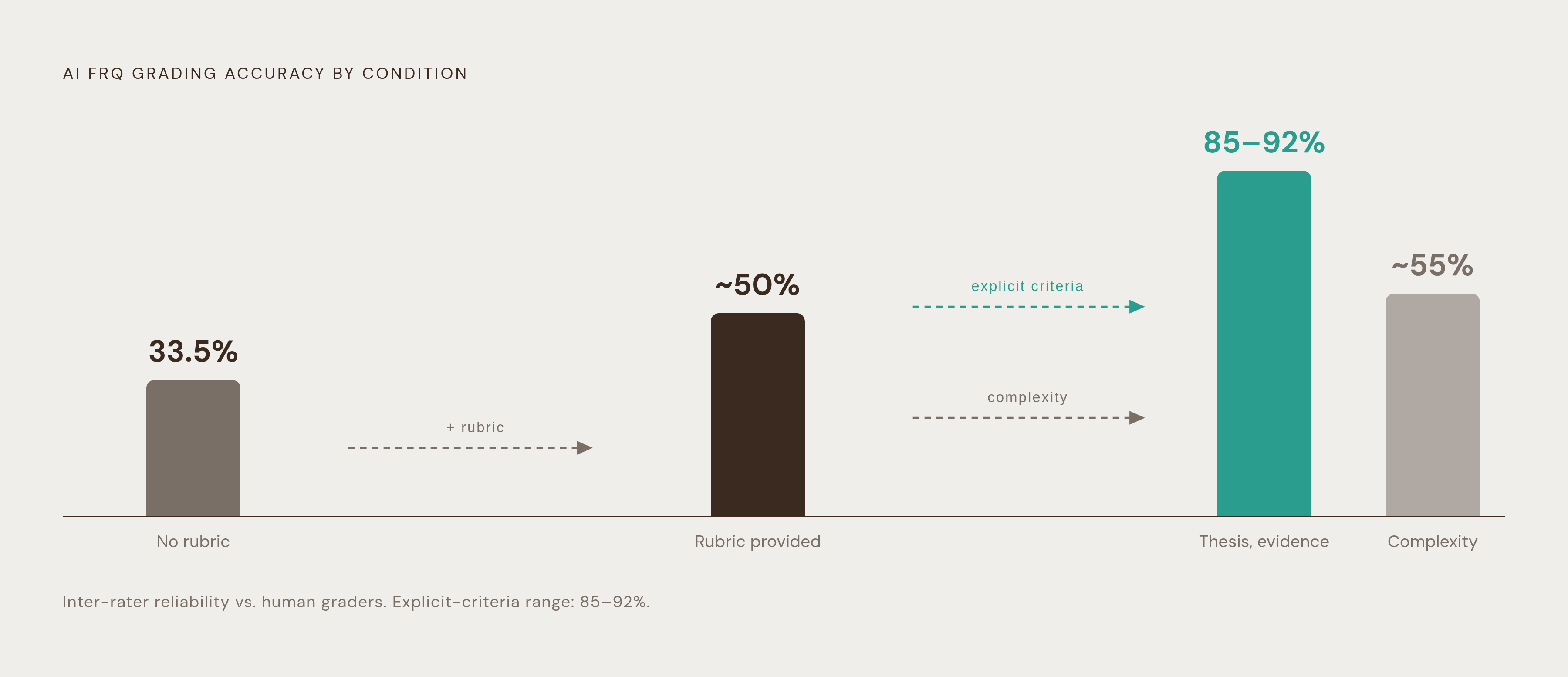
Tools like EduSageAI, which accept the full College Board rubric as input, report inter-rater reliability with human grader scores in the range of 85 to 92% on individual criteria. That number is worth interrogating. What it actually means is that the AI is reliable on criteria that are explicit and well-defined. Did the thesis make a historically defensible claim? Did the student use specific evidence? Those are answerable questions. The complexity point, which requires reading the argument as a whole and judging its analytical sophistication, is where that agreement starts to soften.
This distinction matters. Trust the per-criterion diagnosis on the explicit stuff. Treat the complexity score as a conversation starter, not a verdict.
What changes for the student is the specificity of the feedback, which is what makes this a genuine formative assessment tool rather than just a scoring mechanism. Instead of "you lost points on evidence," they see which piece of evidence was missing, vague, or disconnected from the argument. That's a different kind of information. It's actionable in a way a holistic score isn't.
How AI Moves From Scoring a Single Response to Identifying a Student's Actual Knowledge Gaps
One graded FRQ is a data point. A pattern of them is a diagnosis.
A student who consistently earns the evidence points but loses contextualization has a fundamentally different problem than a student who loses the thesis on every attempt. Those aren't the same issue dressed differently. They require different interventions.
AI platforms that track submissions over time can surface these patterns. Adaptive platforms go further, shifting prompt type and difficulty based on where the breakdowns keep occurring. Jenova's AP Exam Tutor, for example, reports that over 30,000 students used the platform across subjects including AP Chemistry and AP US History, with an average improvement of 1.5 rubric points across FRQ submissions.
That 1.5 points sounds modest. It isn't. AP rubrics are granular. Gaining one or two points on a single FRQ can shift a composite score from a 3 to a 4. The improvement is meaningful in practice, not just on paper.
This is what separates AI-powered prep from a student simply writing more essays and hoping something sticks, which is closer to a mastery-based learning model than traditional timed practice. The feedback accumulates. It builds a model of what the student actually understands versus what they think they understand. Those two things are often very different.
What Different AI Tools Do Well — and Where They Differ in Approach
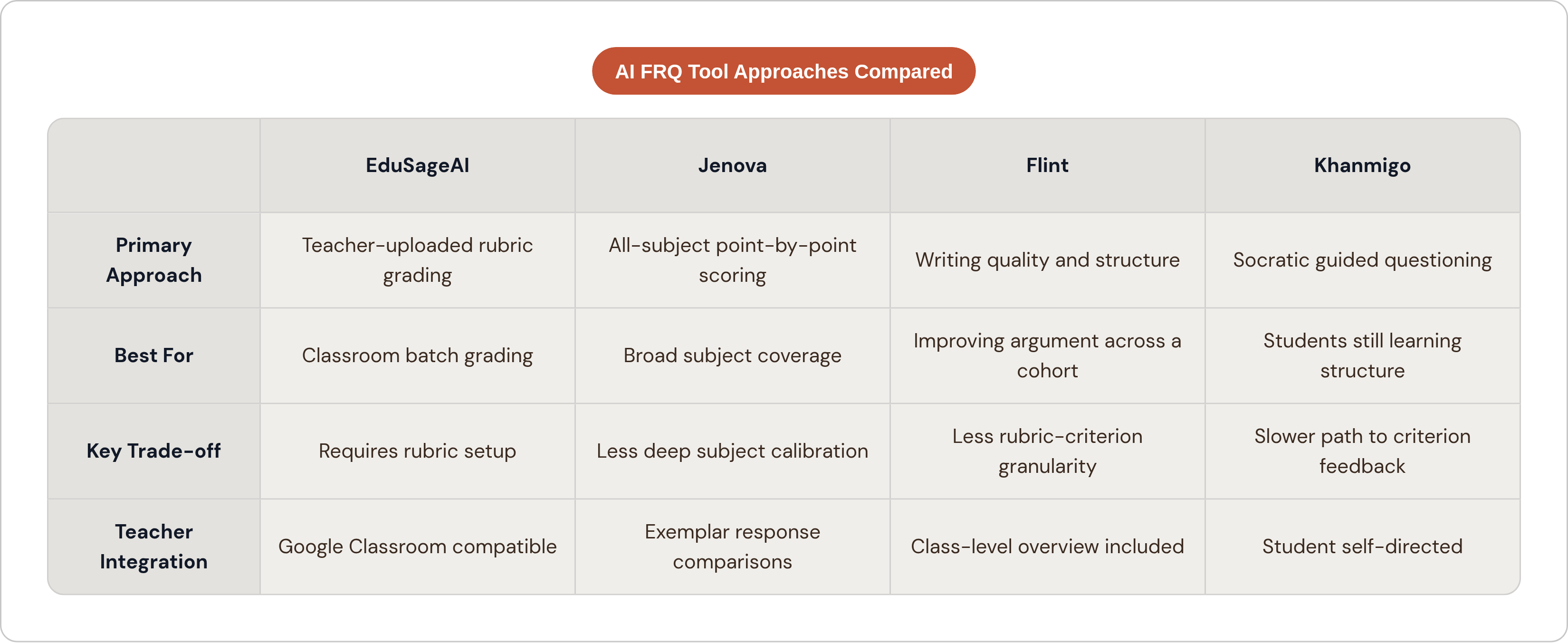
Not all AI FRQ tools work the same way, and that's not a flaw. It reflects different design philosophies, which produce notably different outcomes depending on what the student or teacher needs.
Here's a rough breakdown:
- Rubric-input tools (EduSageAI): The teacher uploads the College Board rubric. The AI grades against those exact descriptors. Strong for classroom batch grading and integration with tools like Google Classroom.
- Subject-spanning platforms (Jenova): Cover all 40 AP subjects. Return point-by-point rubric feedback alongside comparisons to exemplar responses. The breadth is the value. The trade-off is that you lose some of the deepest subject-specific calibration.
- Writing-focused tools (Flint): Emphasize thesis clarity, evidence use, grammar, and tone. Teachers upload custom prompts and reference materials. Also give teachers a class-level overview, not just individual scores. Useful when the goal is improving argument structure across a whole cohort.
- Socratic-style tools (Khanmigo): Don't give answers. Guide students toward their own reasoning. Grew from around 68,000 users in the 2023-24 school year to more than 700,000 in 2024-25, according to Khan Academy.
That last one deserves a closer look. The Socratic approach and the rubric-grading approach are serving different moments in a student's learning arc. If a student doesn't yet know how to construct a thesis, being handed a rubric score that says "thesis: 0" doesn't help much. A guided question might get them further. But once a student understands the structure and is drilling for consistency, fast criterion-level feedback becomes the more valuable tool.
It's also worth noting what teachers are building on their own. AP Psychology teacher Zach Kennelly used an AI platform called Playlab to generate format-accurate Article Analysis Questions on demand. He estimated students need around 35 AAQs to reach exam readiness. There's no realistic version of a teacher writing 35 of those manually. AI made the supply achievable.
The Limits of AI Grading on Constructed-Response Tasks
Let's not oversell this.
A 2025 University of Georgia study found that without teacher-provided rubrics, AI grading accuracy on written responses landed around 33.5%. With detailed rubrics, it rose to just over 50%. That's an improvement. It's also still not good enough to operate without human oversight.
Known failure modes include:
- Overvaluing surface features like length or terminology
- Penalizing nonstandard answers that are technically correct
- Scoring multilingual writing too harshly because language patterns distract the model from the underlying idea
Research has also found consistent bias in automated essay scoring and generally low agreement with human scores on nuanced writing tasks. The complexity point in AP History rubrics is the clearest place where this shows up in practice.
There's also an equity dimension here that's worth naming directly. Students whose writing patterns don't match the distribution the model was trained on — including multilingual learners and students from under-resourced schools — may receive less accurate feedback. If the tool is less reliable for those students, it risks compounding existing disadvantage rather than closing gaps.
The practical takeaway isn't that AI grading is unreliable. It's that its reliability is uneven, and the criteria where it's most reliable are not the same as the criteria where it's least reliable. Students and teachers need to know which scores to trust.
How the Combination of AI Feedback and Teacher Judgment Works Better Than Either Alone
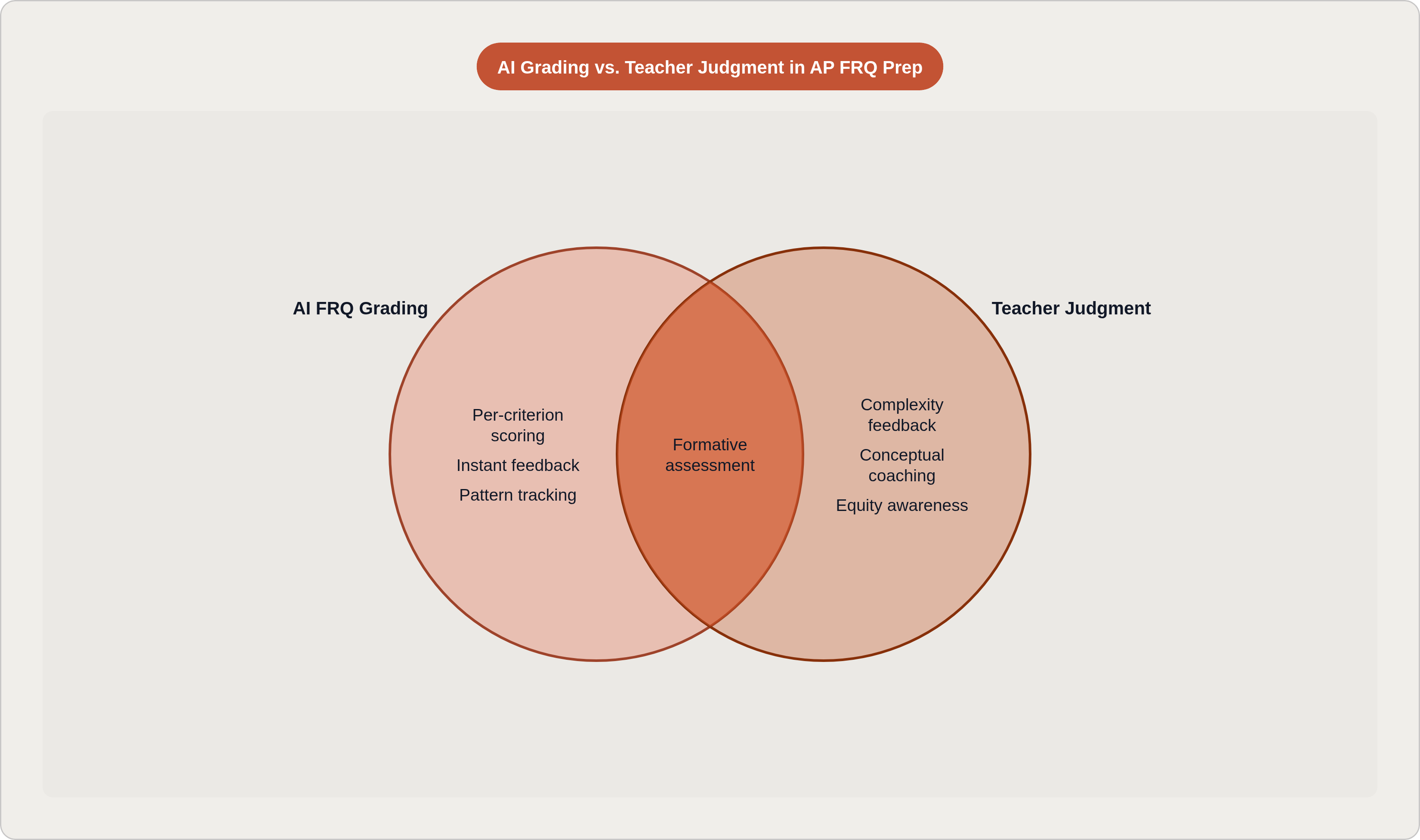
Here's the thing about the limits we just talked about. They're not reasons to avoid the tools. They're reasons to deploy them strategically.
AI handles what it does best: consistent application of explicit rubric criteria across every submission, at speed. A Gallup survey from 2024-25 found that 60% of U.S. K-12 public school teachers used AI tools that year. The teachers who used them weekly saved an average of 5.9 hours per week. That's roughly six weeks of reclaimed time over a school year.
What does a teacher do with six weeks? Ideally, not more grading. Ideally, higher-order feedback on the students and criteria that actually need a human in the loop.
For AP prep specifically, removing the grading bottleneck means students can get more FRQ attempts. The quality of feedback stays consistent because the AI handles the consistent work. The quantity of practice goes up because the teacher isn't the ceiling anymore.
And the complexity point, again, is the right example here. AI can flag when a response lacks analytical sophistication. What it cannot do is determine what the student needs to understand in order to produce it. That's a teacher conversation. The AI creates the condition for it by doing the legwork first.
The model isn't AI replacing teacher grading. It's AI doing the mechanical work so teachers can do the consequential work.
What the College Board's AI Policy Means for Students Using These Tools
The College Board's position is specific. Generative AI is permitted for exploration, understanding complex texts, finding sources, and checking grammar and tone. It is not permitted for writing or creating assignments.
Using AI to receive feedback on a practice FRQ a student wrote themselves is permitted. Using AI to draft the response is not.
The College Board has also partnered with Turnitin, which claims detection accuracy in the high nineties for AI-written material. Penalties range from a zero on a component to exam cancellation to bans from future exams.
But the policy line isn't where the real argument is. The real argument is simpler. A student who uses AI feedback to improve their own constructed-response writing is building the skill the exam tests. A student who uses it to skip the writing isn't building anything. The shortcut defeats the purpose of the tool, the practice, and the exam prep entirely. The feedback is only useful if there's a response worth giving feedback on.
How to Use AI FRQ Feedback in Practice — What a Productive Session Actually Looks Like
Here's what a useful session looks like, practically speaking.
The loop:
- Write a complete FRQ under timed conditions. No shortcuts.
- Submit for AI grading.
- Read the per-criterion feedback before you look at the score.
- Identify the one criterion that failed.
- Rewrite the response with that criterion as the explicit target.
The rewrite is where the learning happens. Not the first submission. The first submission is just the diagnostic. The feedback creates the condition for the rewrite to matter.
Track patterns across sessions. If contextualization is the recurring miss across three different prompts, the problem isn't the prompt. It's a conceptual misunderstanding of what contextualization actually requires. That's a different problem than writing a weak thesis on a single attempt, and it needs a different fix.
For history FRQs specifically: treat AI feedback on thesis and evidence criteria as high-confidence signals. Treat complexity feedback as a question to bring to a teacher or to interrogate against a sample response. The tool is less reliable there and you should use it accordingly.
The volume question also becomes real in a way it wasn't before. With AI feedback available on every attempt, students can write more FRQs than any teacher could manually grade in a semester. Each attempt returns specific, actionable information. The practice compounds in a way that holistic impressions and delayed feedback have not tended to allow.
But the goal isn't a better score on a practice FRQ. The goal is a student who knows exactly which rubric criteria they've mastered and which ones still need work before May.
That's the difference between prep that feels productive and prep that actually is.