Free SAT Practice Apps Worth Using
These free tools work only if you pick the right one for what you actually need to fix.
I once sat with a kid who'd done 300 practice problems that month. I asked why he missed the last 60. He shrugged. That shrug tells you a lot about how many students use these apps: volume can feel like progress, but it often isn't, not on its own.
So what actually matters when you're picking one of these things? A handful of questions, really:
- Is the content built off the real digital SAT, or just SAT-flavored questions from a decade that doesn't matter anymore?
- Does the feedback explain why an answer's wrong, or just slap an X on it and move on?
- Does the difficulty adjust to what you actually know, the way the real adaptive test does?
- Does it make you feel a clock ticking? Or can you sit there and think forever?
- Does the screen look and feel like test day, or like something a developer whipped up in 2019?
- Does it show you where your understanding actually breaks?
That last question is the one almost nobody answers well, and it's often the one that matters most. Missing a question because you misread it and missing it because the rule never clicked are two different problems. Most apps treat them as the same problem. They're usually not. And one more thing: many of the "free" apps out there are free the way a grocery store sample is free. Take a bite, then hit the paywall.
With that in mind, here's how the actual tools stack up.
Bluebook: the non-negotiable starting point
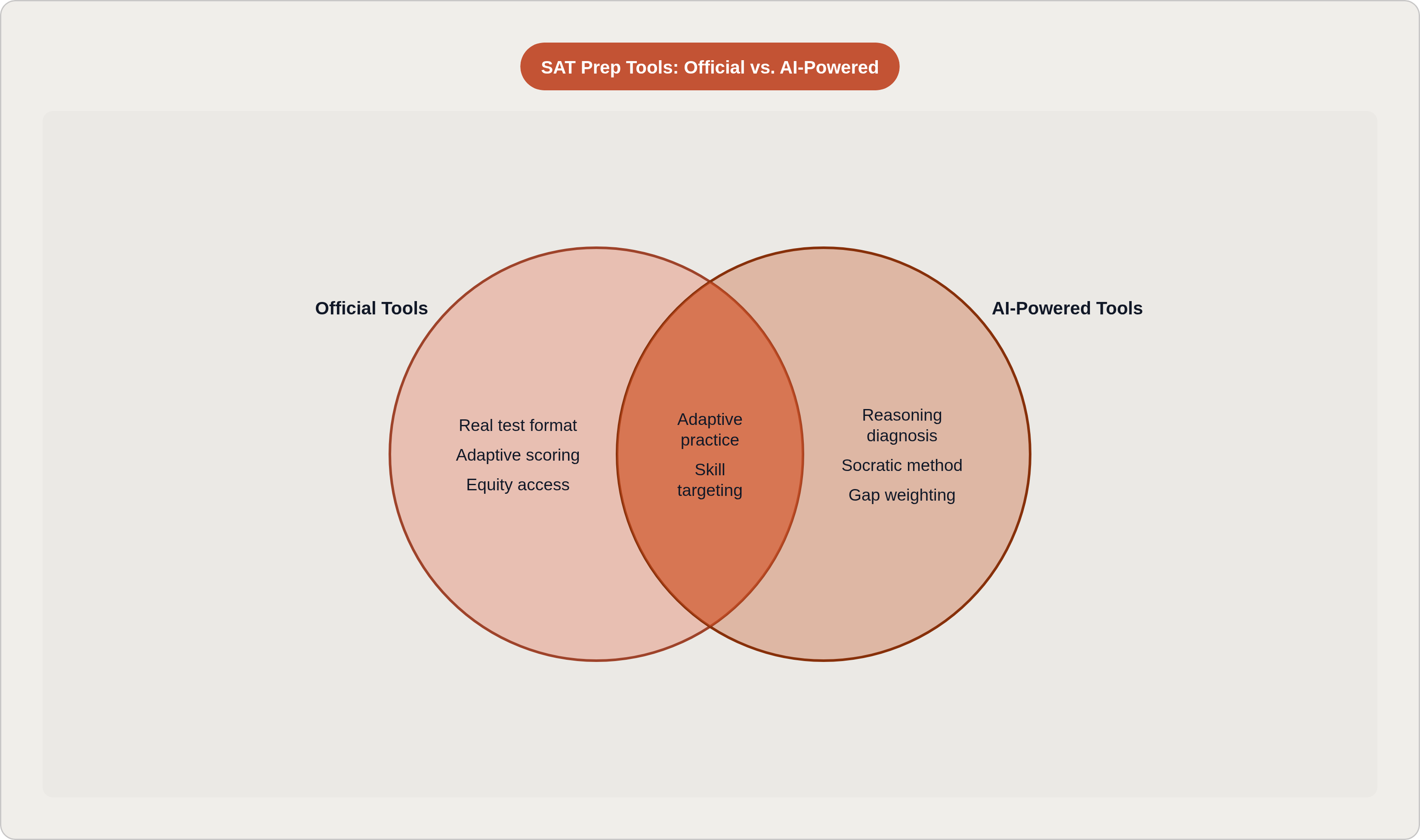
Bluebook isn't a lookalike or a simulation. It's the actual software the real SAT runs on. Whatever you think of it, this is where you start.
Right now it has six full-length official digital practice tests, with more coming in early 2025. The tools mirror test day closely: the annotation feature, the line reader, the answer eliminator, question flagging, the built-in calculator, the timer. Spend a handful of sessions in here and test day starts to feel less like a surprise. The adaptive structure is real, too. Your first module shifts the difficulty of the second, close to how the actual scoring works.
Two things are worth using once you finish a test. "Get Tailored Practice" builds new questions around your specific weak spots. The Student Question Bank lets you filter official questions by section, domain, skill, and difficulty. And a College Board study from May 2025 found that just completing one Bluebook practice test correlates with real score gains, across a wide range of backgrounds. Sometimes the biggest lever really is just showing up and doing the real thing, under real conditions, before you touch anything else.
But it has real limits, and they're not small. Bluebook only runs on Windows, Mac, iPad (with a keyboard attached), and school-managed Chromebooks. No personal Chromebooks. No phones. For some students, that's a wall. And even when it runs well, Bluebook will tell you that you missed a question, rarely why. It surfaces the gap. It does little to close it.
So think of Bluebook as the floor. Every student needs to be in it, regularly. But if it's the only thing in the rotation, you're skipping the half of prep that actually teaches you anything.
Khan Academy Official SAT Practice: strong on concept, uneven on execution
Khan Academy has been the College Board's official prep partner since 2015, and it became the largest SAT prep provider in the country by 2017. That partnership is a big reason to trust the question bank: it's built off the real test, not someone's best guess at it.
One number is worth remembering. A 2017 joint study by the College Board and Khan Academy found students who logged 20 hours on the platform gained an average of 115 points. Six hours got you 90 points, on average. Some kids gained over 200, and the effect held up over time. That's a notable claim.
Why does it work? An adaptive study plan that tracks your strengths and weaknesses. The option to import a PSAT/NMSQT score so you're not starting from zero. A link back to Bluebook that can generate targeted practice off your results. And there's an equity story here too, one that's easy to skip past: paid prep has often tilted toward families who can afford it, and a free adaptive alternative pushes back on that directly. One Florida district ran this with 73,000 students, a quarter of them English-language learners, and moved the needle on scores, graduation rates, and college access all at once.
But if this is the only tool a student touches, a few things will bite:
- Most exercises are untimed, which quietly erodes the pacing instinct the real test demands.
- Explanations often stop at "wrong," without walking through where the reasoning actually went sideways.
- There's no strong way to track your own error patterns over time.
- Every skill area gets roughly equal screen time, even though the real SAT weights sections unevenly.
- The Bluebook link is manual and a little clunky. It's a bridge, not a real feedback loop.
Use it to build concepts. Don't use it as a stand-in for a timed test. It's a strong partner to Bluebook, not a replacement for it.
Khanmigo: what an AI tutor actually adds to free SAT prep
Khanmigo is Khan Academy's AI tutor, built on GPT-4, and it runs on the Socratic method: it won't just hand you the answer, it asks questions that push you toward finding it yourself. That's a notably different approach than most everything else on this list.
There's an SAT-specific mode with its own diagnostics for finding weak areas and building a plan around the fixes that matter most. The step-by-step reasoning is a real value, since regular Khan Academy usually just marks something right or wrong and keeps moving.
For teachers, it's free, thanks to a 2024 partnership between Khan Academy and Microsoft, run through Azure. That's what lets Khan Academy offer this to more than 6 million teachers worldwide. Teachers get a Skills Insight tool showing what students at a given score band typically know, and they can prompt Khanmigo to build practice questions or lesson plans straight from that. There's also an on-demand summary that flags class-wide gaps fast, useful if you want to reteach something before the test instead of after.
For students, it's a modest monthly fee, which is worth weighing against whatever else that time or money would go toward. Classroom access has to come through a school or district. A teacher can't just hand out logins on their own. And Common Sense Media gave Khanmigo 4 stars among AI learning tools, ranking it above several general-purpose AI products in their review.
Here's the catch, though: Khanmigo mostly knows what Khan Academy's own content library knows. It won't sit on top of your Bluebook results and coach you through those specific misses. Smart tutor. Small yard.
Ready4SAT and other mobile-first apps: when convenience helps and when it hurts
Apps like Ready4SAT are built for a different kind of studying. Short sessions. Adaptive difficulty. A steady nudge toward whatever's weak. If a student studies in five-minute bursts between classes, this format actually fits how they live.
That matters more than it sounds like it should. A tool on your phone gets opened. A tool that needs a laptop and a quiet desk competes with everything else pulling at a teenager's attention, which is to say, a lot.
But the SAT isn't taken on a phone, and that tension rarely goes away. Practice on a phone and you rarely build comfort with Bluebook's interface, its keyboard navigation, or the specific kind of tired you get from reading long passages on a laptop screen for hours. There's a subtler risk too: apps built around quick sessions can train a habit of bailing the second a question gets hard, because "next" is one tap away. That's close to the opposite instinct the real, timed, adaptive test rewards.
Before sinking real time into any app in this category, check one thing: is the content actually calibrated to the current digital SAT, or does it just look like SAT questions? That varies widely across third-party apps, and five minutes of checking saves you from building a habit around the wrong one.
Best use here is vocabulary, quick review, staying warm between real Bluebook sessions. Think supplement, not foundation.
Passionfruit: AI-powered practice built around what students actually don't understand
Here's the gap every tool above leaves open. Bluebook shows you where you're weak and stops. Khan Academy teaches the concepts but doesn't always show you where your specific reasoning broke. Khanmigo guides your thinking well, but it's boxed into Khan's own content, and it costs students money.
Passionfruit covers AP subjects and the SAT, using AI grading on unlimited practice problems. The feedback tries to find the point where your thinking went sideways, not just whether the final answer was right. That's a much harder problem to solve than flagging a wrong answer, and it's often the one that matters most.
Think about the student who keeps missing the same type of question, over and over, with no idea why. More repetition won't fix that. It just adds more reps to the same broken loop. Passionfruit tracks understanding instead of outcomes, and it weights gaps by how much they're actually costing you, rather than treating every skill area the same way Khan Academy tends to. If one gap is bleeding more points than the rest, that's where the attention goes first.
For teachers, the same logic scales: see where a group's understanding is actually breaking, not just who missed what on Tuesday's quiz.
If a student has run the Bluebook tests, worked through Khan Academy, and the score still won't move, a likely culprit is an undetected knowledge gap. That's exactly the problem a diagnostic tool like this is built to solve. Passionfruit works alongside the official tools, not instead of them. Bluebook gives you the real format. Passionfruit gives you a diagnostic layer the official tools rarely finish building.
How to combine these tools into a prep sequence that actually builds toward a score
Here's a failure mode I see often: a student downloads three or four apps, bounces between them with no real plan, racks up hours of "studying," and the score barely moves. The AI tutoring market is growing around 30.3% a year as of 2025, so more apps keep showing up every semester. More apps doesn't mean a better score. Usually it just means more noise to wade through before you find what works.
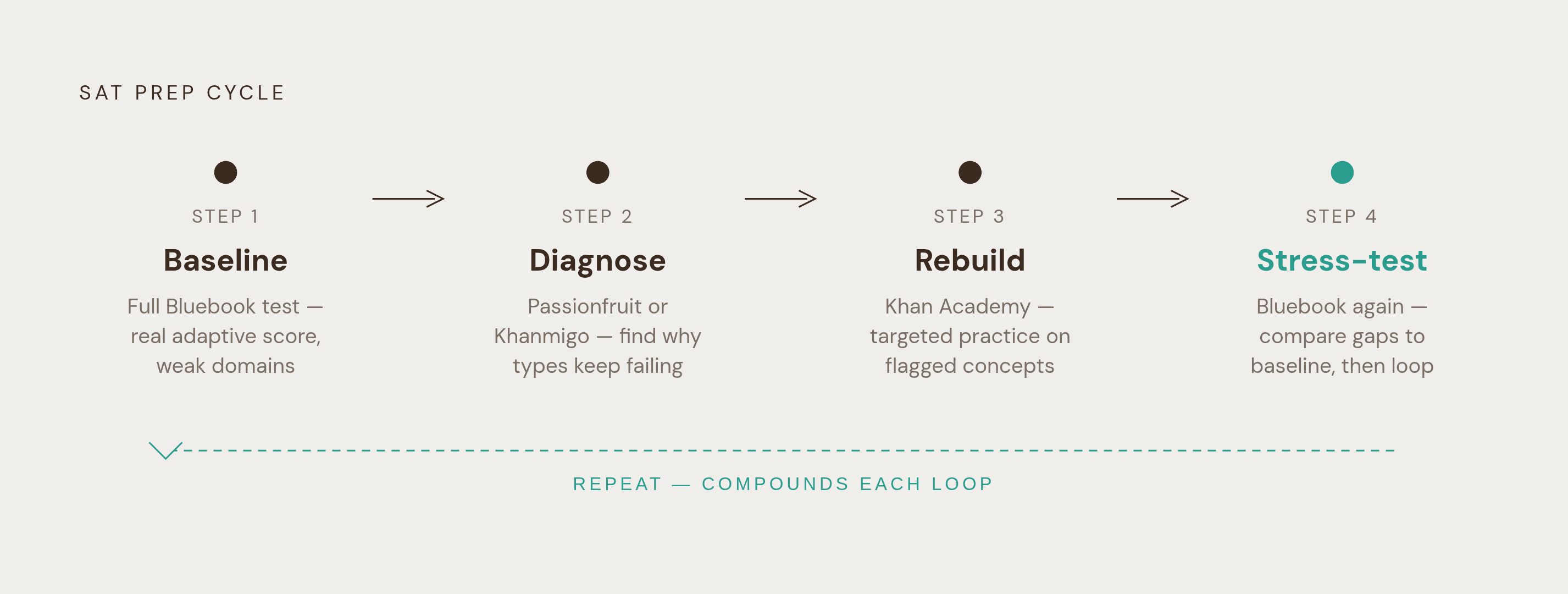
A sequence beats a pile of apps used at random. Something like this:
- Baseline. Take a full-length Bluebook test before drilling anything. The adaptive score gives you a real number and points at which domains need work.
- Diagnose. Use Passionfruit, or Khanmigo if school access is available, to figure out why certain question types keep getting missed, not just which ones.
- Rebuild. Go to Khan Academy's Official SAT Practice and work the concept areas the diagnosis flagged. The adaptive study plan is far more useful once you know exactly where to point it.
- Stress-test. Back to Bluebook for another full-length timed test. Compare it to the baseline. Did the gaps close, or did they just move somewhere else?
Then repeat. Prep tends to compound when you cycle between real simulation and targeted fixing, not when you set up permanent camp in one app. Mobile apps like Ready4SAT fit best in the rebuild stage, for light reinforcement between heavier sessions, not as the main event. For teachers, Bluebook's educator access, paired with Khanmigo's Skills Insight and Passionfruit's classroom-level gap tracking, turns scattered practice data into actual decisions about what to teach next, which is a different thing entirely from staring at a spreadsheet of scores.
So where's the ceiling on all this? The 2017 Khan Academy data shows real, lasting gains are possible with structured free tools, and the sequence above can carry a motivated student a long way. But if the target is that top 7%, the 1,400-plus band, the margins get thin enough that free tools alone probably won't get you there. You'll likely need more personal, more granular feedback than any free app gives on its own.
What tends to decide the outcome isn't which app had the nicer interface or the bigger question bank. It's whether a student is using practice to actually understand how they think, or just running up the number of reps and calling it done.