Ethical Concerns Around AI in K-12 Education
Federal momentum is pushing adoption forward: an April 2025 executive order directs the expansion of AI education in K-12. FutureEd is tracking 77 bills across 27 states for the 2026 legislative session. Plenty of motion here, but not much agreement.
Only 29% of districts nationally (33% in Wisconsin, per one 2025-2026 survey) say they have a formal AI policy. Everyone's driving the car here. Almost nobody wrote the manual, and most people haven't checked if there's gas in the tank.
Why data privacy in schools is structurally harder than in consumer tech
Consumer apps collect your browsing habits. Schools collect something else entirely: age, learning disabilities, behavioral records, family circumstances. Not "which ads should we show you" data. More like "here's a detailed profile of a child's mind and home life" data.
Now drop AI into that mix. Adaptive learning platforms don't just log a final answer. They track every hesitation, every revision, every wrong turn a kid takes on the way to a right one. That's a continuous stream of cognitive data on a minor, collected quietly, in the background, while the kid just thinks they're doing homework.
The laws on the books, FERPA and COPPA, were written before this kind of tracking was even technically possible. They set a floor, not a ceiling. Plenty of vendor agreements give schools surprisingly little visibility into where that data actually goes once it leaves the classroom.
It's not only a security question. The U.S. Commission on Civil Rights' Pennsylvania Advisory Committee has flagged children's social-emotional development specifically, as a concern tied to how this data gets used. That's a different category of harm than "someone hacked a server." Hacks get headlines. This kind of harm tends to stay quiet instead.
A 2024 systematic review found a lot of educators and students think privacy risk with AI tools just doesn't exist. Not that they weighed it and accepted it. They think there's nothing to weigh in the first place. Worth pausing on that, because it's hard to guard against a risk you don't believe is real.
I once sat in on a district technology meeting where an administrator proudly announced they'd adopted a new AI writing assistant for their elementary schoolers. When someone asked what the data policy looked like, she checked her binder, flipped through three empty tabs labeled "Privacy," "Retention," and "Vendor Terms," and said, "We're still working on that part." The tool had already been live in classrooms for two months.
Responsible practice on the ground looks like:
- Data minimization. Collect only what's needed, nothing more.
- Contractual limits on secondary use. No quietly repurposing student data for something else down the line.
- Transparency with parents. What's collected, why, who sees it. In plain language, not a 40-page terms-of-service doc nobody reads.
A school that rolls out an AI grading platform with no data governance contract in place isn't just accepting legal exposure. It's handing over a detailed cognitive profile of a child to a third party and hoping for the best. That's a gamble, not a policy position.
How algorithmic bias can quietly widen the gaps schools are trying to close
AI systems learn from historical data. If that data carries the fingerprints of old inequities, the system inherits them too. This isn't a bug you patch in the next update. It's baked into how large language models and adaptive systems tend to work.
Consider what "mastery" tracking measures on some of these platforms. The proxies it leans on can correlate with race, language background, or income, and often nobody's checking whether that correlation exists until it's already shaping outcomes.
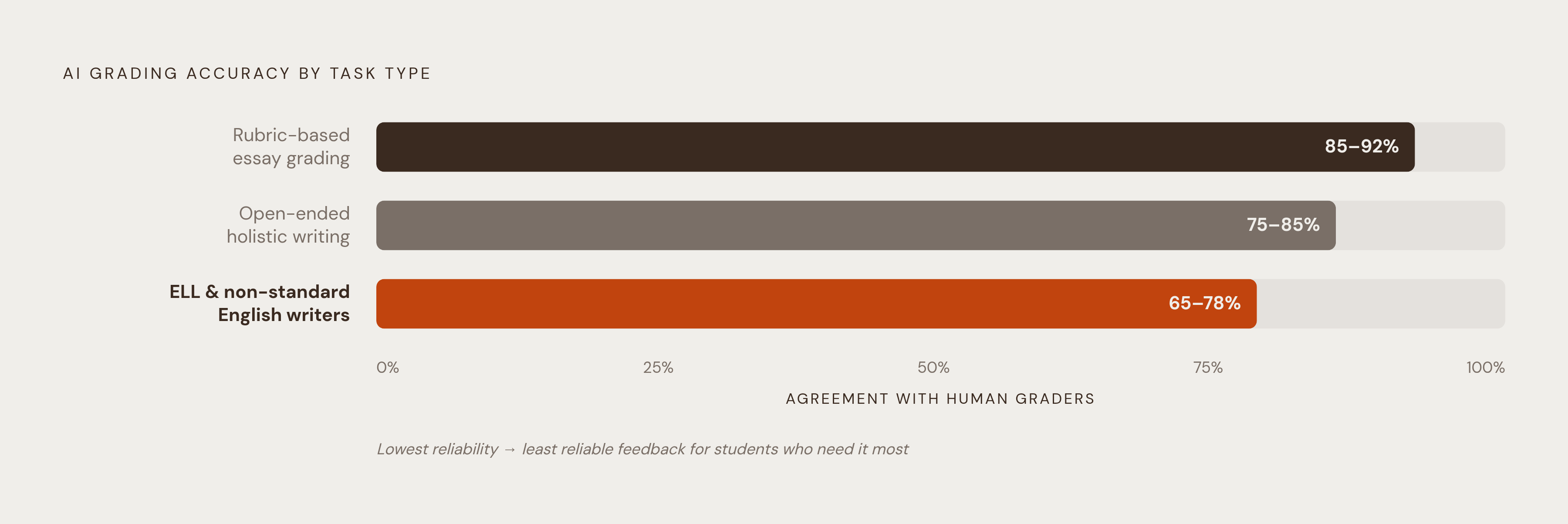
Here's a number worth sitting with: AI grading accuracy for English language learners and non-standard English writers drops to somewhere between 65% and 78% in current research. That's the lowest accuracy band we have data for. It's also exactly the band where human review should be non-negotiable.
The students already facing the steepest climb get the least reliable feedback from tools that were supposedly built to help them. The Pennsylvania Advisory Committee named this directly: the promotion and reinforcement of bias as an ongoing concern, not a theoretical one.
Bias doesn't stay contained to one bad grade. A miscalibrated readiness assessment in sixth grade can shape course placement that follows a student straight through high school. A biased algorithm in a classroom is a lot like a crack in a foundation: invisible on move-in day, and often the reason the whole house tilts ten years later.
Here's the irony: AI gets marketed hardest to under-resourced districts, sold as a way to stretch thin teaching capacity. Those are precisely the places where biased outputs are least likely to get caught, because there's less staff time to scrutinize anything in the first place. The districts that need the most protection get the least of it.
Responsible practice here means:
- Disaggregated outcome data by demographic group
- Regular audits, not a one-time vendor claim you take on faith
- Human override built into any high-stakes decision, full stop
What AI grading can and cannot reliably do right now
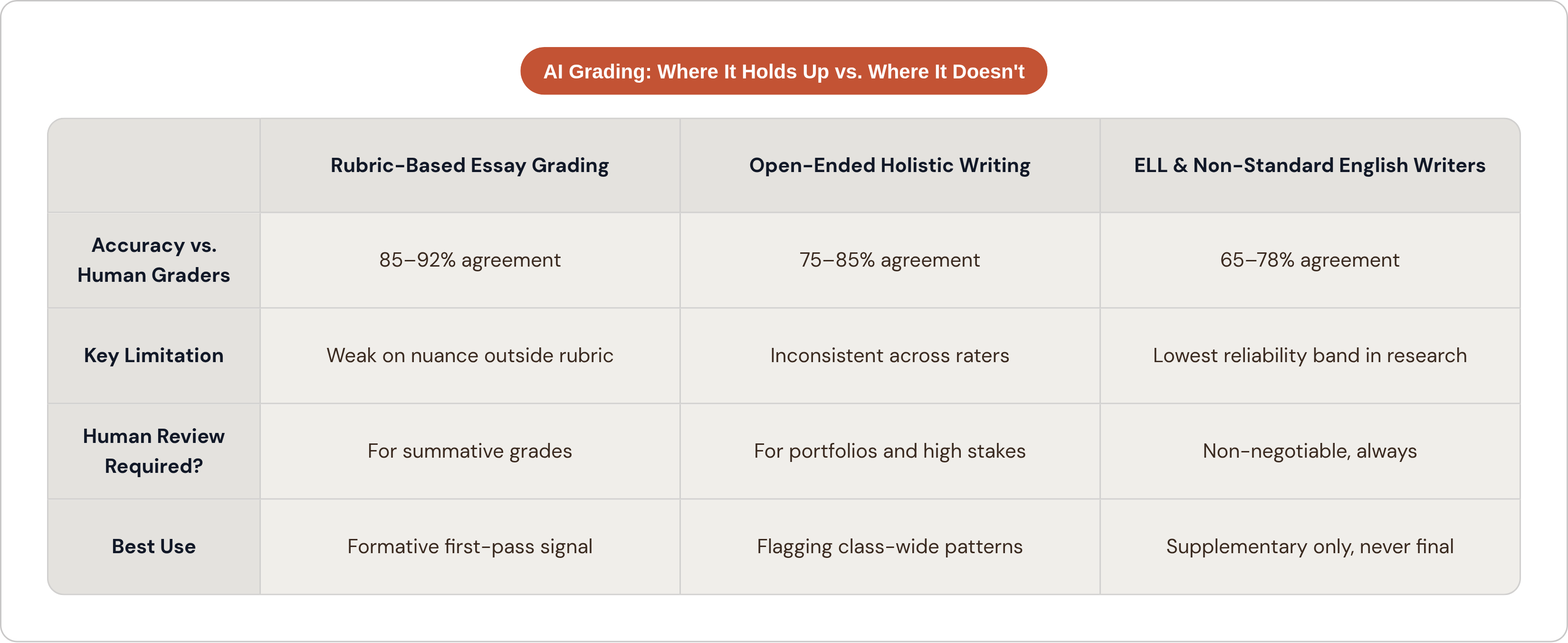
AI grading isn't one thing. Treating it like a single technology is where a lot of the confusion starts, and where a lot of vendor pitches get away with more than they should.
Rubric-based essay grading hits 85-92% agreement with human graders. Open-ended, holistic writing drops to 75-85%. Both numbers sit lower than what a lot of marketing copy implies.
A June 2025 study in Innovation in Language Learning and Teaching tested ChatGPT-4 and Gemini against 120 essays and found real limits on consistency compared to human raters. Correlations between AI scores and human scores ranged from negligible to moderate.
Research by Wetzler et al. (2024) documents what they call "consistent proportional bias," where AI grades weak essays more leniently and strong essays more harshly. The students at both ends, the ones who most need accurate feedback, get the least reliable version of it.
None of this makes AI grading useless. It means treating it as a first-pass signal, not a final verdict. Where it tends to help:
- Cutting teacher turnaround time on routine work
- Making frequent, low-stakes practice more feasible
- Flagging class-wide patterns a single teacher might miss buried in 30 essays
Where human review stays mandatory:
- Summative grades
- ELL student work
- Portfolio submissions
- Anything with real consequences attached
This is the design philosophy behind tools like Passionfruit, which treats AI feedback as a formative layer, showing where a student's thinking breaks down rather than standing in for a teacher's judgment on the grades that actually count.
The academic integrity problem is bigger than cheating detection
The cheating infrastructure out there is more organized than most educators realize. The College Board sued over software called "Auto SAT," priced at $499.99, that bypasses Bluebook's security and overlays correct answers onto a student's screen in real time. It's one of the first known federal legal actions against a product like this.
There's also a documented black market on Discord servers distributing AP exam materials across more than a dozen subjects. Prices ranged from $50 for resold leaks up to $250 per exam straight from primary sellers.
AP Seminar is a clean example of the vulnerability, because most of the score comes from portfolio work done outside the exam room, exactly where AI assistance is hardest to catch.
Schools reached for detection tools the way you'd reach for a fire extinguisher. A 2025 national survey found 43% of teachers in grades six through twelve use AI-detection apps regularly, with another 27% having tried them.
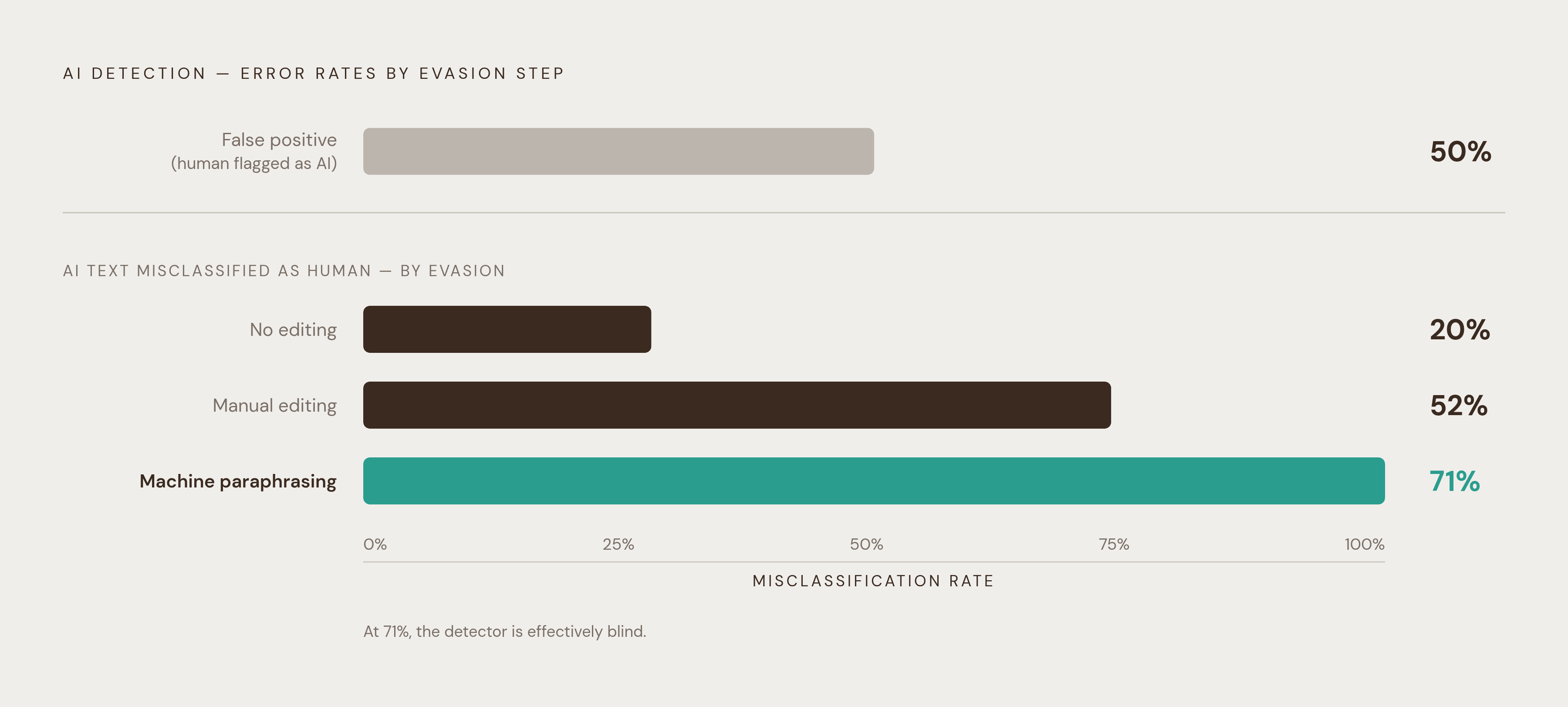
Here's the catch: those tools often work far worse than their adoption rate suggests. One study of 14 detection tools found false-positive rates as high as 50% and false-negative rates as high as 100%. About 20% of AI-generated text got misclassified as human-written. That number jumped to 52% when the text was manually edited, and 71% when it was machine-paraphrased.
A false positive isn't a technical hiccup. It's a student wrongly accused of cheating. That's an equity and due-process problem, and yet some schools use a single flat threshold to make real disciplinary calls. One principal described a 50% TurnItIn score as the trigger, on a tool with error rates like the ones above. It's a bit like convicting someone based on a coin flip and calling it forensic evidence.
The stakes make this worse, not better. College Board's own penalties for verified cheating are severe: bans from a class's AP exam, other AP exams, in the worst cases the PSAT or SAT. Real consequences, riding on tools that get it wrong at rates between 50% and 71%.
The harder question isn't "how do we build a better detector." That's likely an unwinnable arms race. The better question is what's actually driving students to bypass learning in the first place. Nobody's selling Auto SAT to kids who feel prepared.
The deeper risk: AI use that produces credentials without understanding
Remember that 84% figure, the share of high schoolers who've used generative AI for schoolwork? Most of them aren't running Auto SAT or buying leaked exams off Discord. They're using AI in ways that feel completely normal, which is exactly what makes this concern harder to spot than outright cheating. There's no black market to point to here. Just a kid, a laptop, and a chatbot that's very good at sounding helpful.
A 2025 Center for Democracy & Technology report found 71% of teachers worry AI is hurting students' critical thinking. A 2024 systematic review of K-12 AI use backs that up: AI used without teacher direction may foster automatic thought patterns and shrink students' capacity for critical thinking.
Here's the distinction that actually matters: using AI to check your reasoning versus using AI to produce your reasoning. It's the same tool, but a completely different outcome.
There's real evidence AI helps when used the first way. Students using AI-adaptive SAT prep tools scored an average of 90 points higher; one joint study between the College Board and Khan Academy found their AI plan averaged a 120-point gain. But those numbers only hold up if the student is doing the thinking and using AI to sharpen it, not outsourcing the thinking altogether.
There's a catch even inside the "good" use case. Experts reviewing AI-generated SAT practice content, including practice material from Google Gemini, found questions that mimicked the style of the SAT without actually testing the reasoning skills the real exam measures. Students build confidence from practice that doesn't transfer, arguably worse than no practice at all, because it feels like progress right up until it isn't.
This is what "over-reliance" really means: a student who can only solve a problem with AI sitting next to them hasn't learned the material. It makes no difference if every answer on the page is technically correct. The page was never the point.
No detection tool touches this problem, either. Flagging a paper for "the student didn't really understand this" isn't something these systems can do. That requires a different starting question: what is AI actually for in a learning context?
This is the exact premise Passionfruit builds around. The goal isn't unlimited AI-graded practice for its own sake. It's using that practice to find where a student's understanding breaks down, so the gap gets surfaced instead of quietly papered over by an AI that hands over the answer before the struggle even happens.
What responsible AI use in K-12 schools actually requires
None of this is an argument against AI in schools. Think of it as a checklist for what has to be true before AI actually helps instead of just looking like it helps.
On policy: the gap between how fast schools adopted AI and how slowly they wrote rules for it is the most urgent problem on this list. Only 29% of districts nationally have a formal policy. That number needs to move, and soon, because every month it doesn't is a month of decisions made with no rulebook.
On data: any vendor contract should require data minimization, ban secondary commercial use of student data, and spell out breach notification. These aren't nice-to-haves; they're the baseline.
On bias: districts should demand disaggregated accuracy data, broken down by demographic group, before they buy anything. Human override needs to exist for every high-stakes decision. No exceptions carved out because a tool is "usually" fine.
On grading: AI feedback belongs in the formative lane. Frequent, low-stakes, focused on finding gaps. Not the final word on a report card or a portfolio.
On integrity: detection tools are often too unreliable to serve as evidence in disciplinary proceedings. What tends to work better is designing assignments differently and building student metacognition, not stacking on more surveillance and hoping the false-positive rate improves on its own.
On learning: ask one question of every AI tool in the building. Does it show a student what they actually understand, or does it substitute for that understanding? Tools that expose where thinking breaks down earn their place. Tools that let students submit work they never engaged with fail that test, no matter what category they get filed under.
All of this rests on one foundation: real training for teachers, real AI literacy for students, aimed at understanding how these systems work, where they fail, and what they can't replace, not just which buttons to click.
The 2025 executive order and the wave of state legislation open a real window here. The risk isn't that AI keeps expanding into classrooms. It's that policy keeps expanding access without ever getting around to the safeguards that make that access worth having. Building the car faster doesn't help much if nobody's gotten around to the brakes.