Kinesthetic Learning Examples From Montessori Classrooms
How Montessori materials turn abstract concepts into physical experiences children can feel.
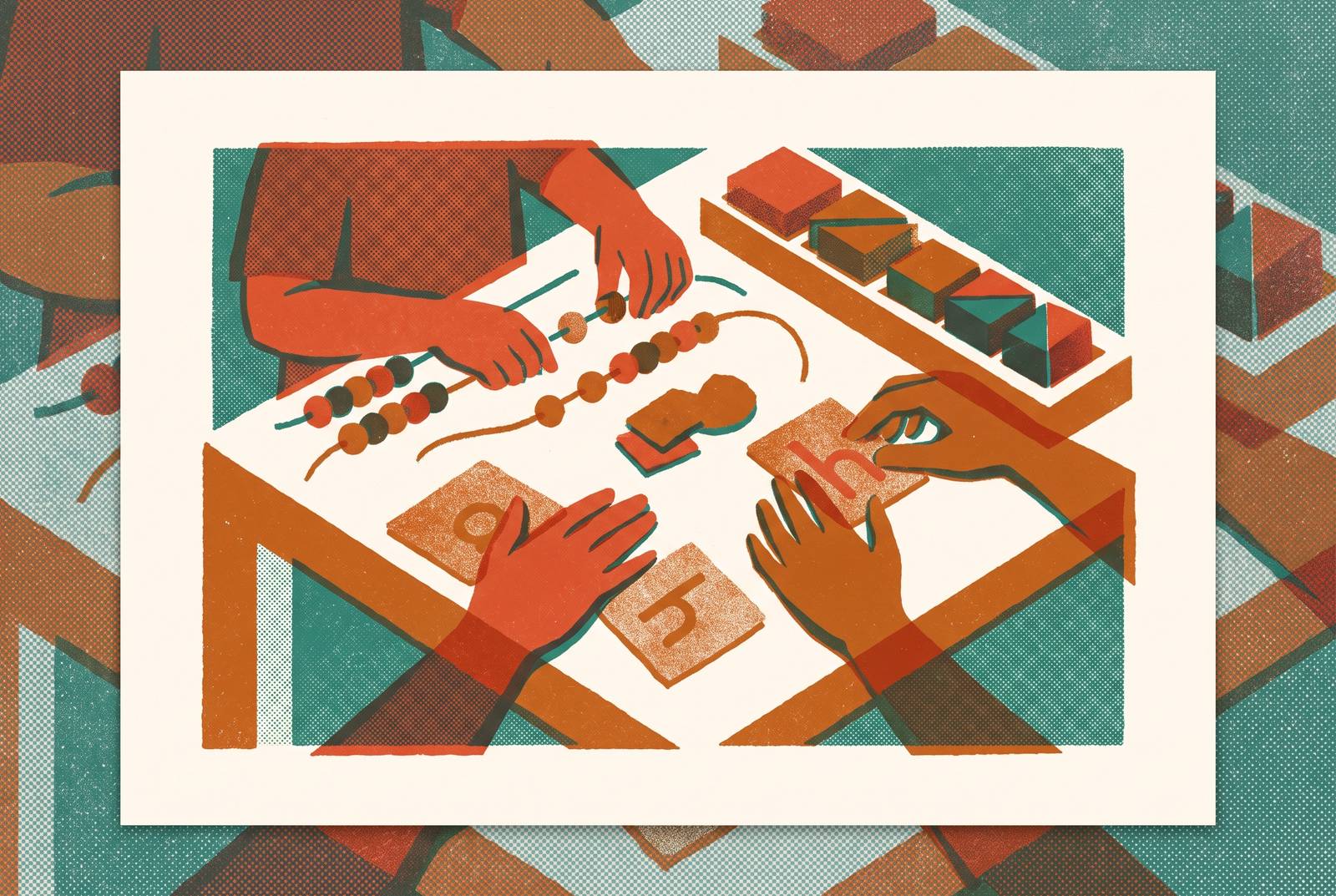
This piece is about kinesthetic learning, and the clearest place to see it in action is a Montessori classroom. It built an entire system around a simple bet: kids understand things through their hands and bodies before they understand them through words.
Kinesthetic Learning and the Montessori Classroom
Kinesthetic learning means learning through movement and doing, not just watching or listening. A visual learner studies a diagram. An auditory learner absorbs a lecture. A kinesthetic learner needs to move, touch, build, or physically act something out before it sticks. Most young kids lean this way naturally, which raises a fair question: if that's true, why do so few classrooms actually teach that way?
Kinesthetic is not the same as tactile. Touching something is part of it, but kinesthetic learning asks for more than fingertips on a surface. It asks the whole body to get involved in a purposeful task, engaging more than a momentary sensation.
Montessori classrooms build their entire structure around this idea. Movement is the learning itself, not a reward for finishing work or a break from the "real" learning. That's a sharp break from the seated-lecture model most people picture when they think "school," where sitting still is the default and getting up is the exception.
Maria Montessori put it in her own words: "What the hand does, the mind remembers". The doing creates the understanding. The instruction that comes before the doing is just setup.
So why look at Montessori specifically, out of every movement-based teaching method out there? Because Montessori didn't bolt kinesthetic activities onto an otherwise normal classroom. Every material, every routine, every piece of furniture is built around the idea that the child's body is the instrument of learning. That makes it the clearest real-world case study available, so it's worth walking through how that plays out, material by material.
How the Sensorial Materials Train Perception
Start with the Sensorial materials, because they isolate the idea in its purest form. Each one targets a single quality, like size, weight, texture, or sound, and makes the child perceive that quality entirely through their hands. No verbal shortcut. No one tells the child the answer.
Take the Pink Tower. Ten wooden cubes, graded across three dimensions, and the child's job is to stack them in order from largest to smallest. Get it wrong and the tower leans or wobbles. The child feels the mistake through weight and balance, corrects it with their hands, and builds the concept of graduated size through trial and error rather than being told "that one goes on top".
The Cylinder Blocks work the same way, with an even more direct feedback loop. Four wooden blocks, ten cylinders each, varying in height and width, and each cylinder fits exactly one socket. Forcing the wrong cylinder into the wrong hole means it simply won't sit flush. The material corrects the child before any adult has to.
That self-correcting design means the material teaches the child without an adult ever having to intervene. The feedback comes through the body. The child's body discovers the error at the exact moment the error happens, which is a faster and more direct loop than waiting for a teacher to walk over and point it out.
The broader goal behind all of this is to train an analytical mindset, one built on noticing fine differences through every sense available. Sit a child down with these materials long enough and something else starts to build alongside the perceptual skill: the capacity to focus on one task for an extended stretch, which researchers today would call grit.
Sandpaper letters and the movable alphabet: making abstract symbols physically real
Letters are abstract. A shape on a page means nothing on its own, a kid has to be taught that this squiggle equals this sound. Montessori's answer to that gap is sandpaper letters, and it might be the single clearest kinesthetic literacy tool in the entire method.
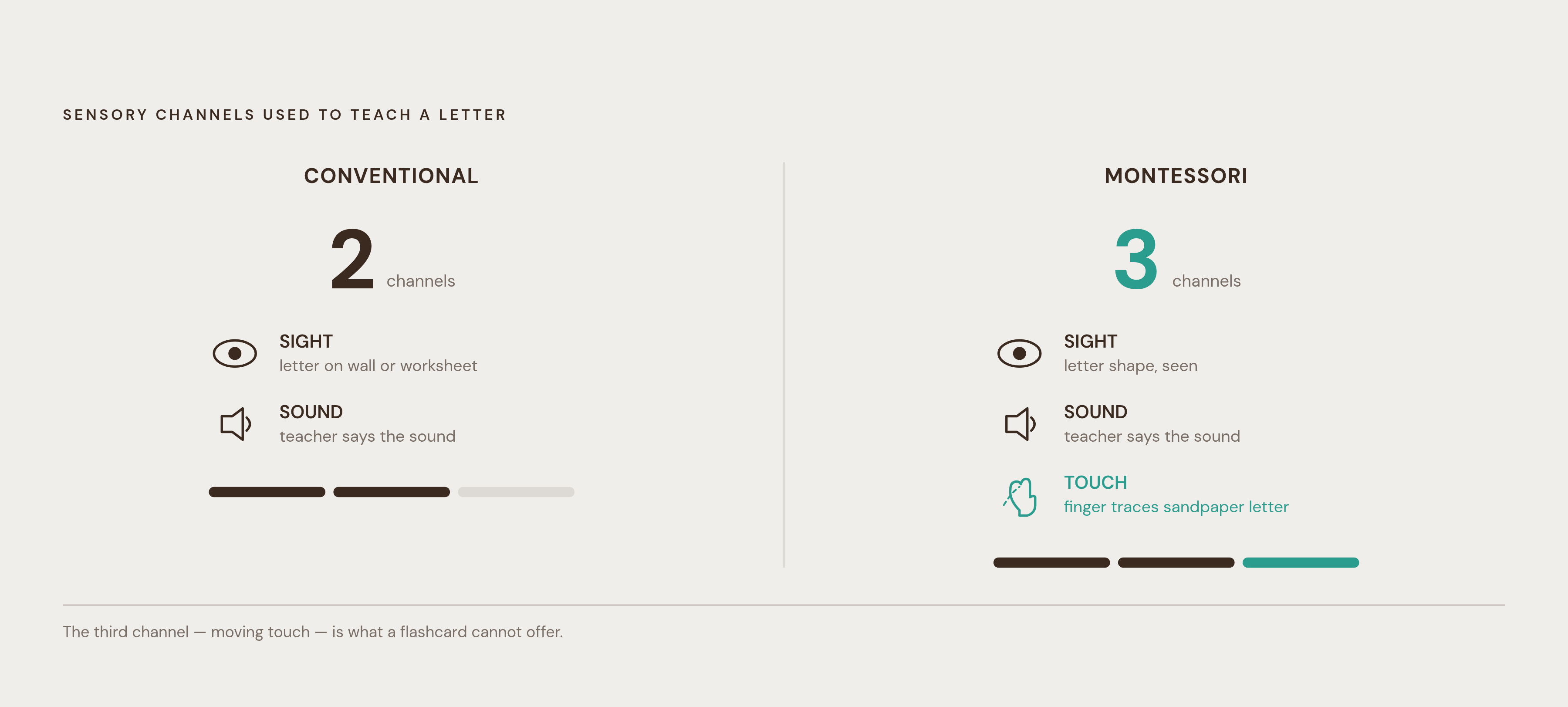
Each letter sits on a board, its shape traced out in sandpaper. A child runs a fingertip along the rough outline while saying the letter's sound out loud and hearing it at the same time. That's three channels (touch, sound, sight) encoding the exact same fact at once.
Compare that to a typical classroom. A child there sees the letter on a wall or a worksheet and hears a teacher say its sound. Two channels. The Montessori child gets a third: the shape, felt directly through a moving finger. That's not a minor add-on, either. Touch brings in large-muscle movement and fine-motor memory that a flashcard simply can't offer.
Before most kids have the fine-motor control for a pencil, Montessori classrooms also have them trace letters in trays of sand. The big, loose arm movement builds two things at once: the letter-sound link, and the physical groundwork for handwriting that comes later.
From there, kids move to the movable alphabet, a set of individual letter tiles they arrange by hand to build words. Composing a word becomes a physical, spatial task that happens through the hands. Each sound gets handled as an object first, something you can pick up and place, long before it turns into an abstract written word on its own.
Golden beads and number rods: arithmetic as a physical experience before it becomes symbolic
Math has the same problem as reading, maybe worse. A written numeral like "1,000" carries no felt sense of how much that actually is. Montessori's golden beads close that gap by turning place value into something a child can pick up and carry.
A single bead stands for one unit. The Pink Tower uses ten wooden cubes graded in three dimensions, which the child must physically stack in order, correcting errors through weight and spatial feedback rather than being told the answer. A cube made of a thousand beads stands for a thousand. Kids carry these amounts around the room, trade ten unit beads in for a ten-bar, and feel the weight climb as the numbers climb. A thousand-cube is noticeably heavier in the hand than a single bead, so magnitude changes from a concept you're told into something you've felt.
The golden bead chain pushes this further. Kids lay a long chain of beads out across the classroom floor and walk its length while counting.
Number rods apply the same logic to addition. A set of rods, graduated in length and alternately colored red and blue, gets laid out in sequence by hand, so the child experiences the growing length of each rod as the physical shape of what addition actually is.
The logic connecting all of this back to the written numeral is simple: by the time a child writes "1,000" on paper, they've already lifted the block that weighs that much. The numeral is shorthand for something they've held, not an arbitrary squiggle they're told to memorize.
Practical life activities: everyday physical routines as deliberate skill-building
Not every kinesthetic lesson in a Montessori classroom comes from a specially designed material. Some of the most important ones are just chores, done carefully and on purpose.
Pouring water from one small pitcher to another. Spooning dry beans from one bowl to the next. These look like nothing, but they're training hand-eye coordination, grip control, and the patience it takes to slow a movement down and do it precisely. Those same skills reappear the moment a child picks up a sandpaper letter or a golden bead.
Dressing frames fit here too: fabric panels mounted with buttons, buckles, zippers, or laces, each one a stand-in for the real task of getting dressed, broken down into a piece a child can practice on repeat. These practical life tasks sit alongside the Sensorial materials and manipulatives as core curriculum.
The thing that separates this from ordinary play is purpose. Pouring water isn't make-believe. It has a visible end point. A real jug gets filled, a real table gets set. That grounds the motor skill in a consequence the child can see, instead of leaving it as an abstract drill with no reason attached.
Montessori classrooms also mix ages together, and that pays off here in a specific way. An older child showing a younger one how to pour carefully or button a frame has to slow down and re-perform the task cleanly themselves. Teaching the task locks in their own motor understanding of it. Kinesthetic learning doesn't just move from teacher to child, it loops back through the kids teaching each other.
Freedom of movement and child-directed pacing as the structural conditions that make kinesthetic learning work
All of this depends on one more ingredient: freedom. Take the Pink Tower, the sandpaper letters, the golden beads, and drop them into a classroom with assigned seats and a fixed schedule, and they stop being learning experiences. They turn into demonstrations the teacher performs while the kids watch.
Montessori classrooms are built so kids can move around freely and pick whatever activity interests them at that moment. That's not movement tolerated as a minor inconvenience, it's movement designed into the floor plan on purpose.
Self-selection changes what "practice" even means. A child goes back to the Pink Tower not because a bell rings or a lesson plan says so, but until the skill actually clicks. Kinesthetic learning runs on repetition of the physical act, and a Montessori schedule leaves room for that repetition to happen as many times as it needs to.
Picture the alternative. A child in a fixed-schedule classroom needs one more pass at stacking the cubes, but the lesson is over and the class has moved on. In a Montessori room, the child's own sense of "I haven't gotten this yet" decides when to move on.
That same freedom changes the teacher's job, too. Instead of standing at the front directing every step, the Montessori guide watches. The guide tracks exactly where a child's hands start to struggle with a material, and steps in right at that point, not a moment before. Observation works as a teaching method because unstructured, self-paced movement lets kids show where they're actually stuck.
Research on Montessori Outcomes and Kinesthetic Learning
All of this description is well and good, but does it actually produce anything? A large, well-designed study says yes.
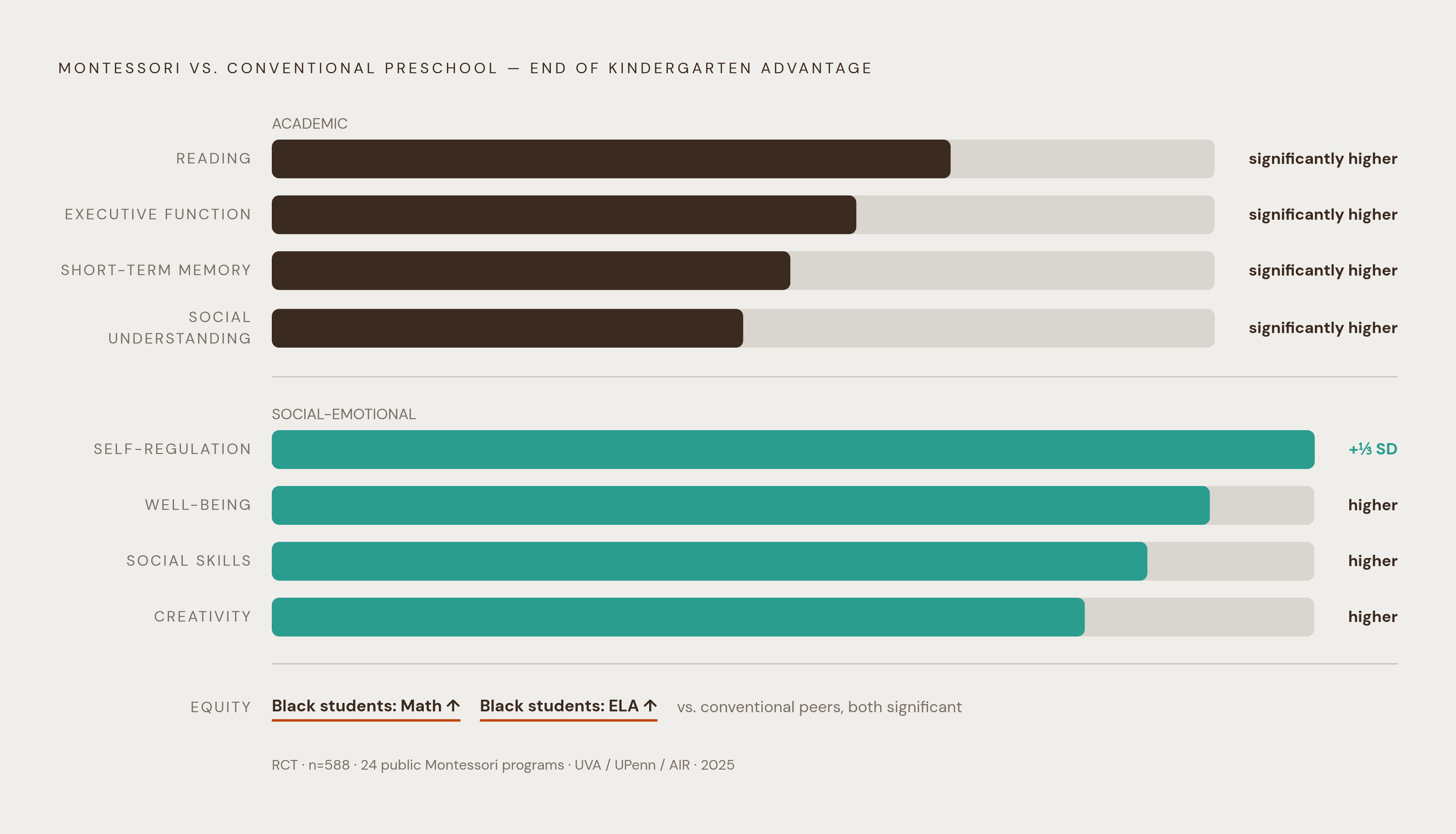
A rigorous, large-scale randomized controlled trial published in October 2025 is the strongest evidence yet that this kinesthetic, self-directed approach produces measurable advantages over conventional classrooms, in academics and beyond. Researchers from the University of Virginia, the University of Pennsylvania, and the American Institutes for Research ran it, tracking 588 children across 24 public Montessori programs nationwide, the first randomized trial of its kind for public Montessori preschools.
By the end of kindergarten, the Montessori kids were reading at significantly higher levels than kids in traditional preschool, and scored better on executive function, short-term memory, and social understanding. The academic gains weren't even the biggest story. Self-regulation, well-being at school, social skills, and creativity came out slightly stronger still, with Montessori students scoring about a third of a standard deviation higher on those measures.
A separate look at test-score data across multiple states adds an equity angle. Opportunity gaps were significantly smaller in Montessori schools, and Black children in those schools scored significantly higher in both math and ELA compared to peers in conventional settings.
Put those findings next to everything described in the sections above, the Pink Tower, the sandpaper letters, the golden beads, the freedom to move and repeat, and a pattern starts to form: the hands-on structure is tied to outcomes researchers can actually measure.
Where Montessori's kinesthetic foundation creates genuine tension with standardized testing
None of this means the model runs friction-free. The same features that make Montessori rooms such rich kinesthetic environments, no grades, no standardized tests, a curriculum that doesn't move in a fixed line, create a real mismatch with the pencil-and-paper, fixed-sequence world of conventional testing.
Montessori's philosophy rejects grades and tests on purpose. Learning is supposed to be its own reward, aimed at a child's overall development.
That rejection creates practical friction once Montessori kids sit down for a standardized test. A few things seem to explain why some of them underperform early on: switching from physical materials to a pencil-and-paper format is itself a jump in format they haven't practiced; Montessori's own vocabulary (like "units") doesn't match test vocabulary (like "ones"); and the nonlinear curriculum might not have covered the specific third-grade content a given test assumes it has.
By eighth grade, that gap closes, and Montessori students end up performing modestly better than their conventionally schooled peers. Whatever the early mismatch is, it looks temporary rather than permanent.
The pressure from testing accountability is real enough that some public Montessori programs have already changed core practices to respond to it, a documented tension between staying faithful to the kinesthetic method and meeting narrow external benchmarks.
City Montessori School in Lucknow, India, shows one way to hold both sides at once. It runs an Advanced Placement Exam Centre at its Gomtinagar Campus (I), offering AP exams across 34 subjects, plus a SAT exam center, the first in the state of Uttar Pradesh. That positions Montessori-educated students to compete in high-stakes standardized testing without the school giving up its Montessori identity.
On the ground, that same balancing act plays out one student at a time. Lynda Ratmeyer, a tutor at Applerouth with more than 20 years of experience as a Montessori high school math and science teacher, works directly with students preparing for the SAT. Her background runs through the exact kinesthetic method this piece has been describing, and her current work sits on the other side of it, helping kids translate that foundation into a format built on bubble sheets and timers, not beads and sandpaper.